Sponsored

HaulingAss

Well-known member
Joined
Oct 3, 2020
Threads
28
Messages
10,298
Reaction score
20,703
Location
Western Washington, USA
Vehicles
Cybertruck DM, 2010 F-150, 2018 Performance Model 3, 2024 Performance Model 3
Country flag
I'm not looking for confirmation bias at all, it is not an exoskeleton. During the 2019 reveal event they said it would be an exoskeleton where the stainless steel body would actually be structural. I do not believe the stainless steel panels on the current unibody implementation are structural at all. Do you?
Yes, just like the aluminum skin of an airliner is structural. The skin increases the rigidity and the strength of the fuselage. And an airliner is primarily an exoskeleton too, at least the fuselage. The aluminum framing underneath the structural skin of the fuselage is part of the exoskeleton. The Cybertruck is an exoskeleton and the structural battery, the front and rear castings, the "wing" castings, the steel passenger compartment and the stainless steel bonded to the framework stiffens the entire structure. An F-150, Ram and Silverado are not exoskeleton, they are clearly body on frame.
Sponsored


Bill837

Well-known member
First Name
Bill
Joined
Sep 21, 2023
Threads
5
Messages
264
Reaction score
541
Location
Southern Maryland
Vehicles
2020 Z4, 2015 Cherokee Trailhawk, 2008 R1200RT
Occupation
Aviation Weapons/Systems
Country flag
Yes, just like the aluminum skin of an airliner is structural. The skin increases the rigidity and the strength of the fuselage. And an airliner is primarily an exoskeleton too, at least the fuselage. The aluminum framing underneath the structural skin of the fuselage is part of the exoskeleton. The Cybertruck is an exoskeleton and the structural battery, the front and rear castings, the "wing" castings, the steel passenger compartment and the stainless steel bonded to the framework stiffens the entire structure. An F-150, Ram and Silverado are not exoskeleton, they are clearly body on frame.
All of the panels on the exterior of the CT will hold shape if removed. Airline skin, not so much. So in that sense, the CTs exterior panels are more structural than aircraft skin.
 

newwave1331

Well-known member
Joined
Jun 30, 2020
Threads
12
Messages
526
Reaction score
1,465
Location
NJ
Vehicles
Ordered: Cybertruck Tri FSD x 3
Country flag
WTF cares if the term exoskeleton is 100% accurate? What does it matter at this point? Obviously the marketing team didn't care. They didn.t even care to spell it correct.

The body is hard AF. Move on.
 

Deleted member 20282

Guest
Okay, that's fair. Most fleet sales are typically for lower end trucks, I would think, and not flagship trucks. My point was that most trucks that I see here in Nebraska are not used as mobile tool boxes. Nebraska isn't exactly the motor city, of course. The contractors haul some stuff in the bed but most of them pull trailers with equipment loaded. The fleet trucks around here seem to all be larger, F350 sized trucks like the power company uses. Tesla started with the most popular truck segment, the F-150 size. Maybe they'll tackle the fleet sales that are 17% of all truck sales someday (well, 17% of all Ford truck sales, anyway) though I doubt they'll offer discounts to fleets like Ford does.

November Fleet Sales Up Nearly 55% Year Over Year - Cox Automotive Inc. (coxautoinc.com)
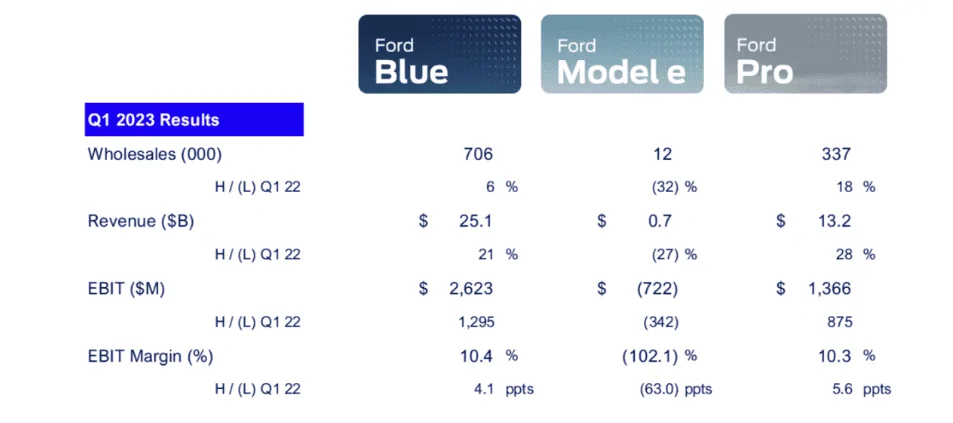
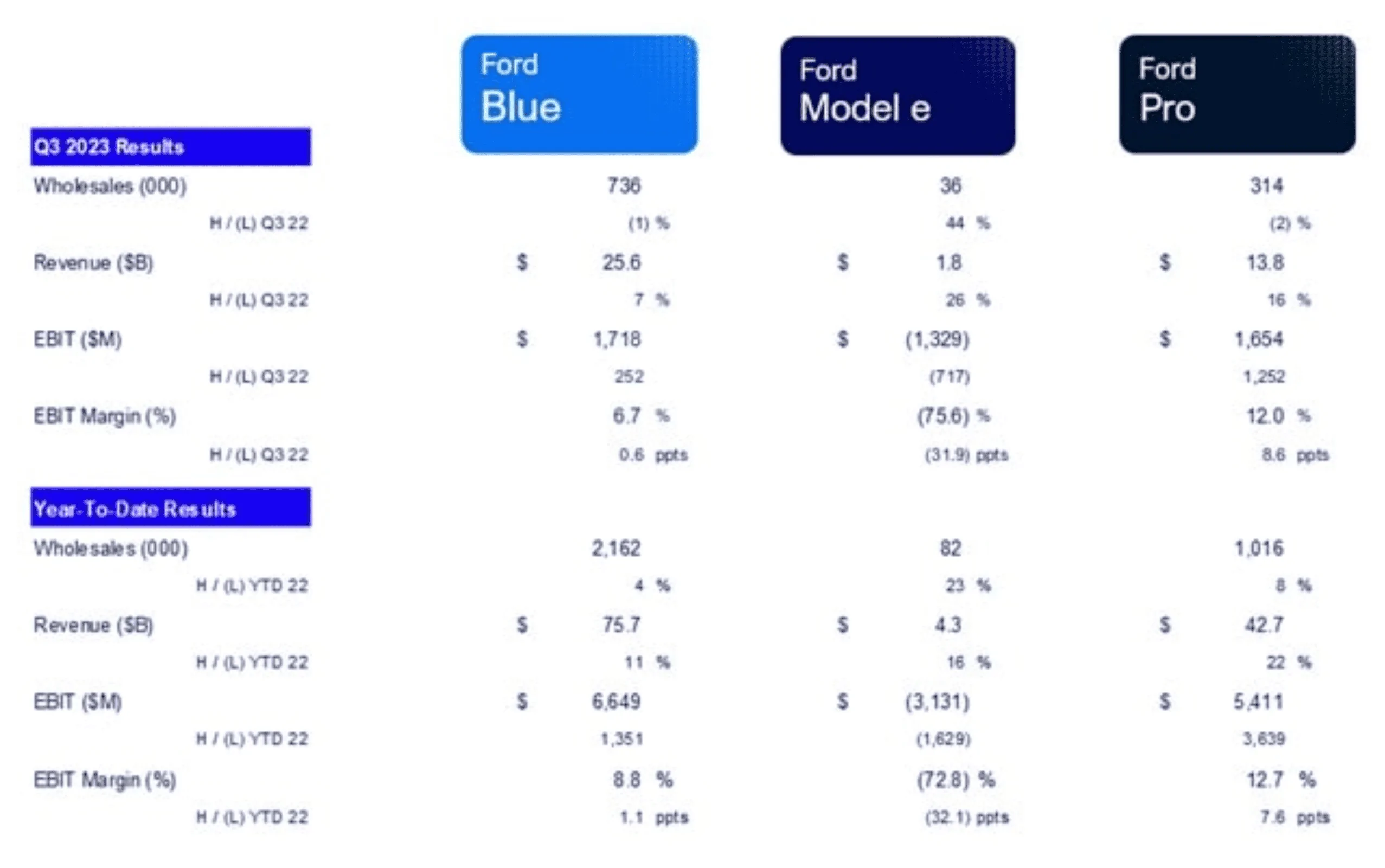
The number is much higher than 17%. It’s been in the 30’s. Was 34% in 2016 last number I could find. Ever since Ford created Ford Pro and broke out earnings it’s harder to see. But Ford Pro was 28% of revenue. That’s nothing to sneeze at when you look at it as Fords Pro biz is almost the entire Tesla car revenue. Look at the 2023 quarters data. A lot of post Covid growth this year.

purely talking f150 as that’s really the core competitor right now.


Deleted member 20282

Guest
Actually fleet sales are much bigger in revenue and units. From their earnings 337,000 units are fleet vs 706,000 retail. Both ICE units are profitable and growing but the EV unit is dragging it down.

Tesla Cybertruck Confirmed: 11,000 lbs tow rating / 2,500 lbs payload capacity (official specs)! + Shatter-resistant glass Screenshot 2023-11-21 at 3.25.41 PM
 

CyberGus

Well-known member
First Name
Gus
Joined
May 22, 2021
Threads
91
Messages
10,236
Reaction score
33,888
Location
Austin, TX
Vehicles
1981 DeLorean, 2024 Cybertruck
Occupation
IT Specialist
Country flag
I'm not looking for confirmation bias at all, it is not an exoskeleton. During the 2019 reveal event they said it would be an exoskeleton where the stainless steel body would actually be structural. I do not believe the stainless steel panels on the current unibody implementation are structural at all. Do you?
If Elon says it's an exoskeleton, then it's a goddamn exoskeleton
 

newwave1331

Well-known member
Joined
Jun 30, 2020
Threads
12
Messages
526
Reaction score
1,465
Location
NJ
Vehicles
Ordered: Cybertruck Tri FSD x 3
Country flag

CyberTW

Well-known member
Joined
May 25, 2023
Threads
6
Messages
827
Reaction score
1,615
Location
Oregon
Vehicles
Tesla Model Y &3
Occupation
Firefighter
Country flag
I’ll qualify this up front to try and stop people from getting angry and replying without reading what I’m writing. Please note the words “Nationwide” and “Averge”

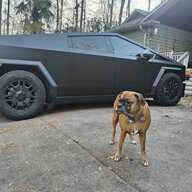
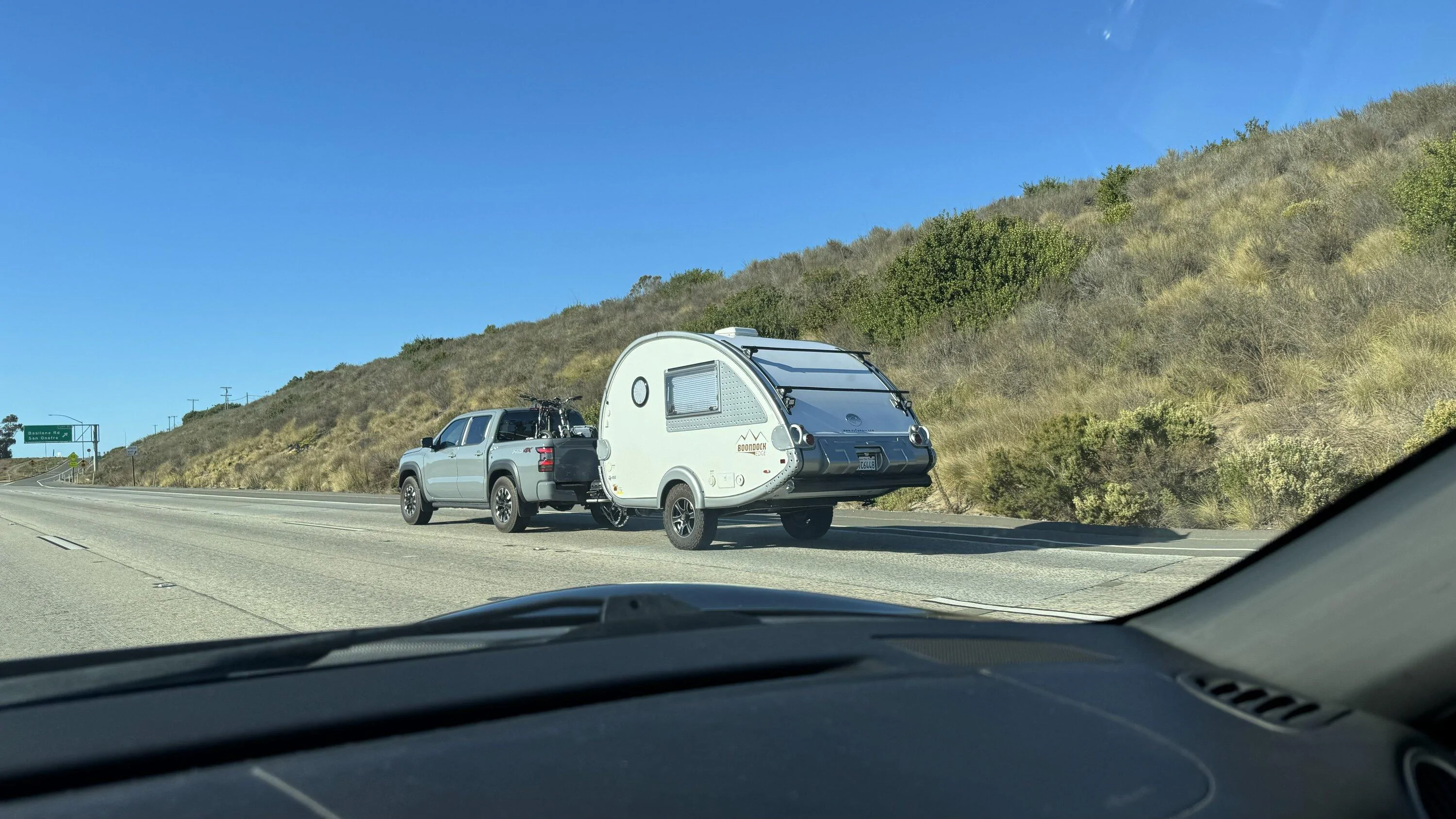
Nationwide, the average consumer truck purchase is not a truck purchase. It’s a style choice. People buy because they like the look of a truck. They like the image of a truck. Just as those who buy sports cars generally don’t take them to the track. Most sports car drivers have never taken a single “advanced driving” class, much less earned a racing license of some level. Look at the same thing for Jeeps. How many Jeeps never see the off-road, much less rock crawl or drive in Baja? The fat part of the bell curve is a highway commuter. My neighbor has a Jeep that is as custom as they get. Every toy or accessory you could want or imagine. It has NEVER driven on an unpaved road, much less done “off roading”. But he likes the look. Good for him, he is happy. The fat part of the bell curve in the full size truck market is not the F350 5th wheel car transport market, or horse trailering, or 50’ boat towing, or 14k# backhoe towing. The fat part of the curve is comprised of people that like the look, and people that do light “truck” things (see the photo).

The CT isn’t designed to compete with the F350/3500 trucks. I don’t see why people are saying “I guess I’m going to have to keep my F650!” Well, duh! And when the new $26,000 model comes out, it won’t replace your F650 or 350 then either! Why? It wasn’t supposed to!
IMG_3082.webp
Yup! I am a part of the big bell curve and photo you showed as an example. Can’t wait!!
 

CyberTW

Well-known member
Joined
May 25, 2023
Threads
6
Messages
827
Reaction score
1,615
Location
Oregon
Vehicles
Tesla Model Y &3
Occupation
Firefighter
Country flag
I disagree with this characterization of 1/2 ton truck people reducing down to buying for the look, like jeeps


Super crew 1/2 tons, the vast majority of the retail market, are like any full sized SUV, but with a rear cargo hold that is open air, more “2nd row” room, and - if it’s useful - better hauling/payload

Do people buy full-sized SUVs “for the look”?
CT will be essentially an SUV but with the truck bed for light truck things for me.. so excited!


CyberTW

Well-known member
Joined
May 25, 2023
Threads
6
Messages
827
Reaction score
1,615
Location
Oregon
Vehicles
Tesla Model Y &3
Occupation
Firefighter
Country flag
Then that’s exactly my point.

That is decidedly *unlike* sports cars and Jeeps.

People who buy 4-door jeeps with hard tops and doors they never take off, and don’t offroad, are purchasing “a look” - because that vehicle makes near zero sense otherwise. It’s noisy, has a near terrible ride, and worse interior room than comparable mid-sized SUVs, and is generally more expensive. Buying a Jeep as a daily driver with no intent of either off-roading or at least taking off the roof/top, reduces down to what you’re describing as a look.

The same goes, pretty straightforwardly, for real sports cars.


Contrast that to large SUVs and 1/2 ton super crews. They offer BOTH great daily driving comfort as well as added utility.

And then there’s your comment about large SUV’s and the third row: that these third rows tend to be largely useless and unused, is exactly why 1/2 ton super crew trucks make more sense for many. In exchange for that nearly useless 3rd row, they get more second row room, and more cargo area. My wife’s expedition is just as large as my Lightning, but relatively useless (for us) in terms of both interior comfort and utility.

When the whole family needs to go somewhere, we take my truck because it’s easier and more comfortable to load/unload 3 kids than an expedition. When I need to haul away this year’s spring cleaning garbage, it goes in the back of my truck, not her expedition. When I need to grab 3/4 tons of gravel for my garden, it sure isn’t going in the back of the Expedition. Headed to nursery for plants - my truck. Moving furniture - my truck. Renting trailered equipment for my landscaping - my truck. There’s not a single scenario of vehicle utility where we reach for my wife’s keys instead of my truck keys.

And if I regularly needed more lockable space, a nice tonneau or a fine topper are a ~$1,500 accessory. (We don’t, but some do).

All-in-all, you might disagree with whether people should want in a vehicle interior room, limousine-like room for 5 grown men, ride comfort, plus general utility in their vehicle. But they to me sound like just fundamental vehivle qualities and preferences. To reduce those fundamental things down to “the look” - as with a Jeep or sports car, neither of which offer near zero of these fundamental qualities - seems an error.

And for all these fundamental qualities, almost any full-sized SUV will be bested or equaled by any similarly-priced 1/2 ton super crew truck.

If anything, despite the trucks being better than SUVs, as many people choose full-sized SUVs to *avoid* “the look”/stigma of a pickup.


Which brings me to what seems the fundamental schizophrenia on this forum around this topic: simultaneously cheering on that Tesla is entering the 1/2 ton supercrew segment because it’s the best selling category in the US, while then bashing 1/2 ton trucks as not being “real trucks” being used for “real truck things.”

If folks wanted Tesla to enter a vehicle into the heart of the largest category in the U.S., that’s exactly what they’ve attempted here (though remains to be seen if they struck the right compromise in size, or price point).

Anecdotal views of “I spend a lot of time in RV parks and so I’m biased to think a lot of people RV” obviously fly in the face of Tesla’s intended TAM/SAM research and conclusions with this truck.

Tesla’s leading with *this exact configuration* because their TAM/SAM conclusions are at odds with those sorts of anecdotal musings.

If later Tesla wants to expand its TAM/SAM, then it has a platform to do so - and since 2019 has indicated it understands this potentiality of eventually offering an ‘HD’ version for the - statistically, undeniably - RARER sub-set of people who have 1/2 ton trucks and regularly tow heavy long distances.


All that said? Unlike traditional 1/2 ton trucks, with the Cybertruck you can be sure that MORE people will be buying it for “the look.”
Great post! This is exactly why I am getting the CT.. perfect for everything me and my family need
 

cvalue13

Well-known member
Joined
Aug 17, 2022
Threads
74
Messages
7,153
Reaction score
13,769
Location
Austin, TX
Vehicles
F150L
Occupation
Fun-employed
Country flag
So in that sense, the CTs exterior panels are more structural than aircraft skin.
Anyone seriously interested in this dumb “exoskeleton” debate could, if they are bored with time on their hands, read this one post and pretty much be done with it.

One has to clarify what one means by “structural”

there’s little disagreement as to whether it’s “structural” in the sense of providing ingress protection

there’s also little disagreement as to whether it’s “structural” in the sense of providing structure upon which other items can hang (eg, the door’s window/locks mechanisms can be attached to the panel, rather than an underlying separate structure - in theory)

the rigidity you describe in the panels no doubt contributes to the two senses of “structural” above, which aren’t too controversial

the remaining sense of “structural,” is that of operational-level load-bearing - eg can the castings be lighter/less beefy, and the truck still undergo load/torsion etc., in virtue of the exterior panels

that is the controversial sense of “structure”

and it’s controversial for good reason.

Arguments that it *is* this sort of structural come in varieties of eg “Elon said so, full stop” - but close exam of anything Musk has said does NOT make explicit that Musk was talking specifically of *this* third form of structural vs the first two, uncontroversial ones, above

The *other* arguments that it’s this sort of structural go something like “there are airplanes that exist that have operationally load-bearing skin, and so the CyberTruck does too” - the logical fallacy of those assertions alone should be sufficient enough for deep skepticism. And that simply can’t be otherwise known or deduced from the armchair - it requires an understanding of exactly where, how, and to what degree the panels are attached to and across the various underlying components. Anyone claiming this line of argument is way out over their skis, unless/until they have a CT in hand, have done a tear-down, and performed some legit analysis of what the operational load-bearing capacity is both with and without the skins attached.


As for those who find it unlikely to impossible the panels will have this third, controversial, type of load-bearing structure?

Well, experts in the field (eg Munroe and others in the field) are deeply dubious that what *has* been seen of the body in black, the methods of attaching the panels, and where they attach, could amount to an engineering approach that’s anything like airplanes, etc., in this respect.

In fact, regarding this third type of “structural” one CAN from merely the armchair plus available photos winnow down the narrow extent to which any such operational load-bearing structural could be possible:

• it can’t include the windshield, glass roof, or the battery pack (those aren’t even SS panels)

• it can’t include any of the four doors, the hood, or the tailgate (those are free-hanging, articulating, panels of SS that cannot provide any operational load

• the SS trim above the doors are clipped on with basic automotive trim attachments, and are to this extent free-floating

• the two front quarter panels have more obvious and already seen attachment points that make it unlikely they are capable of being operationally load-bearing, PLUS front crashworthiness would make it unlikely Tesla would ever try for this


which, once tallied, gets us down to realizing that the entire controversy about whether the stainless can provide operational load bearing structure, is about and can really only be about? The two rear quarter-panels.

on one hand, this means the controversy is pretty trivial in respect of the truck’s overall utilization of the SS as load bearing operational structure. (And is also a pretty good indication that anyone suggesting the truck’s overall SS design provides overall airplane-like operational structure, probably doesn’t know what they’re talking about.

on the other hand, when it comes specifically to truck performance, eg payload and towing, the rear quarterpanel’s may be outsized in importance.

at the same time, there’s a strange thing here where people seem to assume that better payload and towing necessarily benefit from increased rigidity - when in fact flexibility (to a point) is a key benefit of load bearing structures.


to all this, what does Tesla have to say to date?

well, they’ve laid out pretty clearly what they mean by “exoskeleton” in their patent titled “Vehicle With Exoskeleton”.


the “Cybertruck is like an airplane” crowd conveniently overlooks the substance of the 20+ page technical document with extended discussion of what Tesla means by “exoskeleton.”

That patent describes only the first two, uncontroversial, senses of “structure” - as can be gleaned from the parent’s abstract (my emphasis):
A vehicle having an exoskeleton exterior panel that provides crash resistance [ie intrusion structure] is described. The exterior panel may be formed from a monolithic metal sheet and attached to an exterior portion of the vehicle frame, and the exterior panel does not comprise an additional support structure [eg like a door] At least one component may be directly attached to the exterior panel, and the exterior panel may bear the load of the at least one component [ie structure to hang things upon]. Methods of manufacturing the vehicle are also described.”​

The patent then goes on to describe how adding intrusion and hanging-upon structure in this was can save manufacturing costs, compared to eg adding anti-intrusion bars inside doors, and a frame inside a door upon which to hang components.

Here is the thrust of it, from the patent:
Embodiments of the present disclosure relate to vehicle architectures designed such that the exterior panels of the vehicle also contribute to the vehicle's structural performance. Such exterior paneling of a vehicle may be referred to as an "exoskeleton." FIGS. 3 and 4 are views of pickup truck embodiments with exterior panel exoskeleton designs. Some embodiments of the present disclose do away with anti-intrusion bars, and instead use a durable unitary exterior panel (e.g. door panel) to provide impact protection. Thus, the exoskeleton design described herein eliminates the inner door structure and protection system, and uses only a unitary outer exterior panel. In this design, the hinges and latches for opening and closing the door, as well as door component such as windows and motors mount directly to the exterior panel. This approach may be applied to side door, roof, hood, fender, and trunk (or liftgate) assemblies of the vehicle. The exoskeleton approach may result in significant reduction in manufacturing footprint and costs.”


What does the patent say, if at all, about providing overall operational load-bearing structure?

It *DOES* talk about it! But there’s a catch:
In another embodiment [eg another concept that *could* be implemented], other externally facing portions of the vehicle [ie other than the doors etc] would also use the exoskeleton concept. For example, in a typical conventional vehicle a welded closed vertical section between the side doors of a vehicle acts as a beam to react against side crash forces applied to the body by an impacting vehicle, resist vertical loads applied to the roof in a roll over even and react seat belt loads for the front seat passenger, among other smaller forces. In contrast, this body side structure construction would convention have a thin, cosmetic outer panel welded to a structural closed section (typically one or more inner stamped sections welded to one or more outer stamped sections). However, embodiments of the present disclosure relate to an exoskeleton construction, where the outer structural reinforcement(s) are made from a single structural panel that provide the same load advantages as the more complex conventional structure, but also serve the cosmetic functions of the customer facing areas of the vehicle.”​

Here, they are now describing a different possible utilization of the patent concept, along the lines of the “airplane” concept, and the 3rd type of “structure.”. The vast majority of the patent deals with the other two kinds of structure, and in doors, etc. So the patent DOES talk about the third type of structure.

But in the next line is the catch:
As such, a vehicle having a vehicle frame is disclosed, wherein the vehicle comprises an exterior panel. In some embodiments, the exterior panel does not comprise an additional support structure.

Here they are describing the “origami” SS frame of lore. The “not comprising an additional support structure” is patent-speak for “the exterior panel itself IS the frame and there is not any ‘additional’ under-frame to which the panel is combined.”

This same distinction - between using the SS for the first two kinds of “structure” vs the third type of “structure” - is carried through in the manufacturing discussion, for example:
“The monolithic metal sheet may be manufactured by providing an initial monolithic metal sheet, cutting the initial monolithic metal sheet to form a cut monolithic metal sheet, and shaping the cut monolithic metal sheet to form the monolithic metal sheet. In some embodiments, the monolithic metal sheet is in the shape of a door panel. In some embodiments, the monolithic metal sheet is in the shape of an external portion of a frame.”​


All-in-all:

• the patent LARGELY describes using SS panels to accomplish the first two types of “structure”

• the patent only BRIEFLY describes using SS to form the frame itself, which frame itself forms an “external” Frame is not “additional” to any other frame, but is itself an external frame

• and so, relative to what we see in the present production Cybertruck, we very much see another “additional” frame, to which the panels are attached, and uncrontriversially do exactly what the patent describes most: providing ingress and hangs-upon structure


So here’s the most concerted, detailed, indisputable conversation Tesla has ever had regarding what it means by “exoskeleton.” And it is almost exclusively discussing the first two types of “structure.” When otherwise the patent briefly describes anything like the third type of structure, it does so by describing a method of construction that does not square with the production Cybertruck we’ve seen.

Anyone suggesting Musk has said otherwise, hasn’t paid close attention and is hearing primarily with their hopium biases.

Anyone asserting from the armchair that “the Cybertruck” SS is operationally structural (1) is glossing over that we could only possibly be talking about the rear quarterpanels, and (2) has ZERO information that would allow them to assert this on any basis (assuming they haven’t done an tear-down and load-path tests. And meanwhile, the Tesla patent doesn’t square with these armchair assertions at all.

Instead, the patent describes what we’ve seen in the doors, hood, and tailgate of the production CT. As for the rear quarterpanels, the patent doesn’t square at all with the construction method we’ve seen.

Is it possible that, when it comes to the rear quarterpanels, Tesla has done some off-patent form of engineeering whereby - unlikely as it seems - the rear QPs are somehow attached to the cab/castings in such a way as to *contribute* to operational load bearing structure? I suppose it’s possible, but the more images we see, and when squares with what Tesla has said in the parent, it sure seems unlikely.

And in any event, the crowd of “the SS provides operational load-bearing structure” is at best overstating the point (only the rear QPs are even theoretically possible), and also asserting as fact from their armchair things they can’t possibly know, not to mention things at odds with the only information Tesla has explicitly described.

SO YES - IT’S EXACTLY THE TYPE OF ‘EXOSKELETON’ TESLA HAS DESCRIBED, INSOFAR AS TESLA HAS ONLY DESCRIBED PROVIDING INGRESS PROTECTION AND HANG-UPON STRUCTURE.

BUT NO - TESLA’S EXPLICIT DESCRIPTION OF HOW OPERATIONAL LOAD-BEARING STRUCTURE WOULD BE ACCOMPLISHED, IF EVER, IS NOT EVIDENCED IN EVEN THE REAR QPs OF THE PRODUCTION CT.


IF they’ve done something here off-patent, NOBODY here has the ability to surmise it from their armchair.
 
Last edited:

Deleted member 20282

Guest
Uhh. Lightning is rotting on dealer lots right now. There is very little EV truck demand at least in the Midwest. Dealer has 10 and they can be had cheap. Like $450/mo lease cheap. Next to the $299/mo ICE variant with 200+ on the lot.
 

Deleted member 20282

Guest
I don’t see the CT getting that over the Lightning. Since lightning and f150 have a lot of common ecosystem components. Salt spreaders, toolboxes, transfer tanks, bed lockers, ladder racks, glass carriers, etc. lots of random shit will just work on Lightning. Don’t think it was smart to try to reinvent the truck.
Sponsored


Top