
Sponsored

123 kWh battery pack on Cybertruck (reported)

intimidator

Well-known member
First Name
TJ
Joined
Nov 16, 2020
Threads
11
Messages
685
Reaction score
929
Location
Alexandria, VA
Vehicles
2023 Ford Lariat Lightning
Country flag
exactly

take the world of 1/2 ton pickup drivers, and the sun-set is small of anyone who ever tows

take that small sub-set of people who ever tow with a 1/2 ton truck, and further parse it for those who tow something big and heavy for long distances, and the sub-sub-set is now very small.

what’s left are people who tow something around town, or to a marina an hour away, etc. - and the Lightning does (and CyberTruck will) do that sort of work better than any existing 1/2 ton ICE truck on the market. The weight of the truck, the power, tech, etc., are just extraordinary.


which goes to show just one (of probably many) reasons that Tesla isn’t champing at the bit to make a bunch of 509mi trucks that are proportionately more expensive. The group of people who actually *need* that, in a 1/2 ton truck, who won’t purchase a CT because of it - is a very, very, small market.

this is a company that deleted adjustable lumbar support because almost no one used it. To think they’d pack an extra 1/3 of battery in a truck, together with all the engineering changes needed to address the weight and performance of that pack, is just too far fetched for me to believe

but hey, maybe on the 30th they’ll say they’re working on it. If the do, personally, I’ll hear them to be saying “I mean, we don’t really think it’s necessary, but if there’s a big battery breakthrough where we can do it with almost no added effort, sure - and for now we’ll coddle the vocal minority with the prospect”
Spot on.

And because the Cybertruck can use the Tesla charging network, as opposed to the rickety CCS network, 1000 miles is not necessary. I would encourage Tesla to keep building out the DCFC network, as they obviously have been. The more locations, the better for everyone. If I know there is going to be several DCFCs along my route, I am not as worried about range.
Sponsored
 

intimidator

Well-known member
First Name
TJ
Joined
Nov 16, 2020
Threads
11
Messages
685
Reaction score
929
Location
Alexandria, VA
Vehicles
2023 Ford Lariat Lightning
Country flag
I wonder what Tesla's actual cost would be to increase the battery from 123kw to 180kw+ to achieve 500 miles of range.
It is both the cost, and the availability of 4680 cells.
Plus I am not sure how much room they will have under the truck to stuff in that many extra batteries.

I think Rivian had to confiscate space under the rear seat to fit their batteries in on their long range version. And under the rear seat space is a very popular feature of owning a truck.
 

davelloydbrown

Well-known member
First Name
Dave
Joined
Feb 13, 2022
Threads
7
Messages
548
Reaction score
617
Location
Canada
Vehicles
model 3, silverado
Occupation
veterinarian - retired
Country flag
as reported here

11:17 timestamp related information
11:50 quote

I do resets all the time on the go, usually because the music download stops.

Why would they need to collect data on regional interest as they have 2 million reservations and know exactly where they are. Probably a make work project for the employees.

I think the battery size makes a lot of sense and as the battery is the most expensive element of the truck, there is a good chance the two motor CT will be close to the initial price possibly as high as 69 k.
 

PilotPete

Well-known member
First Name
Pete
Joined
May 8, 2023
Threads
12
Messages
1,578
Reaction score
3,969
Vehicles
Porsche, BMW, M3LR on order
Occupation
Chief Pilot
Country flag
I wonder what Tesla's actual cost would be to increase the battery from 123kw to 180kw+ to achieve 500 miles of range.
Let’s play the “IF” game for a moment...

IF a CT is ~$60K in cost, and
IF the battery in a BEV is 33% of the cost of the vehicle (as the “experts” report)
THEN…
The battery is costing about $20K, and to add another 50% in capacity would be another $10K just for the battery. Add the additional motor and other assorted costs… ~$12-15K is what I would guess this looks like.


davelloydbrown

Well-known member
First Name
Dave
Joined
Feb 13, 2022
Threads
7
Messages
548
Reaction score
617
Location
Canada
Vehicles
model 3, silverado
Occupation
veterinarian - retired
Country flag
Let’s play the “IF” game for a moment...

IF a CT is ~$60K in cost, and
IF the battery in a BEV is 33% of the cost of the vehicle (as the “experts” report)
THEN…
The battery is costing about $20K, and to add another 50% in capacity would be another $10K just for the battery. Add the additional motor and other assorted costs… ~$12-15K is what I would guess this looks like.
if you are looking at 20% gross margins then that would set the prices at 72 K for duel and 90 k for tri.
 

BayouCityBob

Well-known member
Joined
Apr 14, 2022
Threads
24
Messages
495
Reaction score
1,569
Location
Texas
Vehicles
2018 Model 3
Country flag
Let’s play the “IF” game for a moment...

IF a CT is ~$60K in cost, and
IF the battery in a BEV is 33% of the cost of the vehicle (as the “experts” report)
THEN…
The battery is costing about $20K, and to add another 50% in capacity would be another $10K just for the battery. Add the additional motor and other assorted costs… ~$12-15K is what I would guess this looks like.
The battery pack is costing Tesla around $120 per kwh for the pack. The industry average pack cost jumped in 2023 to $151 (kwh / pack) but the 2024 pricing is back to 2021 and its historic cost reduction trend ($135 kwh pack). All data from BNEF annual survey, will be updated next month.

So at 123 kwh the pack costs $14,760. The cost of bumping it to 160 kwh is an extra $4,400.
 

Bkb13

Well-known member
Joined
Jul 23, 2023
Threads
23
Messages
380
Reaction score
980
Location
Austin
Vehicles
raptor
Occupation
Entrepreneur
Country flag
There are way too many people in this board going through mental gymnastics to convince everyone else that 300 miles of range is “all you need”. I’m starting to believe you work for Tesla and are trying to push an agenda ;) . Can you just stop preaching, and understand that we’ve got different needs.


1. Usable range for a 500 mile version is 400 miles. That means I can drive to Houston from Austin and potentially make it back to Austin without recharging. I do this in my Raptor with 400 miles of range every few weeks. If I had a 300 mile version I would get 240 miles usable and would have to stop once and add 20 minutes to that trip. I’ve done this in my model Y and it’s comparatively very inconvenient.

2. Range anxiety is real. I don’t like having to plan out trips with my model y. I prefer not to take it on long distance trips because of that. If there were superchargers built out every 20 miles like gas stations exist today I may change my opinion. But that’s not the case. There is less pressure with a 500 mile version to plan your exact route and charging stops. According to plugshare there are only 2 superchargers on highway 290 in between houston and austin, but I bet there are 100 gas stations…

3. 400 usable miles provides some redundancy in case I forget to recharge at home since the supercharger network around my house is not very good yet. 240 usable miles means that I have to drive 15-25 minutes out of my way to charge up if I don’t have enough range for the day. I have a gas station within 5 minutes in any direction of my house. So using a supercharger from my home isn’t very convenient if I forget to plug in.

4. Recharging 100 miles on a 500 mile range vehicle should be considerably faster than 100 miles on a 300 mile range vehicle. So when I do have to recharge on my trips to houston or dallas, it will be much easier…

My use case isn’t towing. It’s driving long distances and convenience. I will pay the extra $$$ to make my life easier.

Y’all talk about 800 volt architecture and fast charging all you want, but it doesn’t mean a lot to me until the supercharger density improves dramatically. And even then, I would choose a 400 mile usable range like my raptor over another shorter range vehicle.
 

lowtek

Well-known member
Joined
Oct 18, 2023
Threads
7
Messages
454
Reaction score
1,035
Location
Here
Vehicles
None
Country flag
However you slice it, Ford Lightning has a 131 kWh battery in their 320 mile range pickup.
If the Cybertruck only has a 123 kWh battery, 300-325 miles would be a reasonable estimate, yes? No?
Maybe there is fairy dust that makes it a 400 mile range truck?
No. The Lightning is an aerodynamic nightmare.
 

scottf200

Well-known member
Joined
Jul 31, 2021
Threads
53
Messages
2,221
Reaction score
3,241
Location
Western NC
Vehicles
X; immed family 3 & Y
Country flag
There are way too many people in this board going through mental gymnastics to convince everyone else that 300 miles of range is “all you need”. I’m starting to believe you work for Tesla and are trying to push an agenda ;) . Can you just stop preaching, and understand that we’ve got different needs.
1. Usable range for a 500 mile version is 400 miles. That means I can drive to Houston from Austin and potentially make it back to Austin without recharging. I do this in my Raptor with 400 miles of range every few weeks. If I had a 300 mile version I would get 240 miles usable and would have to stop once and add 20 minutes to that trip. I’ve done this in my model Y and it’s comparatively very inconvenient.

2. Range anxiety is real. I don’t like having to plan out trips with my model y. I prefer not to take it on long distance trips because of that. If there were superchargers built out every 20 miles like gas stations exist today I may change my opinion. But that’s not the case. There is less pressure with a 500 mile version to plan your exact route and charging stops. According to plugshare there are only 2 superchargers on highway 290 in between houston and austin, but I bet there are 100 gas stations…

3. 400 usable miles provides some redundancy in case I forget to recharge at home since the supercharger network around my house is not very good yet. 240 usable miles means that I have to drive 15-25 minutes out of my way to charge up if I don’t have enough range for the day. I have a gas station within 5 minutes in any direction of my house. So using a supercharger from my home isn’t very convenient if I forget to plug in.

4. Recharging 100 miles on a 500 mile range vehicle should be considerably faster than 100 miles on a 300 mile range vehicle. So when I do have to recharge on my trips to houston or dallas, it will be much easier…

My use case isn’t towing. It’s driving long distances and convenience. I will pay the extra $$$ to make my life easier.

Y’all talk about 800 volt architecture and fast charging all you want, but it doesn’t mean a lot to me until the supercharger density improves dramatically. And even then, I would choose a 400 mile usable range like my raptor over another shorter range vehicle.
Well written points.

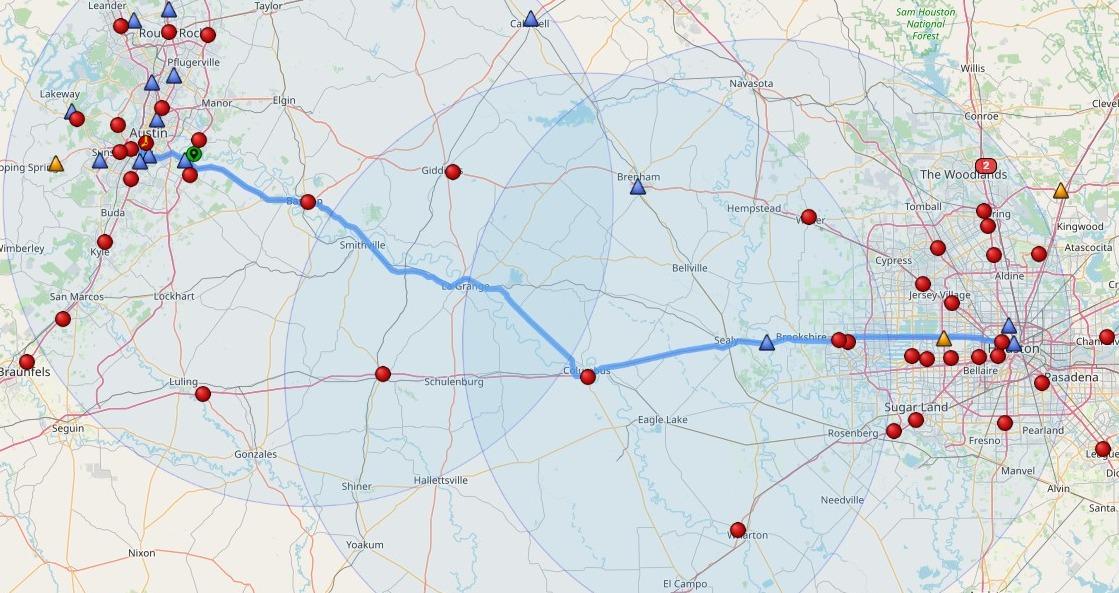
In regards to #3, here is a map just as an example where circles are 50 mile radius. I'm not disputing your point(s) tho.

Tesla Cybertruck 123 kWh battery pack on Cybertruck (reported) 3hHx0P9


HaulingAss

Well-known member
Joined
Oct 3, 2020
Threads
28
Messages
10,313
Reaction score
20,732
Location
Western Washington, USA
Vehicles
Cybertruck DM, 2010 F-150, 2018 Performance Model 3, 2024 Performance Model 3
Country flag
I wonder what Tesla's actual cost would be to increase the battery from 123kw to 180kw+ to achieve 500 miles of range.
It's not a simple calculation (nor is it only one calculation) as some are suggesting. It's a moving target through time as battery production of various types are ramped. Currently, I think 500 miles of range would only be possible (from a practical standpoint) using some of the more expensive 2170 cells. It's a good assumption that, for affordability reasons, Tesla wants to constrain the Cybertruck to only one format of battery cells, the 4680 format, which is still experiencing rapid development. This is for cost reasons (the 4680 cells with dry electrode technology can be produced more cheaply, using a much smaller factory footprint and consuming much less energy). As this development progresses to generation 3 cells, I think the 500-mile range Cybertruck will become practical.

As to cost, it is not simply adding on the cost of the additional cells required to achieve the target range. That's because the additional cells will also add around 700 lbs. to the vehicle. This likely involves tires of a heavier class (costing more) and possibly larger brakes (if the additional regen from the larger pack cannot provide the additional braking capacity required for a heavier vehicle).

Tesla announced the payload of all classes of Cybertruck would be the same, around 3,500 lbs. However, the release version is already associated with a range of around 300+ miles and a capacity of only 2500 lbs. To me this implies the 500+ mile version will require a stronger chassis (if the cargo capacity is not to be impacted negatively). That costs more. Other additional costs when making a vehicle heavier could include higher warranty expenses as the additional weight takes a toll on all components, especially when the use is towards the extreme end where warranty expenses tend to happen.

The expense of larger battery versions are typically mitigated somewhat by leveraging the larger battery to provide more power. This requires additional power electronics, which also adds a bit more to the expense. Also keep in mind that a heavier battery returns slightly lower miles/kWh.

My point here is that it is best to avoid the temptation of thinking the additional expense of a longer-range version scales linearly with the extra range (and not even with simply the extra battery capacity). There is a reason why manufacturers don't mass produce 500 mile EV's, especially not less efficient trucks meant to carry substantial cargo. The additional range comes with a high cost and that can only be mitigated somewhat by making the batteries cost less per kWh and more energy dense.

People on normal budgets will best be served by more ubiquitous fast charging infrastructure, not massively sized batteries. That is why Tesla continues to build out fast charging infrastructure on increasingly rural routes as EV adoption grows into those areas.
 

Bkb13

Well-known member
Joined
Jul 23, 2023
Threads
23
Messages
380
Reaction score
980
Location
Austin
Vehicles
raptor
Occupation
Entrepreneur
Country flag
Thanks for the image and comment.

It’s interesting that in that route, you would get 3 supercharger locations in between austin and houston. Thats a supercharger every 50-60 miles. On a 240 usable range vehicle, that’s one supercharger for every 20% of your cars usable range….

Well written points.

In regards to #3, here is a map just as an example where circles are 50 mile radius. I'm not disputing your point(s) tho.

3hHx0P9.jpg
 

intimidator

Well-known member
First Name
TJ
Joined
Nov 16, 2020
Threads
11
Messages
685
Reaction score
929
Location
Alexandria, VA
Vehicles
2023 Ford Lariat Lightning
Country flag
No. The Lightning is an aerodynamic nightmare.
We will find out in less than a week.

Prepare to be disappointed to all those that held out for Tesla to offer a 500 mile range Cybertruck, or even a 400 mile range CT. Maybe they will have a 321 mile range variant?
 

lowtek

Well-known member
Joined
Oct 18, 2023
Threads
7
Messages
454
Reaction score
1,035
Location
Here
Vehicles
None
Country flag
We will find out in less than a week.

Prepare to be disappointed to all those that held out for Tesla to offer a 500 mile range Cybertruck, or even a 400 mile range CT. Maybe they will have a 321 mile range variant?
Battery supply constraints was always going to prevent a 500 mile variant, at least for a while ... fingers crossed on the tri-motor!
Sponsored


Top