Sponsored

Tinker71

Well-known member
First Name
Ray
Joined
Aug 8, 2020
Threads
93
Messages
1,610
Reaction score
2,102
Location
Utah
Vehicles
1976 VW EV bus, 2007 Sienna, Tesla M3, Cancelled CT2 rez - holding for $65k
Occupation
Project Manager
Country flag
I have a 21 MS long range. I can assure you I have never seen 500 mi?
The advertised rage was 405 I think? Anyway, it’s a little over 300 miles from where I live to LA. I can start out with a full/100% charge and only get to Santa Barbara before needing to charge. My model 3 extended range would only get me to Solvang. Check your maps.
I must say, I don’t expect any more from the car. It’s hilly and I drive fast. But I can’t get anywhere close to 405 miles from a full charge?
For the s I figured 330 miles for the first change then 10-80 percent for the supercharge to add 250 mile. That is not a bad day. 500 miles. I am jealous.
Sponsored


Tinker71

Well-known member
First Name
Ray
Joined
Aug 8, 2020
Threads
93
Messages
1,610
Reaction score
2,102
Location
Utah
Vehicles
1976 VW EV bus, 2007 Sienna, Tesla M3, Cancelled CT2 rez - holding for $65k
Occupation
Project Manager
Country flag
For the s I figured 330 miles for the first change then 10-80 percent for the supercharge to add 250 mile. That is not a bad day. 500 miles. I am jealous.
[/QUOTES

I rounded down from 580 I guess. WTH.
 

DWTango

Member
First Name
David
Joined
Jun 14, 2021
Threads
1
Messages
7
Reaction score
7
Location
Greensburg, PA
Vehicles
CyberTruck
Occupation
Engineer
Country flag
On reveal night, four years ago, it was the 500 mile range of the Tri-Motor trim that stuck in my mind more than anything else.

We don’t know what we don’t know, though. And sometimes something that seems imminently clear… turns out anything but.

Fast forward those four years. Cybertrucks are now finally rolling out of Austin. And here is my stake-in-the-ground: Lots of people are going to be complaining about the range they experience.

Not because they’re towing things. Not because they’re hauling stuff. And not because the truck Tesla finally shipped ended up rated at 300 miles and change instead of the 500 miles that was originally expected.

Even had Tesla hit that bogey, people would be unhappy. Because most people – even longtime EV owners – continue to look at EV range through the prism of their lifelong ICE experience.

There are a hat trick of things going on. First, drivers don’t usually appreciate the vast difference in fuel stores between ICE cars and their EV counterparts.

One gallon of gas is approximately 121,000,000 joules; and is equivalent to around 33.6 kWh.

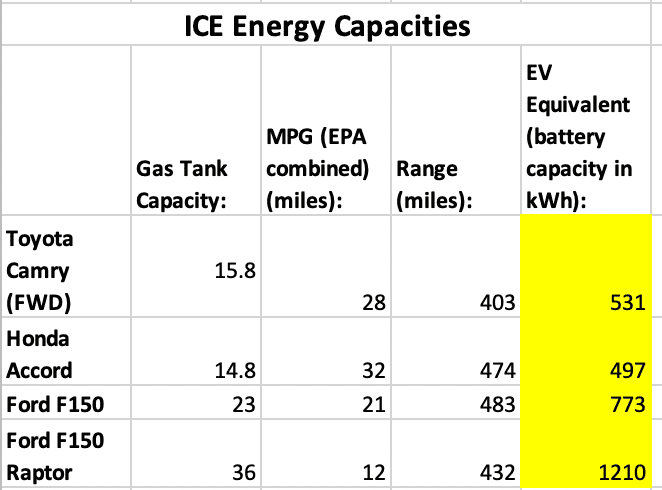
Here’s a quick chart of the fuel capacities of several sample ICE trims, and what would be the equivalent energy in an EV.


ICE Energy.png


Note the extraordinary kWh capacities necessary to match up with what we think of as run-of-the-mill, common-as-can-be vehicles. It underlines how grossly inefficient ICE cars are. The Raptor is just nuts.

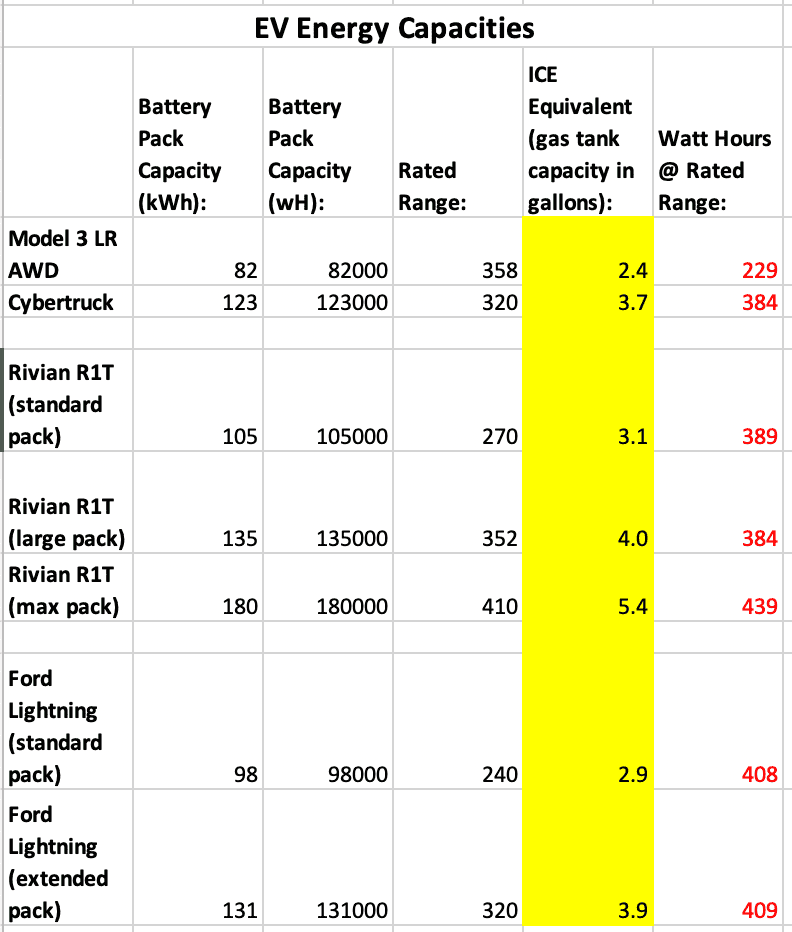
It’s even more revealing when you turn it around and look at it from the EV perspective.


EV Energy.png


Imagine if your ICE family sedan had a 2.5 gallon gas tank. When I go out later this morning and climb into my Model 3, that’s essentially what I’m doing. It underlines how little fuel a Tesla Model 3 or Model Y carries onboard, compared to a similar ICE vehicle. It emphasizes how much more efficient an EV is.

There’s a “But,” though.

All vehicles - ICE or EV - are affected by things like temperature, altitude, and speed. And yet the EV world is inundated with complaints of range falling off as the calendar rolls into winter. Or when a drive involves a long slog on the interstate at speed. Or when a trip sends one up into the mountains.

While ICE drivers rarely give a thought to any of those things.

Lithium EV chemistries certainly have some issues that need to be managed in cold weather. I’m not saying they don’t.

But much of the effect of those kinds of things in the ICE world is hidden within the cavernous supply of fuel that they carry.

Lose ten percent efficiency in an ICE car because you’ve entered a slight uphill grade and it’s lost in the noise. Lose ten percent in an EV, with its tiny fuel supply and parsimonious allocation of energy, and it’s immediately obvious.

I’m reminded of the scene from Apollo 13 when Ken Mattingly, down on the ground, struggles to find a way to power up the Command Module of the ailing spacecraft with the tiny amount of power available in the Lunar Module’s batteries.

How we use our batteries is sometimes a very big deal.


The second thing, the next reason many people will be unhappy with the range they see in their new Cybertruck, is because full in the ICE world is a little bit different than full in the EV world.

Both worlds require some buffer on the low end, in order to find that next gas station or DC fast charger.

But whereas the ICE world habitually fills their tank all the way when they stop, that’s rarely the case in the EV world. Lithium batteries don’t like full charge because it accelerates pack degradation. So those of us who care about such things tend to back away from full charge some amount – 80% or 70% or, for some of us, even more – unless we’re on a road trip or some other situation that absolutely demands 100% SOC.

That promised 320 miles of range can quickly turn into 250 or 270 before we’ve driven the first mile. And that’s with a brand new pack, before any degradation has occurred.


The last reason for range frustration is because of something most people never give a thought to – themselves.

A lot of people look at rated range, fail to ever hit it, and then just squint hard at their vehicle, shaking their head. Muttering something about Elon once again promising something he never delivered.

Well, no.

Most drivers have pretty close to zero appreciation for how much energy it costs pulling away from a traffic light. Or how much is thrown away every time they tap the brakes.

They have not once, during their entire driving life, ever given a thought to momentum or what the benefit of conserving it might be.

They drive their EV exactly like they’ve always driven their ICE car. They press on the throttle to make it go. They press on the brake to make it stop.

And because that ICE car always had such a glorious extravagance of energy carried onboard, they never learned not to waste it.

Even in a car – such as a Tesla – that has the real-time telemetry for such things, they’ve never once contemplated the actual kilowatts of power their rear motor is putting out. Or where the threshold is for when the motor on their front axle engages.

They see the green line on their screen stretch out like a rubber band when they come off the throttle and their car begins regen braking. But they have no idea how much energy got sent back into the pack.

I won’t belabor this. Discussing how to optimize EV driving efficiency is a story for another time. For now, I’ll just say that an EV driver complaining because the “real world” range of their vehicle never approaches its rated range… is probably not seeing the whole picture.

Speaking of that rated range thing. Wouldn’t it be nice if we had an objective, unbiased third-party from whom we could get “real world” numbers?

Turns out we do. It’s called the EPA. They designed the test suite from which rated range emerges. Not Tesla.

The second chart above has the watt-hours/mile needed to hit the vehicle’s rated range, written in red. For the Cybertruck, we’ll be wanting to hit right around 384 in order to make that 320-mile bogey.

Some of us expect to.
Totally agree with you about the 500 mile range at the reveal and the expected range now. I live in a cold weather region with lots of hills. Filled up my Chevy Traverse today and the estimated range was 504 miles. The value proposition four years ago is no longer there. Kudos to those that like the price and the product - we all have different needs. Great post.
 

csphili

Member
Joined
Nov 28, 2023
Threads
0
Messages
18
Reaction score
50
Location
North Alabama
Vehicles
Cybertruck
Country flag
Meanwhile, I am thankful that I won't have to buy or haul around an extra ~200 miles worth of batteries that I don't need. That's practically enough to build another car. :rolleyes:


Saygmo

Well-known member
First Name
Sas
Joined
Dec 28, 2023
Threads
2
Messages
83
Reaction score
134
Location
Norcql
Vehicles
Model 3 awd
Country flag
Meanwhile, I am thankful that I won't have to buy or haul around an extra ~200 miles worth of batteries that I don't need. That's practically enough to build another car. :rolleyes:
Could have simply bought the dual motor they offered to get that then. Those of us wishing for 400-500 miles will continue to be disappointed. Is lucid still the only company with a vehicle that can actually hit 400+ miles between charges on the first leg of a road trip?!
 

Saygmo

Well-known member
First Name
Sas
Joined
Dec 28, 2023
Threads
2
Messages
83
Reaction score
134
Location
Norcql
Vehicles
Model 3 awd
Country flag
I wonder, is there a chance that Tesla increases the size of battery pack for CT?
Without that I can't get rid of impression that CT is a very expensive toy
Don’t see how, they filled the allotted space already. At this point it’s either an increase in range due to improved chemistry/manufacturing, or adding batteries in that storage bin at the rear, possibly offering a version without a vault cover and filling that with batteries and letting us use a manual tonneau cover to keep the range.
 

mrbulk

Well-known member
Joined
May 30, 2020
Threads
15
Messages
205
Reaction score
254
Location
Las Vegas
Vehicles
Tesla Model S75D
Country flag
LOL, I'm old and have had cars and trucks that needed their 25-gallon tanks to go 200 miles on a fill-up so I've never had a problem with range in 9 years of driving my Model S. And with age comes experience if not wisdom, I've never gotten to empty on the S and don't want to remember how many times I ran out of gas.
Hey, me too! In fact this may be my last vehicle, so hopefully when the time comes FSD will be serviceable enough to drive me to the hospital…or funeral parlor.;)

But seriously, some people seem to conflate the maximum numbers that a car can achieve, with what they really need in actual daily driving.

It’s been said in studies that most people drive an average of 40 miles a day so if you charge at home you would never need to drive an extra mile anywhere to pump gas…although TBH, on road trips all bets might be off depending on weather, elevation changes, in-car climate control usage, etc.

There’s the gain in range phenomenon when cruising downhill for an extended period also.
 

Knucklehead

Well-known member
First Name
Mike
Joined
Jan 12, 2023
Threads
0
Messages
115
Reaction score
135
Location
Virginia
Vehicles
Mustang Mach-e, Jeep GC-L, VW Jetta
Country flag
Could have simply bought the dual motor they offered to get that then. Those of us wishing for 400-500 miles will continue to be disappointed. Is lucid still the only company with a vehicle that can actually hit 400+ miles between charges on the first leg of a road trip?!
Only the Air Grand Touring can do that. The other Lucid models cannot at highway speeds. And even the GT can't exceed 400 miles of range at 80 mph.
 

Woodrick

Well-known member
First Name
Ed
Joined
Dec 30, 2023
Threads
6
Messages
4,786
Reaction score
4,762
Location
Gainesville Ga
Vehicles
Model 3, Model Y, Cybertruck AWD
Occupation
Consultant
Country flag
Any trip in a BEV that requires more that 1 supercharge stop is going to be a real hassle. (require time and patience)

For my RWD M3 this is 350 miles
For a model S Long range this is 500 miles

The CT will be between those.

We travel to Washington state 2-3 times per year. It is a 700 mile drive. In a BEV we will just need to find hotel in Boise with destination charger. (very important IMHO)

Marathon trips should just be avoided at this level of technology, but 90% of our miles are super easy. This is worth it IMO to get off oil.
I'm sorry to tell you that you are wrong. Been there, done that, MANY times.

I just finished a trip from Atlanta to Orlando to Atlanta to Nashville, to Branson MO to Memphis and back to Atlanta, over 2300 miles
Time spent on waiting for Supercharging, maybe an hour or two.
Time spent at Superchargers was actually a lot more, but that was combined with things like eating, bio-breaks, and stretch breaks. Those are stops that we would have done in ANY vehicle.
Sitting in a vehicle for over 3 hours is a little rough for most folks.

We passed many chargers without the need to stop and actually picked chargers that best fit our needs, like best restaurants.

We've been from the Florida Keys to Chicago in the car and from the east coast to a little pass the Mississippi. Never ran out of energy.

And that's one of the biggest advantages of the Tesla platform, it routes for you, tells you when to stop and how long you need to charge.

Don't Worry! Be Happy!


Woodrick

Well-known member
First Name
Ed
Joined
Dec 30, 2023
Threads
6
Messages
4,786
Reaction score
4,762
Location
Gainesville Ga
Vehicles
Model 3, Model Y, Cybertruck AWD
Occupation
Consultant
Country flag
I wonder, is there a chance that Tesla increases the size of battery pack for CT?
Without that I can't get rid of impression that CT is a very expensive toy
Yes, but since it was determined that few people would want it (i.e. need and pay for it) the decision was to stay with the standard 330 mile range that the Model 3 and Y have and to use a batter extender for those willing to pay for more.
 

Woodrick

Well-known member
First Name
Ed
Joined
Dec 30, 2023
Threads
6
Messages
4,786
Reaction score
4,762
Location
Gainesville Ga
Vehicles
Model 3, Model Y, Cybertruck AWD
Occupation
Consultant
Country flag
On reveal night, four years ago, it was the 500 mile range of the Tri-Motor trim that stuck in my mind more than anything else.


One gallon of gas is approximately 121,000,000 joules; and is equivalent to around 33.6 kWh.

Here’s a quick chart of the fuel capacities of several sample ICE trims, and what would be the equivalent energy in an EV.


EV Energy.png


Imagine if your ICE family sedan had a 2.5 gallon gas tank. When I go out later this morning and climb into my Model 3, that’s essentially what I’m doing. It underlines how little fuel a Tesla Model 3 or Model Y carries onboard, compared to a similar ICE vehicle. It emphasizes how much more efficient an EV is.


The second chart above has the watt-hours/mile needed to hit the vehicle’s rated range, written in red. For the Cybertruck, we’ll be wanting to hit right around 384 in order to make that 320-mile bogey.
Your yellow line seems to suggest something that I don't see mentioned. Specifically that ICE vehicles are extremely inefficient. As in they only convert about 10% of their fuel into usable energy.

That's because for the first line, while there is 2.4 gallons of energy equivalent gas needed, it's probably near 20 gallons that is actually required to go the distance.
 

Klaxon

Well-known member
Joined
Sep 28, 2020
Threads
7
Messages
397
Reaction score
730
Location
Canada
Vehicles
CT
Country flag
Don’t see how, they filled the allotted space already. At this point it’s either an increase in range due to improved chemistry/manufacturing, or adding batteries in that storage bin at the rear, possibly offering a version without a vault cover and filling that with batteries and letting us use a manual tonneau cover to keep the range.
Extending the 4680 element to 120 mm could increase capacity by about 50%. That would elevate the floor by 40 mm only.
Sweet dreams...
 

Crissa

Well-known member
First Name
Crissa
Joined
Jul 8, 2020
Threads
138
Messages
19,571
Reaction score
31,475
Location
Santa Cruz
Vehicles
2014 Zero S, 2013 Mazda 3
Country flag
Something not appreciated about EVs is that they are so efficient.

I bet you - and I'm speaking to your ICE driver brain, I got one too - think if you hit traffic, or get stopped at construction, or whatever usually bogs you down in town, or toddling up a dusty train where you don't want to kick up or need to see around the tight mountain corners, that you're being inefficient.

But you're not.

A Tesla can keep its occupants, and its battery, in shirt-sleeve conditions inside while it's fifty below outside, for two days.

You stuck at a light, construction, traffic? While that ICE eats its range, your EV barely sips it.

Crawling along mountain roads are twenty and you will get range out your ears that a similar ICE powered truck will be crying about getting back to the gas station.

And the the hat trick: Your EV will charge when you sleep or eat or watch a movie or go for a hike. It doesn't take half the time to charge that way that it would take to fill my Mazda. Because you're getting on with your life instead of waiting for gallons to tick.

-Crissa

Also, you can't go pee or order food while filling up a tank of gas. You do it at a similar time, true, but you have to do them sequentially. Not so with an EV.
 

Saygmo

Well-known member
First Name
Sas
Joined
Dec 28, 2023
Threads
2
Messages
83
Reaction score
134
Location
Norcql
Vehicles
Model 3 awd
Country flag
Only the Air Grand Touring can do that. The other Lucid models cannot at highway speeds. And even the GT can't exceed 400 miles of range at 80 mph.
So both of your conditions are within normal. The grand touring is a normal model, not even their flagship trim, and a solid 400 miles of highway range at 70-80mph (where I live we get speeding tickets over 80 anyways) is fantastic. What Tesla promises for the model s (drive from sfbay to LA on one charge) is an easy reality in the lucid, without hyperlinking like you’d have to do in the model s. Also, that promised 500 miles of cybertruck range was what I was hoping would equate to a real world 350-400 on the highway, at 70-80mph like the lucid can do.
Sponsored


Top