
Sponsored

PilotPete

Well-known member
First Name
Pete
Joined
May 8, 2023
Threads
12
Messages
1,578
Reaction score
3,969
Vehicles
Porsche, BMW, M3LR on order
Occupation
Chief Pilot
Country flag
Maybe it's just me, but having an unscheduled stop make me seriously late to some commitment makes me anxious.
What “unscheduled” stop? Unless you are driving long haul every day, and you have an oversized gas tank on your car/truck, you are stopping far more often in your ICE vehicle than your BEV. You can leave the house EVERY DAY with a ”full tank”. How do you do that with an ICE car?

And for the record, I don’t yet own a BEV, but I will soon. And this is one of the many reasons…
Sponsored

 

electricAK

Well-known member
Joined
Mar 5, 2020
Threads
13
Messages
321
Reaction score
944
Location
Haines, Alaska
Vehicles
Cybertruck dual-motor
Country flag
I think if Tesla had not advertised the initial 500-mile claim for the CT, people would probably be stoked about the new stated range of 340miles. That's an impressive number for a truck and people should appreciate it (likewise the 352mi large-pack option on the Rivian).

Like everyone else, I was a little disappointed to hear the 340mi range number, until I realized the battery size is only 123kWh. That's smaller than I was expecting and it has the upside that the truck is significantly lighter weight than I was expecting. This ain't no Hummer, and ain't no Silverado (thankfully). I was actually quite worried that driving a 500-mile range truck would feel like driving a dump truck.

Tesla made a conscious decision to sacrifice range on the CT in order to have a more reasonably sized battery, and they gained more headroom, better performance, better handling, more payload capacity, and better off road capability. Those are big upsides. Worth the trade off.

As for the stated vs actual range debate, I'm not worried about it personally. I live in a place with max speed limits of 55mph, and I drive very conservatively. I strive to maximize efficiency and tire life in every vehicle I drive, EV or not. From what I hear, drivers like me get pretty damn good range numbers as long as the weather cooperates.
 

CyberGus

Well-known member
First Name
Gus
Joined
May 22, 2021
Threads
91
Messages
10,248
Reaction score
33,929
Location
Austin, TX
Vehicles
1981 DeLorean, 2024 Cybertruck
Occupation
IT Specialist
Country flag
What “unscheduled” stop? Unless you are driving long haul every day, and you have an oversized gas tank on your car/truck, you are stopping far more often in your ICE vehicle than your BEV. You can leave the house EVERY DAY with a ”full tank”. How do you do that with an ICE car?

And for the record, I don’t yet own a BEV, but I will soon. And this is one of the many reasons…
Ikr? When you put your destination into the nav, it calculates the travel time including stops to charge. If you're late, it's not because of range or kWh, it's because of poor planning.
 

rizvend

Well-known member
First Name
JAKEMBL
Joined
Jun 3, 2020
Threads
18
Messages
793
Reaction score
1,154
Location
66215
Vehicles
cybrtrk, aptera reserved
Occupation
Nurse Informaticist
Country flag
On reveal night, four years ago, it was the 500 mile range of the Tri-Motor trim that stuck in my mind more than anything else.

We don’t know what we don’t know, though. And sometimes something that seems imminently clear… turns out anything but.

Fast forward those four years. Cybertrucks are now finally rolling out of Austin. And here is my stake-in-the-ground: Lots of people are going to be complaining about the range they experience.

Not because they’re towing things. Not because they’re hauling stuff. And not because the truck Tesla finally shipped ended up rated at 300 miles and change instead of the 500 miles that was originally expected.

Even had Tesla hit that bogey, people would be unhappy. Because most people – even longtime EV owners – continue to look at EV range through the prism of their lifelong ICE experience.

There are a hat trick of things going on. First, drivers don’t usually appreciate the vast difference in fuel stores between ICE cars and their EV counterparts.

One gallon of gas is approximately 121,000,000 joules; and is equivalent to around 33.6 kWh.

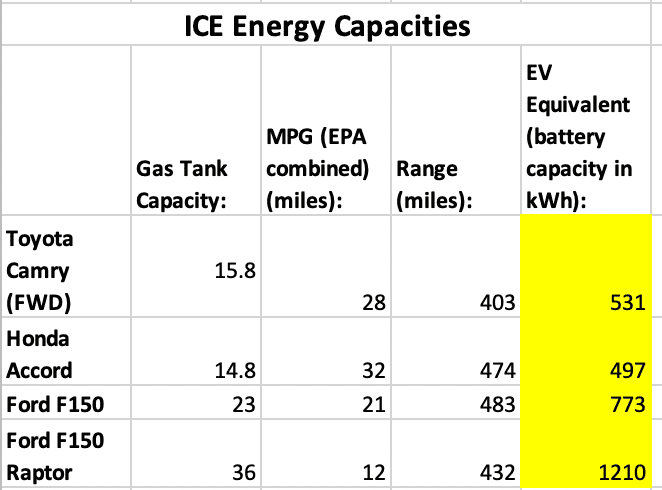
Here’s a quick chart of the fuel capacities of several sample ICE trims, and what would be the equivalent energy in an EV.


ICE Energy.png


Note the extraordinary kWh capacities necessary to match up with what we think of as run-of-the-mill, common-as-can-be vehicles. It underlines how grossly inefficient ICE cars are. The Raptor is just nuts.

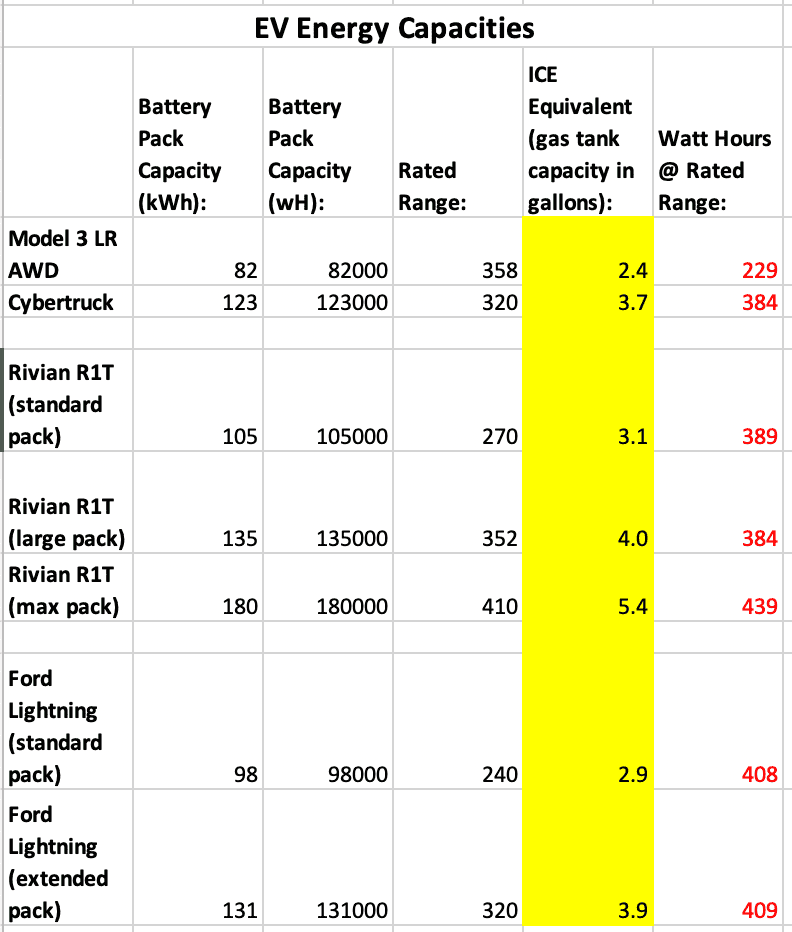
It’s even more revealing when you turn it around and look at it from the EV perspective.


EV Energy.png


Imagine if your ICE family sedan had a 2.5 gallon gas tank. When I go out later this morning and climb into my Model 3, that’s essentially what I’m doing. It underlines how little fuel a Tesla Model 3 or Model Y carries onboard, compared to a similar ICE vehicle. It emphasizes how much more efficient an EV is.

There’s a “But,” though.

All vehicles - ICE or EV - are affected by things like temperature, altitude, and speed. And yet the EV world is inundated with complaints of range falling off as the calendar rolls into winter. Or when a drive involves a long slog on the interstate at speed. Or when a trip sends one up into the mountains.

While ICE drivers rarely give a thought to any of those things.

Lithium EV chemistries certainly have some issues that need to be managed in cold weather. I’m not saying they don’t.

But much of the effect of those kinds of things in the ICE world is hidden within the cavernous supply of fuel that they carry.

Lose ten percent efficiency in an ICE car because you’ve entered a slight uphill grade and it’s lost in the noise. Lose ten percent in an EV, with its tiny fuel supply and parsimonious allocation of energy, and it’s immediately obvious.

I’m reminded of the scene from Apollo 13 when Ken Mattingly, down on the ground, struggles to find a way to power up the Command Module of the ailing spacecraft with the tiny amount of power available in the Lunar Module’s batteries.

How we use our batteries is sometimes a very big deal.


The second thing, the next reason many people will be unhappy with the range they see in their new Cybertruck, is because full in the ICE world is a little bit different than full in the EV world.

Both worlds require some buffer on the low end, in order to find that next gas station or DC fast charger.

But whereas the ICE world habitually fills their tank all the way when they stop, that’s rarely the case in the EV world. Lithium batteries don’t like full charge because it accelerates pack degradation. So those of us who care about such things tend to back away from full charge some amount – 80% or 70% or, for some of us, even more – unless we’re on a road trip or some other situation that absolutely demands 100% SOC.

That promised 320 miles of range can quickly turn into 250 or 270 before we’ve driven the first mile. And that’s with a brand new pack, before any degradation has occurred.


The last reason for range frustration is because of something most people never give a thought to – themselves.

A lot of people look at rated range, fail to ever hit it, and then just squint hard at their vehicle, shaking their head. Muttering something about Elon once again promising something he never delivered.

Well, no.

Most drivers have pretty close to zero appreciation for how much energy it costs pulling away from a traffic light. Or how much is thrown away every time they tap the brakes.

They have not once, during their entire driving life, ever given a thought to momentum or what the benefit of conserving it might be.

They drive their EV exactly like they’ve always driven their ICE car. They press on the throttle to make it go. They press on the brake to make it stop.

And because that ICE car always had such a glorious extravagance of energy carried onboard, they never learned not to waste it.

Even in a car – such as a Tesla – that has the real-time telemetry for such things, they’ve never once contemplated the actual kilowatts of power their rear motor is putting out. Or where the threshold is for when the motor on their front axle engages.

They see the green line on their screen stretch out like a rubber band when they come off the throttle and their car begins regen braking. But they have no idea how much energy got sent back into the pack.

I won’t belabor this. Discussing how to optimize EV driving efficiency is a story for another time. For now, I’ll just say that an EV driver complaining because the “real world” range of their vehicle never approaches its rated range… is probably not seeing the whole picture.

Speaking of that rated range thing. Wouldn’t it be nice if we had an objective, unbiased third-party from whom we could get “real world” numbers?

Turns out we do. It’s called the EPA. They designed the test suite from which rated range emerges. Not Tesla.

The second chart above has the watt-hours/mile needed to hit the vehicle’s rated range, written in red. For the Cybertruck, we’ll be wanting to hit right around 384 in order to make that 320-mile bogey.

Some of us expect to.
For every product, there is a certain amount of money we allow for spending. This no exception. I will not be held to my option because of what others perceive as an arbitrary number. Don't want it, don't buy it. End of story.


Cybergirl

Well-known member
Joined
Jul 3, 2020
Threads
40
Messages
873
Reaction score
2,934
Location
Illinois and Arizona
Vehicles
Tesla Model Y LR, Model Y SR, Cybertruck AWD FS
Country flag
The longer you're disconnected from the ICEV experience, the less you're influenced by it. Since October 2018, when I bought a Tesla, everything that used to be important to me regarding personal transportation has been wiped out, and I'm very happy about that.
 

cbrtrckrsrvd112219

Well-known member
First Name
eric
Joined
Mar 26, 2023
Threads
3
Messages
226
Reaction score
344
Location
Northwest, US
Vehicles
Model 3, Cybertruck FS AWD
Country flag
On reveal night, four years ago, it was the 500 mile range of the Tri-Motor trim that stuck in my mind more than anything else.

We don’t know what we don’t know, though. And sometimes something that seems imminently clear… turns out anything but.

Fast forward those four years. Cybertrucks are now finally rolling out of Austin. And here is my stake-in-the-ground: Lots of people are going to be complaining about the range they experience.

Not because they’re towing things. Not because they’re hauling stuff. And not because the truck Tesla finally shipped ended up rated at 300 miles and change instead of the 500 miles that was originally expected.

Even had Tesla hit that bogey, people would be unhappy. Because most people – even longtime EV owners – continue to look at EV range through the prism of their lifelong ICE experience.

There are a hat trick of things going on. First, drivers don’t usually appreciate the vast difference in fuel stores between ICE cars and their EV counterparts.

One gallon of gas is approximately 121,000,000 joules; and is equivalent to around 33.6 kWh.

Here’s a quick chart of the fuel capacities of several sample ICE trims, and what would be the equivalent energy in an EV.


ICE Energy.png


Note the extraordinary kWh capacities necessary to match up with what we think of as run-of-the-mill, common-as-can-be vehicles. It underlines how grossly inefficient ICE cars are. The Raptor is just nuts.

It’s even more revealing when you turn it around and look at it from the EV perspective.


EV Energy.png


Imagine if your ICE family sedan had a 2.5 gallon gas tank. When I go out later this morning and climb into my Model 3, that’s essentially what I’m doing. It underlines how little fuel a Tesla Model 3 or Model Y carries onboard, compared to a similar ICE vehicle. It emphasizes how much more efficient an EV is.

There’s a “But,” though.

All vehicles - ICE or EV - are affected by things like temperature, altitude, and speed. And yet the EV world is inundated with complaints of range falling off as the calendar rolls into winter. Or when a drive involves a long slog on the interstate at speed. Or when a trip sends one up into the mountains.

While ICE drivers rarely give a thought to any of those things.

Lithium EV chemistries certainly have some issues that need to be managed in cold weather. I’m not saying they don’t.

But much of the effect of those kinds of things in the ICE world is hidden within the cavernous supply of fuel that they carry.

Lose ten percent efficiency in an ICE car because you’ve entered a slight uphill grade and it’s lost in the noise. Lose ten percent in an EV, with its tiny fuel supply and parsimonious allocation of energy, and it’s immediately obvious.

I’m reminded of the scene from Apollo 13 when Ken Mattingly, down on the ground, struggles to find a way to power up the Command Module of the ailing spacecraft with the tiny amount of power available in the Lunar Module’s batteries.

How we use our batteries is sometimes a very big deal.


The second thing, the next reason many people will be unhappy with the range they see in their new Cybertruck, is because full in the ICE world is a little bit different than full in the EV world.

Both worlds require some buffer on the low end, in order to find that next gas station or DC fast charger.

But whereas the ICE world habitually fills their tank all the way when they stop, that’s rarely the case in the EV world. Lithium batteries don’t like full charge because it accelerates pack degradation. So those of us who care about such things tend to back away from full charge some amount – 80% or 70% or, for some of us, even more – unless we’re on a road trip or some other situation that absolutely demands 100% SOC.

That promised 320 miles of range can quickly turn into 250 or 270 before we’ve driven the first mile. And that’s with a brand new pack, before any degradation has occurred.


The last reason for range frustration is because of something most people never give a thought to – themselves.

A lot of people look at rated range, fail to ever hit it, and then just squint hard at their vehicle, shaking their head. Muttering something about Elon once again promising something he never delivered.

Well, no.

Most drivers have pretty close to zero appreciation for how much energy it costs pulling away from a traffic light. Or how much is thrown away every time they tap the brakes.

They have not once, during their entire driving life, ever given a thought to momentum or what the benefit of conserving it might be.

They drive their EV exactly like they’ve always driven their ICE car. They press on the throttle to make it go. They press on the brake to make it stop.

And because that ICE car always had such a glorious extravagance of energy carried onboard, they never learned not to waste it.

Even in a car – such as a Tesla – that has the real-time telemetry for such things, they’ve never once contemplated the actual kilowatts of power their rear motor is putting out. Or where the threshold is for when the motor on their front axle engages.

They see the green line on their screen stretch out like a rubber band when they come off the throttle and their car begins regen braking. But they have no idea how much energy got sent back into the pack.

I won’t belabor this. Discussing how to optimize EV driving efficiency is a story for another time. For now, I’ll just say that an EV driver complaining because the “real world” range of their vehicle never approaches its rated range… is probably not seeing the whole picture.

Speaking of that rated range thing. Wouldn’t it be nice if we had an objective, unbiased third-party from whom we could get “real world” numbers?

Turns out we do. It’s called the EPA. They designed the test suite from which rated range emerges. Not Tesla.

The second chart above has the watt-hours/mile needed to hit the vehicle’s rated range, written in red. For the Cybertruck, we’ll be wanting to hit right around 384 in order to make that 320-mile bogey.

Some of us expect to.
It is very impressive analysis, especially comparing apples to oranges and putting impressive tables of apples by oranges and oranges by apples. the algebra is impressive and reminds me to try to convert Fahrenheit to Celsius as I dont understand and hate this stupid imperial system! So I found ways to deal with it: for temperature I set my phone/PC to Celsius and if my kids or any other americans ask me about it I tell them in Celsius. Feet and gallons are relatively easy I divide/multiply by 3 for ft or 4 for gallons. and then speed is easy - I dont care what is measured in - just follow speed limit Plus 5 and whatever speedometer shows - fair game, no need to convert! :)

but I am not sure what is the q-n? and what is expected outcome of this tread?
 

GuyV

Well-known member
First Name
Guy
Joined
Aug 17, 2023
Threads
1
Messages
814
Reaction score
1,073
Location
St. Louis, MO
Vehicles
Tesla Model S, FS Cybertruck AWD
Occupation
Retired
Country flag
On reveal night, four years ago, it was the 500 mile range of the Tri-Motor trim that stuck in my mind more than anything else.

We don’t know what we don’t know, though. And sometimes something that seems imminently clear… turns out anything but.

Fast forward those four years. Cybertrucks are now finally rolling out of Austin. And here is my stake-in-the-ground: Lots of people are going to be complaining about the range they experience.

Not because they’re towing things. Not because they’re hauling stuff. And not because the truck Tesla finally shipped ended up rated at 300 miles and change instead of the 500 miles that was originally expected.

Even had Tesla hit that bogey, people would be unhappy. Because most people – even longtime EV owners – continue to look at EV range through the prism of their lifelong ICE experience.

There are a hat trick of things going on. First, drivers don’t usually appreciate the vast difference in fuel stores between ICE cars and their EV counterparts.

One gallon of gas is approximately 121,000,000 joules; and is equivalent to around 33.6 kWh.

Here’s a quick chart of the fuel capacities of several sample ICE trims, and what would be the equivalent energy in an EV.


ICE Energy.png


Note the extraordinary kWh capacities necessary to match up with what we think of as run-of-the-mill, common-as-can-be vehicles. It underlines how grossly inefficient ICE cars are. The Raptor is just nuts.

It’s even more revealing when you turn it around and look at it from the EV perspective.


EV Energy.png


Imagine if your ICE family sedan had a 2.5 gallon gas tank. When I go out later this morning and climb into my Model 3, that’s essentially what I’m doing. It underlines how little fuel a Tesla Model 3 or Model Y carries onboard, compared to a similar ICE vehicle. It emphasizes how much more efficient an EV is.

There’s a “But,” though.

All vehicles - ICE or EV - are affected by things like temperature, altitude, and speed. And yet the EV world is inundated with complaints of range falling off as the calendar rolls into winter. Or when a drive involves a long slog on the interstate at speed. Or when a trip sends one up into the mountains.

While ICE drivers rarely give a thought to any of those things.

Lithium EV chemistries certainly have some issues that need to be managed in cold weather. I’m not saying they don’t.

But much of the effect of those kinds of things in the ICE world is hidden within the cavernous supply of fuel that they carry.

Lose ten percent efficiency in an ICE car because you’ve entered a slight uphill grade and it’s lost in the noise. Lose ten percent in an EV, with its tiny fuel supply and parsimonious allocation of energy, and it’s immediately obvious.

I’m reminded of the scene from Apollo 13 when Ken Mattingly, down on the ground, struggles to find a way to power up the Command Module of the ailing spacecraft with the tiny amount of power available in the Lunar Module’s batteries.

How we use our batteries is sometimes a very big deal.


The second thing, the next reason many people will be unhappy with the range they see in their new Cybertruck, is because full in the ICE world is a little bit different than full in the EV world.

Both worlds require some buffer on the low end, in order to find that next gas station or DC fast charger.

But whereas the ICE world habitually fills their tank all the way when they stop, that’s rarely the case in the EV world. Lithium batteries don’t like full charge because it accelerates pack degradation. So those of us who care about such things tend to back away from full charge some amount – 80% or 70% or, for some of us, even more – unless we’re on a road trip or some other situation that absolutely demands 100% SOC.

That promised 320 miles of range can quickly turn into 250 or 270 before we’ve driven the first mile. And that’s with a brand new pack, before any degradation has occurred.


The last reason for range frustration is because of something most people never give a thought to – themselves.

A lot of people look at rated range, fail to ever hit it, and then just squint hard at their vehicle, shaking their head. Muttering something about Elon once again promising something he never delivered.

Well, no.

Most drivers have pretty close to zero appreciation for how much energy it costs pulling away from a traffic light. Or how much is thrown away every time they tap the brakes.

They have not once, during their entire driving life, ever given a thought to momentum or what the benefit of conserving it might be.

They drive their EV exactly like they’ve always driven their ICE car. They press on the throttle to make it go. They press on the brake to make it stop.

And because that ICE car always had such a glorious extravagance of energy carried onboard, they never learned not to waste it.

Even in a car – such as a Tesla – that has the real-time telemetry for such things, they’ve never once contemplated the actual kilowatts of power their rear motor is putting out. Or where the threshold is for when the motor on their front axle engages.

They see the green line on their screen stretch out like a rubber band when they come off the throttle and their car begins regen braking. But they have no idea how much energy got sent back into the pack.

I won’t belabor this. Discussing how to optimize EV driving efficiency is a story for another time. For now, I’ll just say that an EV driver complaining because the “real world” range of their vehicle never approaches its rated range… is probably not seeing the whole picture.

Speaking of that rated range thing. Wouldn’t it be nice if we had an objective, unbiased third-party from whom we could get “real world” numbers?

Turns out we do. It’s called the EPA. They designed the test suite from which rated range emerges. Not Tesla.

The second chart above has the watt-hours/mile needed to hit the vehicle’s rated range, written in red. For the Cybertruck, we’ll be wanting to hit right around 384 in order to make that 320-mile bogey.

Some of us expect to.
LOL, I'm old and have had cars and trucks that needed their 25-gallon tanks to go 200 miles on a fill-up so I've never had a problem with range in 9 years of driving my Model S. And with age comes experience if not wisdom, I've never gotten to empty on the S and don't want to remember how many times I ran out of gas.
 

GuyV

Well-known member
First Name
Guy
Joined
Aug 17, 2023
Threads
1
Messages
814
Reaction score
1,073
Location
St. Louis, MO
Vehicles
Tesla Model S, FS Cybertruck AWD
Occupation
Retired
Country flag
Maybe it's just me, but having an unscheduled stop make me seriously late to some commitment makes me anxious.
There's no good reason for it being unscheduled any more than if you let your gas tank get too low.
 

Michael Dobbs

Well-known member
First Name
Michael
Joined
Apr 7, 2021
Threads
0
Messages
47
Reaction score
111
Location
Pebble Beach Ca.
Vehicles
Cybertruck, model 3 and model S
Occupation
Biomedical Engineer
Country flag
Do you stop “more frequently”??? Or do you spend more time charging than sitting at gas stations?

I’m not talking about a single trip, I am talking about over a year. If you charge at home, and your daily drive is within the range that you can recharge at home (say, 30 miles each way), and let say every other weekend you take a 1,000 mile round trip vacation. (Or a 500 mile round trip towing a trailer) Let’s look at it…

A REAL truck/car;
You can get 400 miles out of a tank of gas, but you stop and fill up around 360. You are stopping at the gas station every 6 days. So between your every 2 week trips, you are making 2 stops at a gas station. Average time 5 minutes. And then on your trip, you’ve driven two days since filling up, so you leave the house with 240 miles of effective range (meaning you drive until that light is almost on, but you ain’t empty) You’re filling up once enroute on your trip each way and arriving home with, oh wait, you have to choose between stretching the trip between fill ups to 370 or stopping again. Well, there’s a gas station on every off-ramp, so you stretch each leg another 10 miles and you arrive home with less than 10 miles of gas. Just enough to get you to the gas station first thing in the morning before work, OR, you stop just as you are arriving home. Either way, another 5 minutes. And on the way to/from you have to stop at Starbucks for a potty break, so another 5 minutes each way, add 10 minutes overall.

So every two weeks you are stopping 6 times, at 5 minutes each., or 30 minutes of your life each two weeks is at a gas station, and 40 minutes with bathroom breaks. And here we are assuming you aren’t ever having to wait for a pump to open up, best case. And you don’t ever go anywhere other than work and your trips. You take something else out to dinner, or shopping, or getting groceries, or to drive through for dinner, or a lunch run at work, or whatever.

One of them dang MARS trucks/cars
You get 340 miles from a full charge, but you stop around 270-275, doesn’t matter really. You plug in at home every night and leave the house with 80% like the book says. So during your two weeks, you never stop to charge. And when you leave for your trip, you leave with 340 miles of range. you stop once on your way, and use a destination charger to top it off before you head home. You stop once on the way. Each stop is 30 minutes, and you stop at Starbucks while you are charging. You are charging for 60 minutes every two weeks. You also have enough range to get groceries every few days, take little Susie to soccer practice twice a week, and little Bobby to baseball practice as well. You have the range to take your spouse out to dinner in your car, make a lunch run for the office everyday, and run other errands whenever, without impacting the amount of time you spend “refueling” your car.

Not many people drive 1000 miles on a trip every two weeks, but the ICE car/truck has stopped 7 times for 40 minutes, and the BEV has stopped 2 times for 60 minutes. Not a huge difference. And certainly the BEV is more convenient overall in day to day real life. You aren’t stopping more often, just a few more minutes and far LESS often.

Make that long trip just 4 or 5 times a year, and you now are spending MORE time filling up with gas than charging your car. The difference is like having a gas station in your garage, and someone else to fill it up every night. Make the daily commute to work longer, and it tilts even more in favor of the BEV. This is one of the (many) reasons I’m making the change to a BEV.
For me, it’s more about the driving experience than range or cost. I think if I tried to compare the difference in the cost of the vehicle vs an ICE vehicle and the savings for charging vs fuel costs, I would never recoup the purchase price difference.
Don’t get me wrong. I love my Maserati! The sound, the feel, the look. I equally enjoy the driving experience I get from my model S or X. I just don’t try to compare them?


CyberMoose

Well-known member
Joined
Aug 19, 2020
Threads
1
Messages
825
Reaction score
1,437
Location
.
Vehicles
.
Yeah I've been saying this as probably the biggest benefit of electric vehicles. You do not have to go to a gas station. the majority of people (who can use home chargers) won't even have to go to a supercharger.

I haven't ever used a supercharger or a public charger because Almost all my driving gets me home that night, regardless of how far. One time I went to a friends after my driving and wouldn't have had enough by morning to make it home. But even the level 1 charging still gave me what I needed to drive an hour back.

500 miles of range, 340 miles of range, even if it turns out for be 280 miles of real world driving range. I'm still going to probably use a super/public charger like 5 or less times a year. And charging up at home with my $0.08/kwh offpeak rate is a whole lot cheaper and that only compliments the already huge advantage of being able to go home, plug in, and not have to drive somewhere specific.

And I personally ignore the people who compare the times to charge vs the time to pump gas. If I actually needed to use a super charger, I have probably been driving for a while, i'm not near home, so I'll happily stretch my legs and maybe grab a bite to eat. I could even do grocery shopping, run errands, or if there is a lvl 2 charger near someone's work, they could park it there on a really low charge and then return after work.

I'm not saying it will be the best option for everyone. But unless someone is one of the very very rare people where they will be driving in excess of 250 miles a day, or in areas that charging is very unreliable, or doesn't have home charging as an option and the only public chargers have insane rates, I think the 340 miles of listed range will be more than enough to make electric a better option.
And I've also mentioned on previous posts that Cybertruck will have truck capabilities and offroad capabilities that will satisfy the needs of like 95% or more of the people looking at Cybertruck. But someone that has constant needs for an actual truck for long range towing often or goes offroading in extreme conditions, they should buy a vehicle specifically built for those things.
 

Tinker71

Well-known member
First Name
Ray
Joined
Aug 8, 2020
Threads
93
Messages
1,610
Reaction score
2,102
Location
Utah
Vehicles
1976 VW EV bus, 2007 Sienna, Tesla M3, Cancelled CT2 rez - holding for $65k
Occupation
Project Manager
Country flag
Any trip in a BEV that requires more that 1 supercharge stop is going to be a real hassle. (require time and patience)

For my RWD M3 this is 350 miles
For a model S Long range this is 500 miles

The CT will be between those.

We travel to Washington state 2-3 times per year. It is a 700 mile drive. In a BEV we will just need to find hotel in Boise with destination charger. (very important IMHO)

Marathon trips should just be avoided at this level of technology, but 90% of our miles are super easy. This is worth it IMO to get off oil.
 

Saygmo

Well-known member
First Name
Sas
Joined
Dec 28, 2023
Threads
2
Messages
83
Reaction score
134
Location
Norcql
Vehicles
Model 3 awd
Country flag
First, the are two EPA range numbers, it is just that media outlets do not publish them.

Do we have any data from the Monroney sticker on HWY / CTY range? There are very significant differences between vehicles. For example:
VehicleEPA OverallEPA CTY RangeEPA HWY Range
F150 Lightning320350282
Rivian R1T328342310
Silverado EV393418360

And when you look at the Tesla vehicles here is theirs
VehicleEPA OverallEPA CTY RangeEPA HWY Range
Model Y LR AWD330342316
Model 3315329299
Model S LR AWD405420388
Model X LR AWD350363389

Once we get this data we will get a better indication.

Second, Tesla does overstate its EPA numbers significantly using an allowed but misleading methodology for the correction factor. (see next post)
But to this point, the epa also needs to update the highway number to reflect the fact that speeds on nearly any highway in the USA average 65-75mph, so it should be run at those speeds.
 

Michael Dobbs

Well-known member
First Name
Michael
Joined
Apr 7, 2021
Threads
0
Messages
47
Reaction score
111
Location
Pebble Beach Ca.
Vehicles
Cybertruck, model 3 and model S
Occupation
Biomedical Engineer
Country flag
Any trip in a BEV that requires more that 1 supercharge stop is going to be a real hassle. (require time and patience)

For my RWD M3 this is 350 miles
For a model S Long range this is 500 miles

The CT will be between those.

We travel to Washington state 2-3 times per year. It is a 700 mile drive. In a BEV we will just need to find hotel in Boise with destination charger. (very important IMHO)

Marathon trips should just be avoided at this level of technology, but 90% of our miles are super easy. This is worth it IMO to get off oil.
I have a 21 MS long range. I can assure you I have never seen 500 mi?
The advertised rage was 405 I think? Anyway, it’s a little over 300 miles from where I live to LA. I can start out with a full/100% charge and only get to Santa Barbara before needing to charge. My model 3 extended range would only get me to Solvang. Check your maps.
I must say, I don’t expect any more from the car. It’s hilly and I drive fast. But I can’t get anywhere close to 405 miles from a full charge?
Sponsored


Top