
Sponsored
Cybertruck Stainless Panels are falling off ...Is this a new phenomena?

Black306
Well-known member
- Joined
- Oct 18, 2024
- Threads
- 9
- Messages
- 775
- Reaction score
- 1,609
- Location
- Sacramento
- Vehicles
- ‘26 PAWD CT | ‘23 M3 RWD

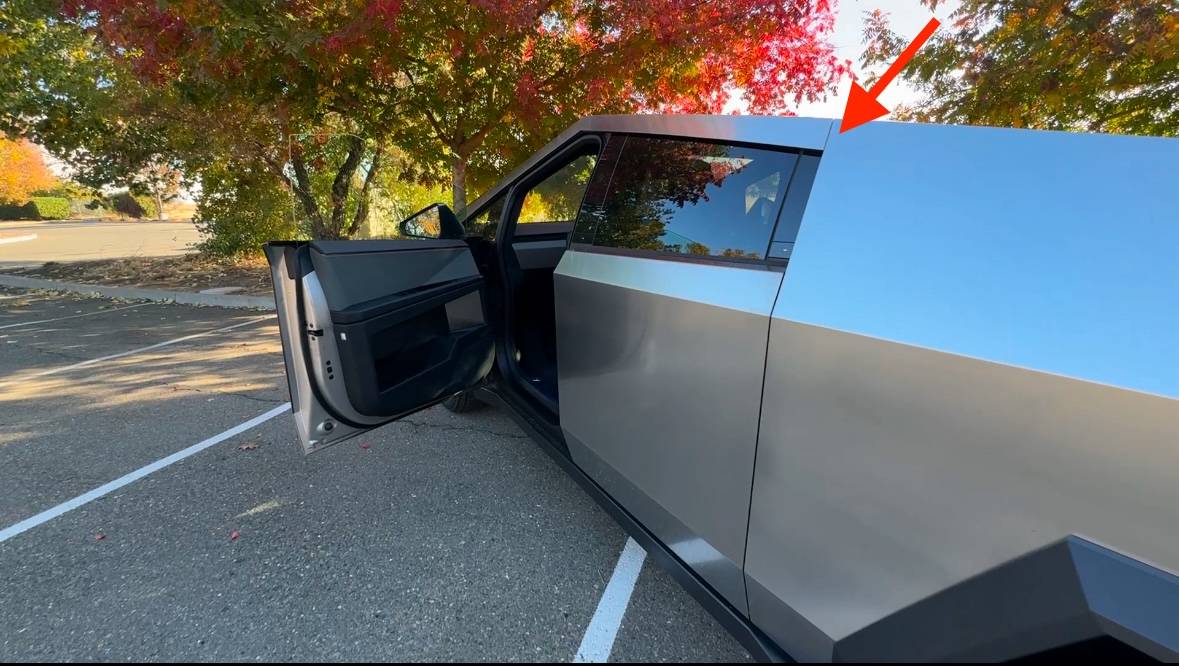
Checked my truck (44k VIN) after watching that video yesterday. Noticed a small section on the rear driver's side quarter panel has stainless/glue separation.

Not going to worry about it for now. Still have 3+ years of bumper-to-bumper warranty. I'll just wait for more separations to occur (if any) before opening a service ticket. Also, I'd rather have a future [ie better] fix than a current build replacement panel that will likely have the same issue.
If I notice sail panel separation, that's a different story. I'd put in a request for that right away.
Not going to worry about it for now. Still have 3+ years of bumper-to-bumper warranty. I'll just wait for more separations to occur (if any) before opening a service ticket. Also, I'd rather have a future [ie better] fix than a current build replacement panel that will likely have the same issue.
If I notice sail panel separation, that's a different story. I'd put in a request for that right away.
AlmostHuman
Well-known member
- Joined
- May 1, 2024
- Threads
- 7
- Messages
- 985
- Reaction score
- 1,349
- Location
- Earth
- Vehicles
- Model X, Cybertruck
- Occupation
- Human
It does seem like a silly build decision to use glue. I’m not saying I have a better idea just seems interesting. I wonder if this has happened on a truck that is not wrapped. All the ones I have seen with this issue are wrapped.
Edit: I see the post here and it is not wrapped. Bummer.
Edit: I see the post here and it is not wrapped. Bummer.
cybercricket
Well-known member
I've seen references to this before. I agree with the guy in the video - glued sheet metal is very likely to separate in very cold temps. It is a poor design decision not to have any type of mechanical fasteners for that trim.
mongo
Well-known member
- Joined
- May 27, 2024
- Threads
- 5
- Messages
- 4,527
- Reaction score
- 5,510
- Location
- SE Michigan
- Vehicles
- Cyberbeast
And this one:It does seem like a silly build decision to use glue. I’m not saying I have a better idea just seems interesting. I wonder if this has happened on a truck that is not wrapped. All the ones I have seen with this issue are wrapped.
Edit: I see the post here and it is not wrapped. Bummer.
Let me chime in here, this has NOTHING to do with the wrap as my wife had the same thing happen on the passenger side of the truck going 20 MPH on a side road. When I picked up the truck in June of last year, I made sure to tighten the bolts, but come to find out it is indeed two pieces, one is held by a bolt and the other by glue. When I mentioned to SC we should change out drivers side just in case, SC they stated they are unable to change it until it comes off.
SO in this case, if my drivers piece decides to fall off and hurt someone I will sue.
Deleted member 17810
Guest
Seems they skimped on the adhesives.
This also means they probably didn't age test the adhesives. yikes.
This also means they probably didn't age test the adhesives. yikes.
cybercricket
Well-known member
A follow up thought... this is guaranteed to result in a safety recall once a panel and/or trim flies off at a highway speed and hits another vehicle.
cybercricket
Well-known member
I don't believe there is an adhesive that would work for this application. Coefficient of thermal expansion will be significantly different for stuff like steel and any type of organic goo, which will ensure separation especially since the metal surface doesn't present enough roughness for bonding.Seems they skimped on the adhesives.
This also means they probably didn't age test the adhesives. yikes.
Some folks do 3D printing with FDM printers. To help the adhesion of the printed part to the bed glue sticks are used sometimes. Works great, but on a larger part it then becomes impossible to separate it from the bed (typically glass). Throw it into the freezer and the thing pops right off...
Sandman1962
Well-known member
- First Name
- Sel
- Joined
- Apr 18, 2023
- Threads
- 12
- Messages
- 265
- Reaction score
- 514
- Location
- San Diego
- Vehicles
- Model S , Model X
Interestingly, in some 3D printing, glue is used both to keep the object on the print plate, but also to aid in releasing the object once printed. I’m afraid that the steel panels may be “releasing”, I’m sure more knowledgeable folk will chime in on this situation soon.
ChiTownCT
Well-known member
- First Name
- OG Rivet Crew
- Joined
- Aug 22, 2023
- Threads
- 34
- Messages
- 793
- Reaction score
- 2,109
- Location
- Chicago
- Vehicles
- CYBERTRUCK
Definitely the cold temps, this part was definitely not properly designed..Seems they skimped on the adhesives.
This also means they probably didn't age test the adhesives. yikes.
Deleted member 17810
Guest
There are definitely plenty of adhesives for bonding different metals in extreme (more than cars see) in the aviation industry.I don't believe there is an adhesive that would work for this application. Coefficient of thermal expansion will be significantly different for stuff like steel and any type of organic goo, which will ensure separation especially since the metal surface doesn't present enough roughness for bonding.
Some folks do 3D printing with FDM printers. To help the adhesion of the printed part to the bed glue sticks are used sometimes. Works great, but on a larger part it then becomes impossible to separate it from the bed (typically glass). Throw it into the freezer and the thing pops right off...
They are just more expensive to process.
Mini2nut
Well-known member
- Joined
- Apr 2, 2020
- Threads
- 138
- Messages
- 4,088
- Reaction score
- 7,427
- Location
- Planet Earth
- Vehicles
- *Tesla MYP *SAWD Cybertruck ordered 2/20/26
The mainstream media will have a field day if Tesla is forced to issue a recall on cantrails unfastening while the vehicle is in motion.
I read a report of an owner having their cantrail totally dislodge on the freeway and become a flying hazard to fellow motorists.
I read a report of an owner having their cantrail totally dislodge on the freeway and become a flying hazard to fellow motorists.
Last edited:

TickTock
Well-known member
- Joined
- Jul 27, 2023
- Threads
- 41
- Messages
- 861
- Reaction score
- 1,834
- Location
- Phoenix, AZ
- Vehicles
- `11 Nissan Leaf; '18 Model 3; '18 Model S; '24 Beast
- Occupation
- Electrical Engineer
The laser-welded the door panels. They can do the same to add reliable mechanical attachment points for the roof rail, too. I'm sure the decision was based on cost which may turn out to be a bad decision if a recall does, indeed, happen.
cybercricket
Well-known member
Theoretically I see how it may work. An adhesive that can maintain elasticity in a wide variety of temperatures will be able to shrink and expand with the metal it's attached to, but it will still be undergoing stresses from the more substantial expansion and shrinking of the metal compared to the adhesive. That combined with low roughness of the metal surface will inevitably cause separation, the question is only after how many cycles. Tesla could switch to a different adhesive and apply some kind of roughing process to the inside surface of the trim... but at that point they might as well redesign it for mechanical fastening instead.There are definitely plenty of adhesives for bonding different metals in extreme (more than cars see) in the aviation industry.
They are just more expensive to process.
And we didn't even talk about the other side, which appears to be plastic. Or is it painted steel ?
Mal
Well-known member
- First Name
- Mal
- Joined
- Feb 13, 2024
- Threads
- 31
- Messages
- 637
- Reaction score
- 1,619
- Location
- WA
- Vehicles
- Foundation CB "Rocinante"
Sigh.
I'm a pretty staunch defender of the CT among my friends and the random folks I encounter, especially knowing I bought a 'Foundation' series. But stuff like this, if systemic in the build, is demoralizing.
I know Tesla will make it right, but it's just kind of ... embarrassing.
I'm a pretty staunch defender of the CT among my friends and the random folks I encounter, especially knowing I bought a 'Foundation' series. But stuff like this, if systemic in the build, is demoralizing.
I know Tesla will make it right, but it's just kind of ... embarrassing.
Sponsored


