
Sponsored

Solar Charging the Truck

OP
OP
Cybertruck 1974

Cybertruck 1974

Well-known member
Joined
Dec 15, 2019
Threads
51
Messages
1,193
Reaction score
1,623
Location
Everywhere
Vehicles
Cybertruck, H2, Samurai, Ford Transit, Chevy Silverado EV, Jaguar, Corvette, M38
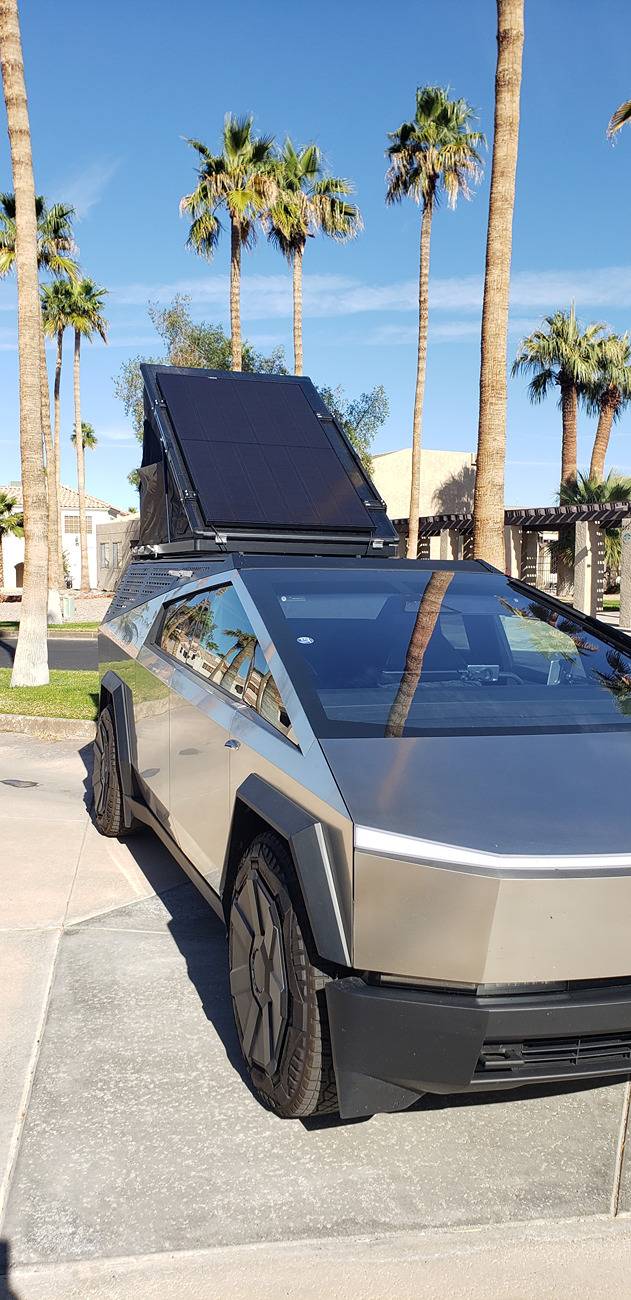
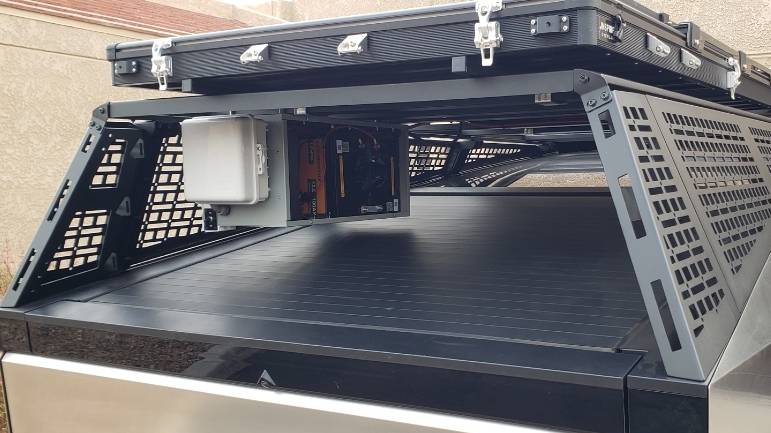
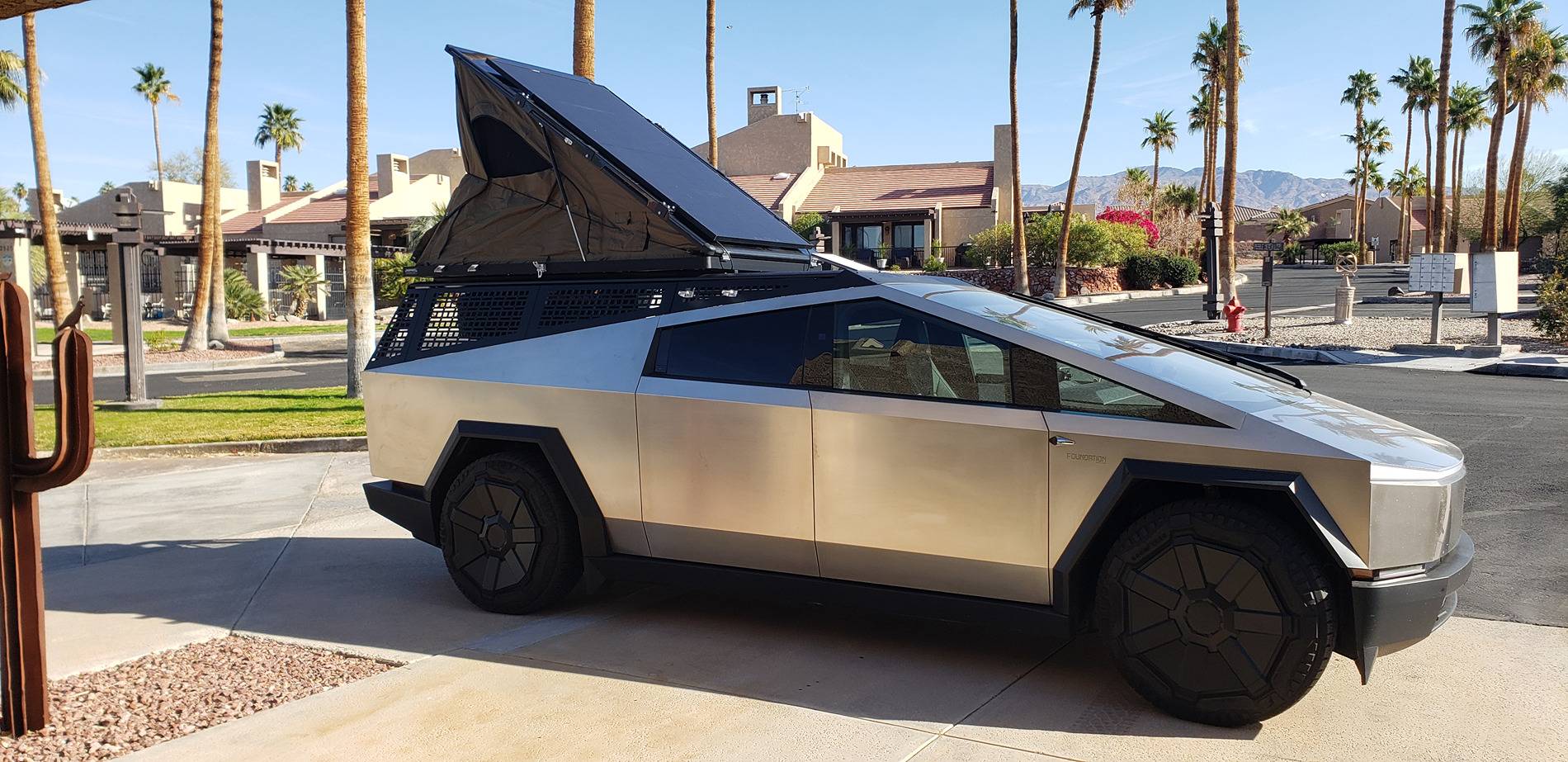
I have done the same. I used a 420W REC solar panel charging a 2580Wh LFP battery with a Renogy 20W Rover charge controller. I charge my CT using a 1000W inverter at 8A. The battery is constantly being charged from the panel as the truck is being charged. Even on a good sunny day, however, the panel tops out at 320 to 340W so eventually charging stops to recharge the solar battery. The issue I've found is that the efficiency charging this way is very inefficient, less than 50%, making the charging process extremely slow. I use my CT's solar generation to supply power for accessories - refrigerator, tent A/C, electric blanket, Starlink, camp lights, etc.
Solar panel up.jpg

Solar power box.jpg
Very ?
Sponsored

 
  • Like
Reactions: REM

Crissa

Well-known member
First Name
Crissa
Joined
Jul 8, 2020
Threads
138
Messages
19,571
Reaction score
31,475
Location
Santa Cruz
Vehicles
2014 Zero S, 2013 Mazda 3
Country flag
I looked into the EcoFlow Delta Pro 3. It's a capable power source, and I like EcoFlow products (I have two). I took a pass on the Pro 3 for range extending these reasons:
1) Cost $3100. Since I have solar and battery backup at my home already that's a lot to spend for backup power for camping and off road travel.
2) Capacity 4 kWh. At an off road efficiency of 500 Wh/mi the Pro 3 provides 8 miles of extended range. That's hardly enough to relieve range anxiety on an overland trip 200 miles from the nearest charging station. One can add solar panels to recharge the unit, but even a 1000W solar panel would like take at least 5 hours to recharge the Pro 3 under favorable conditions
3) Having ruled it out for off road range extension, I felt it overkill for powering my other camping electrical needs.

Instead, I chose a 3700/3300W dual fuel generator at a third the cost and less weight. A 20 lb bottle of propane will produce 20 kWh of energy to the truck's battery (40 miles of extra range) in 6 hours. The big disadvantage of the generator is noise, but in an emergency situation, I can deal with that.
Yeah, although I have powered an entire weekend camp on my older model Delta Pro, and the silence is definitely a positive. I only run the generator at home when I power the heaters. Since I can't always control if I get to park at my tent site (especially when on budget camp fees) it works out great for me.

Making those bottles last includes making sure you're using as much of the power as your generator can efficiently put out, lest you end up wasting that fuel either by icing up or idle shifting too much.

But I know you know this! I'm speaking to the choir.

There are and have been sales (like last month) that make the Delta Pro quite a bit more price competitive.

-Crissa
 

Cybergirl

Well-known member
Joined
Jul 3, 2020
Threads
40
Messages
872
Reaction score
2,933
Location
Illinois and Arizona
Vehicles
Tesla Model Y LR, Model Y SR, Cybertruck AWD FS
Country flag
Yeah, although I have powered an entire weekend camp on my older model Delta Pro, and the silence is definitely a positive. I only run the generator at home when I power the heaters. Since I can't always control if I get to park at my tent site (especially when on budget camp fees) it works out great for me.

Making those bottles last includes making sure you're using as much of the power as your generator can efficiently put out, lest you end up wasting that fuel either by icing up or idle shifting too much.

But I know you know this! I'm speaking to the choir.

There are and have been sales (like last month) that make the Delta Pro quite a bit more price competitive.

-Crissa
I know you will agree that one has to decide on an approach that makes sense in a given situation for a given need. There is no one best solution to providing electrical power away from home. Camping a few dozen miles from a reasonably sized town is different than camping 100 miles from civilization. Relying on a propane generator for supplemental power in the dry southwest is different than in Florida or Missouri where carburetor icing is common if not mitigated. Average annual sunshine will predict the effectiveness of solar energy generation as a way to provide for one's power needs. Traveling and camping in a group can discourage the use of ICE generators.

Here in the Southwest U.S., Utah, Nevada, Arizona, there are large geographical areas that contain no EV charging stations. I'm sure the same is true in the Northwest, many parts of Canada, and Alaska. Traveling and camping in these often beautiful natural environments with an electric vehicle is very rewarding, but also more challenging from a power standpoint than driving an ICE vehicle. While venturing deep into these areas in my CT, I have experienced range anxiety, even after careful planning for recharging. The anxiety is intensified when traveling solo. Self-sufficiency becomes a huge priority in travel planning and preparation.

In my case, having multiple energy sources is reassuring when over-landing. Solar is my preferred supplementary energy source here in the wide open sunny Southwest skies. I can virtually count on 2.5kWh of extra energy each day, even while in motion with the roof top panel. The propane generator is my backup power source for the truck in case my charging plans go awry. I prefer propane for various reasons. It's clean. It doesn't smell. Generator maintenance is minimal. I can easily adjust for altitude changes (simple orifice change). If propane is used up, and can resort to burning gasoline. Even small towns have a gas station, and unless I'm at altitude, the generator produces more power running on gasoline than on propane.

As I gain more experience in overland adventuring, I'm sure I will refine my set up to better suit my needs. I appreciate the advice I get from you and others on the forum that have already gained meaningful experience.
 

Cybergirl

Well-known member
Joined
Jul 3, 2020
Threads
40
Messages
872
Reaction score
2,933
Location
Illinois and Arizona
Vehicles
Tesla Model Y LR, Model Y SR, Cybertruck AWD FS
Country flag
I repeated a test I did last year charging with my iGen4500DF generator, but to the Cybertruck instead of the Model Y. I charged using a Gen 2 mobile connector at 24A/119V. Using an accurate scale, I measured how much propane was used to add 2 kWh to the truck's battery. The outside air temperature was 71F.

The Cybertruck limits the charging amps to 24A using the TT-30 adapter (80% of the plug’s amp rating), so the steady state charging watts was 2856W. It took 37 minutes to charge the battery with 2kWh using 1.63 lbs of propane. That’s better than my test last year. It means that a full 20 lb cylinder of propane can produce 24.5 kWh of charge to the battery in 7.6 hours. At a driving efficiency of 500 Wh/mi, that a range extension of 49 miles.

The advantage of using a generator is that it can be run over night. If placed 20 feet from sleeping quarters, the noise level is about 70 dBm at 75% load. That's about as loud as an average outdoor A/C condenser unit.

My onboard independent 2.5 kWh solar power station will continue to power the fridge, A/C, etc, which would otherwise have their power cut off while the truck’s battery is being charged.

If one is willing to put up with a generator running overnight on occasion, overland driving range is limited only by the amount of fuel you take along. Of course, I would never do this when grid sources of power are available. A 120V/24A TT-30 outlet at a campground may charge no faster than the generator, but it’s cheaper and quiet.

The problem we EV owners face on overland travel is reduced vehicle driving range. With weighty cargo and poorer aerodynamics, vehicle efficiency takes a hit. I'm happy to achieve 500 Wh/mi on good roads. On primitive roads that can be reduced to 600, 700, or even 800 Wh/mi depending on trail surface, tire pressure, speed, weather, etc. When traveling with a group of Jeeps, Broncos, and 4x4 pickups you have to be able to match their range.


Woodrick

Well-known member
First Name
Ed
Joined
Dec 30, 2023
Threads
6
Messages
4,786
Reaction score
4,762
Location
Gainesville Ga
Vehicles
Model 3, Model Y, Cybertruck AWD
Occupation
Consultant
Country flag
The truck is sensitive to power fluctuations, so unless you have a large enough array and battery to act as a buffer, you are pretty much stuck at the charge, dump, repeat. Solar panels need a charge controller to work, so that's what the Jackery is doing. It has a battery bank built into it, so that's your buffer.

You could build a really nice travel system yourself. What's your budget?

If you want to start dabbling into Solar, I highly recommending this channel to get you started: https://www.youtube.com/@WillProwse
Agreed, it's not a simple issue and the only real alternatives are to have a battery large enough to take s day's worth of solar output and then dump it into the truck when the sun sets.

With 400W of solar power and an average of 5-6 hours of effective charging, that's about 3kWh of batteries.
And at 400W/mi, that's 2.5mi/kWh and a total of 8 miles per day.

800W and 6kWh give you 16 miles.

That's a lot of cost for such a marginal payback. How many time is 16 miles going to make a difference?
 

Bobo_LaDouche

Well-known member
Joined
Nov 13, 2024
Threads
8
Messages
179
Reaction score
268
Location
Carson City, Nevada
Vehicles
Cybertruck, Model 3
Country flag
16 miles a day solar charging could be a real advantage, if you park for several days, as I typically do. This amount of solar range extension probably makes remote field work feasible. While I like Cybergirl's measurements that indicate 50 miles range from a tank of propane, that is the same as 3 days of solar collection +/-. For longer trips, the solar is better.

This is about the most encouraging solution I have seen.
 

IntoTheRain916

Well-known member
First Name
Kai
Joined
Jan 27, 2025
Threads
7
Messages
203
Reaction score
418
Location
Sacramento
Vehicles
Model Y, Cybertruck
Occupation
Business Owner
Country flag
My setup for a long Stay of 7+ days is my Jackery 3000 Pro with two x500 Solarsaga panels. with not many trees and decent sun for 5-6 hours. I'd get 8 - 10 miles daily with my CT just sitting, after about 7 days it's like a Low estimate of 55 miles and a High estimate of 70 miles free while it sits, can't beat it.
 
OP
OP
Cybertruck 1974

Cybertruck 1974

Well-known member
Joined
Dec 15, 2019
Threads
51
Messages
1,193
Reaction score
1,623
Location
Everywhere
Vehicles
Cybertruck, H2, Samurai, Ford Transit, Chevy Silverado EV, Jaguar, Corvette, M38
16 miles a day solar charging could be a real advantage, if you park for several days, as I typically do. This amount of solar range extension probably makes remote field work feasible. While I like Cybergirl's measurements that indicate 50 miles range from a tank of propane, that is the same as 3 days of solar collection +/-. For longer trips, the solar is better.

This is about the most encouraging solution I have seen.
Agreed and that was what I was going for. 7 days, solar charging, smaller system, cheaper, lighter and easy to manage. It worked great for my trip using Jackery battery, 4 solar panels and my Tesla 38amp charger in the desert. Had rain, sun, snow. And at my cabin retired with all the time I dont need PGE to power my truck or an elaborate solar system just a little easy kit to get by. Since my trip I bumped it up to the 5kw
My setup for a long Stay of 7+ days is my Jackery 3000 Pro with two x500 Solarsaga panels. with not many trees and decent sun for 5-6 hours. I'd get 8 - 10 miles daily with my CT just sitting, after about 7 days it's like a Low estimate of 55 miles and a High estimate of 70 miles free while it sits, can't beat it.
I have the Jackery 1000 with 2 100 and 1 200 watt panels and it max out at 400 watts input. What's your 3000 maximum allowable solar watts input?
 

Outdoors

Well-known member
First Name
Outdoors
Joined
Nov 19, 2019
Threads
17
Messages
1,879
Reaction score
3,460
Location
North West Montana
Vehicles
S,3,Y,CT,CT(holding pattern) Slate is back on
Some may knock the bigger battery systems, they if fully charged when leaving home can run just about everything outside of the truck for a week or more. Then to say they are expensive. I look at all the other junk the people have. Yet have no money for a battery bank. OK.....

I have a friend that brings his charged up in the back of a truck to run a tiny home for a weekend off grid, and then brings it home.

For those that truly base camp a set up with solar will work just fine. Just have to dump the power. Or play a little electric math on where to dump or to use the power stored.

For my solar setup. I use the rule as ABC always be charging. Go for a day hike. Set up the solar for the day, and come back. One can heat water, watch TV, cook. Or one could dump it into truck.

While a propane sounds like a good idea. It doesn't sound good. Almost embarrassing if you ask me. Yeah I live off the grid almost 7-8 months. I run a generator on a once a week checkup. I routinely drive 100 miles into nothing. My nearest supercharger is over 200 miles away from my most remote spot. A propane generator. :(


IntoTheRain916

Well-known member
First Name
Kai
Joined
Jan 27, 2025
Threads
7
Messages
203
Reaction score
418
Location
Sacramento
Vehicles
Model Y, Cybertruck
Occupation
Business Owner
Country flag
Agreed and that was what I was going for. 7 days, solar charging, smaller system, cheaper, lighter and easy to manage. It worked great for my trip using Jackery battery, 4 solar panels and my Tesla 38amp charger in the desert. Had rain, sun, snow. And at my cabin retired with all the time I dont need PGE to power my truck or an elaborate solar system just a little easy kit to get by. Since my trip I bumped it up to the 5kw

I have the Jackery 1000 with 2 100 and 1 200 watt panels and it max out at 400 watts input. What's your 3000 maximum allowable solar watts input?
The Jackery Explorer 3000 Pro has a maximum allowable solar input of 1,400 watts (via multiple solar panels). It supports up to 60V and 30A input through its solar charging port.
 
OP
OP
Cybertruck 1974

Cybertruck 1974

Well-known member
Joined
Dec 15, 2019
Threads
51
Messages
1,193
Reaction score
1,623
Location
Everywhere
Vehicles
Cybertruck, H2, Samurai, Ford Transit, Chevy Silverado EV, Jaguar, Corvette, M38
The Jackery Explorer 3000 Pro has a maximum allowable solar input of 1,400 watts (via multiple solar panels). It supports up to 60V and 30A input through its solar charging port.
thank you for this information.
 

Cybergirl

Well-known member
Joined
Jul 3, 2020
Threads
40
Messages
872
Reaction score
2,933
Location
Illinois and Arizona
Vehicles
Tesla Model Y LR, Model Y SR, Cybertruck AWD FS
Country flag
I have done the same. I used a 420W REC solar panel charging a 2580Wh LFP battery with a Renogy 20W Rover charge controller. I charge my CT using a 1000W inverter at 8A. The battery is constantly being charged from the panel as the truck is being charged. Even on a good sunny day, however, the panel tops out at 320 to 340W so eventually charging stops to recharge the solar battery. The issue I've found is that the efficiency charging this way is very inefficient, less than 50%, making the charging process extremely slow. I use my CT's solar generation to supply power for accessories - refrigerator, tent A/C, electric blanket, Starlink, camp lights, etc.
Solar panel up.jpg

Solar power box.jpg
I ran another test charging my CT from the solar power station's 2.5kWh fully charged LFP battery (two EcoWorthy 12.8V 100Ah batteries wired in series). At 64degF ambient, it took 1 hr and 40 min to put 1 kWh of charge into the truck battery consuming 1.58 kWh of energy from the solar battery, reducing its SOC to 34%. That turns out to be an efficiency of 63% charging with the Gen 2 mobile connector at 950W (8A). I'm sure that the loss of efficiency is mainly due to the power conversion losses going from DC to AC and then from AC to DC into the truck. Recovering that energy via solar on a clear day takes 5 to 8 hours depending on whether I'm in camp with the tent open or on the road. My REC 420W Alpha Pure 2 panel was putting out 410W at noon today in full sun with the tent opened up.

Tesla Cybertruck Solar Charging the Truck RTT Deployed


Having solar energy generation on overland trips isn't going to significantly extend driving range, but it does help to preserve driving range by isolating electrical loads. Any time I plug something into one of the truck's power outlets, I'm reducing the driving range of the truck. Camp Mode is a huge range reducer. The more I can avoid draining the HV battery, the less stress I feel when located miles from the next charging station. There's no substitute for carefully planning trip charging stops, but having solar does help to make trip planning easier and safer.
 

Crissa

Well-known member
First Name
Crissa
Joined
Jul 8, 2020
Threads
138
Messages
19,571
Reaction score
31,475
Location
Santa Cruz
Vehicles
2014 Zero S, 2013 Mazda 3
Country flag
Wow, I wonder if being able to use more amps would make much of a difference in the truck's current configuration. My old Ecoflow has a 30a outlet. It could dump two, three times the power into the truck in an hour.

Be interesting to compare different setups at the low end, plot the data.

-Crissa
Sponsored


Top