
Sponsored

Maximum speed driving cross country

OP
OP

Hazard One

Active member
First Name
Jeff
Joined
Jul 2, 2025
Threads
2
Messages
44
Reaction score
37
Location
Boise, ID
Vehicles
Cybertruck, Model Y, Jeep Wrangler, Jeep CJ7
Occupation
Retired USAF
Country flag
It's not though (at least with Cybertruck), at the higher speeds your additional energy usage takes longer to recharge than the time you save.
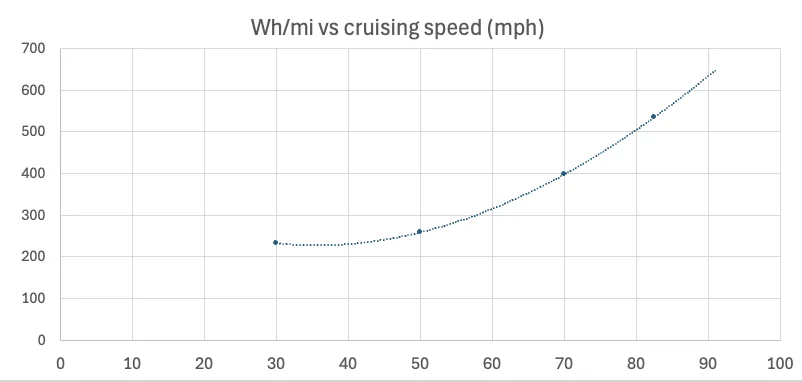
If these charts are correct, then, yes....there comes a speed at which going faster will take longer to go somewhere....same thing happens in my airplane. Sometimes I slow down to extend range to avoid a fuel stop (which takes a hour).

Tesla Cybertruck Maximum speed driving cross country Screenshot 2025-09-19 at 11.49.06


Tesla Cybertruck Maximum speed driving cross country Screenshot 2025-09-19 at 11.49.27
Sponsored


HaulingAss

Well-known member
Joined
Oct 3, 2020
Threads
28
Messages
10,334
Reaction score
20,756
Location
Western Washington, USA
Vehicles
Cybertruck DM, 2010 F-150, 2018 Performance Model 3, 2024 Performance Model 3
Country flag
It's not though (at least with Cybertruck), at the higher speeds your additional energy usage takes longer to recharge than the time you save.
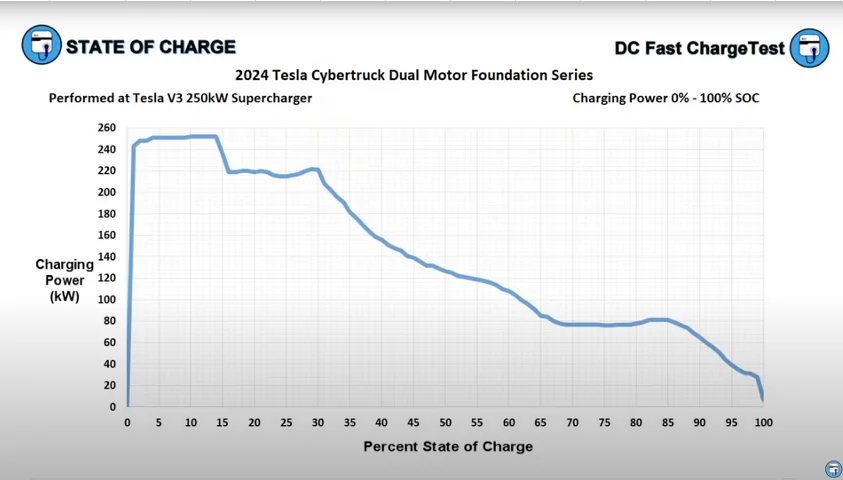
Not if you are using an optimal SOC strategy and keeping the SOC below 60%.

As suggested by @REM, I created three identical Dual Motor Cybertruck trips with ABRP, except one had a maximum speed of 65 mph, one 90 mph and one of 112 mph (all three had a reference speed of 200% of posted to ensure the speed limit didn't slow the vehicle down). The trip went from Mount Vernon City Center on I-5 (north of Seattle and near my home) to Los Angeles, CA. Starting charge was 60%. The charge level was set to remain between 3% and 60%, and charging overhead was set to 2 minutes. It was set to ignore real time weather and traffic. Temperature was 68 degrees F.

The trip with a maximum speed of 65 mph:

18 hours 52 minutes driving
1 hour 54 minutes charging
Total: 20 hours 46 minutes

The trip with a maximum speed of 90 mph:

13 hours 57 minutes driving
2 hours 56 minutes charging
Total: 16 hours 53 minutes

The trip with a maximum speed of 112 mph:

11 hours 33 minutes driving
4 hours 30 minutes charging
Total: 16 hours 3 minutes

As you can see, the faster one drives, right up to the top speed of 112 mph, the sooner one will arrive, including charging stops. And this makes perfect sense when you consider how many miles per hour modern Superchargers can add, even when those miles per hour are cut in half (or more) by the lost efficiency at high speed).

Now if you start doing stupid and unnecessary things (like charging to 80%), all bets are off. Remember, the stated problem was to arrive as quickly as possible. To do that one does not charge to 80%.
 
Last edited:
  • Like
Reactions: REM

hemiarch

Well-known member
First Name
Ace
Joined
Jan 22, 2025
Threads
116
Messages
8,391
Reaction score
9,643
Location
Arizona
Vehicles
2024 foundation AWD, 2024 model x
Occupation
Trauma Surgeon
Country flag
Who charges to 80% on a road trip? I unplug at around 60-65% SOC unless I'm still busy taking my rest break! The only time I charge to 80% or beyond is when I'm using level 2 destination charging and I'm asleep!
You obviously aren’t traveling with young children. You’re AlWAYS still busy taking your rest break. The process of unloading and getting reloaded into car seats and everybody contented with snack and drink and empty bladder means we generally leave with about 90 plus percent. Your method sounds way more efficient but simply out of reach for people like us.
 

REM

Well-known member
Joined
Dec 9, 2023
Threads
14
Messages
3,582
Reaction score
6,657
Location
NC
Vehicles
2020 Model 3 Standard Range++ & Diet Cybertruck, Dual Motor
Occupation
Professional Retard
Country flag
Spent 25 years in the USAF as a pilot, now make my living working for a think tank part time.
Do you work on DoD projects? If so, anything directly involving the Cybertruck?


hemiarch

Well-known member
First Name
Ace
Joined
Jan 22, 2025
Threads
116
Messages
8,391
Reaction score
9,643
Location
Arizona
Vehicles
2024 foundation AWD, 2024 model x
Occupation
Trauma Surgeon
Country flag
Do you work on DoD projects? If so, anything directly involving the Cybertruck?
That you would also like to discuss on the internet? lol.
 
OP
OP

Hazard One

Active member
First Name
Jeff
Joined
Jul 2, 2025
Threads
2
Messages
44
Reaction score
37
Location
Boise, ID
Vehicles
Cybertruck, Model Y, Jeep Wrangler, Jeep CJ7
Occupation
Retired USAF
Country flag
Do you work on DoD projects? If so, anything directly involving the Cybertruck?
Nothing on the Cybertruck, but did work a couple of projects on Space X Starship
 

eser50

Well-known member
First Name
Enrique
Joined
Nov 7, 2024
Threads
0
Messages
78
Reaction score
62
Location
Oceanside, CA
Vehicles
'24 AWD CT, '18 Model S, '16 Mustang GT, '19 XC90
Country flag
the 800 Wh/mi figure came from searches on the net and this forum...but, would love to tweak in the model with good data! Lemme re-run using your figure of 535 wh/mi at 82.5 mph....
I get 800 towing a 23 foot travel trailer going 65. Going 85 with just the truck I get high 400s, maybe low 500s
 
OP
OP

Hazard One

Active member
First Name
Jeff
Joined
Jul 2, 2025
Threads
2
Messages
44
Reaction score
37
Location
Boise, ID
Vehicles
Cybertruck, Model Y, Jeep Wrangler, Jeep CJ7
Occupation
Retired USAF
Country flag
Not if you are using an optimal SOC strategy and keeping the SOC below 60%.

As suggested by @REM, I created three identical Dual Motor Cybertruck trips with ABRP, except one had a maximum speed of 65 mph, one 90 mph and one of 112 mph (all three had a reference speed of 200% of posted to ensure the speed limit didn't slow the vehicle down). The trip went from Mount Vernon City Center on I-5 (north of Seattle and near my home) to Los Angeles, CA. Starting charge was 60%. The charge level was set to remain between 3% and 60%, and charging overhead was set to 2 minutes. It was set to ignore real time weather and traffic. Temperature was 68 degrees F.

The trip with a maximum speed of 65 mph:

18 hours 52 minutes driving
1 hour 54 minutes charging
Total: 20 hours 46 minutes

The trip with a maximum speed of 90 mph:

13 hours 57 minutes driving
2 hours 56 minutes charging
Total: 16 hours 53 minutes

The trip with a maximum speed of 112 mph:

11 hours 33 minutes driving
4 hours 30 minutes charging
Total: 16 hours 3 minutes

As you can see, the faster one drives, right up to the top speed of 112 mph, the sooner one will arrive, including charging stops. And this makes perfect sense when you consider how many miles per hour modern Superchargers can add, even when those miles per hour are cut in half (or more) by the lost efficiency at high speed).

Now if you start doing stupid and unnecessary things (like charging to 80%), all bets are off. Remember, the stated problem was to arrive as quickly as possible. To do that one does not charge to 80%.
Cool! Thanks for vectoring me to ABRP, didn't know that existed. Just poking around it now, it has a "Reference consumption @ 65 mph" input for Wh/mi. What setting did you use for that?
 

eser50

Well-known member
First Name
Enrique
Joined
Nov 7, 2024
Threads
0
Messages
78
Reaction score
62
Location
Oceanside, CA
Vehicles
'24 AWD CT, '18 Model S, '16 Mustang GT, '19 XC90
Country flag
You obviously aren’t traveling with young children. You’re AlWAYS still busy taking your rest break. The process of unloading and getting reloaded into car seats and everybody contented with snack and drink and empty bladder means we generally leave with about 90 plus percent. Your method sounds way more efficient but simply out of reach for people like us.
facts. having a baby this year has added an hour to my San Diego to Vegas trip to see my family. Mostly because of feeding and diaper changes.


mongo

Well-known member
Joined
May 27, 2024
Threads
5
Messages
4,527
Reaction score
5,510
Location
SE Michigan
Vehicles
Cyberbeast
Country flag
Not if you are using an optimal SOC strategy and keeping the SOC below 60%.

As suggested by @REM, I created three identical Dual Motor Cybertruck trips with ABRP, except one had a maximum speed of 65 mph, one 90 mph and one of 112 mph (all three had a reference speed of 200% of posted to ensure the speed limit didn't slow the vehicle down). The trip went from Mount Vernon City Center on I-5 (north of Seattle and near my home) to Los Angeles, CA. Starting charge was 60%. The charge level was set to remain between 3% and 60%, and charging overhead was set to 2 minutes. It was set to ignore real time weather and traffic. Temperature was 68 degrees F.

The trip with a maximum speed of 65 mph:

18 hours 52 minutes driving
1 hour 54 minutes charging
Total: 20 hours 46 minutes

The trip with a maximum speed of 90 mph:

13 hours 57 minutes driving
2 hours 56 minutes charging
Total: 16 hours 53 minutes

The trip with a maximum speed of 112 mph:

11 hours 33 minutes driving
4 hours 30 minutes charging
Total: 16 hours 3 minutes

As you can see, the faster one drives, right up to the top speed of 112 mph, the sooner one will arrive, including charging stops. And this makes perfect sense when you consider how many miles per hour modern Superchargers can add, even when those miles per hour are cut in half (or more) by the lost efficiency at high speed).

Now if you start doing stupid and unnecessary things (like charging to 80%), all bets are off. Remember, the stated problem was to arrive as quickly as possible. To do that one does not charge to 80%.
Sure, if you limit yourself to AWD speeds and legs that you can reach without exceeding 60%, you'll be in the part of the charge curve where speed doesn't matter.
If you extend the range to 130, the story changes. 110 is around the tipping point depending on the assumed coefficients.

55% SOC is 67kWh
Wh/mile vs range
400 (65ish) 167
700 (90ish) 96
1000 (112ish) 67
1250 (130ish) 54

112 vs 130
54 mile leg
29 minutes at 112, 25 minutes at 130, 4 minutes drive savings
54kWh at 112, 67.5 kWh at 130, 13.5 kWh difference
Charge rate needed 13.5kWh in 4 minutes = 202.5 kW. And you need that from 49% (5% buffer plus 54/123) to 60%. My last charge session on a 325kW unit dropped below 200kW at 40%.

But cannonballing is less of a factor to me.
I'm interested in legs where there is either a lack of chargers or I'm towing. For example, the sequential chargers on I-75 in northern Michigan are 121 miles apart. There is a less direct route though so I was working on modeling high Wh/mile optimization.

We mostly have slower chargers too...
 

REM

Well-known member
Joined
Dec 9, 2023
Threads
14
Messages
3,582
Reaction score
6,657
Location
NC
Vehicles
2020 Model 3 Standard Range++ & Diet Cybertruck, Dual Motor
Occupation
Professional Retard
Country flag
That you would also like to discuss on the internet? lol.
Oh for sure. I'm not bound by any security clearances anymore haha.
 

Outdoors

Well-known member
First Name
Outdoors
Joined
Nov 19, 2019
Threads
18
Messages
1,888
Reaction score
3,477
Location
North West Montana
Vehicles
S,3,Y,CT,CT(holding pattern) Slate is back on
Splash and dash is the way to go with cross country travel. What is it? Maximizing the curve and looking at everything three chargers ahead. Being willing to push it to the right point 5-7, 10% or whatever it is for one's vehicle. All are different. One learns. Then I can sit here at this charge rate, but unless I am tired I am wasting time. That is when ya need to be moving.

I have dozens and dozens of cross country and north south with many Tesla's including Cybertruck. Most I can get solo per day is 1300 miles. Charging times are getting less, and rest is required to travel those distances even with FSD. I could do maybe a bit more, but I am just a solo driver, sometimes with a dog.

So bottom line there is no perfect speed. One needs to manage as they go if they care that much.
I remember Bighorn who has the most superchargers visited said to me one day at a supercharger. If one is moving 55-60mph in a full 24 hour period. Including charging and rest that is optimal.
 

HaulingAss

Well-known member
Joined
Oct 3, 2020
Threads
28
Messages
10,334
Reaction score
20,756
Location
Western Washington, USA
Vehicles
Cybertruck DM, 2010 F-150, 2018 Performance Model 3, 2024 Performance Model 3
Country flag
Cool! Thanks for vectoring me to ABRP, didn't know that existed. Just poking around it now, it has a "Reference consumption @ 65 mph" input for Wh/mi. What setting did you use for that?
I left the default value of 389 Wh/mile, which is very close to what I've actually experienced at 65 mph with All-Terrain tires (the All Season Pirellis would naturally do better than the All-Terrain).
 

HaulingAss

Well-known member
Joined
Oct 3, 2020
Threads
28
Messages
10,334
Reaction score
20,756
Location
Western Washington, USA
Vehicles
Cybertruck DM, 2010 F-150, 2018 Performance Model 3, 2024 Performance Model 3
Country flag
I'm interested in legs where there is either a lack of chargers or I'm towing. For example, the sequential chargers on I-75 in northern Michigan are 121 miles apart.
I was answering the OP's question. I thought I made it clear that I was talking about normal cross-country routes that are well-served by 250 kW Superchargers (and more well-served every year).

The quickest way to get there is generally to drive as fast as possible. But that's a fools errand, gas or electric. Just go with the flow of traffic.
Sponsored


Top