
Sponsored

Losing Mileage per 80% Charge over Time

Cyber06

Member
First Name
Bill
Joined
Jun 23, 2025
Threads
3
Messages
12
Reaction score
17
Location
Cherry Hill NJ
Vehicles
CyberTruck
Occupation
Real Estate
Country flag
I've had my CT for about 4 months now. I charge to 80% and only charge the vehicle 1x per week on average. I only have about 3K miles on the vehicle. I used to get 260 miles at a 80% charge but I've noticed it is going down after only 4 months. I'm down to about 255 miles per charge. Is this weather related now that we are getting into the fall months (still relatively hot where I live in NJ) or is this drop off normal for a relatively new vehicle? This is my 3rd Tesla. If this was happening on my other Tesla's I guess I didn't notice it or simply wasn't paying attention. Anyone else seeing this and is this normal?
Sponsored


 

SCTesla

Well-known member
Joined
Jun 11, 2024
Threads
6
Messages
2,480
Reaction score
3,693
Location
USA
Vehicles
22 Model S, 24 CT
Country flag
The number on the screen involves the BMS (battery management system). It's a prediction of your range on a full charge and is only accurate to EPA conditions. Charging once per week is likely the issue. This calculation has nothing to do with weather or driving habits. There are tricks to reset the BMS, but honestly it doesn't matter.

The BMS/vehicle works best when it can be put on the charger every day, even if small chargers/discharges. The worst things for it is very few, but large charges. This is also the worst overall for your battery, but that's a different story.

In short, there's 99% chance it's nothing and just the BMS drifting a bit.
 

henchman24

Well-known member
Joined
Jul 19, 2023
Threads
0
Messages
370
Reaction score
611
Location
Wyoming
Vehicles
Dual Motor Cybertruck
Country flag
5 miles for 80% would be a touch over 6 miles overall. Which would be a little less than 2%. It is likely battery degradation and completely normal. Losing ~5-7% early (first year/15k mi) should be expected then leveling off and gradually losing another 5-7% over the next 5-7 years 100k mi.
 

SCTesla

Well-known member
Joined
Jun 11, 2024
Threads
6
Messages
2,480
Reaction score
3,693
Location
USA
Vehicles
22 Model S, 24 CT
Country flag
5 miles for 80% would be a touch over 6 miles overall. Which would be a little less than 2%. It is likely battery degradation and completely normal. Losing ~5-7% early (first year/15k mi) should be expected then leveling off and gradually losing another 5-7% over the next 5-7 years 100k mi.
I doubt it's degradation. A large group of people have reported their "battery health" even at 50k miles, mine is 99%.


henchman24

Well-known member
Joined
Jul 19, 2023
Threads
0
Messages
370
Reaction score
611
Location
Wyoming
Vehicles
Dual Motor Cybertruck
Country flag
I doubt it's degradation. A large group of people have reported their "battery health" even at 50k miles, mine is 99%.
The battery health test isn't real accurate (which is a main reason it is going away) and any of the 3rd party trackers rely on BMS data which is also inaccurate. This falls well within the normal of what should be expected out of NMC cells and how they degrade.
 

SCTesla

Well-known member
Joined
Jun 11, 2024
Threads
6
Messages
2,480
Reaction score
3,693
Location
USA
Vehicles
22 Model S, 24 CT
Country flag
The battery health test isn't real accurate (which is a main reason it is going away) and any of the 3rd party trackers rely on BMS data which is also inaccurate. This falls well within the normal of what should be expected out of NMC cells and how they degrade.
It does, but the CT has a pretty big "reserve" compared to most vehicles which all. Almost all of us at some point have seen the starting battery drop and then when we do a BMS reset, it goes back up. There is some degradation, sure...there's also a pretty big reserve with the CT, but the BMS also gets off....
 

Jhodgesatmb

Well-known member
First Name
Jack
Joined
Dec 1, 2019
Threads
89
Messages
6,488
Reaction score
9,025
Location
San Francisco Bay area
Website
www.arbor-studios.com
Vehicles
Tesla Cybertruck FS AWD, Tesla Model Y LR
Occupation
Retired AI researcher
Country flag
The battery health test isn't real accurate (which is a main reason it is going away) and any of the 3rd party trackers rely on BMS data which is also inaccurate. This falls well within the normal of what should be expected out of NMC cells and how they degrade.
My understanding is that battery health isn’t going away altogether; just for non-service people. Is this true? I could guess as to why but I won’t because it would be an uninformed guess.
 
OP
OP
Cyber06

Cyber06

Member
First Name
Bill
Joined
Jun 23, 2025
Threads
3
Messages
12
Reaction score
17
Location
Cherry Hill NJ
Vehicles
CyberTruck
Occupation
Real Estate
Country flag
The number on the screen involves the BMS (battery management system). It's a prediction of your range on a full charge and is only accurate to EPA conditions. Charging once per week is likely the issue. This calculation has nothing to do with weather or driving habits. There are tricks to reset the BMS, but honestly it doesn't matter.

The BMS/vehicle works best when it can be put on the charger every day, even if small chargers/discharges. The worst things for it is very few, but large charges. This is also the worst overall for your battery, but that's a different story.

In short, there's 99% chance it's nothing and just the BMS drifting a bit.
Did not realize it should be charged more frequently to help the battery life. I take the battery down to about 75-80 miles remaining and then charge so based on how often I drive the car I charge about every 5-6 days. We do the same for my wife's model S.
 

henchman24

Well-known member
Joined
Jul 19, 2023
Threads
0
Messages
370
Reaction score
611
Location
Wyoming
Vehicles
Dual Motor Cybertruck
Country flag
It does, but the CT has a pretty big "reserve" compared to most vehicles which all. Almost all of us at some point have seen the starting battery drop and then when we do a BMS reset, it goes back up. There is some degradation, sure...there's also a pretty big reserve with the CT, but the BMS also gets off....
What do you mean by reserve? Below 0% or locked out buffer to protect the battery?

BMS sway happens a lot, especially if you don't charge >95% ever. 2% here though would be well within normal and nothing to worry about on the degradation side (this difference is probably a bit of both).

My understanding is that battery health isn’t going away altogether; just for non-service people. Is this true? I could guess as to why but I won’t because it would be an uninformed guess.
That is correct, and the service version is slightly different in how it operates. Releasing it lead to a rash usage and people complaining about 80% results (which could easily sway +/- 5% from the actual truth). So they scrapped it.

Did not realize it should be charged more frequently to help the battery life. I take the battery down to about 75-80 miles remaining and then charge so based on how often I drive the car I charge about every 5-6 days. We do the same for my wife's model S.
The ideal usage of NMC cells is as narrow of gap as possible between charges, and ideally that ranges is 30-35%. We don't really get that option, so charging to 50% daily instead would be better for your battery. It all depends on how long you want to keep the vehicle though. If you're talking under 6 years, you're unlikely to experience a huge difference ~5% maybe (and probably closer to 3%). Up to you if the trade off is worth it.

IMO the worst thing for the 80% charge with the CT is that it uses 955 chemistry on NMC cells. Any time you're above ~60% (and possibly even 55%), you're accelerating calendar degradation of the pack. The higher up you are, the quicker that happens. NMC just isn't as happy as NCMA or NCA chemistries at higher states of charge. So it will degrade a bit faster if you leave it at 80%. Now we're not talking enormous amounts and the timeframe for caring on this is >8 years... but if you care for that, the lowest SoC you can reasonably use is what you should set on the CT. The Panasonic cell 3/Y cars are NCA and are fine to 65-70%. The LG pack cars are NCMA and they don't really mind ~75%. This is all too nuanced for the everyday consumer, so Tesla just takes a calculated risk and sets at 80% (which is really fine for the ~8 year timeframe)


OP
OP
Cyber06

Cyber06

Member
First Name
Bill
Joined
Jun 23, 2025
Threads
3
Messages
12
Reaction score
17
Location
Cherry Hill NJ
Vehicles
CyberTruck
Occupation
Real Estate
Country flag
What do you mean by reserve? Below 0% or locked out buffer to protect the battery?

BMS sway happens a lot, especially if you don't charge >95% ever. 2% here though would be well within normal and nothing to worry about on the degradation side (this difference is probably a bit of both).


That is correct, and the service version is slightly different in how it operates. Releasing it lead to a rash usage and people complaining about 80% results (which could easily sway +/- 5% from the actual truth). So they scrapped it.


The ideal usage of NMC cells is as narrow of gap as possible between charges, and ideally that ranges is 30-35%. We don't really get that option, so charging to 50% daily instead would be better for your battery. It all depends on how long you want to keep the vehicle though. If you're talking under 6 years, you're unlikely to experience a huge difference ~5% maybe (and probably closer to 3%). Up to you if the trade off is worth it.

IMO the worst thing for the 80% charge with the CT is that it uses 955 chemistry on NMC cells. Any time you're above ~60% (and possibly even 55%), you're accelerating calendar degradation of the pack. The higher up you are, the quicker that happens. NMC just isn't as happy as NCMA or NCA chemistries at higher states of charge. So it will degrade a bit faster if you leave it at 80%. Now we're not talking enormous amounts and the timeframe for caring on this is >8 years... but if you care for that, the lowest SoC you can reasonably use is what you should set on the CT. The Panasonic cell 3/Y cars are NCA and are fine to 65-70%. The LG pack cars are NCMA and they don't really mind ~75%. This is all too nuanced for the everyday consumer, so Tesla just takes a calculated risk and sets at 80% (which is really fine for the ~8 year timeframe)
If I understand your last comment accurately you are saying the best way to preserve battery life long term is to bounce between say 30% and 50% and charge more frequently vs. running it down and charging up to 80% less frequently? Am I understanding you correctly?
 

henchman24

Well-known member
Joined
Jul 19, 2023
Threads
0
Messages
370
Reaction score
611
Location
Wyoming
Vehicles
Dual Motor Cybertruck
Country flag
If I understand your last comment accurately you are saying the best way to preserve battery life long term is to bounce between say 30% and 50% and charge more frequently vs. running it down and charging up to 80% less frequently? Am I understanding you correctly?
Yup, that is correct. The simplest way is just set at 50% and charge whenever you are done for the day.
 

Beetlebug62

Well-known member
First Name
Ken
Joined
Mar 24, 2025
Threads
6
Messages
457
Reaction score
802
Location
Maine, USA
Vehicles
2018 Tesla Model 3 LR-AWD, 2025 CyberTruck dual-motor
Occupation
retired
Country flag
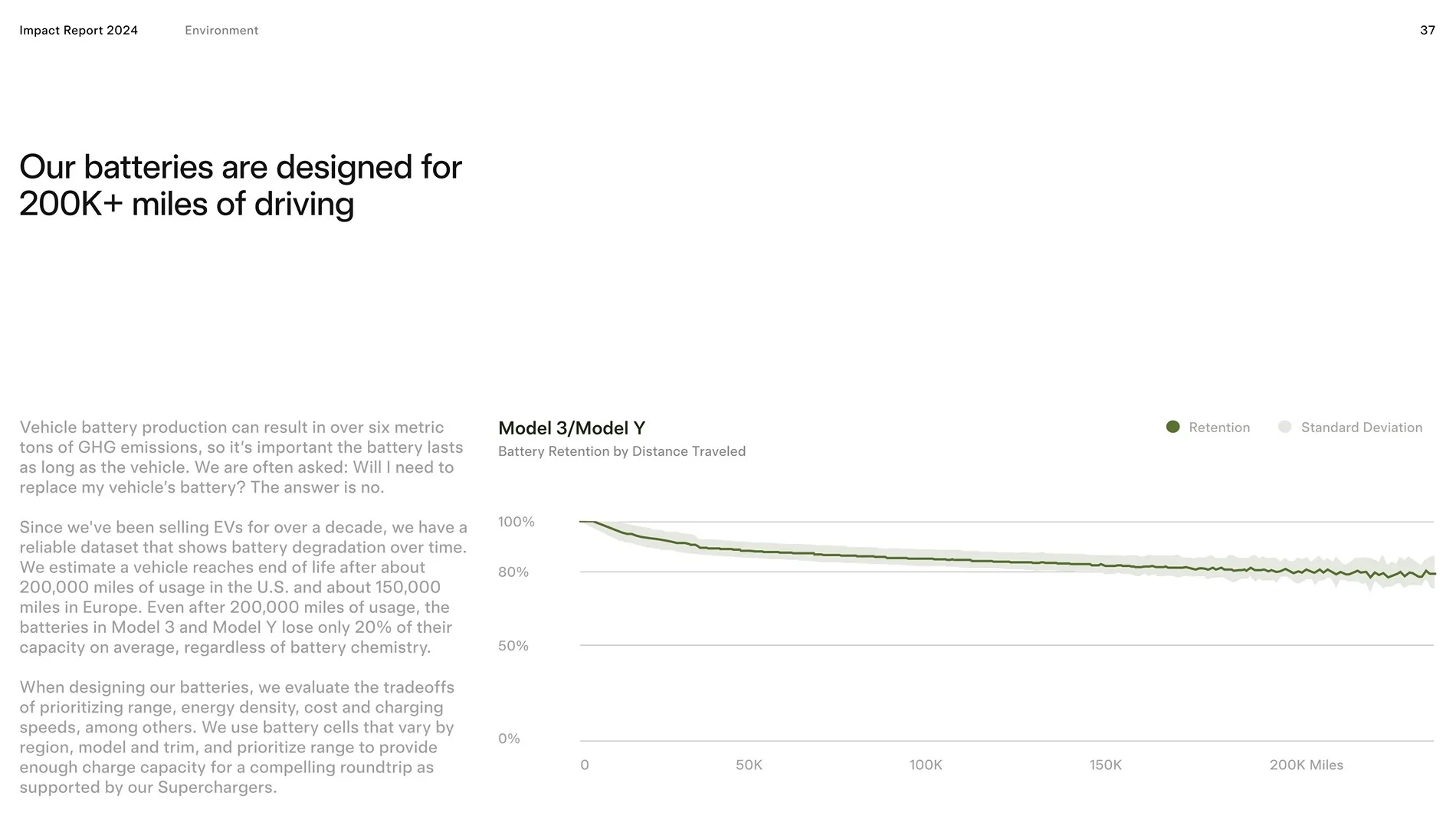
This chart is from Tesla, and it shows the steepest deg at the beginning, and then flattening over time. This is similar to many such charts. There is often a small flat spot at the start, which is due to the top buffer, which is due to manufacturing variances between battery cell suppliers. So, the EPA-rated size is smaller than the actual battery size to accommodate that variance, thus the chart shows a flat spot where the cells are above the EPA-rated size.
Tesla Cybertruck Losing Mileage per 80% Charge over Time Image 63

I imagine the same thing happens with the Cybertruck battery. Most deg will be in the first 6 months, and then a flattening. I would think your 5mi difference in the first 6mos is totally normal deg.

The number has nothing to do with your driving style. It's the BMS calculation of what it thinks is your battery size based upon average voltage. There can be error because it's an approximation.

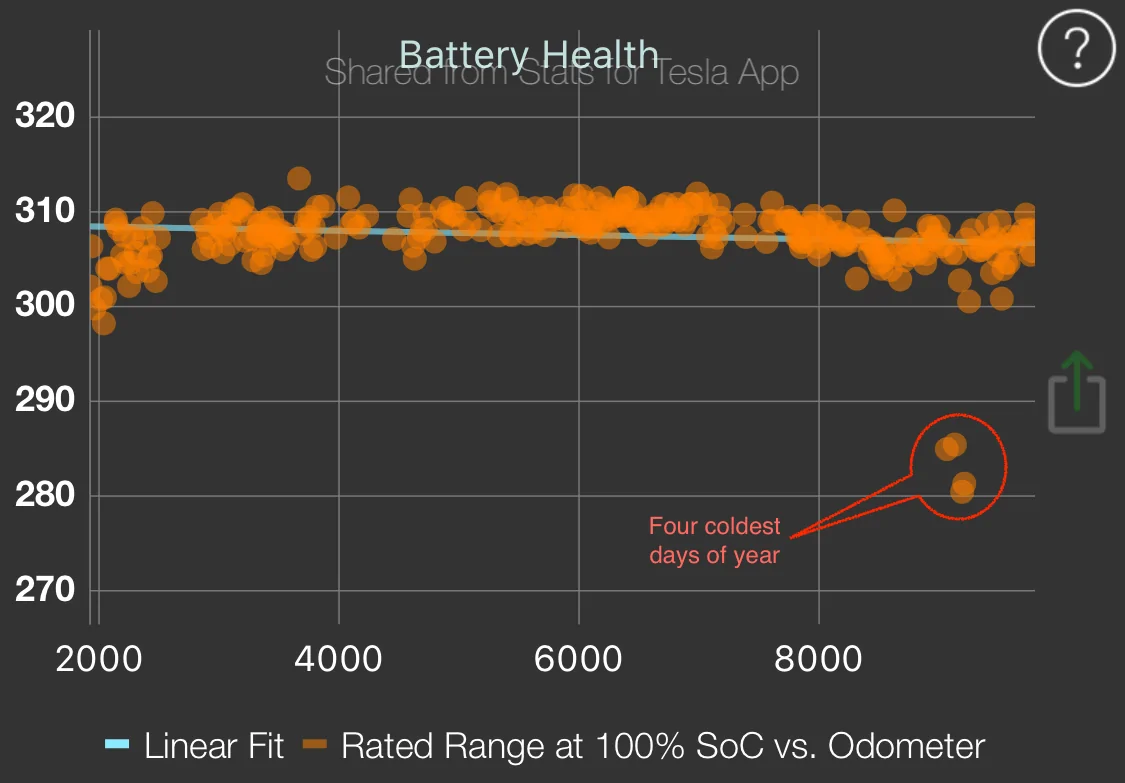
On my Model 3, there were two APIs that an app developer could use, one was temp-sensitive and one was not. So, battery sizes could vary if the app used the temp-sensitive one. For example, the Stats developer used the temp-sensitive one, and later switche
Tesla Cybertruck Losing Mileage per 80% Charge over Time File Mar 03, 2 25 17 PM
d to the one that was not. So, graphs that used to bounce around, started to flatten.

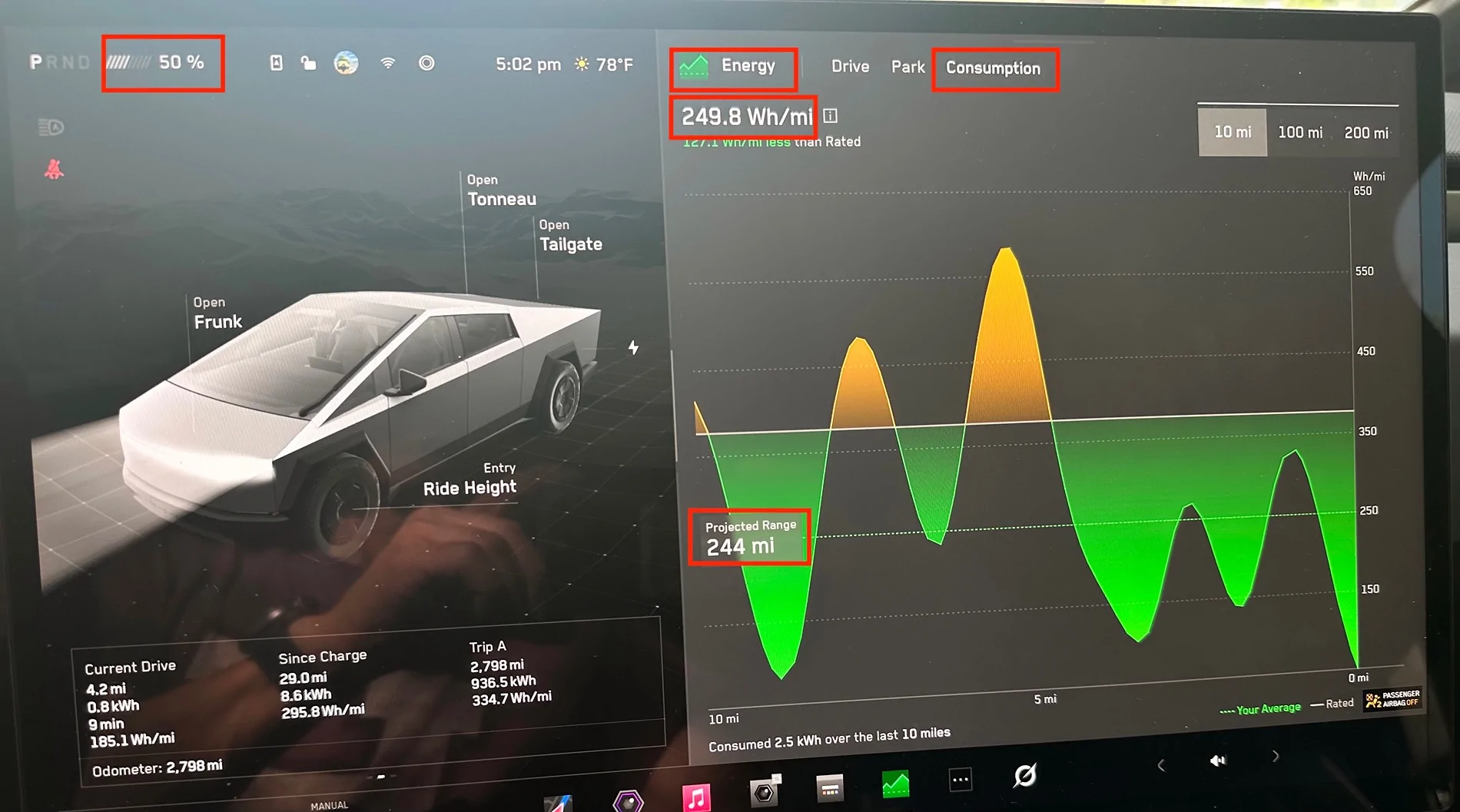
If you want to see what the CT's BMS calculates the size of your battery is, got to the Energy Consumption screen. Choose any range you like, 10mi, 100mi or 200mi, then multiply the efficiency by the projected range and divide by the current SOC %age. In the pictured example, multiply 249.8Wh/mi by 244mi. The units give you 60,951.2Wh. Divide that by 50% and I get 121.9kWh. There's rounding going on, since the divisor could be 49.51%, whic
Tesla Cybertruck Losing Mileage per 80% Charge over Time IMG_2189
h would make my estimated battery size 123.1kWh, or it could be 50.49% and 120.7kWh.
 
Last edited:

CyberGus

Well-known member
First Name
Gus
Joined
May 22, 2021
Threads
91
Messages
10,247
Reaction score
33,920
Location
Austin, TX
Vehicles
1981 DeLorean, 2024 Cybertruck
Occupation
IT Specialist
Country flag
If I understand your last comment accurately you are saying the best way to preserve battery life long term is to bounce between say 30% and 50% and charge more frequently vs. running it down and charging up to 80% less frequently? Am I understanding you correctly?
As a matter of best practices for battery health:

  • Lower state-of-charge (SoC) is better generally, but there's a significant bump around 55%. Stay below that when practical.
  • Shallow depth-of-discharge (DoD) is better; charge smaller amounts frequently.
  • Combat BMS drift by occasionally discharging below 10% and then charging to 100%. This will make range estimates more accurate.

That said, the BMS won't let you melt the pack. Do the opposite of the above, and you still won't get below the warranty threshold (70% capacity before 8 years), but you will lose total range a little quicker. The range will drop over time no matter what you do, but most packs will continue to be viable well beyond 200,000 miles.
Sponsored


Top