
Sponsored

YDR37
Well-known member
- Joined
- Dec 29, 2023
- Threads
- 26
- Messages
- 1,477
- Reaction score
- 2,415
- Location
- California
- Vehicles
- Tacoma

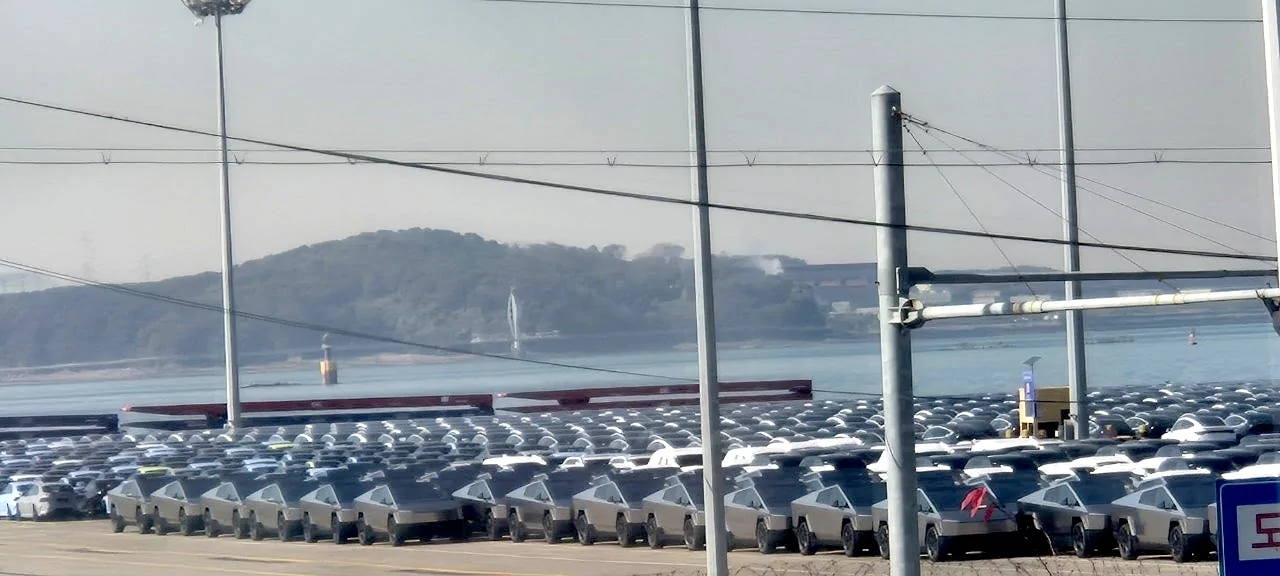
Tesla has already delivered the Cybertruck internationally to Canada and Mexico. So technically South Korea would be the first international deliveries outside of North America.Customer bound Cybertrucks have arrived at Pyeongtaek Port in South Korea! These will be the first international Cybertruck deliveries.
The South Korea order page says that deliveries will start in 4th Quarter 2025 "subject to change". But it seems like the timing probably won't change, since CTs have already arrived at the port.
Tesla is also accepting orders from Saudi Arabia, United Arab Emirates, and Qatar, with deliveries scheduled for February-March 2026.
No other countries can officially order CTs at this time. Of course, this hasn't stopped people from importing them to other countries unofficially.
YDR37
Well-known member
- Joined
- Dec 29, 2023
- Threads
- 26
- Messages
- 1,477
- Reaction score
- 2,415
- Location
- California
- Vehicles
- Tacoma
I believe South Korean Teslas and South Korean Superchargers all use NACS. CT should be the same. The South Korea accessories page offers adapters so Teslas can charge using J1772 and CCS Combo 1 chargers.Any word on the charging port?
Regarding the power outlets, there's a note that says: "The Cybertruck's outlets are different from the standard voltage in Korea, so you will need a universal voltage adapter or transformer" (Google Chrome translation).
Don't see any indication that South Korean CTs are any different from US CTs in these respects.
Setok
Well-known member
- Joined
- May 1, 2023
- Threads
- 8
- Messages
- 363
- Reaction score
- 568
- Location
- Finland
- Vehicles
- Land Rover Defender, Jeep Avenger EV, Tesla Model 3

Any word on the charging port in
But for the Cybertruck the prices are such that sales will probably be single digit monthly numbers so probably not worth any custom work (unless they started to put any serious consideration for international sales).
I think South Korea is CCS otherwise so if Teslas there use NACS, that would be pretty awkward and a bit odd.I believe South Korean Teslas and South Korean Superchargers all use NACS. CT should be the same. The South Korea accessories page offers adapters so Teslas can charge using J1772 and CCS Combo 1 chargers.
Regarding the power outlets, there's a note that says: "The Cybertruck's outlets are different from the standard voltage in Korea, so you will need a universal voltage adapter or transformer" (Google Chrome translation).
Don't see any indication that South Korean CTs are any different from US CTs in these respects.
But for the Cybertruck the prices are such that sales will probably be single digit monthly numbers so probably not worth any custom work (unless they started to put any serious consideration for international sales).
YDR37
Well-known member
- Joined
- Dec 29, 2023
- Threads
- 26
- Messages
- 1,477
- Reaction score
- 2,415
- Location
- California
- Vehicles
- Tacoma
NACS came late to South Korea, but its popularity has been growing. The ultimate outcome will probably depend on Hyundai Motor Group (which includes Kia and Genesis). Hyundai is definitely switching to NACS for the North American market; if they do the same in South Korea, then that will settle it.I think South Korea is CCS otherwise so if Teslas there use NACS, that would be pretty awkward and a bit odd.
Tesla's NACS Spreads to Charging Networks in South Korea
Brite Energy Partners’ Water charging network in South Korea has started deploying chargers equipped with Tesla-developed NACS charging connectors. It’s the first time we’ve heard about NACS chargers, other than Tesla Superchargers, in South Korea.
In the early years of modern electrification, South Korea followed Japan in using mainly the CHAdeMO standard. However, at some point, the country decided to shift to the Combined Charging System (CCS1), following the US. Because the EV industry in the US announced that it would switch to the Tesla-developed NACS (standardized as SAE J3400) in 2024, the support of the CCS1 in a small number of other countries, like South Korea, is questionable.
We have already seen the first signs of the adoption of the NACS in Japan, so the use of the NACS in non-Tesla EVs and chargers in South Korea would not be surprising. ...
It’s an open question whether we will see Hyundai and Kia switching to the NACS, not only in North America but also in its home market. It would simplify charging for South Korea’s largest automotive group. Having the first third-party networks with NACS chargers available would be an additional argument for making the switch.
Last edited:
Zane Edwards
Well-known member
- First Name
- ZMAN
- Joined
- Feb 18, 2024
- Threads
- 21
- Messages
- 424
- Reaction score
- 570
- Location
- California
- Vehicles
- Audi R8, BMW 4 Conv. MB GLS, Tesla CT AWD
- Occupation
- Exec
I remember when I saw my first CT on the road.....I flipped a u-turn and followed it for a bit....so amazing. Excited for S.Korea they will be experiencing that same ahh!!Customer bound Cybertrucks have arrived at Pyeongtaek Port in South Korea! These will be the first international Cybertruck deliveries.

YDR37
Well-known member
- Joined
- Dec 29, 2023
- Threads
- 26
- Messages
- 1,477
- Reaction score
- 2,415
- Location
- California
- Vehicles
- Tacoma
South Korea is not usually regarded as a big pickup market. From January to August 2025, there were 17,126 pickup sales, so they could maybe hit 25,000 to 30,000 for the full 2025 calendar year. That would be like 1% of the US pickup market.But for the Cybertruck the prices are such that sales will probably be single digit monthly numbers so probably not worth any custom work (unless they started to put any serious consideration for international sales).
The biggest sellers are the Kia Tasman and the KG Mobility Musso EV, which both sold over 6,000 units through August-September. Both models are noted for low prices:
For comparison, the AWD Cybertruck is priced at 145 million won, and the Cyberbeast at 160 million won (without the Luxe Package) -- roughly five times the starting cost for the smaller locally made options. At current exchange rates, the Tasman/Musso EV start at about $21,000, AWD CT at about $101,000, CB at $111,000.The biggest competitive edge of the two domestically produced pickup trucks is their "cost-effectiveness." Both new models start at a real purchase price in the 30 million Korean won range. They have superior price competitiveness compared to foreign models exceeding 60 million Korean won.
So I agree that Cybertruck sales in South Korea will be relatively low. A few hundred per year is maybe the best case.
WHIZZARD OF OZ
Well-known member
- First Name
- Ivan
- Joined
- Mar 11, 2021
- Threads
- 1
- Messages
- 2,288
- Reaction score
- 2,090
- Location
- Australia
- Vehicles
- VW Up!
- Occupation
- Electric Wheelchair Builder

Looks like it's Portside..... NACS!?!?Any word on the charging port?
Setok
Well-known member
- Joined
- May 1, 2023
- Threads
- 8
- Messages
- 363
- Reaction score
- 568
- Location
- Finland
- Vehicles
- Land Rover Defender, Jeep Avenger EV, Tesla Model 3
Nice work on pulling the statistics. Indeed, those prices really highlight the issue.South Korea is not usually regarded as a big pickup market. From January to August 2025, there were 17,126 pickup sales, so they could maybe hit 25,000 to 30,000 for the full 2025 calendar year. That would be like 1% of the US pickup market.
The biggest sellers are the Kia Tasman and the KG Mobility Musso EV, which both sold over 6,000 units through August-September. Both models are noted for low prices:
For comparison, the AWD Cybertruck is priced at 145 million won, and the Cyberbeast at 160 million won (without the Luxe Package) -- roughly five times the starting cost for the smaller locally made options. At current exchange rates, the Tasman/Musso EV start at about $21,000, AWD CT at about $101,000, CB at $111,000.
So I agree that Cybertruck sales in South Korea will be relatively low. A few hundred per year is maybe the best case.
The Musso EV is available here too and I kind of eyed it for a bit: the price is good. But the features aren’t quite where they need to be (ground clearance, towing). Also the Korean advanced driver distraction system is super bad and difficult to turn off. But it is a real contender. If the CT is costing something like 4 times as much, that’s just not going to fly.
Pickups are a small vehicle category everywhere except the US. Partly that is cost but a big part is that they’re just not that useful. They’re not as good offroad as a real 4x4 off-roader (Jeep, Land Rover) but also not as good at hauling stuff as a van. Even in towing the advantage isn’t so clear as the chunkier off-roaders can already tow the legal limit here (and can be modified to be light trucks and tow even more). For actual big work, commercial lorries are used, and a few commercial van platforms with beds. And American pickups are unnecessarily big.
I recently did a rough observational calculation that on the road here you will see 30 vans to 1 pickup. And 5 non-American type pickups to 1 American (on a good day).
I haven’t had any interest in pickups before. But the Cybertruck has a certain allure. Especially as there are basically no utilitarian EVs available here that can tow. That situation won’t last and the Musso is showing one path.
YDR37
Well-known member
- Joined
- Dec 29, 2023
- Threads
- 26
- Messages
- 1,477
- Reaction score
- 2,415
- Location
- California
- Vehicles
- Tacoma
My guess is that Tesla has no plans to ship Cybertrucks with anything other than NACS. The Cybertruck is only expected to sell at low volumes outside of North America (it's not exactly high volume even within North America). And in that case, it probably isn't worth the hassle of manufacturing them with different charging ports. Tesla will simply provide an appropriate adapter instead.Looks like it's Portside..... NACS!?!?
Tesla plans to start delivering CTs to Saudi Arabia, Qatar, and UAE early next year. Those countries have standardized on CCS2, and the Cybertruck order page for those countries says: "Chargeport includes CCS2 adapter." Don't expect to see a CT with a built-in CCS2 port.
Last edited:
YDR37
Well-known member
- Joined
- Dec 29, 2023
- Threads
- 26
- Messages
- 1,477
- Reaction score
- 2,415
- Location
- California
- Vehicles
- Tacoma
I'm in California, which is not typical of the US when it comes to the new vehicle market:That situation won’t last and the Musso is showing one path.
(1) In the US generally, only 8.4% of 2025 vehicle sales (through 3Q) were EVs. In California, that number was 21.1%. California buys more EVs than France.
(2) In most of the US, the top selling pickup is either the Ford F-150 or the Chevrolet Silverado. In California, the top-selling pickup is the Toyota Tacoma.
So Californians love EVs, and they love small pickups. Yet no one has ever tried selling a small EV pickup here. We don't get the Musso, or anything else.
Last edited:

Crissa
Well-known member
- First Name
- Crissa
- Joined
- Jul 8, 2020
- Threads
- 138
- Messages
- 19,571
- Reaction score
- 31,477
- Location
- Santa Cruz
- Vehicles
- 2014 Zero S, 2013 Mazda 3
...And we have more than twice the GDP of South Korea, thirteen times the GDP of Finland, and almost a quarter more than the GDP of France.I'm in California, which is not typical of the US when it comes to the new vehicle market:
(1) In the US generally, only 8.4% of 2025 vehicle sales (through 3Q) were EVs. In California, that number was 21.1%. California buys more EVs than France.
(2) In most of the US, the top selling pickup is either the Ford F-150 or the Chevrolet Silverado. In California, the top-selling pickup is the Toyota Tacoma.
So Californians love EVs, and they love small pickups. Yet no one has ever tried selling a small EV pickup here. We don't get the Musso, or anything else.
California is itself, a big market.
-Crissa
YDR37
Well-known member
- Joined
- Dec 29, 2023
- Threads
- 26
- Messages
- 1,477
- Reaction score
- 2,415
- Location
- California
- Vehicles
- Tacoma
2024 Tesla deliveries, global: 1,789,226California is itself, a big market.
2024 Tesla deliveries, California: 203,221 (about 11.4%)
Rough approximation, out of every 9 Teslas sold globally in 2024:
3 were sold in China
2 were sold in USA outside California
2 were sold in Europe/Middle East
1 was sold in California
1 was sold in Rest of World (mostly Canada, Mexico, Australia, Japan, South Korea, Taiwan)
Sponsored
Last edited:
Similar threads


- Replies
- 259
- Views
- 43,904
- Replies
- 35
- Views
- 10,714