Sponsored

funnbobby

Well-known member
First Name
Bob
Joined
Oct 25, 2025
Threads
4
Messages
191
Reaction score
190
Location
USA
Vehicles
2025 Cybertruck AWD
Country flag
Hogwash. 3 Tons is just fine, especially with a super stablilized jack with a jackstand built in, Teslas puny jack is way more dangerous, as it is much more of a point load and unstable.

The point is, you will be on the side of the road, maybe partially on dirt/grass, stability is important with a #7,000 truck.
That’s what I thought too. When it comes on Monday, I’m going to try it on the truck and see how hard it is to raise. And I’ll also get some tire plugs as suggested above.
Sponsored


mitch9

Well-known member
First Name
Mitch
Joined
Apr 19, 2021
Threads
2
Messages
211
Reaction score
370
Location
Boston, MA
Vehicles
2025 Dual Motor Cybertruck
Occupation
Engineer
Country flag
That’s what I thought too. When it comes on Monday, I’m going to try it on the truck and see how hard it is to raise. And I’ll also get some tire plugs as suggested above.
I have this tire repair kit, again from Amazon, $20.. we are now up to $110, add in the lug wrench for $20 and an entire box of gloves for $10, we have not passed $150, 1/2 the price of Teslas kit, use that extra $ to get yourself a nice portable inflator (well good ones are more than $150, this one is $170)
now your up to $320, but more capability than the Tesla kit

Repair Kit
https://www.amazon.com/dp/B07F31J7S9?ref=ppx_yo2ov_dt_b_fed_asin_title&th=1

Tire Inflator
https://www.amazon.com/dp/B0CQK4SRD8?ref=ppx_yo2ov_dt_b_fed_asin_title
 

AverageLogic

Well-known member
First Name
Leslie
Joined
Mar 13, 2024
Threads
6
Messages
56
Reaction score
132
Location
Oceanside, CA
Vehicles
Model Y,Model 3 (sold), CT RN1130****
Occupation
civil engineer
Country flag
It's a multi-part plan (in order):

1) While driving, know where my tires are, look where I'm going…..
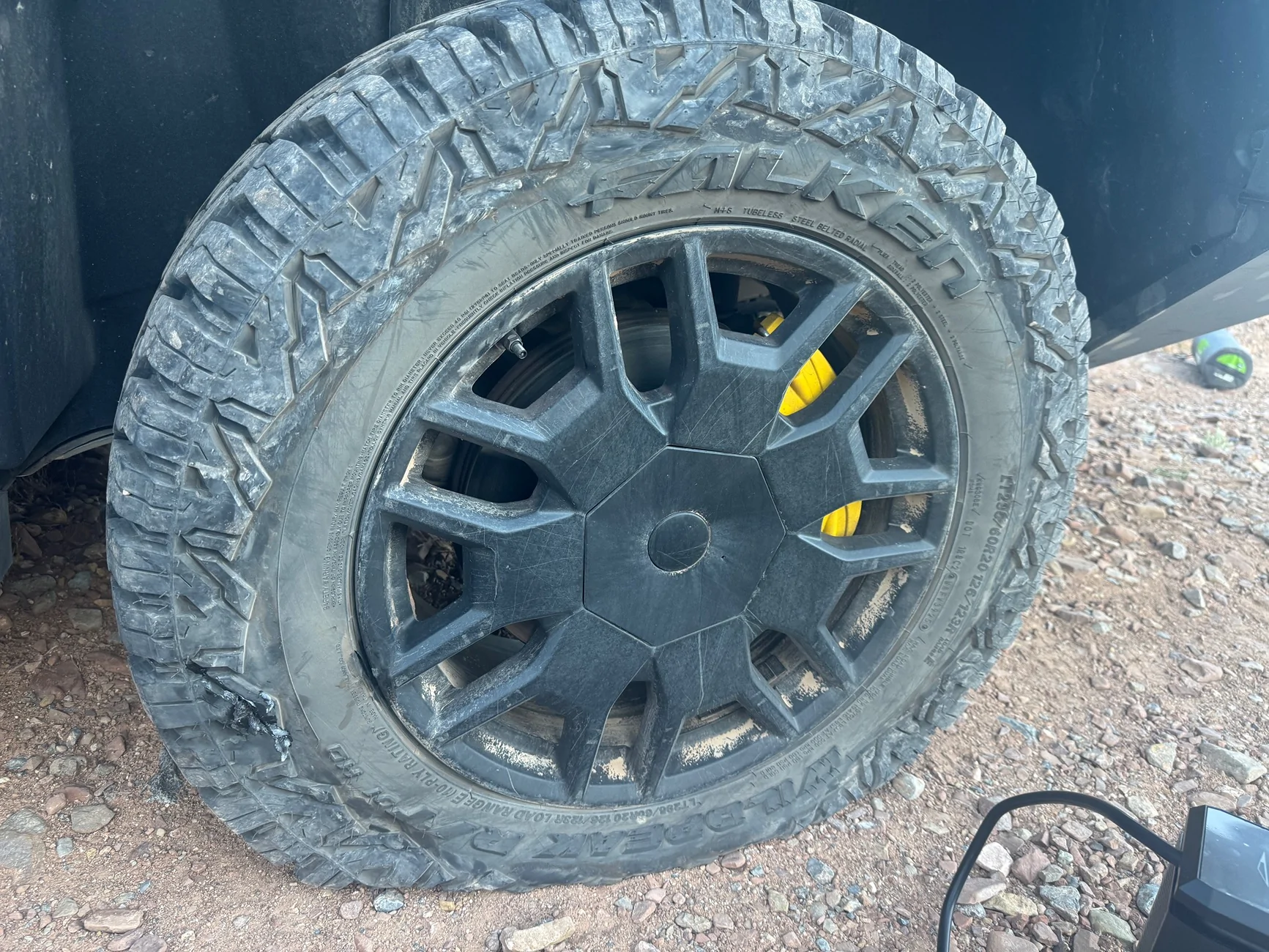
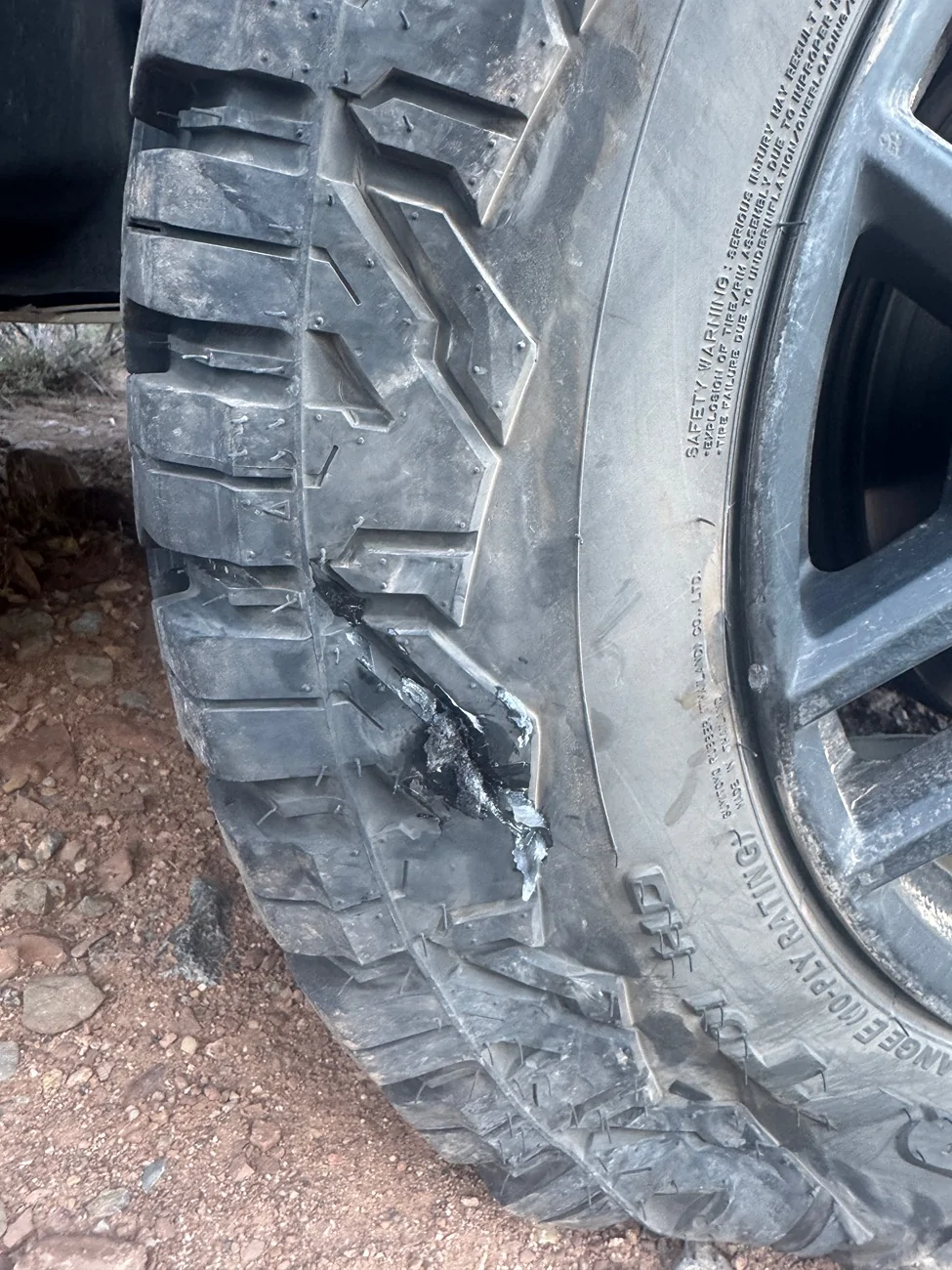
Two weeks ago, Spring Mountains, SW of Vegas, OnX level 5: I clearly didn’t know where my left rear tire was, or whatever tf gave it this brutal, unpatchable puncture.
There was also a secondary deep slice by the rim, presumably executed by the rim…
Plugging fail. Patching fail. Tesla spare tire and jack (and pump) for the win.
Tesla Cybertruck Cybertruck Tool Kit new in Tesla Shop IMG_8045


Tesla Cybertruck Cybertruck Tool Kit new in Tesla Shop IMG_8046
 

65SoYoLO

Well-known member
First Name
Keith
Joined
Feb 9, 2021
Threads
51
Messages
1,978
Reaction score
2,576
Location
Long Island NY
Vehicles
2024 CyberTruck
Occupation
Retired truck driver
Country flag
Two weeks ago, Spring Mountains, SW of Vegas, OnX level 5: I clearly didn’t know where my left rear tire was, or whatever tf gave it this brutal, unpatchable puncture.
There was also a secondary deep slice by the rim, presumably executed by the rim…
Plugging fail. Patching fail. Tesla spare tire and jack (and pump) for the win.
IMG_8045.webp


IMG_8046.webp
Ouch.
 

cyberjeff25

Well-known member
First Name
jeffrey
Joined
Sep 3, 2024
Threads
4
Messages
183
Reaction score
277
Location
temecula california
Vehicles
cyberbeast
Occupation
registerd investment advisor
Country flag
I just created a spare tire setup for my cybertruck -used wheel from eBay and than the least expensive new tire I could find, had it mounted and bal as need. Follow the directions on changing a tire - it says to turn on the tire change setting and put the car in maximum height. Problem is most bottle jacks can’t lift to the required height / my bet is this kit from Tesla can’t lift the truck high enough as well. I ended up adding a 2” this piece of laminated wood to provide a base which also helps if the truck is in dirt or sand.


Mikec3399

Well-known member
First Name
Michael
Joined
Dec 14, 2021
Threads
18
Messages
409
Reaction score
417
Location
Waterbury Connecticut
Vehicles
Cybertruck
Occupation
School Owner
Country flag
Harbor Freight 3-ton Bottle Jack, and a 1/2 drive Dewalt Impact tool and sockets, air pump, and Tire Patch kit. i just don't have a fancy case yet. less than half price
 

HaulingAss

Well-known member
Joined
Oct 3, 2020
Threads
28
Messages
10,298
Reaction score
20,705
Location
Western Washington, USA
Vehicles
Cybertruck DM, 2010 F-150, 2018 Performance Model 3, 2024 Performance Model 3
Country flag
Two weeks ago, Spring Mountains, SW of Vegas, OnX level 5: I clearly didn’t know where my left rear tire was, or whatever tf gave it this brutal, unpatchable puncture.
There was also a secondary deep slice by the rim, presumably executed by the rim…
Plugging fail. Patching fail. Tesla spare tire and jack (and pump) for the win.

Ouch! I've seen a big spike in sidewall cuts in the last couple of decades, ever since many people started routinely airing down well below what is required (or advisable) for the technical difficulty of the trail and the loaded vehicle weight. The more weight you pack (including spare wheel/tire/jack, etc), the less you should air down. Trust me, you don't need really low pressures for most stuff, just know where your tires are and pick good lines. I still don't understand this fetish with airing down below what is necessary to safely complete whatever terrain you're looking at. I think people are afraid of failing miserably if they don't air down enough. Which of course leads to unnecessary sidewall tire cuts. Or maybe they don't know how much to air down so they listen to people who want to sound like they know what they are talking about so they just quote some low numbers because it makes them sound hardcore and experienced. Some of these people get flat tires off-road all the time but apparently it's just part of the experience for them. If they aren't breaking things and failing, they are not having much fun. It's also possible they just haven't connected the dots yet (because they think it's always necessary to run lower pressures than really necessary)! In other words, they don't have any time with higher pressures to compare sidewall failure (cut) rates.

I don't like flats, even in a past life when I always carried a spare, so one of my goals is to complete the route without getting a flat. It's not that hard if you have the correct air pressure for the terrain challenges and loaded weight. Never go lower than you need to, especially if you are not travelling light. And relentlessly cut unnecessary weight. It all adds up and increases the chance of cuts and punctures. More importantly, pick lines that won't have your tires making slicing movements against sharp rocks. But it's still possible for shit to happen, even with skill and care, if the terrain is difficult enough. Plus, mistakes get made.

The part I don't understand is you had a sidewall cut and a spare tire and a jack but you thought you would try to plug it first, sidewall patch it second, and only use the spare if those two methods both failed? If I had decided to pack a spare and necessary tools, and I found myself in your shoes, I would have gone for the spare first (considering it was a pretty nasty sidewall cut and not a simple puncture). I'm guessing with that spare sitting on top of your bed topper, there wasn't much exigency to make the plugs (or the patch) work, the urgency or necessity simply didn't exist with that aired up spare staring down at you. I don't use patches, I think your best bet to fix it without the spare would have been with some creative plug use.

Of course, avoiding the sidewall cut to begin with is always preferable. It pays to get good at that.


HaulingAss

Well-known member
Joined
Oct 3, 2020
Threads
28
Messages
10,298
Reaction score
20,705
Location
Western Washington, USA
Vehicles
Cybertruck DM, 2010 F-150, 2018 Performance Model 3, 2024 Performance Model 3
Country flag
Follow the directions on changing a tire - it says to turn on the tire change setting and put the car in maximum height. Problem is most bottle jacks can’t lift to the required height / my bet is this kit from Tesla can’t lift the truck high enough as well. I ended up adding a 2” this piece of laminated wood to provide a base which also helps if the truck is in dirt or sand.
Exactly. You are expected to have/use suitable cribbing as needed. The reason to put the vehicle in maximum height mode is so your jack doesn't run out of available lift. As you jack the chassis up, the suspension will let the wheel(s) droop. The higher you set the air suspension, the less the wheel will "droop" as you jack the chassis higher.
 

AverageLogic

Well-known member
First Name
Leslie
Joined
Mar 13, 2024
Threads
6
Messages
56
Reaction score
132
Location
Oceanside, CA
Vehicles
Model Y,Model 3 (sold), CT RN1130****
Occupation
civil engineer
Country flag
Ouch! I've seen a big spike in sidewall cuts in the last couple of decades, ever since many people started routinely airing down well below what is required (or advisable) for the technical difficulty of the trail and the loaded vehicle weight. The more weight you pack (including spare wheel/tire/jack, etc), the less you should air down. Trust me, you don't need really low pressures for most stuff, just know where your tires are and pick good lines. I still don't understand this fetish with airing down below what is necessary to safely complete whatever terrain you're looking at. I think people are afraid of failing miserably if they don't air down enough. Which of course leads to unnecessary sidewall tire cuts. Or maybe they don't know how much to air down so they listen to people who want to sound like they know what they are talking about so they just quote some low numbers because it makes them sound hardcore and experienced. Some of these people get flat tires off-road all the time but apparently it's just part of the experience for them. If they aren't breaking things and failing, they are not having much fun. It's also possible they just haven't connected the dots yet (because they think it's always necessary to run lower pressures than really necessary)! In other words, they don't have any time with higher pressures to compare sidewall failure (cut) rates.

I don't like flats, even in a past life when I always carried a spare, so one of my goals is to complete the route without getting a flat. It's not that hard if you have the correct air pressure for the terrain challenges and loaded weight. Never go lower than you need to, especially if you are not travelling light. And relentlessly cut unnecessary weight. It all adds up and increases the chance of cuts and punctures. More importantly, pick lines that won't have your tires making slicing movements against sharp rocks. But it's still possible for shit to happen, even with skill and care, if the terrain is difficult enough. Plus, mistakes get made.

The part I don't understand is you had a sidewall cut and a spare tire and a jack but you thought you would try to plug it first, sidewall patch it second, and only use the spare if those two methods both failed? If I had decided to pack a spare and necessary tools, and I found myself in your shoes, I would have gone for the spare first (considering it was a pretty nasty sidewall cut and not a simple puncture). I'm guessing with that spare sitting on top of your bed topper, there wasn't much exigency to make the plugs (or the patch) work, the urgency or necessity simply didn't exist with that aired up spare staring down at you. I don't use patches, I think your best bet to fix it without the spare would have been with some creative plug use.

Of course, avoiding the sidewall cut to begin with is always preferable. It pays to get good at that.
Thanks for the constructive feedback. So, yeah the roof mounted tire isn’t a thing anymore, that was a short-lived experiment. My spare was in the truck bed, but it was covered in too much camping gear. It’s okay though, I’ve now got a little experience with my plug kit and the patch kit. I’m hella new to all this, so steep learning curve.
Interesting the conflicting advice. I do have folks pushing the nobody deflates enough pitch, and you saying the opposite. I instinctively lean your way and don’t deflate as much as those in my group. For the run this tire puncture occurred I was at 34-35 psi. The secondary slice at the rim supports your view that heavy deflating introduces its own set of issues.
 

SabrToothSqrl

Well-known member
Joined
Apr 1, 2026
Threads
2
Messages
120
Reaction score
176
Location
PA
Vehicles
CT Ordered | 2023 Y, X, Previous: 2013 S85, 2018 3, 2019X. 3 Wranglers, 2 Tahoes
Occupation
Cat Herder
Country flag
Well, y'all inspired me to test my 2 ton jack on my 10k trailer (with load).
It couldn't budge it. This is a jack usually used on cars for a quick lift.
I'd been packing it for years for a trailer where I have a spare, and tools to change it... and thought a 4,000lb jack could lift 1/4 tires on a 10k load... (it cannot).

My 3 ton jack struggles to get it up enough to put jacks under it for the winter.
Ordered this at $29. (8 ton)
https://www.amazon.com/dp/B08CS2W6F9
And it lifted the trailer axle just fine. Was able to spin the tire easily 3-4" off the ground, so if I get a flat now, I will be able to change it.

Still don't know why they bother selling 2,3,4, 6 etc ton when a 8ton is this inexpensive... I can only assume a 8ton jack can lift a 2 ton load...

Anyway, now I feel better prepared. thanks
 

HaulingAss

Well-known member
Joined
Oct 3, 2020
Threads
28
Messages
10,298
Reaction score
20,705
Location
Western Washington, USA
Vehicles
Cybertruck DM, 2010 F-150, 2018 Performance Model 3, 2024 Performance Model 3
Country flag
Still don't know why they bother selling 2,3,4, 6 etc ton when a 8ton is this inexpensive... I can only assume a 8ton jack can lift a 2 ton load...

Anyway, now I feel better prepared. thanks
They sell the jacks in a wide range of capacities to suit the application better. An 8-ton jack will require more pumping strokes for every inch of lift vs. a 2-ton jack.
 

HaulingAss

Well-known member
Joined
Oct 3, 2020
Threads
28
Messages
10,298
Reaction score
20,705
Location
Western Washington, USA
Vehicles
Cybertruck DM, 2010 F-150, 2018 Performance Model 3, 2024 Performance Model 3
Country flag
Interesting the conflicting advice. I do have folks pushing the nobody deflates enough pitch, and you saying the opposite.
That conflicting advice is easily explainable, it has to do with whether you value more climbing performance at the expense of reliability (cuts, punctures, pinched sidewalls, de-beadings). If you need the climbing performance, you need it. If you don't, you really don't. That's why I always say to only air down as much as needed.

If you are on relatively level deep sand or old snowpack, you can afford to deflate more. Here's why:

1) You probably actually need the additional floatation.

2) The sidewalls will bulge out, providing more floatation but the sand or snow is not going to cut or puncture your tire, it will actually support it. When the sidewalls bulge out on rocky terrain they present themselves to sharp rocks. And since the pressure is low, they deform around that rock and hold it captive (giving it more chance to penetrate the cords, especially if that tire is heavily loaded). This deforming around rocks is the same mechanism that gives you more traction, but it comes at a steep potential cost.

3) The nature of more level terrain with sand or snow is the vehicles weight is more evenly distributed between all four tires. On steep, rocky, uneven terrain, you will run into situations where 50-75% of the weight of the entire vehicle is on ONE tire! That is asking a hella lot of the tire that has most of the weight of the vehicle on it, especially if you've aired it down far below spec. And in these situations there is always a strong side component to the load. That makes it want to slip, it makes it want to de-bead, the side load and extreme weight on that one tire makes it want to pinch the tire against the rim. That is also the tire you will be relying on for most of your climbing drive (since it is the most loaded with weight) which energy (torque from the motor) can be used by a rock (in addition to the weight loading) to penetrate the cords. With more tire pressure there is less sidewall bulge and less sidewall compliance, making it more difficult for the sharp rock to gain purchase on the sidewall.

Some off-roaders will never forget the night and day difference that airing down in deep sand or old snowpack makes on capability, it's like a drug they can't resist, even when they don't need it and even when the terrain is such that airing down more greatly increases the chances of sidewall penetration, sidewall pinches, etc. Even on steep rocky terrain airing down makes a noticeable performance difference (but the terrain has to be very difficult for excessive airing down to be necessary simply to safely navigate the terrain). The Cybertruck, with it's dual locking differentials and exceptional electronic traction controls and fine throttle control and four-wheel steering can navigate some pretty gnarly stuff just fine without airing down to the pressures many ICE off-roaders use. It's just that much more capable of finding traction and putting your tires where you want them.

And the more miles a tire is driven on easy terrain when aired down more than necessary, the more the non-stretchy fibers embedded in the rubber flex and get fatigue fractures. This is a very real thing. Over time this makes it easier for rocks to penetrate the weakened fibers. It might seem like a PITA to air up or down more than once on an outing, but it's actually easier and more enjoyable to set the needed pressure for different terrain than it is to repair/replace flat tires. It's also more cost effective. You will find that most common terrain can be safely navigated with the full 50 psi although I like to air down moderately to 40 psi as a matter of course if I know I won't be exceeding ~40 mph for extended periods of time. You don't want to build heat in your tires, especially during warm/hot weather. This is when I'm lightly loaded. If near the rear axle rating (which corresponds to something like ~1800 lbs. of additional weight centered over the rear axle), I would be even more reluctant to air down, all in the name of reducing tire failure.


I instinctively lean your way and don’t deflate as much as those in my group. For the run this tire puncture occurred I was at 34-35 psi. The secondary slice at the rim supports your view that heavy deflating introduces its own set of issues.
Here's the thing; Tire pressure is always specified cold. A tire that has been driven significant distance, especially if it's out in the sun, easily gains 4-5 psi over the stone cold pressure. I've noticed most people who air down at the beginning of a trail fail to account for this 4-5 psi difference. They are essentially using a hot tire pressure. They may think they only aired down to 34 psi when they are actually at 29 psi cold.

I've avoided getting deep into what pressures to run because it really depends upon how much gear you've packed, the temperature (I typically run a bit lower in the cold, but not into de-beading territory), the terrain (how much do you really need to air down), and how much you value a bit more performance for a much higher chance of tire failure. I air down to 40 psi (cold pressure) as a matter of course, because my rig is lightly loaded, speeds will be moderate, and I want a little more tire compliance (mostly for comfort, but also for performance). For me to go below that in a Cybertruck, I need a good reason. There is a huge difference between 40 psi cold and 34 psi hot (in terms of how vulnerable your tires are when loaded on rocky terrain). I've been to 29 psi (cold) in deep snowpack but not as a matter of course, because I needed it. I was prepared to go lower if needed as the snow continued to soften through the day (but I didn't need to). But I would never drive a Cybertruck on rocky terrain with only 29 psi cold, especially with a heavy load, for reasons of tire reliability and care, unless I had gotten myself into a situation that required it, perhaps to increase safety. Even that is suspect because there is nothing safe about de-beading a tire when the rig has roll-over exposure. The Cybertruck is not a rock-crawler, especially one loaded with all kinds of gear. Easy to moderate trails can be done all day long with more pressure than most people run. The Cybertruck makes it easy.

With a bed topper, spare and jack, extensive camping gear (maybe a heavy powerbank), you run a considerably heavier rig than I do. Weight up high (like the topper) causes more weight transfer to a single tire when the terrain is steep or has a side camber. Off-roading is all about physics and geometry (driver skill simply harnesses those principles). The more the weight of the rig, and the physics of where that weight is located, work against you, the higher the tire pressure you should run to increase tire reliability and respect the tire.

I often off-road and explore solo, or just me and my wife or a friend, with no other backup support vehicles. That means I value and respect the reliability of my tires. That, in turn, means I'm very unlikely to get a flat, even when the terrain is steep, uneven, and there are loose sharp rocks. That's just the way I roll, and why I don't feel the need to carry a spare (the weight of which, ironically, makes it slightly more likely to need to use it). Weight matters.
Sponsored


Top