
Sponsored

SPECIAL EDITION QUAD-MOTOR Cybertruck rumor

Status
Not open for further replies.

Crissa

Well-known member
First Name
Crissa
Joined
Jul 8, 2020
Threads
138
Messages
19,571
Reaction score
31,475
Location
Santa Cruz
Vehicles
2014 Zero S, 2013 Mazda 3
Country flag
...Isn't why I mentioned range.

Different torque curves for parallel motors means different energy inputs for different top speeds. That means increased range at speed.

Being able to also use less motor at the low end is just more variables for traction control accuracy.

-Crissa
Sponsored

 

CappyJax

Well-known member
Joined
Aug 2, 2020
Threads
4
Messages
137
Reaction score
100
Location
Bakersfield, Ca
Vehicles
Subaru Forester
Occupation
Pilot
Country flag
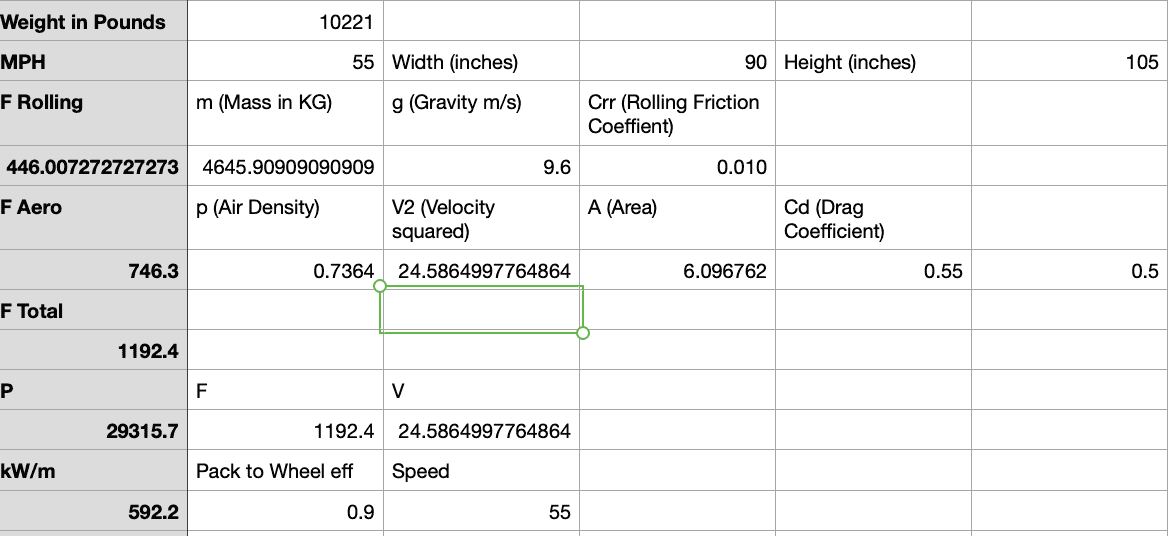
Are you saying your spreadsheet predicted that at 55mph the results would be:
335Wh/mi for Tesla Model X 5,421 lb (2,459 kg)
and
800Wh/mi for Tesla Model X LR+ 5,421 lb (2,459 kg) + Apex Nano 194bhs 22-ft 4,800lbs
Tesla Cybertruck SPECIAL EDITION QUAD-MOTOR Cybertruck rumor Screen Shot 2020-11-21 at 12.23.56 AM
 

firsttruck

Well-known member
Joined
Sep 25, 2020
Threads
205
Messages
2,761
Reaction score
4,441
Location
mx
Vehicles
none
Country flag
Tesla Model X LR+, 100 kwh, 5,421 lb (2,459 kg), 350 miles range
2018 Airsteam Bambi 22', 4,500lbs, 55mph, 489 wh/mi, 177 mi between charge
Able to go about 50 more miles before having to charge using Airstream Bambi.
50% range increase.
489 Wh/mi for Tesla Model X LR+ 5,421 lb (2,459 kg) + Airsteam Bambi 22', 4,500lbs

So how does spreadsheet explain a huge 300 Wh/mi drop in energy use for a trailer that is only 300 lbs lighter in weight?
 

ajdelange

Well-known member
First Name
A. J.
Joined
Dec 8, 2019
Threads
4
Messages
3,203
Reaction score
3,409
Location
Virginia/Quebec
Vehicles
Tesla X LR+, Lexus SUV, Toyota SR5, Toyota Landcruiser
Occupation
EE (Retired)
Country flag
Not very adequately. The trailer's mass related loads are complicated in that they can range from very small (appearing only through rolling resistance) to the largest loads depending on terrain and whether you use the brakes (trailer and tow vehicle) or not. Whether you use the brakes or not depends on the speed profile you must follow (I say "must" because if you come round a corner to find yourself behind a vehicle going 20 mph slower than you are you must apply the brakes).

This means that isolated, single calculations, such as come from spreadsheets are usually grossly inadequate for analyzing what to expect when towing. You need a model that follows the dynamics of a drive. If, towing a 4500 lb trailer at 60 for example, you accelerate on the freeway to 60 mph, maintain 60 mph (26.8 m/s) for an hour on level terrain and then coast to a stop your inertial utilization is 0 Wh/mi irrespective of mass. The rolling resistance would consume about 180 Wh/mi. If you must slow from 60 to 40 for traffic or whatever 113.5 watt hours fly off as heat and must be replaced by the battery. If you do that once per mile the driving dynamics add 113.5 Wh/mi for the trip. Changing the weight by 300 pounds would not change the inertial load in the first case but it would increase the rolling load by 12 Wh/mi. In the dynamic case ± 300 pounds would change the load by ±7.6 Wh per cycle and add ± 7.7 Wh/mi if you must cycle once per mile.

Of course this leaves the question as to how we predict trailering performance. About the best I can come up with is to run multiple Monte Carlos using randomly generated speed profiles which, we hope, at least grossly approximate the speed profiles we will actually encounter and look at the statistics from those runs. Those familiar with modeling will know that one adjusts the parameters of the model until he gets the answer he wants so I won't go into any numbers here.

All of this ultimately comes down to the simple fact that you will get what you will get when towing a trailer with the broad observation that you ought not to count on more than half the non towing range. It is also clear that you will get more range by driving at slow, uniform speed.
 
Last edited:

firsttruck

Well-known member
Joined
Sep 25, 2020
Threads
205
Messages
2,761
Reaction score
4,441
Location
mx
Vehicles
none
Country flag
Not very adequately. The trailer's mass related loads are complicated in that they can range from very small (appearing only through rolling resistance) to the largest loads depending on terrain and whether you use the brakes (trailer and tow vehicle) or not. Whether you use the brakes or not depends on the speed profile you must follow (I say "must" because if you come round a corner to find yourself behind a vehicle going 20 mph slower than you are you must apply the brakes).

This means that isolated, single calculations, such as come from spreadsheets are usually grossly inadequate for analyzing what to expect when towing. You need a model that follows the dynamics of a drive. If, towing a 4500 lb trailer at 60 for example, you accelerate on the freeway to 60 mph, maintain 60 mph (26.8 m/s) for an hour on level terrain and then coast to a stop your inertial utilization is 0 Wh/mi irrespective of mass. The rolling resistance would consume about 180 Wh/mi. If you must slow from 60 to 40 for traffic or whatever 113.5 watt hours fly off as heat and must be replaced by the battery. If you do that once per mile the driving dynamics add 113.5 Wh/mi for the trip. Changing the weight by 300 pounds would not change the inertial load in the first case but it would increase the rolling load by 12 Wh/mi. In the dynamic case ± 300 pounds would change the load by ±7.6 Wh per cycle and add ± 7.7 Wh/mi if you must cycle once per mile.

Of course this leaves the question as to how we predict trailering performance. About the best I can come up with is to run multiple Monte Carlos using randomly generated speed profiles which, we hope, at least grossly approximate the speed profiles we will actually encounter and look at the statistics from those runs. Those familiar with modeling will know that one adjusts the parameters of the model until he gets the answer he wants so I won't go into any numbers here.

All of this ultimately comes down to the simple fact that you will get what you will get when towing a trailer with the broad observation that you ought not to count on more than half the non towing range. It is also clear that you will get more range by driving at slow, uniform speed.
Most of what you posit does not apply.
The real world tests were done at a steady 55 mph speed on level highway, not extended stop & go in town. There are no large hills or mountains.
They are already slowest speed on the highway because they are only going 55mph. If they go slower because the vehicle in front was even slower their energy usage would drop because there is even less drag and get some regen during the initial slowing process.

Also the factors you mention should increase the energy use (wh/mi) so the spreadsheet prediction of 840 wh/mi should be the low value not the high value.

If the spreadsheet worked properly you could not get such different energy use (wh/mi) differences for minor 300lbs weight reduction on a 10,200 combined weight at steady 55 mph speed.

His spreadsheet does not seem to be accurate.

Seeing what the spreadsheet predicts with this real world example:

Tesla Model X LR+, 100 kwh, 5,421 lb (2,459 kg), 350 miles range
2018 Airsteam Bambi 22', 4,500lbs, 55mph, 489 wh/mi, 177 mi between charge

might help determine where the spreadsheet errors are.
 
Last edited:


ajdelange

Well-known member
First Name
A. J.
Joined
Dec 8, 2019
Threads
4
Messages
3,203
Reaction score
3,409
Location
Virginia/Quebec
Vehicles
Tesla X LR+, Lexus SUV, Toyota SR5, Toyota Landcruiser
Occupation
EE (Retired)
Country flag
Most of what you posit does not apply.
All of what I posited applies. You asked where the errors in his spreadsheet lie. I answered that the problem cannot be solved with a spreadsheet and why.

The real world tests were done at a steady 55 mph speed on level highway, not extended stop & go in town. There are no large hills or mountains.
They are already slowest speed on the highway because they are only going 55mph. If they go slower because the vehicle in front was even slower their energy usage would drop because there is even less drag and get some regen during the initial slowing process.
One of the most significant things about towing is that you DON'T get regen. The returned kinetic and potential energies are absorbed by the trailer brakes - not the tow vehicle battery. But if you never decelerate faster than drag and rolling resistance decelerate you that doesn't matter because that energy does "userful" work i.e. overcome drag and rolling resistance. The basic principle is that at constant speed, if the trailer brakes do not come on, mass only matters a little bit through rolling resistance whether that speed be 55 or 60 so evidently you are not following what I posted. You can either go back and re read my post in the hope that you will understand it or realize that it is more complicated than you think, accept that and forget about it.


If the spreadsheet worked properly you could not get such different energy use (wh/mi) differences for minor 300lbs weight reduction on a 10,200 combined weight at steady 55 mph speed.
If the spreadsheet worked properly the difference for 300 lbs would be m*g*f = (300/2.2)*9.8*0.009 = 12 Wh/mi irrespective of speed assuming the coefficient is 0.009 which is representative. This is the rolling resistance difference. There is no difference in inertial load at constant speed if you (or rather if the trailer) doesn't use the brake. If you do the inertial load depends on how you use the brake. That's the physics. Don't model those physics and you don't get the right answer. As you can't model the dynamics of brake use (unless you want to get into Visual Basic programming) in a spread sheet the problem with a spread sheet is that it is not adequate for this problem. I said all this before so my best advice to you at this point is to go back to my previous post and read it for understanding.


His spreadsheet does not seem to be accurate.
It can't be. You cannot predict the stock market by looking at pigeon entrails and you can't predict trailering performance with a spreadsheet beyond making some rough calculations that must be applied quite broadly.

I actually simplified the problem quite a bit. There are losses that depend on the power consumption so you must solve an equation (though it is a linear one) to determine what the actual power consumption is. Thus this problem is to a layman not a trivial problem. If you have training/experience in math, physics, engineering, statistics etc. I can explain it pretty simply but if you don't I can't. And keep in mind GIGO (Garbage In, Garbage Out). It's pretty easy to come up with a fairly robust model of how the various loads sink power but unless you have a good parametric description of each load and of the speed profile you want to study you cannot get an accurate prediction. As it is impossible to have any of that at this point we really can't say more than "Drive slow at uniform speed, don't brake, put as much load in the truck as you can and you'll get about 50%.
 
Last edited:

ajdelange

Well-known member
First Name
A. J.
Joined
Dec 8, 2019
Threads
4
Messages
3,203
Reaction score
3,409
Location
Virginia/Quebec
Vehicles
Tesla X LR+, Lexus SUV, Toyota SR5, Toyota Landcruiser
Occupation
EE (Retired)
Country flag
We wonder how Rivian (quad motor), for example, will handle a single motor failure.

[Edit]I sent them an e-mail in which I asked that question but won't hear back until next week.
We got an answer from Rivian but we are still wondering. The respondent said she would have to research that question with the engineering team.
 

CappyJax

Well-known member
Joined
Aug 2, 2020
Threads
4
Messages
137
Reaction score
100
Location
Bakersfield, Ca
Vehicles
Subaru Forester
Occupation
Pilot
Country flag
Most of what you posit does not apply.
The real world tests were done at a steady 55 mph speed on level highway, not extended stop & go in town. There are no large hills or mountains.
They are already slowest speed on the highway because they are only going 55mph. If they go slower because the vehicle in front was even slower their energy usage would drop because there is even less drag and get some regen during the initial slowing process.

Also the factors you mention should increase the energy use (wh/mi) so the spreadsheet prediction of 840 wh/mi should be the low value not the high value.

If the spreadsheet worked properly you could not get such different energy use (wh/mi) differences for minor 300lbs weight reduction on a 10,200 combined weight at steady 55 mph speed.

His spreadsheet does not seem to be accurate.

Seeing what the spreadsheet predicts with this real world example:

Tesla Model X LR+, 100 kwh, 5,421 lb (2,459 kg), 350 miles range
2018 Airsteam Bambi 22', 4,500lbs, 55mph, 489 wh/mi, 177 mi between charge

might help determine where the spreadsheet errors are.
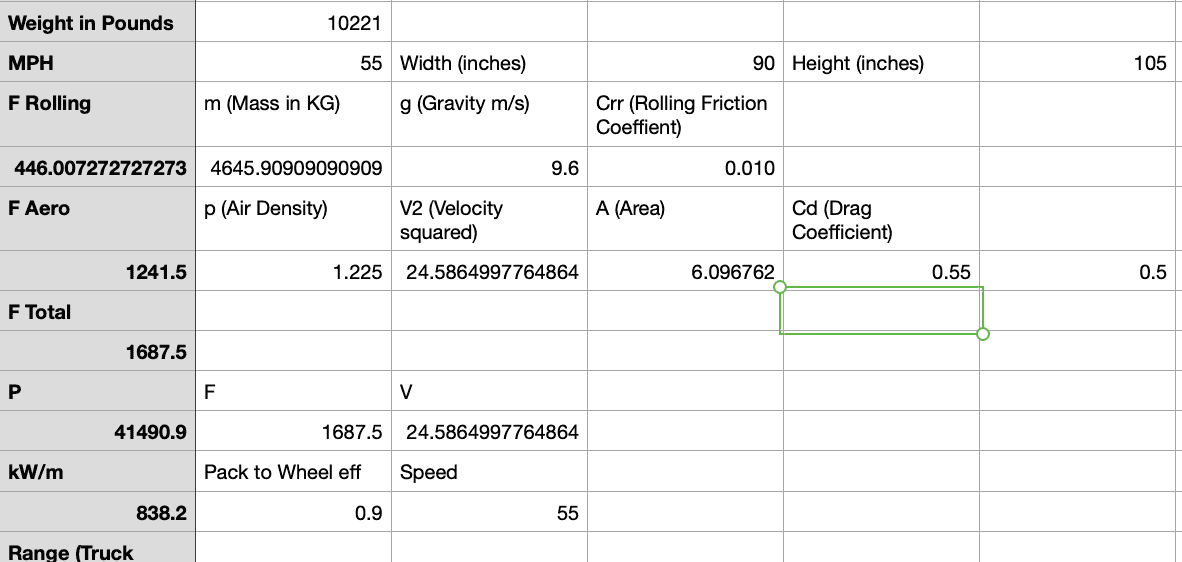
Here are the exact same calculations at 5,000 foot altitude. There is a 233Wh/mile difference from sea level. So you see, unless your references start listing altitude, temperature, headwind/tailwind component, the average grade of the drive, the type of tires, the material of the roadway, and whether or not they had the windows down or the heat pump/AC on, your numbers are completely and entirely worthless for determining the energy consumption when towing with an EV.

The spreadsheet gives a baseline, nothing more, nothing less.
Tesla Cybertruck SPECIAL EDITION QUAD-MOTOR Cybertruck rumor Screen Shot 2020-11-21 at 11.59.40 AM
 

CappyJax

Well-known member
Joined
Aug 2, 2020
Threads
4
Messages
137
Reaction score
100
Location
Bakersfield, Ca
Vehicles
Subaru Forester
Occupation
Pilot
Country flag
All of what I posited applies. You asked where the errors in his spreadsheet lie. I answered that the problem cannot be solved with a spreadsheet and why.

One of the most significant things about towing is that you DON'T get regen. The returned kinetic and potential energies are absorbed by the trailer brakes - not the tow vehicle battery. But if you never decelerate faster than drag and rolling resistance decelerate you that doesn't matter because that energy does "userful" work i.e. overcome drag and rolling resistance. The basic principle is that at constant speed, if the trailer brakes do not come on, mass only matters a little bit through rolling resistance whether that speed be 55 or 60 so evidently you are not following what I posted. You can either go back and re read my post in the hope that you will understand it or realize that it is more complicated than you think, accept that and forget about it.


If the spreadsheet worked properly the difference for 300 lbs would be m*g*f = (300/2.2)*9.8*0.009 = 12 Wh/mi irrespective of speed assuming the coefficient is 0.009 which is representative. This is the rolling resistance difference. There is no difference in inertial load at constant speed if you (or rather if the trailer) doesn't use the brake. If you do the inertial load depends on how you use the brake. That's the physics. Don't model those physics and you don't get the right answer. As you can't model the dynamics of brake use (unless you want to get into Visual Basic programming) in a spread sheet the problem with a spread sheet is that it is not adequate for this problem. I said all this before so my best advice to you at this point is to go back to my previous post and read it for understanding.


It can't be. You cannot predict the stock market by looking at pigeon entrails and you can't predict trailering performance with a spreadsheet beyond making some rough calculations that must be applied quite broadly.

I actually simplified the problem quite a bit. There are losses that depend on the power consumption so you must solve an equation (though it is a linear one) to determine what the actual power consumption is. Thus this problem is to a layman not a trivial problem. If you have training/experience in math, physics, engineering, statistics etc. I can explain it pretty simply but if you don't I can't. And keep in mind GIGO (Garbage In, Garbage Out). It's pretty easy to come up with a fairly robust model of how the various loads sink power but unless you have a good parametric description of each load and of the speed profile you want to study you cannot get an accurate prediction. As it is impossible to have any of that at this point we really can't say more than "Drive slow at uniform speed, don't brake, put as much load in the truck as you can and you'll get about 50%.
Physics and the stock market are not comparable. One is quantifiable, the other is speculative. The parameters that are contained in the spreadsheet give a baseline, nothing more, nothing less.
 

firsttruck

Well-known member
Joined
Sep 25, 2020
Threads
205
Messages
2,761
Reaction score
4,441
Location
mx
Vehicles
none
Country flag
Here are the exact same calculations at 5,000 foot altitude. There is a 233Wh/mile difference from sea level. So you see, unless your references start listing altitude, temperature, headwind/tailwind component, the average grade of the drive, the type of tires, the material of the roadway, and whether or not they had the windows down or the heat pump/AC on, your numbers are completely and entirely worthless for determining the energy consumption when towing with an EV.

The spreadsheet gives a baseline, nothing more, nothing less.
Screen Shot 2020-11-21 at 11.59.40 AM.png
In previous comments nobody mentioned altitude. What was repeatedly mentioned was steady speed 55 mph, no hills/no mountains. Why do you bring up altitude now. Assumption is sea level. Did you put in altitude 5,000 ft before?
We already mentioned grade (no hills / no mountains) so why now claim it is unknown.
When you did previous spreadsheet you said nothing about temp & wind. I assumed you would using a normal temp (70F) and no wind. So were you using different values?
In previous you made assumptions about tires & roadway. I said 55mph on highway. I assumed you where using reasonable assumptions about U.S. highways not a dirt road in middle of the Baja.

You made repeated assertions about Cybertruck tri-motor 500 mi towing 14,000 pounds would have much much less than 250 mi towing range. You told us your spreadsheet prediction of Cybertruck towing of 2,000 wh/mi was informative but now claim there are too many variables for you to match simple real world existing vehicles in pretty standard environments that thousands of people drive in every weekend during summer vacation season.
 
Last edited:


firsttruck

Well-known member
Joined
Sep 25, 2020
Threads
205
Messages
2,761
Reaction score
4,441
Location
mx
Vehicles
none
Country flag
"Tesla Model X LR+, 100 kwh, 5,421 lb (2,459 kg), 350 miles range
2021 Apex Nano 194bhs 22', 4,800lbs, 55mph, 800 wh/mi 108 mi between charge"

An increase from 335Wh/mi to 800Wh/mi from a 4,800 pound trailer with a frontal area of 74 sq/ft would mean that a fifth wheel that weighs nearly 3 times as much with a frontal area of 110 sq/ft is going to us a heck of a lot more energy.
I never said frontal area is 75sq/ft ball hitch travel trailer vs 110sq/ft for 5th wheel.
Where do you get those numbers?

My assertion is that both trailers have similar frontal area but 5th wheel is closer to Cybertruck so the cD will effectively be less than that of ball hitch travel trailer.
Studies from trucking industry confirm that the size of gap between tractor and trailer is significant.

Here is a simple example for rv trailer
difference in cD ( coefficient of drag ) based on tow vehicle to trailer gap
https://teslamotorsclub.com/tmc/threads/ohmmans-airstream-adventures.83350/#post-1893394
 

CappyJax

Well-known member
Joined
Aug 2, 2020
Threads
4
Messages
137
Reaction score
100
Location
Bakersfield, Ca
Vehicles
Subaru Forester
Occupation
Pilot
Country flag
In previous comments nobody mentioned altitude. What was repeatedly mentioned was steady speed 55 mph, no hills/no mountains. Why do you bring up altitude now. Assumption is sea level. Did you put in altitude 5,000 ft before?
We already mentioned grade (no hills / no mountains) so why now claim it is unknown.
When you did previous spreadsheet you said nothing about temp & wind. I assumed you would using a normal temp (70F) and no wind. So were you using different values?
In previous you made assumptions about tires & roadway. I said 55mph on highway. I assumed you where using reasonable assumptions about U.S. highways not a dirt road in middle of the Baja.

You made repeated assertions about Cybertruck tri-motor 500 mi towing 14,000 pounds would have much much less than 250 mi towing range. You told us your spreadsheet prediction of Cybertruck towing of 2,000 wh/mi was informative but now claim there are too many variables for you to match simple real world existing vehicles in pretty standard environments that thousands of people drive in every weekend during summer vacation season.

You can be at 5,000 feet and still be pretty flat. But there are ALWAYS changes in grade. They may be imperceivable at times, but they are there. You can drive from Chicago to Denver and gain over 4,500 feet, and it is flat as hell.

You single data points don't provide any such information, and I was just showing you how there could easily be a large difference in energy usage with a small variable.

I made no "assertion". I provided actual fucking math as to the energy required to move a 14,000 fifth wheel trailer of common size with a tow vehicle at sea level doing 55MPH with tires typical of those on pickup trucks.

Well you use less energy on some trips? Of course! Will you use more energy on some trips? Of course! Try educating yourself instead of arguing with science dude. Are you one of those people who doesn't wear a mask?
 

CappyJax

Well-known member
Joined
Aug 2, 2020
Threads
4
Messages
137
Reaction score
100
Location
Bakersfield, Ca
Vehicles
Subaru Forester
Occupation
Pilot
Country flag
I never said frontal area is 75sq/ft ball hitch travel trailer vs 110sq/ft for 5th wheel.
Where do you get those numbers?

My assertion is that both trailers have similar frontal area but 5th wheel is closer to Cybertruck so the cD will effectively be less than that of ball hitch travel trailer.
Studies from trucking industry confirm that the size of gap between tractor and trailer is significant.

Here is a simple example for rv trailer
difference in cD ( coefficient of drag ) based on tow vehicle to trailer gap
https://teslamotorsclub.com/tmc/threads/ohmmans-airstream-adventures.83350/#post-1893394
https://coachmenrv.com/travel-trailers/apex-nano
 

firsttruck

Well-known member
Joined
Sep 25, 2020
Threads
205
Messages
2,761
Reaction score
4,441
Location
mx
Vehicles
none
Country flag
You can be at 5,000 feet and still be pretty flat. But there are ALWAYS changes in grade. They may be imperceptible at times, but they are there. You can drive from Chicago to Denver and gain over 4,500 feet, and it is flat as hell.

You single data points don't provide any such information, and I was just showing you how there could easily be a large difference in energy usage with a small variable.
Sure, in the real world it is hard to sense slight altitude changes.
The real world example given here were for round trip over the same roads so any change would mostly be canceled out.

But you make assumptions when you did the Cybertruck towing 14,000 lbs will be 2,000 wh/mi
You did not inform the forum readers of all these caveats then.

What are all the assumptions you used?

I made no "assertion". I provided actual fucking math as to the energy required to move a 14,000 fifth wheel trailer of common size with a tow vehicle at sea level doing 55MPH with tires typical of those on pickup trucks.

Well you use less energy on some trips? Of course! Will you use more energy on some trips? Of course! Try educating yourself instead of arguing with science dude. Are you one of those people who doesn't wear a mask?
More ad hominem attacks.

I could make similar attacks but I will let facts & science do the work.

You made all these assumptions when you used this supposedly fancy spreadsheet to do an estimate for the Cybertruck but now you say it is too difficult to make reasonable assumptions for real world examples that all forum readers have access too.

I guess forum readers should infer that the assumptions you used for the Cybertruck were not reasonable.

Well you use less energy on some trips? Of course! Will you use more energy on some trips? Of course! Try educating yourself instead of arguing with science dude. Are you one of those people who doesn't wear a mask?
I am not disputing there will be some variances but you are the one that now throws out that there are all types of mitigating factors when your original 2,000 wh/mi answer did not mention any of them.

Your Cybertruck towing 14,000 2,000 wh/mi estimate is worthless since your spreadsheet does not give results close to typical real world trips without vetted & validated spreadsheet.

assumptions to use with Cybertruck towing 14,000lbs and other real world examples
steady speed 55 mph
altitude: sea level
level U.S. highway with normal speeds of 55-80mph (no hills, no mountains)
no stop & go traffic
no wind
moderate temp 70F

Are they other types of materially significant assumptions you made with Cybertruck towing 14,000 lbs 2,000 wh/ni estimate but did not tell us.

Here are some real world examples that would tell us about reliability of the spreadsheet

real world example 2
Tesla Model X LR+, 100 kwh, 5,421 lb (2,459 kg), 350 miles range
2018 Airsteam Bambi 22', 4,500lbs, 55mph, 489 wh/mi

real world example example 3
1. total weight: 11,000 lbs ( 4,990 kg )
--- (tow vehicle, 2 people (400lbs), bags (400lbs), misc stuff (120 lbs), trailer ( 6,000lbs)
2. Coefficient of drag for tow vehicle: 0.25
3. Coefficient of drag for trailer: 0.55
4. area of front of tow vehicle: 25 square ft ( 2.31 sq meters )
5. area of front of trailer: 76.5 sq ft ( 7.124 sq meters = 2.60m x 2.74m)
6. speed: 56 mph ( 90 k/h )

real world example 4
2017 Ford F-350 Gross weight 9900 lbs 15-17 mpg, 8-10 mpg towing ( 50% loss when towing)
2019 Grand Design Reflection 312BHTS 37ft GVWR 11,295 trailer
Height 11' 8" ( 3,556 mm )
Width 8' ( 2,438 mm )

I suspect you will not give us answers to these real world examples because the answer would show your spreadsheet does not work.

A spreadsheet that does not provide entire source so it can be vetted and is not validated against real work examples is worthless.
 

Tinker71

Well-known member
First Name
Ray
Joined
Aug 8, 2020
Threads
93
Messages
1,610
Reaction score
2,102
Location
Utah
Vehicles
1976 VW EV bus, 2007 Sienna, Tesla M3, Cancelled CT2 rez - holding for $65k
Occupation
Project Manager
Country flag
The actual physics of energy use per mile does not care if vehicles are BEV (kwh) or ICE (mpg). If same total weight (tow vehicle + trailer), same cD, same frontal area you get same answer from formulas.
If ICE + trailer total weight is 14,000lbs, cD .55, frontal area X has 40% mpg loss.
then BEV + trailer total weight is 14,000lbs, cD .55, frontal area X will have same 40% kwh loss.

Below are examples of how much worse energy use is (40-50%) when towing large trailers.
Even shows how towing 5th wheel trailer is more energy effecient than similar ball hitch travel trailer.

------------

Ford F-150, curb weight 4,995lbs, non-towing range 15-18 mpg

Ford F150 that tows 10,000 lbs., Eco-Boost - iRV2 Forums
https://www.irv2.com/forums/f45/ford-f150-that-tows-10-000-lbs-eco-boost-433691.html
03-08-2019, 10:04 AM #11
tscarps, Senior Member, Location: Omaha, NE
Mallard travel trailer with a dry weight of roughly 8,000 lbs. loaded up closer to 9,000.
total 14,000 lbs
towing the Mallard travel trailer got about 8 mpg.

Open Roads Forum - Travel trailer "vs" fith wheel -- MPG to tow
2016
https://www.rv.net/forum/index.cfm/fuseaction/thread/tid/29131182/print/true.cfm
Posted By: Padlin on 12/18/16 05:10am
both trailers were 10.5 ft high
5th wheel trailer was 1 ft longer, 2" wider and 900lbs heavier.
10 mpg ball hitch Travel Trailer, 20 ft, 3,500 lbs, 10.5 ft high
13 mpg 5th wheel trailer, 21 ft, 4,400 lbs, 10.5 ft high, 2 inches wider
17 mpg without trailer
17 mpg is more than 40% better than 10mpg

.....
Posted By: StirCrazy on 12/20/16 12:51am
my experience was similar to a couple.
towing old travel trailer (29 foot, 7500 lbs) with my 99 7.3I got about 11.4 mpg.
same truck a month later with a new 38-foot, 5th wheel 11,500 lbs trailer I got 15.7 mpg. exact same trip route. As mentioned the more aerodynamic front end of the 5th and being closer to the truck cab makes only one drag zone instead of two with the typical ball hitch travel trailer.


------------

From your spreadsheet what answer do you get for

1. total weight: 11,000 lbs ( 4,990 kg )

--- (tow vehicle, 2 people (400lbs), bags (400lbs), misc stuff (120 lbs), trailer ( 6,000lbs)


2. Coefficient of drag for tow vehicle: 0.25

3. Coefficient of drag for trailer: 0.55

4. area of front of tow vehicle: 25 square ft ( 2.31 sq meters )

5. area of front of trailer: 76.5 sq ft ( 7.124 sq meters = 2.60m x 2.74m)

6. speed: 56 mph ( 90 k/h )
This is good anecdotal data and you are correct about the energy requirement. I lean towards the 50% loss in range. Because the CT is extremely aerodynamic it will be more sensitive to increased drag than an F150 when pulling a blocky trailer.
Sponsored

 
Status
Not open for further replies.


Top