Sponsored

Cybertruck Engineering Innovations - Great Summary

KuMX

Well-known member
First Name
Ku
Joined
Nov 15, 2019
Threads
170
Messages
421
Reaction score
2,726
Location
Socal
Vehicles
Cybertruck AWD + 2017 Model X
Country flag
Saw this posted on a Mach-E forum and thought it was a great summary:
https://www.macheforum.com/site/threads/cybertruck-engineering-innovations.32167/


These may not get much attention from the general public, but Cybertruck does have some significant engineering achievements that will hopefully trickle down to other vehicles:
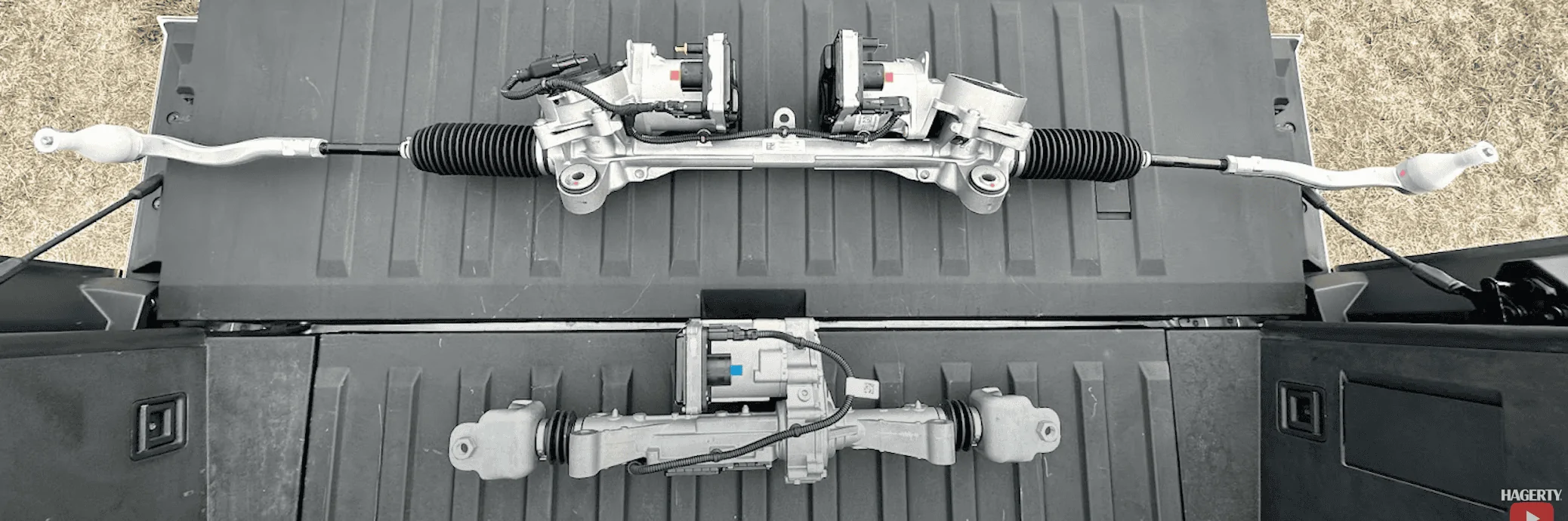
  • Fully Steer-by-Wire - The steering wheel is no longer connected to the wheels, first vehicle to market like this (Lexus is also working on this, but has't been released). It is like a force feedback joystick that causes the front wheels to move. The force feedback unit provides return-to-center torque and force feedback based on detected steering load. The lack of mechanical connection also allows a variable steering ratio to be used (based on speed), and the total steering rotation is less than one turn (vs. 3-4 turns for a regular car). This means hand-over-hand steering is no longer necessary since half a turn is full left or right angle. You can turn the steering wheel when the truck is off and the wheels don't move. The required safety redundancy (that allows complete removal of a mechanical connection) is provided by two separate electric motors on the same steering column, with triple redundant sensors. This is the steering rack, I've never seen one with two motors before:
Tesla Cybertruck Cybertruck Engineering Innovations - Great Summary png-image-png


  • Fully 48V LV Electrical System - The low voltage system has completely switched from 12V to 48V. There are no 12V components in the vehicle (no 12V ports either, 120V and USB-C only). This is the first vehicle in the world to fully switch to 48V, the traditional automakers have been talking about this since the 1980's but haven't been able to make it happen yet. Hopefully this is a kick in the pants. Higher voltage means the wires can be made smaller, and is also more efficient. All three steering motors draw a combined 5 horsepower at full power, which would completely overload a 12V system (300 amps). With 48V, high output steering devices are possible. I assume there is a small 48V lithium battery powering the 48V system when the truck is off.
  • Distributed CAN bus architecture - Everything in the vehicle supposedly runs off gigabit CAN bus network, down to individual lights. This means most wire runs are extremely short and only involve a pair of power and CAN bus wires, eliminating a lot of wiring. This is in contrast to the traditional method where a body control module located in one spot has dozens of wires that run to all parts of the vehicle from it. No more thick harnesses. This is what Jim Farley was talking about when eliminating wiring waste from vehicles. Like other current Tesla models, the Cybertruck also completely eliminates the need for fuses through intelligent power control, which is still unique in the industry.
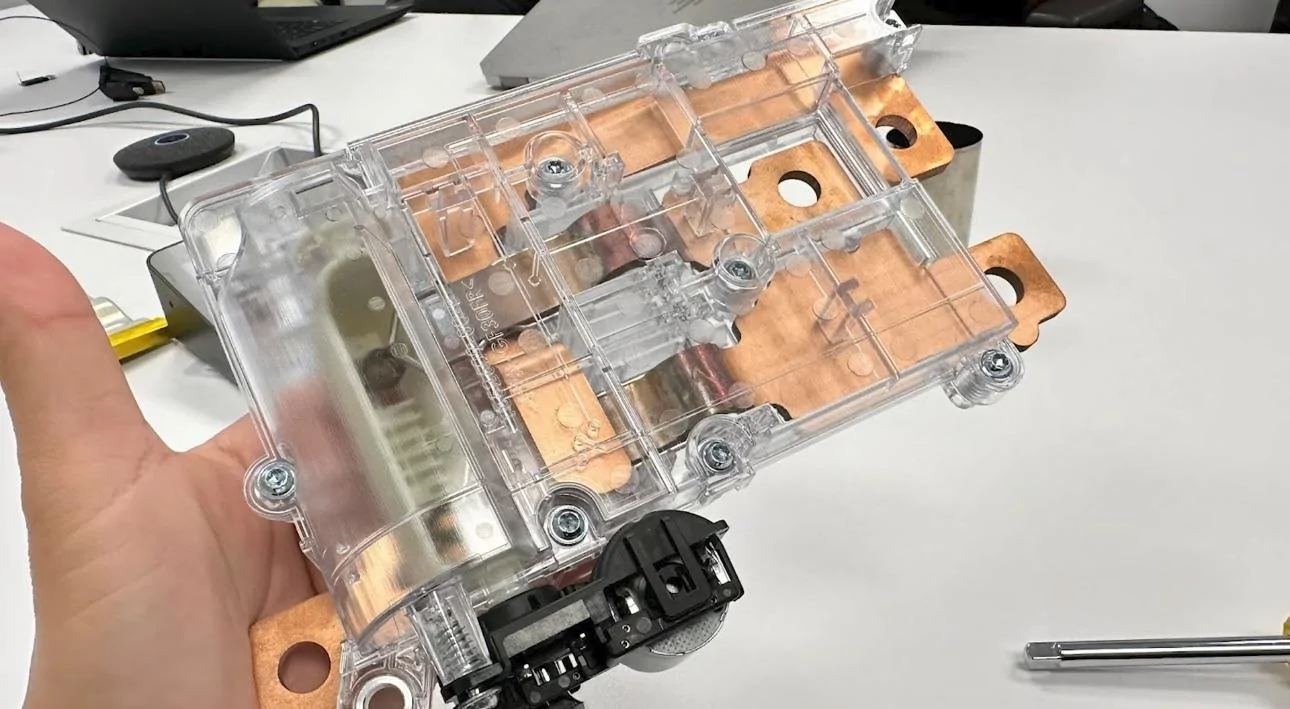
  • 400V/800V switchable pack architecture - The 123 kWh battery pack normally runs in 800V mode for driving, which makes it incompatible with existing Superchargers that only go to 450V. So Tesla invented a switch that splits the pack in two, making two 400V halves in parallel while charging. This works opposite of the Hummer EV which is normally 400V and switches to 800V for charging. It's unknown whether the Cybertruck will allow 800V CCS charging, if so it could break a charging speed record. Here's the switch:
Tesla Cybertruck Cybertruck Engineering Innovations - Great Summary 9pkaf9tzyp3c1-jpg


  • Exoskeleton - In addition to the battery pack, the exterior body panels are also structural. This means there is no internal structure or crash bars inside the doors, and it still passes side impact tests with flying colors. The steel is extremely strong, durable, and actually bulletproof.
  • Quickest pickup truck ever - The Cybertruck has beat the Rivian R1T is is now the quickest pickup truck ever, with a 0-60 of 2.6 sec and 11.0 sec @ 119 mph quarter mile. This performance is available without special battery preconditioning, and apparently unchanged with repeated runs all the down to 33% battery, which is unheard of.
  • Bidirectional charging - Tesla calls this Powershare, the on-board plugs can output 9.6 kW (same as F-150 Lightning), and will also support up to 11.5 kW of power output for V2H to power your home. This will require a Powerwall. Similar to F-150 Lightning Intelligent Backup but with higher total output and less integration equipment required (provided you have a Powerwall). It's unknown whether Tesla will allow the Cybertruck to operate in V2G mode with Autobidder software and sell power back to the grid when it's profitable. If this were possible you could make hundreds of dollars per month, since the Cybertruck has the capacity of 9x Powerwalls.
  • Largest Windshield and Wiper - At 4 feet long, the blade is the longest ever produced. It is a single blade. The huge windshield is also the largest ever mass produced. The wiper actually changes angle slightly while driving to improve the aerodynamics at different speeds (a form of active aero). When the wiper is on, it parks at the bottom of the windshield instead.
Sponsored

 

Gurule92

Well-known member
Joined
Sep 2, 2021
Threads
201
Messages
3,825
Reaction score
7,373
Location
Colorado Springs
Vehicles
MYP
Occupation
"Cyber" stuff
Country flag
Powershare? Idk if I would count that lol

Also, most of that is the stuff that added 30k to the cost.

Couldve done without a lot of it IMO.

I'm not salty you're salty ?
 

wtibbit

Well-known member
First Name
Wayne
Joined
Aug 27, 2020
Threads
12
Messages
819
Reaction score
1,617
Location
DFW
Vehicles
Cybertruck AWD FS, Mercedes sedan, Corvette coupe, 1968 Cougar XR-7
Occupation
Retired Engineering Program Director
Country flag
Also, most of that is the stuff that added 30k to the cost.
*** edited a bit. thanks, Variable556 ***

Let's look at your claim, with consideration given to both development costs and production costs. See the "look at" details below.

To summarize those below, the only items that are new (not in the original product announcement) and likely to have noticeably increased total vehicle cost are: 1. bi-directional charging and, 2. 400v/800v architecture. The other items' costs or savings are likely either a wash or the cost impacts were minimal. I don't see bi-directional charging and 400v/800v architecture adding enough cost to be responsible for a significant part of th $30,000 increase in price. I submit that when Tesla arrived at the price estimate of $49.9K for the Dual Motor trim they underestimated total costs of development and production design (for both labor and materials) as well as underestimating the overhead costs for the facilities and tooling needed for the truck, thereby underestimating the price they would need to charge to achieve a reasonable profit profile.

Add the contribution new stuff costs of the bi-directional charging and the 400v/800v architecture to the announcement's price underestimate, and the impacts of four years of inflation - 18.5% - and Tesla's 40% price increase to $79.9K isn't terribly surprising.

But, that lack of surprise doesn't reduce our pain...
  • Fully Steer-by-Wire- The Production Cost savings may have offset the Development cost enough for this to be a wash, but overall it probably added somewhat to the price increase.
    • Development Cost - this probably did add noticeably to the cost equation.
    • Production Cost - replace the mechanical linkage with, basically, the second steering motor.
  • Fully 48V LV Electrical System -The Production Cost savings very likely outweighed the Development Cost. I think this may have offset any extra cost caused by Fully SBW, washing out the SBW cost for no price impact on these two new functions/features.
    • Development Cost - Every existing 12 volt powered end item, from lights to the motors in the A/C system had to either be replaced with an off-the-shelf 48 volt one, or a new 48 volt end item had to be developed by either Tesla or their suppliers.
    • Production Cost - Every existing 12 volt powered end item......... now has less copper in the motors and can produce more mechanical power per pound and therefore is lighter, saving battery size (and battery cost); with similar savings (due to weight reduction) in every other part of the car. Overall a significant cost savings for total vehicle production costs
  • Distributed CAN bus architecture - Very likely resulted in less overall cost somewhat, making the aggregate impact of the first three items even more likely to be a wash. So no effect on price.
    • Development Cost - There must have been some extra development cost here, but probably not much. The CAN bus network interface function required by the connecting elements (e.g., lights, actuators, sensors) only had to be developed once and share to the end element developer at Tesla or the suppliers. If Tesla made the same change to the new Highland M3 this cost would/could be shared by the two new vehicles.
    • Production Cost - Savings from reduced wire runs and cable sizes, affecting both material and labor, weight reduction again lowers total vehicle production costs.
  • 400V/800V switchable pack architecture - Likely added to the price increase
    • Development Cost - There must have been some extra development cost here, particularly for subsystem and system test and verification. The series/parallel switch had to be developed, too.
    • Production Cost - This is probably minimal, but would add to cost overall.
  • Exoskeleton - This was included in the features listed when the vehicle was first announced, so its inclusion cannot 'add' to the price; those costs were already in the original price estimate
  • Quickest pickup truck ever - see "Exoskeleton"...
  • Bidirectional charging - This is new and is much welcomed by that segment of the buyer pool, those who (like me) were considering an emergency generator for their house. These costs added to the price of the vehicle.
    • Development Cost - Design, integration, test and verification cost were all increased.
    • Production Cost - I suspect there is some addition hardware required, but it is likely no more complex or expensive than the switch used for the 400v/800v switch.
  • Largest Windshield and Wiper - Windshield, see "Exoskeleton"..., Wiper, see "windshield"...
 
Last edited:

Variable556

Well-known member
Joined
Sep 21, 2020
Threads
1
Messages
70
Reaction score
105
Location
West Virginia
Vehicles
Explorer, Escape
Country flag
…for a significant part of the $30,000 increase in price. I submit that when Tesla arrived at the price estimate of $59K for the Dual Motor trim….

…Add the announcement's price underestimate the impacts of four years of inflation - 18.5% - and Tesla's 33% price increase to $79K isn't terribly surprising…
Respectfully: It was $49,900 not $59,900, and that amounts to an increase of slightly over 60%…. Not 33%

Tesla Cybertruck Cybertruck Engineering Innovations - Great Summary IMG_5868
 

Gurule92

Well-known member
Joined
Sep 2, 2021
Threads
201
Messages
3,825
Reaction score
7,373
Location
Colorado Springs
Vehicles
MYP
Occupation
"Cyber" stuff
Country flag
Let's look at your claim, with consideration give to both development costs and production costs. See the "look at" details below.

To summarize those below, the only items that are new (not in the original product announcement) and likely to have noticeably increased total vehicle cost are: 1. bi-directional charging and, 2. 400v/800v architecture. The other items' costs or savings are likely either a wash or the cost impacts were minimal. I don't see bi-directional charging and 400v/800v architecture adding enough cost to be responsible for a significant part of th $30,000 increase in price. I submit that when Tesla arrived at the price estimate of $59K for the Dual Motor trim they underestimated total costs of development and production design (for both labor and materials) as well as underestimating the overhead costs for the facilities and tooling needed for the truck, thereby underestimating the price they would need to charge to achieve a reasonable profit profile.

Add the announcement's price underestimate the impacts of four years of inflation - 18.5% - and Tesla's 33% price increase to $79K isn't terribly surprising.

But, that lack of surprise doesn't reduce our pain...
  • Fully Steer-by-Wire- The Production Cost savings may have offset the Development cost enough for this to be a wash, but overall it probably added somewhat to the price increase.
    • Development Cost - this probably did add noticeably to the cost equation.
    • Production Cost - replace the mechanical linkage with, basically, the second steering motor.
  • Fully 48V LV Electrical System -The Production Cost savings very likely outweighed the Development Cost. I think this may have offset any extra cost caused by Fully SBW, washing out the SBW cost for no price impact on these two new functions/features.
    • Development Cost - Every existing 12 volt powered end item, from lights to the motors in the A/C system had to either be replaced with an off-the-shelf 48 volt one, or a new 48 volt end item had to be developed by either Tesla or their suppliers.
    • Production Cost - Every existing 12 volt powered end item......... now has less copper in the motors and can produce more mechanical power per pound and therefore is lighter, saving battery size (and battery cost); with similar savings (due to weight reduction) in every other part of the car. Overall a significant cost savings for total vehicle production costs
  • Distributed CAN bus architecture - Very likely resulted in less overall cost somewhat, making the aggregate impact of the first three items even more likely to be a wash. So no effect on price.
    • Development Cost - There must have been some extra development cost here, but probably not much. The CAN bus network interface function required by the connecting elements (e.g., lights, actuators, sensors) only had to be developed once and share to the end element developer at Tesla or the suppliers. If Tesla made the same change to the new Highland M3 this cost would/could be shared by the two new vehicles.
    • Production Cost - Savings from reduced wire runs and cable sizes, affecting both material and labor, weight reduction again lowers total vehicle production costs.
  • 400V/800V switchable pack architecture - Likely added to the price increase
    • Development Cost - There must have been some extra development cost here, particularly for subsystem and system test and verification. The series/parallel switch had to be developed, too.
    • Production Cost - This is probably minimal, but would add to cost overall.
  • Exoskeleton - This was included in the features listed when the vehicle was first announced, so its inclusion cannot 'add' to the price; those costs were already in the original price estimate
  • Quickest pickup truck ever - see "Exoskeleton"...
  • Bidirectional charging - This is new and is much welcomed by that segment of the buyer pool, those who (like me) were considering an emergency generator for their house. These costs added to the price of the vehicle.
    • Development Cost - Design, integration, test and verification cost were all increased.
    • Production Cost - I suspect there is some addition hardware required, but it is likely no more complex or expensive than the switch used for the 400v/800v switch.
  • Largest Windshield and Wiper - Windshield, see "Exoskeleton"..., Wiper, see "windshield"...
Tesla officials basically said that every Tesla past a certain year have the capability to power share but there were very minor changes needed. I don't remember the specifics, so if there is one piece that didn't add much if any to cost it's that one.

Most of the things Tesla initially said would be cost savings actually ended up costing us more. R and D on all the casting stuff must've added a huge overhead.

You are only considering the things added. What about the things lost? Those things were considered in the initial costs. Inflation was considered too. (Not to this extent but it was considered)

Original price - removed items (6th seat, tailgate ramp, 3mm thick steel, inside light bar, size, shorter range, etc.) + added items (4WS, 48v, slightly faster beast 0-60, etc) + interest equating to 30k more per truck to me, means either the math was way off the first time(in truck or 4680 or both), or they are just passing off all the extra expense to us because of demand levels being able to sustain it and they don't want to take a hit like ford or rivian even considering economies of scale in the long term.

We can't say what is and isn't a wash. What we can say, is that, has they not went all out trying to make it a technological bandwagon or whatever Elon called it. We might be closer to original prices.

Model Y is close to the same and S and X are lower than ever.

Feels like we are making excuses.

What started as an everyone truck became a rich guy truck, all while Elon was preaching about monthly payments and making the cars affordable. Lol it's insulting tbh.

But I'm an idiot who fell for it, passed on launch prices of other Ev trucks and fell in love with a refrigerator on wheels. So I am going to try and see it through.

But I won't be happy about it until I get my truck.. if I ever can


Mini2nut

Well-known member
Joined
Apr 2, 2020
Threads
137
Messages
4,064
Reaction score
7,375
Location
Planet Earth
Vehicles
*Tesla MYP *SAWD Cybertruck ordered 2/20/26
Country flag
The Cybertruck is the 3rd production vehicle to offer steer-by-wire.
 

firsttruck

Well-known member
Joined
Sep 25, 2020
Threads
205
Messages
2,761
Reaction score
4,441
Location
mx
Vehicles
none
Country flag
Tesla officials basically said that every Tesla past a certain year have the capability to power share but there were very minor changes needed. I don't remember the specifics, so if there is one piece that didn't add much if any to cost it's that one.

Most of the things Tesla initially said would be cost savings actually ended up costing us more. R and D on all the casting stuff must've added a huge overhead.

You are only considering the things added. What about the things lost? Those things were considered in the initial costs. Inflation was considered too. (Not to this extent but it was considered)

Original price - removed items (6th seat, tailgate ramp, 3mm thick steel, inside light bar, size, shorter range, etc.) + added items (4WS, 48v, slightly faster beast 0-60, etc) + interest equating to 30k more per truck to me, means either the math was way off the first time(in truck or 4680 or both), or they are just passing off all the extra expense to us because of demand levels being able to sustain it and they don't want to take a hit like ford or rivian even considering economies of scale in the long term.

We can't say what is and isn't a wash. What we can say, is that, has they not went all out trying to make it a technological bandwagon or whatever Elon called it. We might be closer to original prices.

Model Y is close to the same and S and X are lower than ever.

Feels like we are making excuses.

What started as an everyone truck became a rich guy truck, all while Elon was preaching about monthly payments and making the cars affordable. Lol it's insulting tbh.

But I'm an idiot who fell for it, passed on launch prices of other Ev trucks and fell in love with a refrigerator on wheels. So I am going to try and see it through.

But I won't be happy about it until I get my truck.. if I ever can
Yup, dual motor Cybertruck despite weight savings from reduction of overall size by 5%, exterior stainless steel metal thickness decrease to 1.8mm from 3mm (40%), removal of 6th seat, tailgate ramp, sail pillar storage, after all those major weight reductions the payload capacity dropped significantly to !!!!

Isn't that really a approx total directional swing of at least 2,000 pounds.

Why has total use-able payload capacity dropped almost 30% ( a full 1K pounds. From 3,500 lbs to 2,500)?
 
Last edited:

davelloydbrown

Well-known member
First Name
Dave
Joined
Feb 13, 2022
Threads
7
Messages
548
Reaction score
617
Location
Canada
Vehicles
model 3, silverado
Occupation
veterinarian - retired
Country flag
we keep hearing about the cost savings of the 48 v architecture and giga castings but we haven't heard much about any of the innovations with regards to the machine which builds the machine, which Elon states is the real challenge.

It would be nice to hear about some of the cost savings with regard to the reduction in parts and copper as well as the most expensive component- labour.

If tesla is to stay miles ahead of the pack and maintain its margins when producing the M2 and tesla van, these continuous improvements are essential.

Maybe when Munro does a tear down.


VR Driving

Well-known member
Joined
Jan 25, 2022
Threads
14
Messages
310
Reaction score
471
Location
Canada
Vehicles
Tesla Model 3
Country flag
we keep hearing about the cost savings of the 48 v architecture and giga castings but we haven't heard much about any of the innovations with regards to the machine which builds the machine, which Elon states is the real challenge.

It would be nice to hear about some of the cost savings with regard to the reduction in parts and copper as well as the most expensive component- labour.

If tesla is to stay miles ahead of the pack and maintain its margins when producing the M2 and tesla van, these continuous improvements are essential.

Maybe when Munro does a tear down.
It was shown in the factory tour, that most of the assembly line is automated and each station's speed can be real-time adjusted to match production output.
 

Balthezor

Well-known member
First Name
Ron
Joined
Jun 21, 2020
Threads
28
Messages
1,023
Reaction score
1,400
Location
PA
Vehicles
Cyberbeast, Range Rover, Model Y
Country flag
Can we just buy a Gateway and not a Power Wall? I don't have solar, and dont want solar. But I'd like to have the powershare from CT for outages.
 

davelloydbrown

Well-known member
First Name
Dave
Joined
Feb 13, 2022
Threads
7
Messages
548
Reaction score
617
Location
Canada
Vehicles
model 3, silverado
Occupation
veterinarian - retired
Country flag
I think you need a powerwall unless you just want to run extension cords into your house.
 

wtibbit

Well-known member
First Name
Wayne
Joined
Aug 27, 2020
Threads
12
Messages
819
Reaction score
1,617
Location
DFW
Vehicles
Cybertruck AWD FS, Mercedes sedan, Corvette coupe, 1968 Cougar XR-7
Occupation
Retired Engineering Program Director
Country flag
Feels like we are making excuses.
I wasn't making excuses, I was just saying that I didn't agree with your statement, "...most of that is the stuff that added 30k to the cost", regarding the engineering changes enumerated by the OP. In short, I don't think most the $30K increase resulted from those added features and capabilities.

It's not unusual to see a response that says, "I don't agree", without explaining why. All of the details in my comment were just my basis for my disagreement with that statement. And it's fine for you to not agree with them! Neither of us have enough inside information to be doing more that speculating.

I spent decades in the defense industry trying to estimate the final product cost of large scale systems - development and product contracts with costs at hundreds of millions to over a billion dollars each - when those systems were in the concept phase with a large degree of innovation or new/un-tried technology. Our estimation errors were almost always in the "too low" direction compared to the actual costs, especially for competitive contracts for a fixed price. That situation may be where Tesla is today with the Cybertruck, and the impact is very likely magnified by inflation over expected levels.
Sponsored


Top