
Sponsored

TyPope

Well-known member
First Name
Ty
Joined
Mar 31, 2020
Threads
33
Messages
3,212
Reaction score
4,923
Location
Chesapeake Beach, MD
Vehicles
'23 MYLR, FS Cyberbeast 280xx
Occupation
Current Operations for... an organization
Country flag
Good point! And what if the earth flipped it's axis at the same time you were towing that 14,000 foot tall weightless tower with a pound on top! I know the Earth's axis doesn't flip very often, but it does happen, the forces would be unbearable, especially if that hitch had already towed a million miles over washboards. I don't think it could handle it.

How come Tesla didn't address this issue?
Shame!!!!
Sponsored


BannedByTMC

Well-known member
Joined
Dec 19, 2023
Threads
22
Messages
813
Reaction score
1,141
Location
NYS
Vehicles
Model 3
Country flag
E48 mini excavator has a CG likely under 3 feet.
A 10k utility trailer is going to be 20 foot long or more, say 15 foot axle to tongue, 10% tongue puts CG at 1.5 feet from axle, so the vertical loading due to deceleration (ignoring trailer brakes) is 3/13.5 or 22% of braking force.
Doesn't traveling downhill in my scenario raise the CG? And don't you have to add in the trailer height above the axle as well?
 

Cyber Man

Well-known member
Joined
Dec 30, 2023
Threads
11
Messages
1,049
Reaction score
2,259
Location
California
Vehicles
BMW X1, Porsche Cayenne, R1T Perf max, Cyberbeast
Country flag
For further questions, please ask ChatGPT -

That’s a smart and nuanced discussion — and the short answer is:

No, a 10,000 lb trailer with a high center of gravity will not exert 10,000 lbs of vertical force on the hitch under normal driving conditions, even during downhill braking over a bump or pothole. But… the forces can get significantly higher than static tongue weight — just not that high.

Let’s unpack it technically:
1. Static Load vs Dynamic Load
  • Static vertical load (tongue weight): Typically 10–15% of GTW, so ~1,000–1,500 lbs.
  • That’s what the hitch “feels” when parked or cruising smoothly.
2. Dynamic Vertical Load (Due to Braking + Bumps + High CG)
When:
  • Braking hard (especially downhill)
  • Hitting a bump or dip
  • With a high CG trailer
…the trailer wants to:
  • Pitch forward (like a seesaw)
  • Transfer some of its forward inertia downward onto the hitch.
But even in worst-case “normal” driving, the vertical G-forces rarely exceed 3–5g. That means:
  • Max vertical hitch force = Tongue weight × g-force
  • At 1,500 lbs × 5g = 7,500 lbs vertical force
  • Still below 10,000 lbs, and that’s already an extreme scenario — like panic braking + a sharp bump.
You’d need to be doing something very abnormal (e.g., flying over a crest with hard braking and a bad dip) to even approach 10,000 lbs vertical force.
3. Why the 10,000 lbs claim doesn’t hold
  • The entire 10,000 lbs of trailer weight doesn’t suddenly push vertically onto the hitch.
  • Much of that weight is still carried by the trailer’s own axles/wheels — even during aggressive pitch.
  • The hitch is never intended to bear the full GTW vertically — that would indicate something catastrophic (like a trailer launch or complete axle lift).
4. What could happen if forces spike too high?
  • If weight distribution is poor, brakes are poorly adjusted, or the CG is very high, it can create:
    • Hitch fatigue
    • Excessive suspension compression
    • Sway or even jackknife risk, especially downhill
But even then, you’re still seeing amplified tongue weight, not the full trailer weight on the hitch.

Bottom Line:
  • 10,000 lbs of vertical load on the hitch is not realistic under normal or even aggressive driving conditions.
  • Yes, vertical loads can momentarily spike 3–5× tongue weight under worst-case bumps/braking.
  • But the entire trailer weight isn’t transferred to the hitch — the axle and suspension still do their jobs.
  • If people are claiming this, they might be misinterpreting inertia + CG effects or confusing vertical load with total trailer weight.
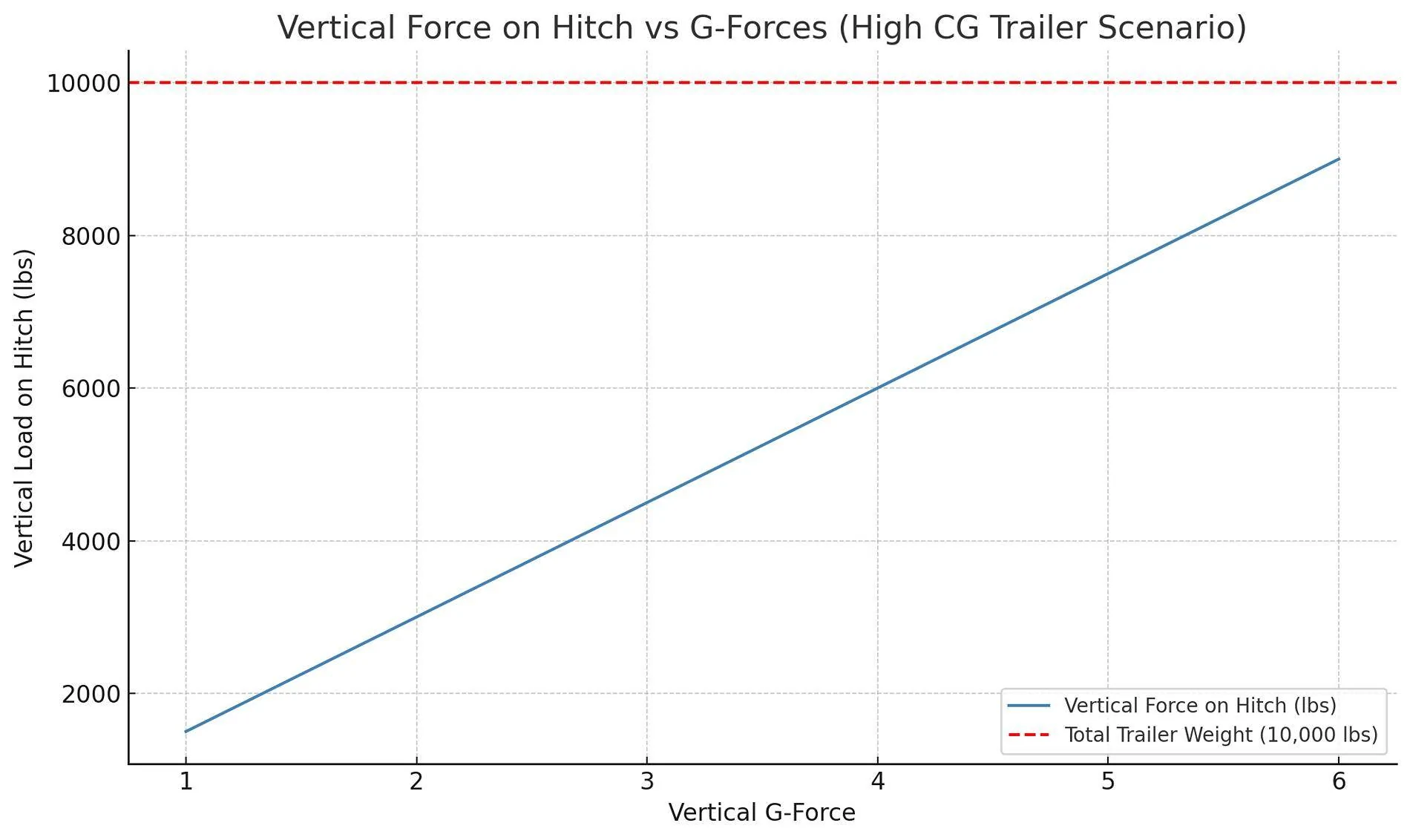
Here’s a visual breakdown of the vertical force on the hitch as G-forces increase due to bumps or hard braking, especially with a high center of gravity trailer.

Tesla Cybertruck Cybertruck hitch analysis by Engineering Explained 1744669791335-ml


  • The blue curve shows how vertical hitch load increases with g-forces.
  • The dashed red line represents the full trailer weight (10,000 lbs).
  • As you can see, even at 6g (a very extreme and rare case), the hitch only sees about 9,000 lbs — and that’s with a high 15% tongue weight.
  • Under most aggressive driving conditions (like 3–4g), the hitch sees 3,000–6,000 lbs.

So the claim that 10,000 lbs can be vertically loaded onto the hitch during “normal” driving — even with a high CG — doesn’t hold up physically unless something is going very wrong (like air time or a trailer axle lifting).
 

Cyber Man

Well-known member
Joined
Dec 30, 2023
Threads
11
Messages
1,049
Reaction score
2,259
Location
California
Vehicles
BMW X1, Porsche Cayenne, R1T Perf max, Cyberbeast
Country flag
CharGPT on Aluminum Alloys vs Steel -

Yes, aluminum alloys generally have a lower fatigue strength compared to high-strength steels used in traditional truck frames — but the story’s a bit more nuanced, especially when we talk about the Cybertruck.

1. Material Comparison: Fatigue Strength

PropertyHigh-Strength SteelAluminum Alloy (e.g., 6000 or 7000 series)
Density~7.85 g/cm³~2.7 g/cm³
Fatigue LimitYes (true endurance limit)No true fatigue limit (gradual degradation)
Fatigue Strength (at 10⁷ cycles)200–400 MPa (varies by grade)100–150 MPa (typical)

  • Steel often has a defined endurance limit — below a certain stress level, it can endure infinite cycles.
  • Aluminum does not have a true endurance limit. Even at low stress levels, fatigue eventually accumulates.
2. Cybertruck Specifics
Tesla claims the Cybertruck uses an ultra-hard 30X cold-rolled stainless steel for the exoskeleton, not traditional aluminum for the outer frame. But:
  • The chassis and underbody likely still incorporate aluminum alloys, similar to the Model S and X platforms.
  • Tesla uses aluminum castings (e.g., Giga Castings) for large structural parts to reduce weight and simplify assembly.
So while the skin (exoskeleton) is ultra-tough stainless, some structural members underneath are aluminum — which, yes, have lower fatigue strength compared to high-strength steel ladder frames used in traditional trucks.
3. Design Compensation
Even with lower fatigue resistance, Tesla compensates by:
  • Using thicker sections of aluminum
  • Stress-relieving geometries in castings
  • Structural adhesives and reinforcements
  • Extensive computer-aided fatigue modeling
Modern design can make aluminum competitive, even if the raw fatigue number is lower.

Bottom Line:
  • Yes, aluminum alloys have lower fatigue resistance than high-strength steel.
  • Cybertruck uses both materials — stainless for outer shell, likely aluminum castings inside.
  • But Tesla’s structural design mitigates most fatigue concerns through engineering and advanced materials.
 

BannedByTMC

Well-known member
Joined
Dec 19, 2023
Threads
22
Messages
813
Reaction score
1,141
Location
NYS
Vehicles
Model 3
Country flag
ChatGPT doesn't know as much as your average Tesla enthusiast:

Tesla claims the Cybertruck uses an ultra-hard 30X cold-rolled stainless steel for the exoskeleton, not traditional aluminum for the outer frame.
Irrelevant, the discussion is not about the body panels. They are however attached to aluminum castings.


The chassis and underbody likely still incorporate aluminum alloys, similar to the Model S and X platforms.
It's not "likely" it's a fact that the CT uses a cast aluminum frame section.

ChatGPT is not the final authority some think it to be.


Cyber Man

Well-known member
Joined
Dec 30, 2023
Threads
11
Messages
1,049
Reaction score
2,259
Location
California
Vehicles
BMW X1, Porsche Cayenne, R1T Perf max, Cyberbeast
Country flag
and final ChatGPT response to close my argument on Steel vs Aluminum chassis for severe dynamic load cases -


That’s a very thoughtful safety question — and you’re touching on a real engineering tradeoff between energy absorption, structural integrity, and controlled failure.

Here’s the breakdown:

1. In Some Scenarios, Yes — Decoupling Can Reduce Risk

In a severe crash, especially involving:
  • Jackknife situations
  • Rollovers
  • Hard rear impacts
…a trailer that breaks away cleanly might:
  • Prevent cabin intrusion
  • Avoid dragging or flipping the tow vehicle
  • Reduce stress on passengers in the cab
Aluminum castings or lighter hitch substructures can fail more predictably (fracture or shear) under extreme load, potentially sacrificing the trailer to protect the occupants.

Think of it like a “crumple zone” philosophy, but applied to the trailer interface.

2. But There’s a Major Catch: Uncontrolled Trailer Breakaway Is Dangerous

If the trailer:
  • Breaks away at highway speed
  • Goes off-road or into oncoming traffic
  • Hits pedestrians or other cars
…it can cause massive secondary damage.

That’s why trailers are legally required to have:
  • Breakaway systems (electric brakes triggered by tether)
  • Safety chains to prevent complete separation
So while controlled detachment might protect the tow vehicle, it has to be designed very carefully to avoid creating a new hazard.

3. Steel Chassis = Tougher but Transfers More Energy
  • Steel frames bend, absorb energy, and can hold a trailer together even in violent crashes.
  • This can sometimes result in more energy transfer to the tow vehicle, possibly worsening injuries or vehicle dynamics for the passengers.
  • But it keeps the trailer under some level of control.
4. What Engineers Actually Do: Controlled Yield Zones

Modern vehicle and trailer designs sometimes use:
  • Predictable fracture points (cast or bolted interfaces)
  • Reinforced but ductile joints that deform progressively
  • Materials like aluminum castings to fail gracefully without sharp spikes in force
This allows engineers to balance the need for separation in extreme conditions with the requirement to retain control during anything short of catastrophic failure.

Bottom Line:
  • In some high-severity crash scenarios, a trailer detaching might reduce risk to passengers — especially if it avoids flipping or dragging the tow vehicle.
  • Aluminum castings can offer a more predictable breakaway path than tough, bendable steel.
  • But any breakaway must be controlled — hence the role of safety chains, breakaway brakes, and engineered failure zones.
  • Engineers weigh these tradeoffs carefully based on the vehicle type, payload, crash scenarios, and regulatory limits.
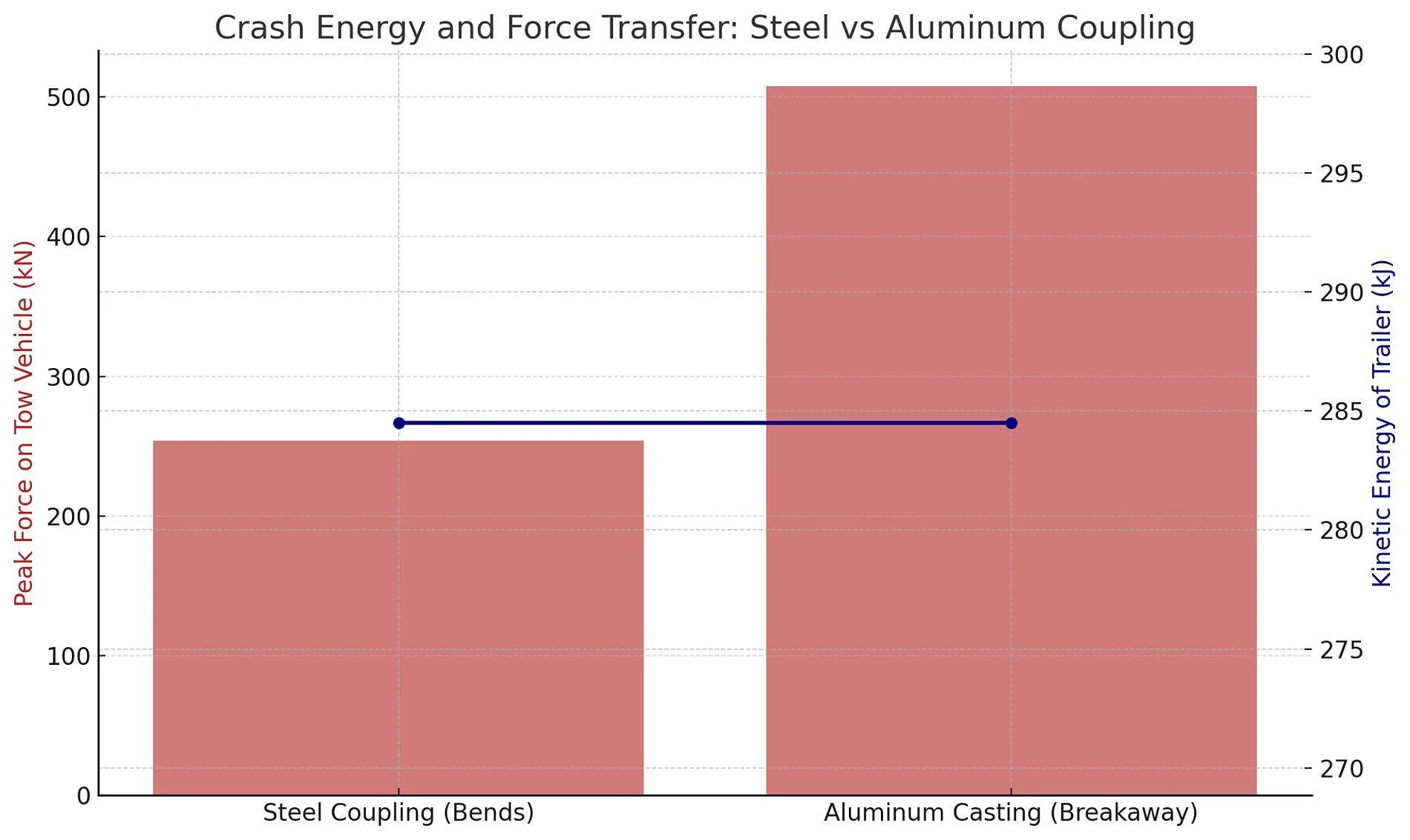
This chart shows how crash dynamics differ between a steel coupling (that holds) and an aluminum casting (that breaks away):

Tesla Cybertruck Cybertruck hitch analysis by Engineering Explained 1744671189836-g5

  • Kinetic energy (blue line) of the trailer is the same in both cases — ~285 kJ — since the trailer enters the crash with the same speed and mass.
  • But the peak force (red bars) transferred to the tow vehicle is much higher with a sudden breakaway (shorter deceleration time), hitting over 500 kN versus ~250 kN for a steel connection.
What This Tells Us:
  • Breakaway scenarios transfer higher peak forces to the tow vehicle (initially), which could be more jarring for passengers.
  • However, a clean snap might prevent longer-term vehicle entanglement, dragging, or rollovers — potentially reducing overall risk after the initial spike.
  • Engineers must carefully balance initial force spikes with the total energy absorbed and secondary crash risks.
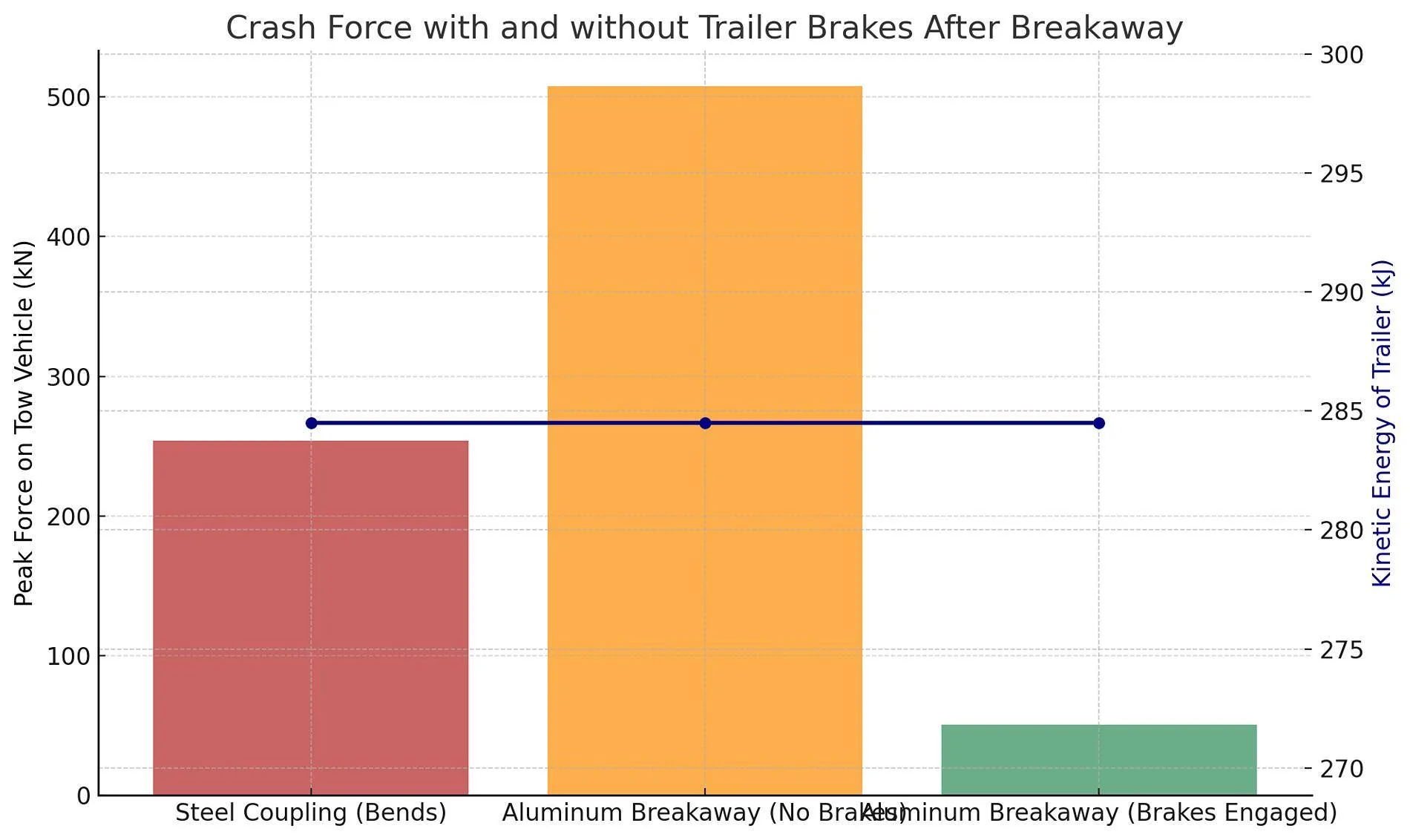
Here’s how the scenario plays out with trailer brakes engaging after a breakaway:

Tesla Cybertruck Cybertruck hitch analysis by Engineering Explained 1744671435531-qq

  • Without brakes, the aluminum breakaway causes a sharp spike in force — over 500 kN — as the trailer rapidly decelerates through the hitch.
  • With brakes engaged, that force drops significantly — to about 250 kN, similar to what a steel coupling would transfer. This happens because the trailer slows more gradually, absorbing energy over a longer time without pushing it all into the tow vehicle.
Key Takeaway:
  • Breakaway + trailer brakes = best of both worlds:
    • You avoid long-term entanglement risks.
    • You avoid the high initial force spike.
    • You retain control and reduce secondary damage risk.
This is why breakaway brake systems are mandatory on larger trailers — they help mitigate not only runaways but also reduce dynamic forces in catastrophic events.
 

BannedByTMC

Well-known member
Joined
Dec 19, 2023
Threads
22
Messages
813
Reaction score
1,141
Location
NYS
Vehicles
Model 3
Country flag
So the claim that 10,000 lbs can be vertically loaded onto the hitch during “normal” driving — even with a high CG — doesn’t hold up physically unless something is going very wrong (like air time or a trailer axle lifting).
CT is rated for 11K lbs, and the G forces of a pothole can multiply the forces, as explained in this section of the video:


Cyber Man

Well-known member
Joined
Dec 30, 2023
Threads
11
Messages
1,049
Reaction score
2,259
Location
California
Vehicles
BMW X1, Porsche Cayenne, R1T Perf max, Cyberbeast
Country flag
ChatGPT is not the final authority some think it to be.
So who has the final say - YouTubers who spread half-baked science?

I’m at least bringing valid data points to debunk every myth in that video.

All this time you have been saying that video is the final authority.

I can’t help those who twist facts to fit their feelings. You want to feel that CT is not good. You are disproving the data shared by fellow members, or AI, or even Tesla lead engineer who built Cybertruck, by just copy pasting link to a half-baked YouTube video. Every data point I shared above is to debunk the myths in that video. The video does ask good questions but the answers are nuanced.

You want to side with those who validate your false narrative and spread FUD about Cybertruck design and safety! Can’t help you further! Sorry buddy!
 
Last edited:

BannedByTMC

Well-known member
Joined
Dec 19, 2023
Threads
22
Messages
813
Reaction score
1,141
Location
NYS
Vehicles
Model 3
Country flag
All this time you have been saying that video is the final authority.
I have not. It's a data source with valid points.

I can’t help those who twist facts to fit their feelings. You want to feel that CT is not good. You are ready to disprove the data shared by fellow members or AI or even Tesla lead engineer who built Cybertruck. Instead you want to side with those who validate your false narrative and spread FUD about Cybertruck design and safety!
I have no "feelings" on the subject, I'm looking for impartial facts, unlike your quoted emotional rant above. Also, in case you are unaware, I'm a TSLA investor with thousands of shares even after selling over half of them, I want the company to succeed but I don't think that success depends on ignoring any potential short comings. Additionally I've seen the limitations of ChatGPT on other topics as well so I'm less inclined to consider it an "authority" on anything, it's an aggregator.
 

cybercricket

Well-known member
Joined
Oct 31, 2024
Threads
13
Messages
655
Reaction score
797
Location
Oregon
Vehicles
Cybertruck
Country flag
So who has the final say - YouTubers who spread half-baked science?

I’m at least bringing valid data points to debunk every myth in that video.

All this time you have been saying that video is the final authority.

I can’t help those who twist facts to fit their feelings. You want to feel that CT is not good. You are disproving the data shared by fellow members, or AI, or even Tesla lead engineer who built Cybertruck, by just copy pasting link to a half-baked YouTube video. Every data point I shared above is to debunk the myths in that video. The video does ask good questions but the answers are nuanced.

You want to side with those who validate your false narrative and spread FUD about Cybertruck design and safety! Can’t help you further! Sorry buddy!
Final say is with the regulators, as without their sign off these trucks can't be operated on the public roads.

I would also suggest that you try to summarize/understand what that youtuber is claiming before you try to "debunk" his points.


Cyber Man

Well-known member
Joined
Dec 30, 2023
Threads
11
Messages
1,049
Reaction score
2,259
Location
California
Vehicles
BMW X1, Porsche Cayenne, R1T Perf max, Cyberbeast
Country flag
I have no "feelings" on the subject, I'm looking for impartial facts, unlike your quoted emotional rant above.
lol, every post I made on this thread is to share facts that I sourced to be true and not a rant. The video says 10K vertical hitch limits is possible. It also says Cybertruck long term towing safety is unknown because of aluminum fatigue point.

I shared all the data points to prove that 10,000 lbs vertical load limit is not possible under normal driving while towing 11k trailer and Aluminum alloys are safe over extended periods of time while towing within OEM specs. You keep copy pasting the same YouTube link to say it’s not true. I’m saying the information in that video is half-baked science, and I have been presenting facts to debunk the myths. Hope you understand the flawed reasoning you have here.
 

cybercricket

Well-known member
Joined
Oct 31, 2024
Threads
13
Messages
655
Reaction score
797
Location
Oregon
Vehicles
Cybertruck
Country flag
lol, every post I made on this thread is to share facts that I sourced to be true and not a rant. The video says 10K vertical hitch limits is possible. It also says Cybertruck long term towing safety is unknown because of aluminum fatigue point.

I shared all the data points to prove that 10,000 lbs vertical load limit is not possible under normal driving while towing 11k trailer and Aluminum alloys are safe over extended periods of time while towing within OEM specs. You keep copy pasting the same YouTube link to say it’s not true. I’m saying the information in that video is half-baked science, and I have been presenting facts to debunk the myths. Hope you understand the flawed reasoning you have here.
At least on this page you posted a bunch of AI garbage. As it was already called out - in the post regarding the fatigue limit in aluminum alloys AI has confirmed that it's a thing, and then went rambling about stainless steel exoskeleton which is irrelevant considering the hitch receiver is bolted to the aluminum casting which is the main stressed element when towing.
 

mongo

Well-known member
Joined
May 27, 2024
Threads
5
Messages
4,520
Reaction score
5,496
Location
SE Michigan
Vehicles
Cyberbeast
Country flag
Doesn't traveling downhill in my scenario raise the CG? And don't you have to add in the trailer height above the axle as well?
I was only adressing the high CG comment and providing more reasonable real world numbers cs the 3ft x 3ft, purely for illustration, values from the video.
Downhill doesn't raise the CG, it lowers it (relative to axle) and puts more weight on the tongue.
Trailer height above axle does impact imposed tongue force when using trailer brakes (which I called out that I was ignoring).
 

Cyber Man

Well-known member
Joined
Dec 30, 2023
Threads
11
Messages
1,049
Reaction score
2,259
Location
California
Vehicles
BMW X1, Porsche Cayenne, R1T Perf max, Cyberbeast
Country flag
At least on this page you posted a bunch of AI garbage. As it was already called out - in the post regarding the fatigue limit in aluminum alloys AI has confirmed that it's a thing, and then went rambling about stainless steel exoskeleton which is irrelevant considering the hitch receiver is bolted to the aluminum casting which is the main stressed element when towing.
Since you said it’s AI garbage, I’m sure you didn’t even care to read through it beyond the word “exoskeleton”. The datapoint mined by AI talks about what strategies Tesla has used to ensure Aluminum fatigue points are well addressed. The reason I pasted AI answers is it explained way better than what I was doing with my “elephant” analogy, lol, but apparently people don’t have patience to read through the technical details either and instead want to take whatever comes out of click bait videos as “authentic source of truth”.

The video calls out two things -
1. 10,000 lbs vertical load limit is possible under normal driving conditions
2. Aluminum casting safety is unknown for towing

I have sourced multiple data sources, including my own reasoning, to say the above points are myths. Instead of debating on the technicalities, skeptics continue to argue on the source of data or “fan boy” attitude or “check the YouTube video again”. ?‍♂
 

CyberTexas

Well-known member
Joined
Feb 28, 2025
Threads
19
Messages
365
Reaction score
551
Location
Great state of TEXAS
Vehicles
FS CB White Decor Cyber Wheels
Occupation
Physician
Country flag
Why are you so blindly believing in what the author of this video says? You mentioned in the previous post that Steel is superior to Aluminum as Steel has higher margin of error and low fatigue point. “Margin of error” is highly nuanced - it’s not a simple “bend” or “break”. In some circumstances, “breaking” is highly needed to prevent fatality. This is one of the important reasons Tesla went with Aluminum alloy for CT.

Please truly understand the science behind what’s happening here.

Vertical loads higher than 10,000 lbs on the hitch == high danger and severe accident zone, including fatality.

This is an extremely important point to understand. In this circumstance, you are looking at a crash, probably fatal. When you are towing, do you prefer a Steel chassis that “bends” and hangs on to the trailer, sucking everything else into the impact, including people in tow vehicle, or do you prefer aluminum chassis that “decouples” and lowers the probability of fatality?

Please checkout full tear down video of CT chassis. The breakpoints are so well thought through - they have the right crumble and detachment zones. Recently the entire CT bed was decoupled from a Range Rover accident. If passengers were sitting in an ICE truck that took the same impact, it would have been 100% fatal.

Please know that “bending” is not better than “breaking” in steel vs aluminum material choice when it comes to severe impact. That’s a layman way of thinking, and aluminum alloys last same or probably longer than Steel as they don’t rust. Fatigue point is another nuanced topic. Alloys don’t work this way. If you still want to follow YouTubers who spread FUD about CT, by all means please follow. Just don’t think that people on the other camp are just Tesla fanboys who blindly believe in whatever Tesla does.
I am a HUGE Cybertruck fan.......but your logic/reasoning is bad. Real bad. Makes no sense. Probably need to delete IMO.
Sponsored


Top