
Deleted member 4261
Guest
Just so long as it’s not April 1st, more important is what year?What month will we see final version?
Sponsored
Just so long as it’s not April 1st, more important is what year?What month will we see final version?




The price will be as low as they can go, cost plus contingency and healthy magin. No more than 20-25% more, but also better included features.Another point with price is...
...If they price it high, even if the market will bear it... The presumption with the public that it's overpriced will remain, even if they reduce prices. Or everyone else increases prices past them.
It's a tough balance to do.
-Crissa
(There will also be a presumption by the investor class that either they can't remain profitable if they lower prices or that it'll ruin their investments if they lower prices, too. Which is another problem with following market The price will be as low as the margins allow with contingency.price. It's sticky.)

I expect Tesla to split any cost increases with a compromise to their margins to keep our prices as close to the quote as possible. I think even a 20% increase would be too much for many. The feature changes were their choice so that should be included.The price will be as low as they can go, cost plus contingency and healthy magin. No more than 20-25% more, but also better included features.

These are good points which is why Tesla will err on pricing it initially a little bit too low (which will still be a little above the reveal pricing scheme). And the comment in parentheses assumes we can even roughly compare the final release versions in terms of range and drive configurations with the reveal configurations. I think a lot has changed since then and the version (s) actually released will not be directly comparable to the announced specs in at least on key metric.Another point with price is...
...If they price it high, even if the market will bear it... The presumption with the public that it's overpriced will remain, even if they reduce prices. Or everyone else increases prices past them.
It's a tough balance to do.
-Crissa
(There will also be a presumption by the investor class that either they can't remain profitable if they lower prices or that it'll ruin their investments if they lower prices, too. Which is another problem with following market price. It's sticky.)

We do not even know if the sail pillars remain a feature of the Cybertruck, but if they are we will likely see one opened in the wild sometime before July. Just my guess.when will we see sail pillar opened? ?
By 'key metrics' do you mean 0-60 times, range, payload, and towing capacity, because Tesla has a history of under promising and over delivering on such features. I can see Tesla changing the [initially] available trims, because they have done that a lot with other models, and they might update the ranges and towing capacities, or accelerations, accordingly, but I would expect that in all cases they would be equal to or better than the original as scaled in whatever ways.These are good points which is why Tesla will err on pricing it initially a little bit too low (which will still be a little above the reveal pricing scheme). And the comment in parentheses assumes we can even roughly compare the final release versions in terms of range and drive configurations with the reveal configurations. I think a lot has changed since then and the version (s) actually released will not be directly comparable to the announced specs in at least on key metric.
The easiest price guess is to look at Tesla's targeted competitors. That may put the dual motor 300 mile CT at $80K ish.Haha! I guess there's not much harm in dreaming!
But realistically, I think the upper and lower price limits are driven by two different things. Obviously, when the cost to produce rises such that they cannot be sold for the anticipated prices, the price has to go up to make production sustainable, assuming there is market demand at the higher prices. If not, the product is not viable if the manufacturer can't figure out how to produce it for less.
However, there is another dynamic at play when the cost to produce is much less than the anticipated price. To understand this dynamic, let's assume in some magical world it only costs $10K to produce a 320-mile 4X4 Cybertruck. Does that mean Tesla will say, "We want 30% margins so we will lower the price to $14,000"?
All of a sudden, people are emptying their piggy-banks to buy one and the truck becomes unavailable for 4 years or longer. It's unobtainable in any normal sense of the word. Scalpers are everywhere selling it for the true market value of $55-$60K to people who don't want to wait. People stop buying the Model Y because they can get 3 Cybertrucks for the same price and sell 2 of them and have money left over to burn.
Pricing the truck too low comes with a myriad of problems and creates untenable wait times for new customers, giving a bad customer experience. If Tesla knew they wouldn't have the batteries to put Cybertruck into production until 2023, they never would have revealed it as early as late 2019. But COVID happened and there was unexpectedly high demand for their other EV's.
Essentially, manufacturer's price their vehicles based upon what they think the market is willing and able to pay in the volumes they want to sell them at. If they over-estimate demand, they have to sell them for less, even if it means losing money on everyone they sell. But they will never lower prices too far below what the actual market value of the vehicle is. Basically, a limit on the number of batteries they can make or buy, whether it's due to limitations on raw materials or a limit on installed production capacity, will limit their ability to manufacture in high enough volumes to satisfy market demand if the price is too far lower than market value.
What this means for people with high reservation numbers is they want Tesla's ramp of 4680 batteries to happen without unexpected problems and for raw materials supply to grow rapidly to meet demand for ever increasing numbers of batteries.
Competing with vehicles for batteries is the utility scale energy storage market. It sounds like Tesla has essentially unlimited demand for multi-million-dollar Megapacks which can use any kind of batteries that are available. These are high margin sales in volume, so they compete directly with Tesla's ability to scale auto production.
Putting all of this together, there is absolutely zero chance Cybertruck will be sold for a song. Because all trucks, including ICE vehicles, are much more expensive now than in 2019, there's not even much chance that Tesla will hit the prices they anticipated in 2019, regardless of their cost to produce. It's all about the batteries!
This same dynamic probably means the initial production will not include 500-mile varients (unless 4680 production ramp beats expectations). Tesla would rather sell more 300-mile versions than 40% fewer 500-mile versions.
I'm unaware to how the conventional ICE awd F150 crew cab mid bed had risen to $80k.The easiest price guess is to look at Tesla's targeted competitors. That may put the dual motor 300 mile CT at $80K ish.
Ford did Tesla a solid by raising Lightning prices. Not that Tesla couldn't price in the high five figures, but the higher Lightning price makes Musk look like less of an ahole. For some people excited about CT the $40K would have been a big stretch but doable. They will remember the initial low entry point presented.

Not sure any revealed prices will apply in 2-3 years when your reservation is tapped.So I'm new to Tesla, made my reservation a while ago. At what point will we see or find out about options and costs? Thought is others in the group may already a Tesla and have been through this before
Comparing the high volume Cybertruck price to low volume trucks with boutique pricing gets you nowhere. Tesla is shooting for 500k+ trucks a year, Cybertruck’s competitors are mostly ICE vehicles.The easiest price guess is to look at Tesla's targeted competitors. That may put the dual motor 300 mile CT at $80K ish.
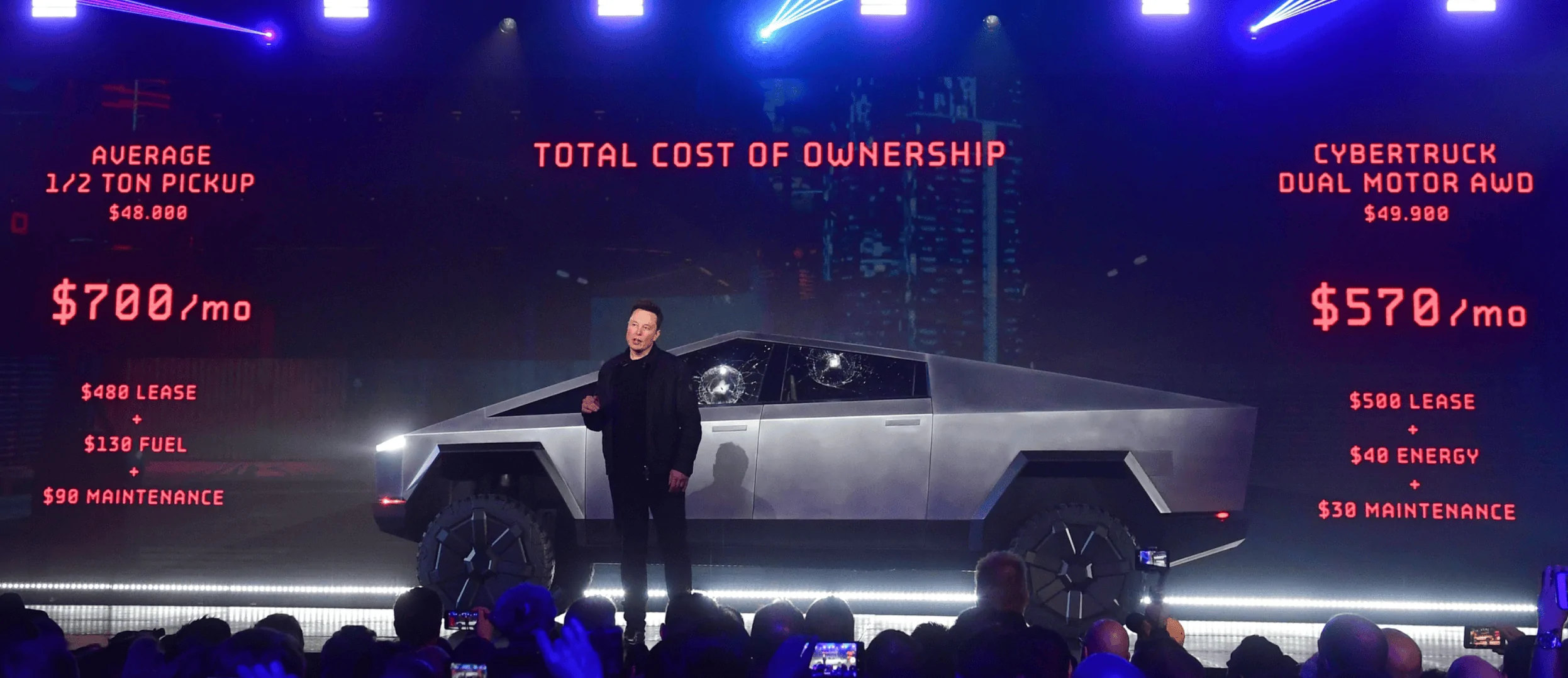
At volume. Ford has the same plan.I'm unaware to how the conventional ICE awd F150 crew cab mid bed had risen to $80k.
That's who Elon said was their targeted competition.
-Crissa
We got that pricing because they ran out of supply and they got lots of whining when the Model 3 had Honda-like build quality.That's how we got a $50K Model 3 instead of the Honda Accord price Musk initially presented.
Yes there is.At volume. Ford has the same plan.
In reality, at volume, the price will settle at what the market will pay. That's how we got a $50K Model 3 instead of the Honda Accord price Musk initially presented.
There is no obvious reason for Tesla to sell a dual motor 300 mile CT for less than $80K


