cvalue13
Well-known member
- Joined
- Aug 17, 2022
- Threads
- 74
- Messages
- 7,153
- Reaction score
- 13,769
- Location
- Austin, TX
- Vehicles
- F150L
- Occupation
- Fun-employed

Yes, that is clear.The "structural" pack essentially means that the battery casing IS the floor of the car, instead of having a pack sitting IN the floor.
This is where our understanding departs. Unless you can point me toward specific, expert, explanation of your statements above, I remain deeply skeptical given what I've learned elsewhere from folks who appear to be pretty expert.because the battery casing is strong enough to just connect front/rear casting, bolt the seats to it, etc. It doesn't mean that a vehicle using a structural pack has to have the same number of cells inside the pack.
Namely, you appear to suggest that what's 'inside' the pack has no bearing on whether it's 'structural,' and that's inapposite to my prior understanding that indeed what is inside, and how it is configured, is itself a material component to the pack's overall structural integrity.
Happy to be instructed otherwise, but so-far confused and unmoved.
Also, see below.**
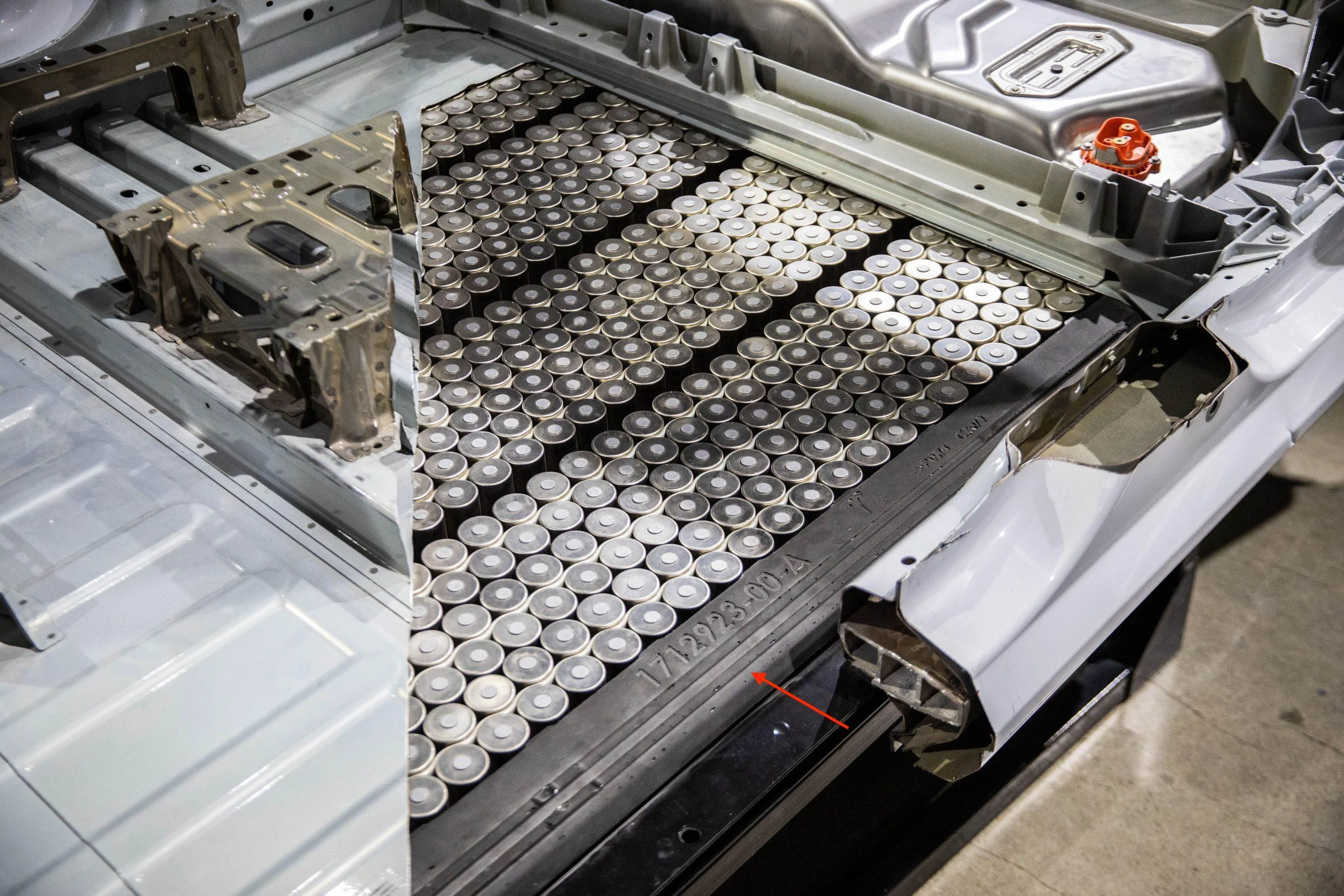
This in particular seems inapposite to available facts. Remembering there was only ever a singular MY AWD structural pack, there's zero available information that suggests the pack wasn't filled to capacity with cells.It was explicitly stated that 4680 cells are supposed to provide greater range and power on the same footprint. Their yields were just so poor initially that they couldn't make enough cells to make Y's. So they made packs with a small number of cells and then just gave up.
Munro's breakdown of the structural pack, showed the 4680 cells are all glued together (and to the steel enclosure) using a pink polyurethane (**reference above about overall pack structural integrity), making the batteries themselves (plus the pink) the structural integrity of the pack - not its outer casing.
At this point one could rightfully say it's the pink polyurethane that provides the gap-filling structure in a "partially full" pack - and that may well be true, but I know of no information that suggests there's (A) a known intended density of cells in the pack, vs (B) what Munro found, or what Tesla's said publically.
Do you have that?
First, I've never finally hung my hat on 115kW, but I have suggested this is what folks have in mind - subject to the fact that Tesla is surely still, even at this late hour, trying to improve that figure incrementally. The end release spec may be nominally greater than 115kW, but not by much - certainly not by enough to breach 400mi, etc., is my position.If the CT has, as you suggest, a 115kWh pack, that's either a choice (the minimum needed to top Lightning's 320 mile range) or a result of really poor quality (low density) 4680 cells to date. It is definitely NOT a limitation of the size of the truck and its battery pack.
Second, based on what do you assert that it's not a limitation of the size of the packaging limits of the pack?
Because otherwise, your comments seem contradictory: "If the CT has, as you suggest, a 115kWh pack, that's ... a result of really poor quality (low density) 4680 cells to date... NOT a limitation of the size of the truck and its battery pack."
If the issue is due to poor quality/density cells, why wouldn't they put more cells in? Cost to manufacture?
Regardless, this entire point about whether they can fit more cells in seems to be merely a violent agreement. I've only said, "range will be about [X], resulting in about [Y]kWh, which one way or another reflects that they're unable to get the density in the pack - one explanation for not getting the density would be physical constraint, others exist, including that they "can't" for broader philosophical reasons (such as cost or not believing the higher ranges are the correct strategy compared to infra)."
This is what I meant above, when describing the Model Y with structural:
Personally, I take this corporate speak to have at least two interpretations:
(1) they couldn’t get the density they wanted, or
(2) the mean it, and intentionally viewed 4680 packs to be not a performance-boosting tool, but an economics tool
Perhaps elsewhere I've said something nominally or apparently to the contrary, in which case it was an error or a miss-speaking in a given context of discussion. Maybe even in this thread (egg on my face).
Inclear what this comparison to the X is about? That the pack can be larger and have superior packaging than the X is obvious - the CT is larger, and the 4680 should have greater density. But also obvious is that for the same reasons, for a vehicle like the CT it would require a pack substantially larger than the X to achieve an end result range identical to the X.The added height of the 4680 cells alone would mean greater than 115kWh would be possible in a pack the same size as the Model X. The larger vehicle and the superior packaging of 4680 cells should allow packs significantly larger than the X, if the cells are of quality and if Tesla chooses to do so. And this can be done without altering the structural shell.
At the end of the day, it seems we at least agree on two possible alternate realities:
(1) Tesla is choosing for philosophical/business reasons to fit fewer cells in the pack envelope (and fill it with pink), because they don't want to offer greater range for some all-things-considered reason (including e.g., resulting MSRP, etc.), or
(2) Tesla has put every cell possible into the pack envelope, and the energy density result is such that the range we see will be the present ceiling constraint of a full 4680 structural pack in a CT.
End result the same, and per my last post, to this extent bares some similarities to the outcome of the Model Y structural pack expectation vs reality.
Sponsored