
Sponsored
2000prerunner
Well-known member
- First Name
- Steve
- Joined
- May 11, 2021
- Threads
- 0
- Messages
- 85
- Reaction score
- 156
- Location
- San Diego, CA
- Vehicles
- 2018 Toyota Tacoma
- Occupation
- BSer

after so many years of real world driving data on Tesla NMC battery packs, and LFP battery packs it would seem they are a lot more robust than previously thought. Showing minimal battery degradation overall, even when supercharged constantly, driven aggressively, or charged to 100% often (NMC). The biggest factor affecting degradation it would seem is just calendar life / time. Effectively that means you can take two identical cars. Keep one in the garage for five years, never driven and always plugged in at 50% state of charge then take another car and supercharge it regularly drive fast and charge to 100% (NMC) and they would show similar degradation after the 5 years. Real world data was kind of a surprise. It would seem Tesla themselves was being overly cautious with charging habits and recommendations. Batteries are more robust than people thought and just good old father time will degrade anyways.
GuyV
Well-known member
- First Name
- Guy
- Joined
- Aug 17, 2023
- Threads
- 1
- Messages
- 814
- Reaction score
- 1,073
- Location
- St. Louis, MO
- Vehicles
- Tesla Model S, FS Cybertruck AWD
- Occupation
- Retired
May I ask the size and cost of battery replacement? Was it under warranty?
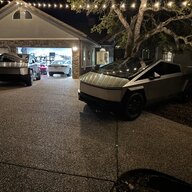
Edit: TREE LIMB! ?
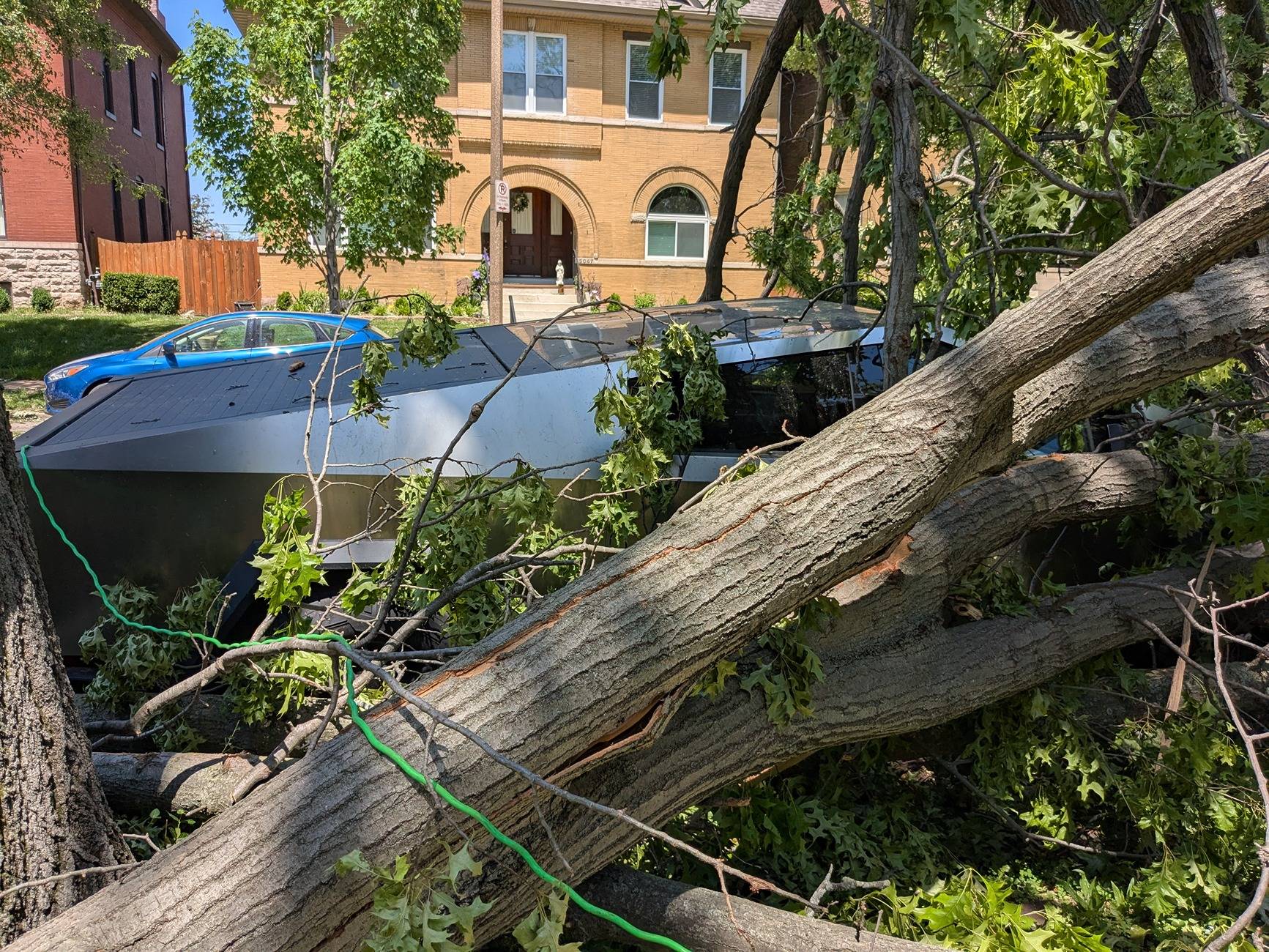
and I still had it running the refrigerator, some lights, my computer and phone for 3 days while my power was out.
speedstuff
Well-known member
- First Name
- Jason
- Joined
- Nov 27, 2024
- Threads
- 19
- Messages
- 126
- Reaction score
- 285
- Location
- El Dorado Hills
- Vehicles
- 26 CT Beast, 24 FS CT Beast, 25 MSP, 23 C8 Z06, 22 GMC 2500HD
- Occupation
- ecom
I heard on a podcast that the 80% suggestion was at least in part also due to supercharger congestion/profitability. Since it slows the charge rate so much when getting full, going from 80% to 100% can eat up as much time as the first 30%-80% did- this mattered after the supercharger network switched from 'time connected' charging rate plan/model to the current actual per KWH used plan/modelafter so many years of real world driving data on Tesla NMC battery packs, and LFP battery packs it would seem they are a lot more robust than previously thought. Showing minimal battery degradation overall, even when supercharged constantly, driven aggressively, or charged to 100% often (NMC). The biggest factor affecting degradation it would seem is just calendar life / time. Effectively that means you can take two identical cars. Keep one in the garage for five years, never driven and always plugged in at 50% state of charge then take another car and supercharge it regularly drive fast and charge to 100% (NMC) and they would show similar degradation after the 5 years. Real world data was kind of a surprise. It would seem Tesla themselves was being overly cautious with charging habits and recommendations. Batteries are more robust than people thought and just good old father time will degrade anyways.

CyberGus
Well-known member
- First Name
- Gus
- Joined
- May 22, 2021
- Threads
- 91
- Messages
- 10,240
- Reaction score
- 33,894
- Location
- Austin, TX
- Vehicles
- 1981 DeLorean, 2024 Cybertruck
- Occupation
- IT Specialist
Everyone knows that parsecs are a measure of time, not distanceYep, I do pretty much measure distance now in parsecs

Duh
henchman24
Well-known member
- Joined
- Jul 19, 2023
- Threads
- 0
- Messages
- 370
- Reaction score
- 611
- Location
- Wyoming
- Vehicles
- Dual Motor Cybertruck
The answer is yes it matters, but how much it should matter to you depends one a lot of factors. How long will you keep the vehicle? How much charge do you need each day? Do you like to have a buffer for any random errands that come up? Etc etc. It isn’t a one sized fits all situation. Tesla chose 80 because there is a real scientific benefit to it, it is easy to follow and advise, and it helps them warranty batteries.
Most NMC cells are rated today at >1000 cycles (some much higher) to 70% capacity. Simple math states 1000 cycles would put the CT at >300k mi with that. Now real world you lose some capacity so the cycle count increases and vampire drain (within reason other features) ticks that up. But even at 50% the battery should be good to 150k (easy to see why that number is chosen). So if you plan to keep beyond that, it matters. Or if you don’t drive that much and want to keep for 15 years, don’t let it sit above 55%. If you don’t, then use what you need. Now the oddity with CT is it uses 955 chemistry which is still a bit unknown on characteristics. But these looks to be safe guesses based on the trend of 811 or 721.
Now on the nerd side…. 30-50% is where NMC chemistry batteries like to live and they like to have short charge and discharge intervals in that. If you can keep it there, the batteries will way outlive the rest of the vehicle (and cycles counts will be in the few thousands). Eventually calendar aging would take over… but even with 955 chemistry, if you generally keep it under 55% that is kept to a minimum. Charging at high rates at lower SoC, low SoC, and cold doesn’t tend to impact degradation at a high level (within reason). Heat, high SoC and charging at a high rate at high states of charge tends to cause the issues. High SoC (generally >90%) and sitting for a while will accelerate lithium plating and thus accelerate calendar aging. Heat accelerates the process (typically >60c).
TLDR don’t worry about it. Use what you need, when you need to. If you don’t need it on certain days, keep it as low as comfortable.
Most NMC cells are rated today at >1000 cycles (some much higher) to 70% capacity. Simple math states 1000 cycles would put the CT at >300k mi with that. Now real world you lose some capacity so the cycle count increases and vampire drain (within reason other features) ticks that up. But even at 50% the battery should be good to 150k (easy to see why that number is chosen). So if you plan to keep beyond that, it matters. Or if you don’t drive that much and want to keep for 15 years, don’t let it sit above 55%. If you don’t, then use what you need. Now the oddity with CT is it uses 955 chemistry which is still a bit unknown on characteristics. But these looks to be safe guesses based on the trend of 811 or 721.
Now on the nerd side…. 30-50% is where NMC chemistry batteries like to live and they like to have short charge and discharge intervals in that. If you can keep it there, the batteries will way outlive the rest of the vehicle (and cycles counts will be in the few thousands). Eventually calendar aging would take over… but even with 955 chemistry, if you generally keep it under 55% that is kept to a minimum. Charging at high rates at lower SoC, low SoC, and cold doesn’t tend to impact degradation at a high level (within reason). Heat, high SoC and charging at a high rate at high states of charge tends to cause the issues. High SoC (generally >90%) and sitting for a while will accelerate lithium plating and thus accelerate calendar aging. Heat accelerates the process (typically >60c).
TLDR don’t worry about it. Use what you need, when you need to. If you don’t need it on certain days, keep it as low as comfortable.

Beetlebug62
Well-known member
- First Name
- Ken
- Joined
- Mar 24, 2025
- Threads
- 6
- Messages
- 457
- Reaction score
- 801
- Location
- Maine, USA
- Vehicles
- 2018 Tesla Model 3 LR-AWD, 2025 CyberTruck dual-motor
- Occupation
- retired

Thanks for that info.The answer is yes it matters, but how much it should matter to you depends one a lot of factors. How long will you keep the vehicle? How much charge do you need each day? Do you like to have a buffer for any random errands that come up? Etc etc. It isn’t a one sized fits all situation. Tesla chose 80 because there is a real scientific benefit to it, it is easy to follow and advise, and it helps them warranty batteries.
Most NMC cells are rated today at >1000 cycles (some much higher) to 70% capacity. Simple math states 1000 cycles would put the CT at >300k mi with that. Now real world you lose some capacity so the cycle count increases and vampire drain (within reason other features) ticks that up. But even at 50% the battery should be good to 150k (easy to see why that number is chosen). So if you plan to keep beyond that, it matters. Or if you don’t drive that much and want to keep for 15 years, don’t let it sit above 55%. If you don’t, then use what you need. Now the oddity with CT is it uses 955 chemistry which is still a bit unknown on characteristics. But these looks to be safe guesses based on the trend of 811 or 721.
Now on the nerd side…. 30-50% is where NMC chemistry batteries like to live and they like to have short charge and discharge intervals in that. If you can keep it there, the batteries will way outlive the rest of the vehicle (and cycles counts will be in the few thousands). Eventually calendar aging would take over… but even with 955 chemistry, if you generally keep it under 55% that is kept to a minimum. Charging at high rates at lower SoC, low SoC, and cold doesn’t tend to impact degradation at a high level (within reason). Heat, high SoC and charging at a high rate at high states of charge tends to cause the issues. High SoC (generally >90%) and sitting for a while will accelerate lithium plating and thus accelerate calendar aging. Heat accelerates the process (typically >60c).
TLDR don’t worry about it. Use what you need, when you need to. If you don’t need it on certain days, keep it as low as comfortable.
My 6 1/2yr old Model 3 is now at 62,800 cycles!

Oops! That's wiper cycles. Dang, all those dry wipes.
Okay, 401 cycles after 78k miles, 5% to 8% deg. Based upon that, 1000 cycles would be about 200k miles. I would guess the Cybertruck would be similar:

Beetlebug62
Well-known member
- First Name
- Ken
- Joined
- Mar 24, 2025
- Threads
- 6
- Messages
- 457
- Reaction score
- 801
- Location
- Maine, USA
- Vehicles
- 2018 Tesla Model 3 LR-AWD, 2025 CyberTruck dual-motor
- Occupation
- retired
Oh, that has to be absolutely true.I heard on a podcast that the 80% suggestion was at least in part also due to supercharger congestion/profitability. Since it slows the charge rate so much when getting full, going from 80% to 100% can eat up as much time as the first 30%-80% did- this mattered after the supercharger network switched from 'time connected' charging rate plan/model to the current actual per KWH used plan/model
In my Model 3, it takes me 18mins to go from 10% to 75% at a V3. And, it takes 20mins to go from 75% to 95%. I rarely charge above 75% because it's so slow. That's like 80kW or less. Once, you dip under 100kW charging speed, it seems like a negative trade-off for trip time. You'd be better off driving fast, stopping more, and charging at lower SOC levels.
Nice2CTu
Well-known member
- Joined
- Jun 15, 2024
- Threads
- 2
- Messages
- 110
- Reaction score
- 154
- Location
- Florida
- Vehicles
- Cybertruck Beast
Einstein kind of blurred this with his Spacetime theory of Special Relativity: "measurements of time and distance are not absolute but are relative to the observer's motion." Einstein's four-dimensional continuum is the arena in which all physical events occur. However, in favor of your statement, this doesn't mean space and time are identical; they are distinct components of spacetime.Everyone knows that parsecs are a measure of time, not distance


While distinct, space and time are interconnected. For example, the speed of light (c) is a constant in both space and time, and it acts as a conversion factor between the two. In some contexts, particularly in theoretical physics, it's convenient to express distances in terms of light-travel time, or vice versa.
Phenomena like time dilation (time passing slower for moving objects) and length contraction (objects appearing shorter in the direction of motion) demonstrate how motion affects measurements of both time and space, but they don't equate the two.
While a parsec is defined based on geometric principles involving parallax and trigonometry in Euclidean (flat) space, Einstein's theory of general relativity asserts that spacetime is curved. This curvature influences the measurement of distances. However, for distances on the scale of individual stars or even within our galaxy, the curvature of spacetime is often negligible. In such instances, the parsec provides a convenient and accurate measure.
I think Dalton108 counselor can probably launch an effective courtroom argument to "split the atom" and propose a discourse of controversy, and of course would encourage that against Cybergus, who is the absolute king of comedic connections on this board and my encouragement here is purely selfish entertainment to see where these two might spar.

Cincycyber
Well-known member
- Joined
- Dec 17, 2019
- Threads
- 6
- Messages
- 197
- Reaction score
- 303
- Location
- Cincinnati Ohio
- Vehicles
- Cyberbeast, Boxster S, Cayenne
- Occupation
- Health professional
This is an in depth look at charging. Worth a watch. I go with ABC = Always Be Charging. It seems that more frequent smaller charges are better for the LiOn crystal and prevents cracking. So my daily is 60% but will gust up to 100% as needed for road trips. Just completed a 250 mile trip that was about 80% highway on FSD (Standard mode). Arrived at destination with 15% in the battery.
henchman24
Well-known member
- Joined
- Jul 19, 2023
- Threads
- 0
- Messages
- 370
- Reaction score
- 611
- Location
- Wyoming
- Vehicles
- Dual Motor Cybertruck
Yeah in the real world you don’t get the full range nor does it account for vampire drain. 200k is a reasonable expectation for 1000 cycles (though don’t expect that many cycles on a 2021 3/Y). Might be slightly below or slightly above depending on many factors.Thanks for that info.
My 6 1/2yr old Model 3 is now at 62,800 cycles!
Oops! That's wiper cycles. Dang, all those dry wipes.
Okay, 401 cycles after 78k miles, 5% to 8% deg. Based upon that, 1000 cycles would be about 200k miles. I would guess the Cybertruck would be similar:
On a NMC or NCA pack, if you treat it perfectly… you might get to 1500-2000 cycles, but then calendar aging really sets in (especially if you hold >70% charge). And the mileage to get to that point is so high, the rest of the vehicle is likely falling apart at that stage.
I do wish that Tesla offered a lfp Cybertruck. I get why they don’t right now as the 4680 lfp cell density is so low that you’re looking at a ~220-240mi range truck. When that improves (and it seems like it will in the next couple years) the sweet spot of 275-290 should be possible. LFP would really open up power sharing to a higher degree and allow the battery to be treated more poorly (higher SoC and more frequent top ups). A 2000-2500 cycle count should be easily possible with LFP even with maintaining high states of charge and frequent top ups.

dalton108
Well-known member
- First Name
- Dalton
- Joined
- Oct 17, 2020
- Threads
- 131
- Messages
- 3,958
- Reaction score
- 7,893
- Location
- USA
- Vehicles
- ‘24 FS/CB; ‘24 MX; ‘23 MS PLAID (Prior: ‘20-MY; ‘21-M3P) (Also: ‘14-FJ; ‘21-C8)
- Occupation
- Lawyer
Everyone knows that parsecs are a measure of time, not distance
Duh
????. You know, I should’ve just gone with my original formulation, which, I shit you not was:Einstein kind of blurred this with his Spacetime theory of Special Relativity: "measurements of time and distance are not absolute but are relative to the observer's motion." Einstein's four-dimensional continuum is the arena in which all physical events occur. However, in favor of your statement, this doesn't mean space and time are identical; they are distinct components of spacetime.
While distinct, space and time are interconnected. For example, the speed of light (c) is a constant in both space and time, and it acts as a conversion factor between the two. In some contexts, particularly in theoretical physics, it's convenient to express distances in terms of light-travel time, or vice versa.
Phenomena like time dilation (time passing slower for moving objects) and length contraction (objects appearing shorter in the direction of motion) demonstrate how motion affects measurements of both time and space, but they don't equate the two.
While a parsec is defined based on geometric principles involving parallax and trigonometry in Euclidean (flat) space, Einstein's theory of general relativity asserts that spacetime is curved. This curvature influences the measurement of distances. However, for distances on the scale of individual stars or even within our galaxy, the curvature of spacetime is often negligible. In such instances, the parsec provides a convenient and accurate measure.
I think Dalton108 counselor can probably launch an effective courtroom argument to "split the atom" and propose a discourse of controversy, and of course would encourage that against Cybergus, who is the absolute king of comedic connections on this board and my encouragement here is purely selfish entertainment to see where these two might spar.
“Yep, I do pretty much measure distance now in parsecs [I know NERD!] — err uhh, I mean percent of battery it will cost me.”
But, I convinced myself that it was unnecessary because nobody on the forum would be so depraved a pedant as to bring it up, and then I would look like an asshole for trying to be preemptive. I blame myself!
Last edited:
mongo
Well-known member
- Joined
- May 27, 2024
- Threads
- 5
- Messages
- 4,521
- Reaction score
- 5,499
- Location
- SE Michigan
- Vehicles
- Cyberbeast
Per the movie Solo, the Millennium Falcon cut 8 parsecs off the normal distance of the Kessel run by flying through the Maw.????. You know, I should’ve just go with my original formulation, which, I shit you not was:
“Yep, I do pretty much measure distance now in parsecs [I know NERD!] — err uhh, I mean percent of battery it will cost me.”
But, I convinced myself that it was unnecessary because nobody on the forum would be so depraved a pedant as to bring it up, and then I would look like an asshole for trying to be preemptive. I blame myself!
Per Lucas's notes, MF has advanced navigation system which allowed shorter Hyperspace transit distances.
Per the script, Han was full of crap and had no idea what he was talking about.
https://starwars.fandom.com/wiki/Kessel_Run/Legends
dalton108
Well-known member
- First Name
- Dalton
- Joined
- Oct 17, 2020
- Threads
- 131
- Messages
- 3,958
- Reaction score
- 7,893
- Location
- USA
- Vehicles
- ‘24 FS/CB; ‘24 MX; ‘23 MS PLAID (Prior: ‘20-MY; ‘21-M3P) (Also: ‘14-FJ; ‘21-C8)
- Occupation
- Lawyer
Per the movie Solo, the Millennium Falcon cut 8 parsecs off the normal distance of the Kessel run by flying through the Maw.
Per Lucas's notes, MF has advanced navigation system which allowed shorter Hyperspace transit distances.
Per the script, Han was full of crap and had no idea what he was talking about.
https://starwars.fandom.com/wiki/Kessel_Run/Legends


REM
Well-known member
- Joined
- Dec 9, 2023
- Threads
- 14
- Messages
- 3,577
- Reaction score
- 6,644
- Location
- NC
- Vehicles
- 2020 Model 3 Standard Range++ & Diet Cybertruck, Dual Motor
- Occupation
- Professional Retard
?? ?TLDR don’t worry about it. Use what you need, when you need to. If you don’t need it on certain days, keep it as low as comfortable.
Sponsored
Similar threads

- Replies
- 33
- Views
- 28,069


