
Sponsored

PCS failure rates by year...is it just a matter of time?

Metalwolftensei

New member
First Name
Nate
Joined
Jan 27, 2026
Threads
0
Messages
2
Reaction score
2
Location
Pennsylvania
Vehicles
Cybertruck Foundation, Model Y Juniper
Occupation
Military
Country flag
Is there a way to see if the PCS is failing if your household setup limits you to 24 amps? Since ownership I have always limited my charging to +24..
Sponsored


 

Outdoors

Well-known member
First Name
Outdoors
Joined
Nov 19, 2019
Threads
18
Messages
1,893
Reaction score
3,482
Location
North West Montana
Vehicles
S,3,Y,CT,CT(holding pattern) Slate is back on
Is there a way to see if the PCS is failing if your household setup limits you to 24 amps? Since ownership I have always limited my charging to +24..
Easy suggestion would be to check plugshare.com for an AC charger nearby. A DC fast charger wouldn't be what would help you if one is trying to test the AC side of the PCS.

Toggle the filters for what you are after amp wise.
 

Sjohnson20

Well-known member
Joined
Nov 30, 2023
Threads
8
Messages
1,440
Reaction score
2,442
Location
Florida
Vehicles
Cybertruck AWD, Model Y
Country flag
Is there a way to see if the PCS is failing if your household setup limits you to 24 amps? Since ownership I have always limited my charging to +24..
not a guarantee but it might say something in the service mode if it had a PCS error.
 

TyPope

Well-known member
First Name
Ty
Joined
Mar 31, 2020
Threads
33
Messages
3,221
Reaction score
4,939
Location
Chesapeake Beach, MD
Vehicles
'23 MYLR, FS Cyberbeast 280xx
Occupation
Current Operations for... an organization
Country flag
I think we all need to file nhtsa especially those that had the issue. Grok says 40% of owners are having issues… https://www.nhtsa.gov/report-a-safety-problem

We could end up stranded in unsafe conditions if our vehicles won’t charge while traveling. We shouldn’t be waiting to either fix it free after it happens or pay $7-6000 dollars when it happens after warranty. Sounds like it’s not an if but a when situation.


My truck hasn’t failed yet, but I’m genuinely concerned it might. I’m hearing from a lot of other Cybertruck owners that their Power Conversion System has failed, and now that people are getting past the 50,000-mile warranty mark, repairs are reportedly costing over $6,000.

From what I understand, when it fails the truck suddenly can’t charge, which essentially makes it unusable. That’s what worries me most. If this happens at 50,001 miles, you’re suddenly responsible for a $6,000 repair on what appears to be a known issue.

I’m getting close to that mileage, and I’ve seen reports of failures happening anywhere from 5,000 miles to much higher. It makes me uneasy knowing this could happen at any time or even worse wrote after my warranty ends!!!

I honestly wish there were a way to proactively test or address it before the warranty expires.

Does this seem like something that should qualify as a recall if it’s a known issue that renders the vehicle unable to charge and effectively unusable? What would you recommend?
I've only heard of a couple having issues. Maybe a handful. It's out of my control so I'm not going to worry about it. Will that bite me in the ass someday? Maybe. That's a problem for future me. Today me is enjoying my truck.
 

Known-Background

Well-known member
Joined
Jan 15, 2024
Threads
39
Messages
286
Reaction score
487
Location
Pennsylvania
Vehicles
ModelY, Cybertruck AWD
Country flag
I've only heard of a couple having issues. Maybe a handful. It's out of my control so I'm not going to worry about it. Will that bite me in the ass someday? Maybe. That's a problem for future me. Today me is enjoying my truck.
Zen


btcrealm

Well-known member
First Name
Brian
Joined
Aug 28, 2024
Threads
7
Messages
761
Reaction score
989
Location
Virginia-ish, USA
Vehicles
cybertruck
Occupation
NOC
Country flag
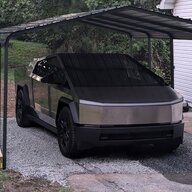
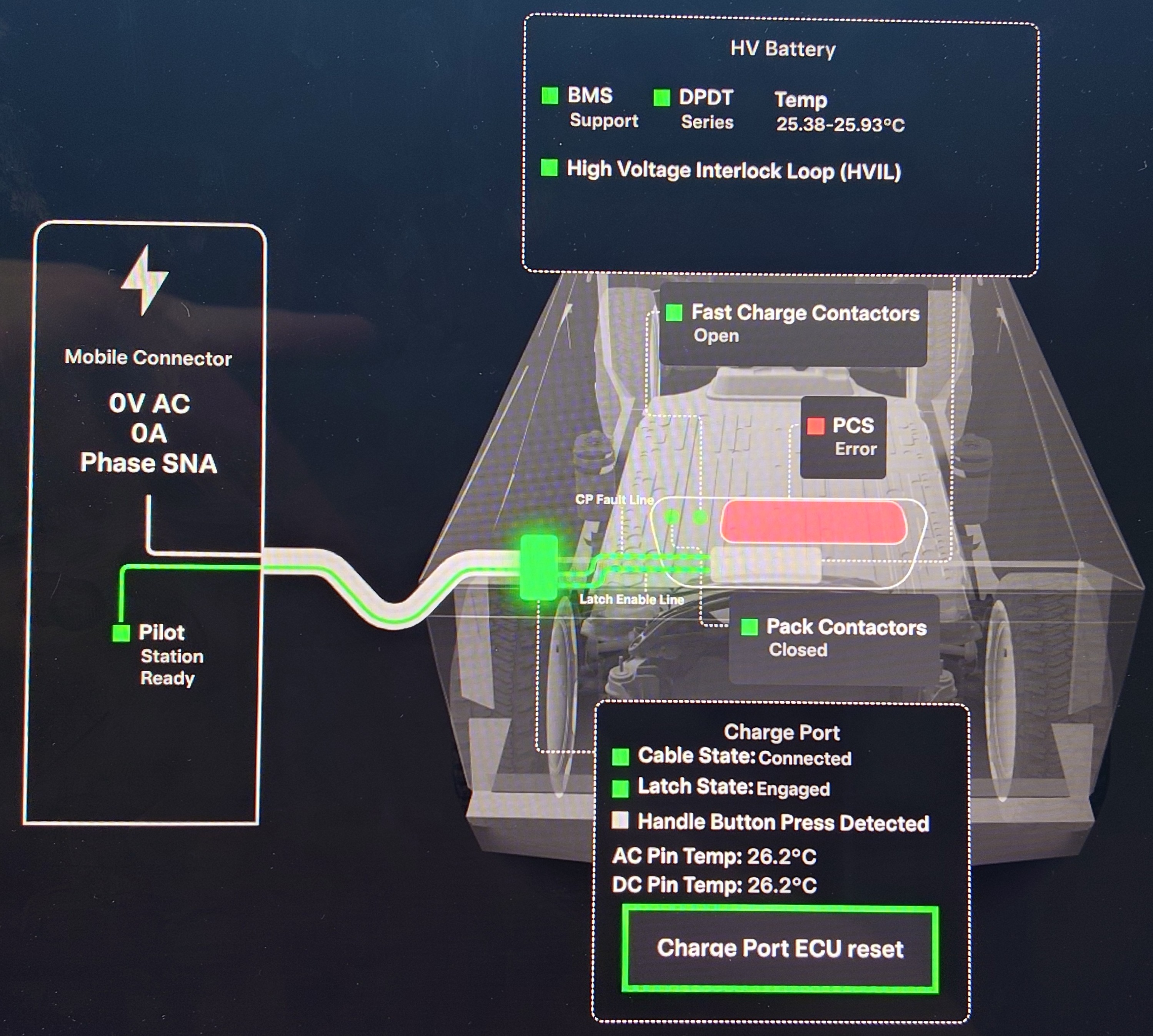
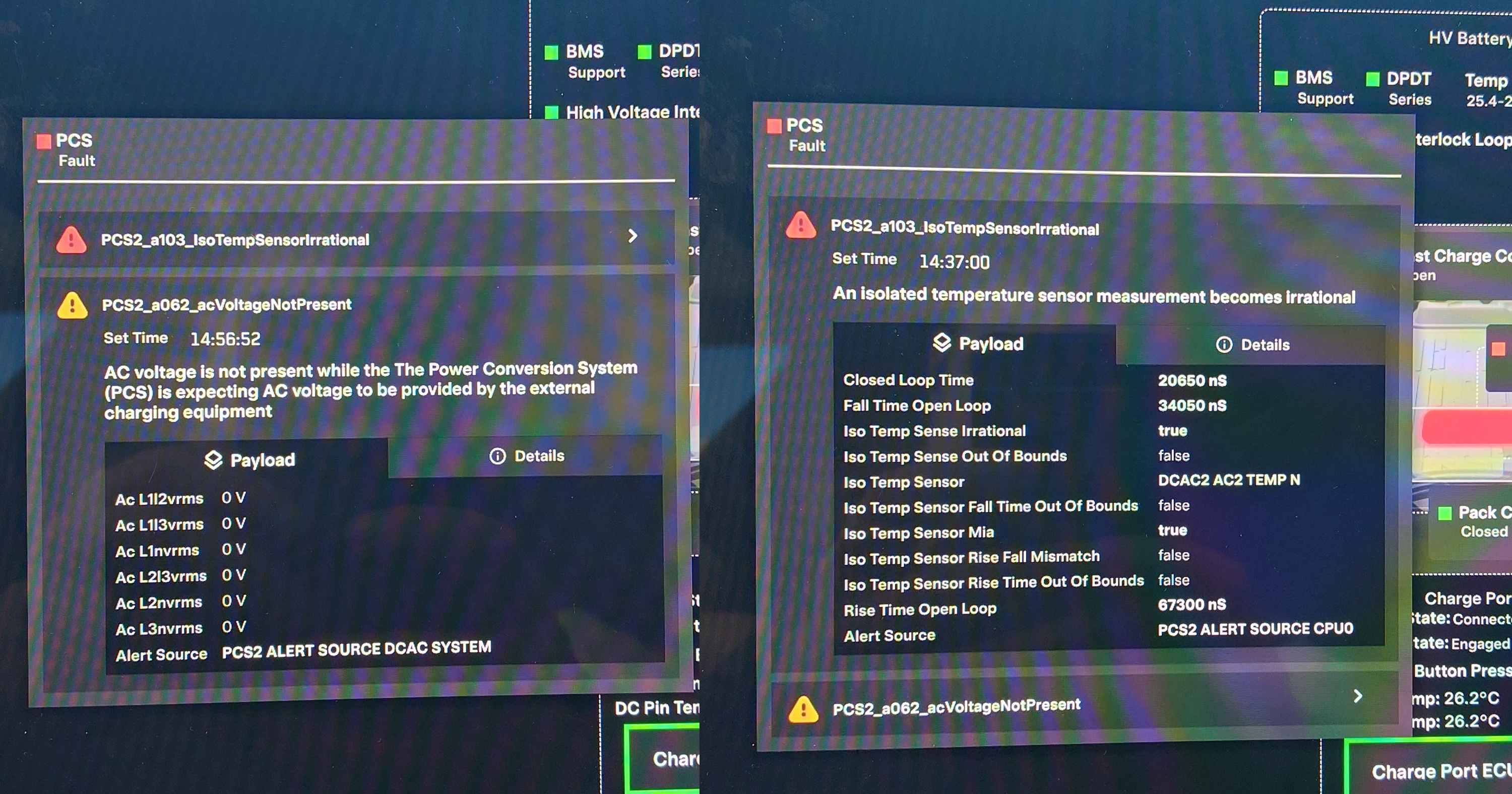
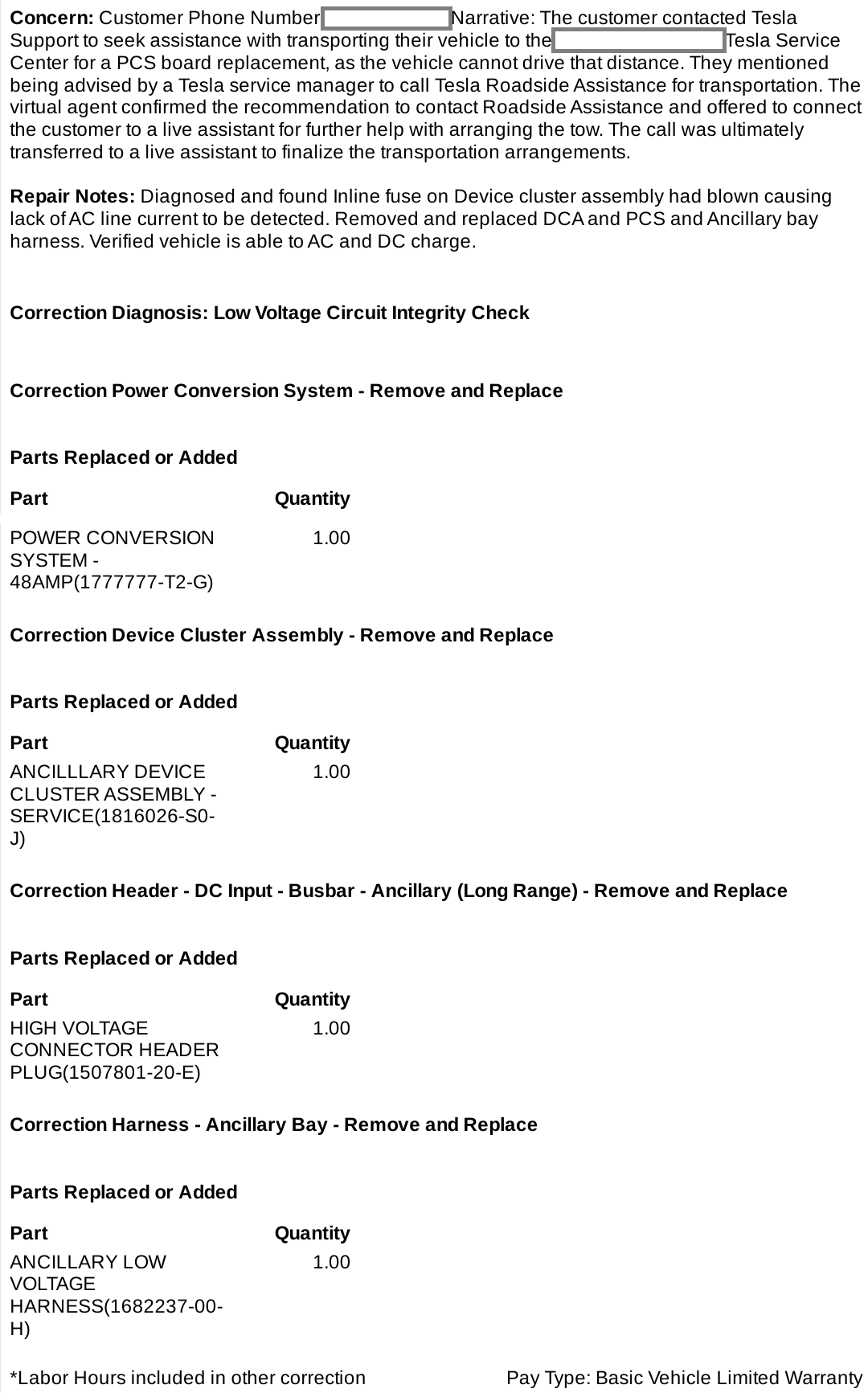
Can confirm my August 2024 Cyberbeast PCS controller failed on me March 10th. It was plugged in and charging (Tesla L2 standard charger) when it failed.
Tesla Cybertruck PCS failure rates by year...is it just a matter of time? PCS.error
Tesla Cybertruck PCS failure rates by year...is it just a matter of time? PCS.codes
Tesla Cybertruck PCS failure rates by year...is it just a matter of time? tesla.pcs.invoice
 

koolio

Well-known member
Joined
Dec 4, 2024
Threads
3
Messages
1,047
Reaction score
1,105
Location
Greater Boston, MA
Vehicles
2024 Cybertruck, 2024 Model 3 (former: 2020 Model Y)
Country flag
Does anyone have data that shows when to expect it to fail?

I’m wondering is it number of charge sessions, amperage of the session, and duration? I’m guessing it’s not mileage dependent per se, but one would expect higher mileage = more charging sessions thus more “wear” on the PCS before failure.

Asking because I’m wondering when this will occur on my Nov 2024 built AWD. I only have 10k miles and 90% of charging is at home (mostly at 24-32amps bc I use Charge on Solar, but also at 48a when needed).
 

noobla3

Well-known member
Joined
Jan 19, 2025
Threads
10
Messages
278
Reaction score
243
Location
United States
Vehicles
CT
Occupation
Unemployed
Country flag
Does anyone have data that shows when to expect it to fail?

I’m wondering is it number of charge sessions, amperage of the session, and duration? I’m guessing it’s not mileage dependent per se, but one would expect higher mileage = more charging sessions thus more “wear” on the PCS before failure.

Asking because I’m wondering when this will occur on my Nov 2024 built AWD. I only have 10k miles and 90% of charging is at home (mostly at 24-32amps bc I use Charge on Solar, but also at 48a when needed).
I charge at 24 amps at home also. I think most of the reports are charging at 48 amps.
 

Jager

Well-known member
First Name
Jeff
Joined
May 25, 2020
Threads
25
Messages
339
Reaction score
1,092
Location
Virginia
Vehicles
2024 Cybertruck AWD, 2022 Model 3 LR AWD
Country flag
No one outside Tesla knows the frequency of PCS failure or any causal pattern(s) that might exist.

The anecdotal examples on the forum here are all over the place. It's been suggested that higher L2 charging amperages might be at play, presumably because of the additional heat that would involve. But it's a pretty straightforward engineering exercise to understand component temperature at various L2 power levels and Tesla's engineers have historically demonstrated a very high degree of technical acumen. So that kind of obvious engineering mistake doesn't make a lot of sense.

And AFAIK Tesla service centers are not quizzing customers with failed PCS units as to what their charging habits have been; and while the vehicle permanently logs AC vs DC kWh's charged, it doesn't, AFAIK, log the actual power levels.

Given all that, I'm disinclined to think higher L2 power levels are the problem. If I could charge at higher than my present 32 amps (40-amp branch circuit), I would.

My guess - and that's all it is - is that the PCS2 failures are related to heat-related component failure, but not associated with L2 power levels.

I might be entirely wrong...


Eka

Well-known member
First Name
Ekaterine
Joined
Feb 20, 2026
Threads
1
Messages
232
Reaction score
215
Location
The land between two rivers.
Vehicles
Model Y, Cybertruck
Occupation
disabled
Country flag
No one outside Tesla knows the frequency of PCS failure or any causal pattern(s) that might exist.

The anecdotal examples on the forum here are all over the place. It's been suggested that higher L2 charging amperages might be at play, presumably because of the additional heat that would involve. But it's a pretty straightforward engineering exercise to understand component temperature at various L2 power levels and Tesla's engineers have historically demonstrated a very high degree of technical acumen. So that kind of obvious engineering mistake doesn't make a lot of sense.

And AFAIK Tesla service centers are not quizzing customers with failed PCS units as to what their charging habits have been; and while the vehicle permanently logs AC vs DC kWh's charged, it doesn't, AFAIK, log the actual power levels.

Given all that, I'm disinclined to think higher L2 power levels are the problem. If I could charge at higher than my present 32 amps (40-amp branch circuit), I would.

My guess - and that's all it is - is that the PCS2 failures are related to heat-related component failure, but not associated with L2 power levels.

I might be entirely wrong...
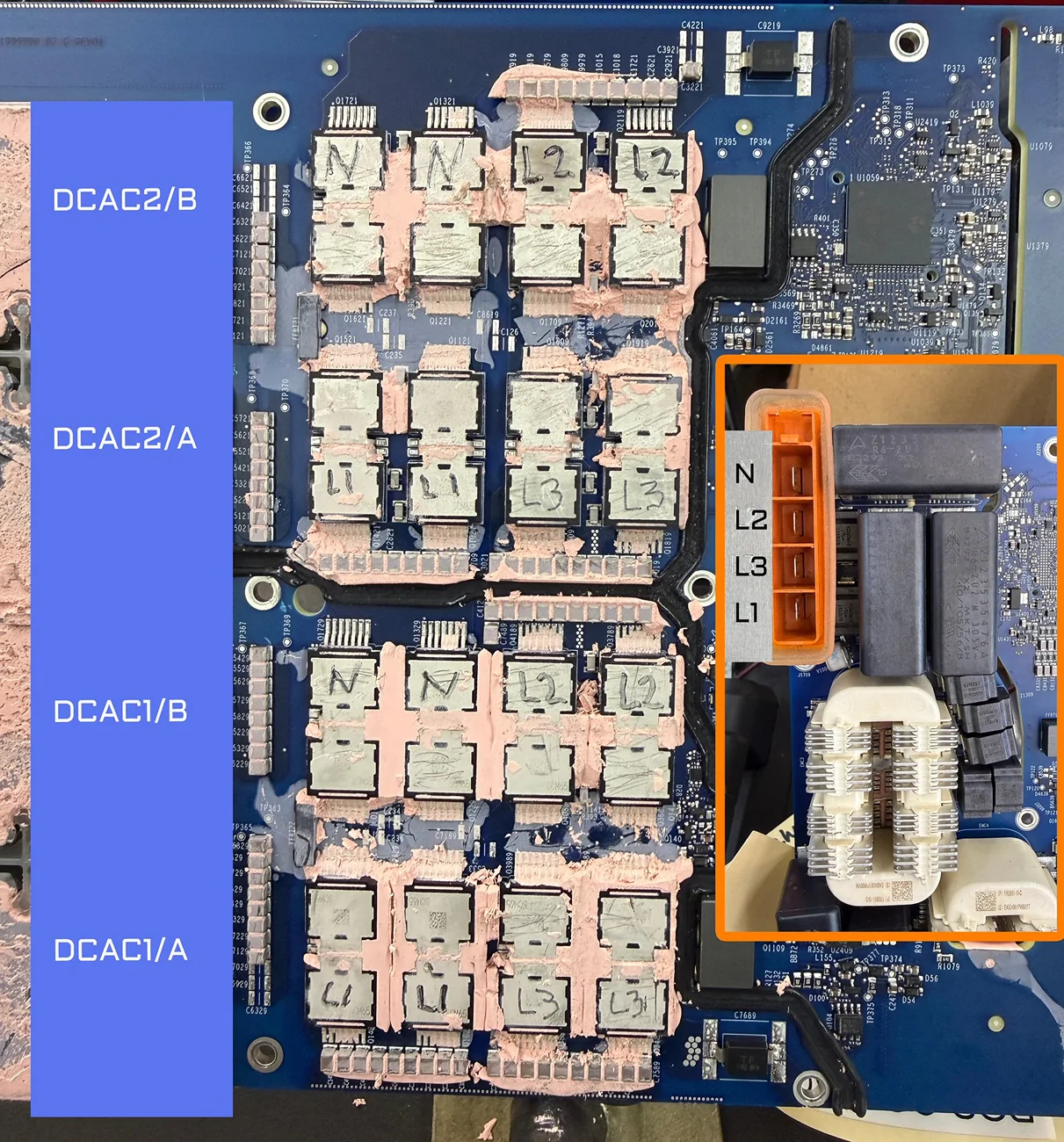
I think it is the AC power components on the bottom of the PCB. The power components may have been hanging on to the bottom side and their solder remelted as the top side chips were soldered in the reflow oven. This allowed them to become less level as they are just hanging on the melted solder. The fix is to have the power components on the last side of the PCB soldered. The other issue is they might not have enough copper in the PCB to draw heat away. A thicker copper layer is the solution. If somebody could get me the chip ID, or power and it's internal construction, I could rough guess the PCB thermal area needed. I thought they were too close, but advances in power FETs. Using a PCB inductor means they need a high switching frequency. That could add lots of thermal load if the gates are not properly driven.

Video in this post shows evidence the components are not level.
https://www.cybertruckownersclub.co...-it-just-a-matter-of-time.55072/post-30778754

(I might have designed and made more than a few high power PCBs in the past.)
 

mongo

Well-known member
Joined
May 27, 2024
Threads
6
Messages
4,549
Reaction score
5,537
Location
SE Michigan
Vehicles
Cyberbeast
Country flag
I think it is the AC power components on the bottom of the PCB. The power components may have been hanging on to the bottom side and their solder remelted as the top side chips were soldered in the reflow oven. This allowed them to become less level as they are just hanging on the melted solder. The fix is to have the power components on the last side of the PCB soldered. The other issue is they might not have enough copper in the PCB to draw heat away. A thicker copper layer is the solution. If somebody could get me the chip ID, or power and it's internal construction, I could rough guess the PCB thermal area needed. I thought they were too close, but advances in power FETs. Using a PCB inductor means they need a high switching frequency. That could add lots of thermal load if the gates are not properly driven.

Video in this post shows evidence the components are not level.
https://www.cybertruckownersclub.co...-it-just-a-matter-of-time.55072/post-30778754

(I might have designed and made more than a few high power PCBs in the past.)
The FETs dump heat to the liquid cooled cold plate. AC side looks like ST SCT040HU65G3AG HU3PAK parts.
https://www.st.com/resource/en/tech...g-and-thermal-behavior-stmicroelectronics.pdf
 
  • Like
Reactions: Eka

Eka

Well-known member
First Name
Ekaterine
Joined
Feb 20, 2026
Threads
1
Messages
232
Reaction score
215
Location
The land between two rivers.
Vehicles
Model Y, Cybertruck
Occupation
disabled
Country flag
The FETs dump heat to the liquid cooled cold plate. AC side looks like ST SCT040HU65G3AG HU3PAK parts.
https://www.st.com/resource/en/tech...g-and-thermal-behavior-stmicroelectronics.pdf
From the PDF file:
If components must be placed on both PCB sides, the side with HU3PAK must be processed last, as wetting forces could not hold the HU3PAK package during a second reflow.
As suspected.

The package looks to be designed to dump heat out via a heatsink/cold wall on top of it like Tesla uses, versus using the PCB copper traces. The copper traces only seam to be used for current flow and signals.

Section "3: Heat sink attachment to package" tells me using a thermal compound that can be totally squished out is electrically bad. Can this be the right package? Where is the needed electrical isolation coming from? The Munro video shows use of what looks like a caulk style gap filling thermal compound. They don't reliably provide electrical isolation. Also many of them are not as good conductors of heat as some of the thermal pad style. OK, looked at the Munro video again. There is a black surface on the electronics side of the cold plate. It might be the electrical insulator.

While it may seam like a very high heat conductivity compound that stays fluid or semi fluid could be used, they often contain electrically conductive particles. In an environment where vibration is common, they eventually end up everywhere. Been there, done that, suffered the consequences. Poor PCB became an arc path as it vaporized...
 

mongo

Well-known member
Joined
May 27, 2024
Threads
6
Messages
4,549
Reaction score
5,537
Location
SE Michigan
Vehicles
Cyberbeast
Country flag
From the PDF file:

As suspected.

The package looks to be designed to dump heat out via a heatsink/cold wall on top of it like Tesla uses, versus using the PCB copper traces. The copper traces only seam to be used for current flow and signals.

Section "3: Heat sink attachment to package" tells me using a thermal compound that can be totally squished out is electrically bad. Can this be the right package? Where is the needed electrical isolation coming from? The Munro video shows use of what looks like a caulk style gap filling thermal compound. They don't reliably provide electrical isolation. Also many of them are not as good conductors of heat as some of the thermal pad style. OK, looked at the Munro video again. There is a black surface on the electronics side of the cold plate. It might be the electrical insulator.

While it may seam like a very high heat conductivity compound that stays fluid or semi fluid could be used, they often contain electrically conductive particles. In an environment where vibration is common, they eventually end up everywhere. Been there, done that, suffered the consequences. Poor PCB became an arc path as it vaporized...
Not sure on what material they used between the package and cold plate.
Tesla Cybertruck PCS failure rates by year...is it just a matter of time? HBd1Ah-bMAAH0fX(2)


btcrealm

Well-known member
First Name
Brian
Joined
Aug 28, 2024
Threads
7
Messages
761
Reaction score
989
Location
Virginia-ish, USA
Vehicles
cybertruck
Occupation
NOC
Country flag
Last edited:


Top