Sponsored

20/80 Li Ion Charging

Stratosurfer

Member
First Name
Mark
Joined
Jan 4, 2020
Threads
2
Messages
10
Reaction score
8
Location
San Angelo Texas
Vehicles
Ford C-Max Hybrid, Honda Pilot, 98 2500 Suburban 2500
Occupation
Financial Advisor
Country flag
My research over the years has found that Li Ion batteries charged to 80% maximum and discharged to no more than 20% have an ‘indefinite’ lifespan. I understand there are many other factors but that this is a fundamental of this battery chemistry.
Will CT (or do any Teslas) allow programming for an 80/20 regimen?
If so… and this is recommended to maintain battery pack life, the a 500 mile range CT would be reduced to a functional range of 60% of that or 300 miles. And a 300 mile range CT would be reduced to 180 miles if these ship with Li Ion packs.
Im having a hard time with this functionality against hybrid tech.
Thoughts?
Sponsored

 

kbolt

Well-known member
Joined
Oct 15, 2021
Threads
16
Messages
748
Reaction score
1,101
Location
SLC
Vehicles
Model Y
Country flag
Are you suggesting that you never charge it above 80% and you never discharge it below 20%, but you can charge/discharge any amount in between? Or, are you saying that once you charge it to 80% you can't charge it anymore until it is discharged to 20%?

Because in the case of the former I have mine set to 80% charge limit and then I'll drive like 10 miles (~2%) and then I'll go back home and charge it back to 80% and repeat on a near daily basis.

In the case of the latter it would require a significant amount of discipline to monitor it for when it reaches 80% and then unplug. You don't want to get trickle charge to top off slow drain. Then you would drive around for a week or two until you reach 20% and you might need to drive around the block a few times to get it from 21% down to 20% with care not to get it to 19%.

It's sort of pedantic in the description, but the real life repercussions are huge. I know I wouldn't want to live in the second scenario. I think Tesla batteries have been tested to last 1 million miles and still go so I would rather live under the first scenario and not worry about a few percent of degradation every year. Fewer gray hairs in the first scenario.
 

JBee

Well-known member
First Name
JB
Joined
Nov 22, 2019
Threads
18
Messages
4,913
Reaction score
6,362
Location
Australia
Vehicles
Cybertruck
Occupation
. Professional Hobbyist
Country flag
Are you suggesting that you never charge it above 80% and you never discharge it below 20%, but you can charge/discharge any amount in between? Or, are you saying that once you charge it to 80% you can't charge it anymore until it is discharged to 20%?

Because in the case of the former I have mine set to 80% charge limit and then I'll drive like 10 miles (~2%) and then I'll go back home and charge it back to 80% and repeat on a near daily basis.

In the case of the latter it would require a significant amount of discipline to monitor it for when it reaches 80% and then unplug. You don't want to get trickle charge to top off slow drain. Then you would drive around for a week or two until you reach 20% and you might need to drive around the block a few times to get it from 21% down to 20% with care not to get it to 19%.

It's sort of pedantic in the description, but the real life repercussions are huge. I know I wouldn't want to live in the second scenario. I think Tesla batteries have been tested to last 1 million miles and still go so I would rather live under the first scenario and not worry about a few percent of degradation every year. Fewer gray hairs in the first scenario.
The less you cycle the battery state of charge the longer it lasts. The cycle life can be orders of magnitude more if you do this.

So recharging it often for small percentages is better than charging it seldom and only when at 20%. Same for driving it from 80%.

It's worth noting here that the 20/80 isn't a hard rule or point, it's just from where it gets considerably worse in comparison. Other factors like rate of charge/discharge and temperature also play a role in how often you can cycle a battery.

Basically the less extreme the conditions and state change, the longer they last.

But all this should be taken with a grain of salt, as many new batteries haven't even been around long enough to test full real-life life cycles. There's some data to support this though, and that has been extrapolated.
 

Gurule92

Well-known member
Joined
Sep 2, 2021
Threads
201
Messages
3,825
Reaction score
7,373
Location
Colorado Springs
Vehicles
MYP
Occupation
"Cyber" stuff
Country flag
You can program max charge.

Keeping it above 20% is up to you.

You can schedule charge, set rates, etc.
 

PilotPete

Well-known member
First Name
Pete
Joined
May 8, 2023
Threads
12
Messages
1,578
Reaction score
3,969
Vehicles
Porsche, BMW, M3LR on order
Occupation
Chief Pilot
Country flag
LFP batteries in the M3 contain a note that they SHOULD be charged to 100%, not 80%. NMC batteries (like the 4680) are the ones Tesla sets a lower daily charge to by default.

There is a company that drives between LA and SFO and the almost exclusively use superchargers. Their batteries SHOULD be worthless after 100,000 miles, according to “common knowledge” and the interwebthing, but they’re not. They’re far closer to brand new than any of the projections. In fact, all Tesla’s data is indicating battery performance far better than expected.


Crissa

Well-known member
First Name
Crissa
Joined
Jul 8, 2020
Threads
138
Messages
19,571
Reaction score
31,475
Location
Santa Cruz
Vehicles
2014 Zero S, 2013 Mazda 3
Country flag
My research over the years has found that Li Ion batteries charged to 80% maximum and discharged to no more than 20% have an ‘indefinite’ lifespan. I understand there are many other factors but that this is a fundamental of this battery chemistry.
Will CT (or do any Teslas) allow programming for an 80/20 regimen?
If so… and this is recommended to maintain battery pack life, the a 500 mile range CT would be reduced to a functional range of 60% of that or 300 miles. And a 300 mile range CT would be reduced to 180 miles if these ship with Li Ion packs.
Im having a hard time with this functionality against hybrid tech.
Thoughts?
Pretty much all Tesla batteries seem to have an indeterminate (aka long) lifetime.

-Crissa
 
Last edited:
OP
OP

Stratosurfer

Member
First Name
Mark
Joined
Jan 4, 2020
Threads
2
Messages
10
Reaction score
8
Location
San Angelo Texas
Vehicles
Ford C-Max Hybrid, Honda Pilot, 98 2500 Suburban 2500
Occupation
Financial Advisor
Country flag
So then… bottom line on the 3 motor CT it should actually be able to be driven 500ish miles on the largest pack and charged to 100 then discharged to near zero and the pack should suffer little or no accelerated degradation?
 

CyberGus

Well-known member
First Name
Gus
Joined
May 22, 2021
Threads
91
Messages
10,236
Reaction score
33,888
Location
Austin, TX
Vehicles
1981 DeLorean, 2024 Cybertruck
Occupation
IT Specialist
Country flag
There are multiple, lengthy threads on TMC about degradation. For NMC cells, in short:
  • Cells degrade with time (“calendar aging”) regardless of your behavior
  • Calendar aging accelerates when stored above 50% State of Charge (SoC) and dramatically above 80%
  • Calendar aging is worse in higher temps, better in lower temps, proportionate to SoC
  • While the 80-20 rule is good guidance, you can use the full capacity of your pack when needed without worry.
 

charliemagpie

Well-known member
First Name
Charlie
Joined
Jul 6, 2021
Threads
48
Messages
2,982
Reaction score
5,369
Location
Australia
Vehicles
CybrBEAST
Occupation
retired
Country flag
I am far from being an expert at this

But If performance is going to degrade ~5% in 10 years Vrs ~3% if I take care of it....

I don't care to fark around every week and fuss over it.
If I am out a few percent, same applies.
 

JBee

Well-known member
First Name
JB
Joined
Nov 22, 2019
Threads
18
Messages
4,913
Reaction score
6,362
Location
Australia
Vehicles
Cybertruck
Occupation
. Professional Hobbyist
Country flag
So then… bottom line on the 3 motor CT it should actually be able to be driven 500ish miles on the largest pack and charged to 100 then discharged to near zero and the pack should suffer little or no accelerated degradation?
No this will damage your pack. you should never go to a low state of charge (SoC) if you can avoid it, and if so not keep it there for a long period before recharging.

The best part of the pack SoC to use to combat degradation is roughly 70% of the pack and working out from there with a bias to the lower SOC to like between 75-45%.

The effects on cycle degradation of using large amounts of state of charge are well documented.

Using the middle portion of the SoC and avoiding the high and low parts, reduces the physical amount the cell expands and contracts, which in turn reduces structural reforming and island creation within the cell from SEI formation. The 80/20 rule lops off the most damaging parts of SoC, but is still not as good as prioritising certain SoC methods. This means that the cell not only holds its capacity for longer, it also can double how many cycles you can do without meaningful degradation. As can be seen below.

Tesla Cybertruck 20/80 Li Ion Charging 1698033999738


So as pointed out above the more often you charge within the ideal SoC range, like doing it daily after a commute to work, the better it is for cell performance.

You should AVOID using the battery to lower SoC (under 15% of "actual"capacity is doing meaningful changes and damage) and should NOT charge it once a week if you use it every day and can charge it at home to keep it around 70%.

So if you only want to do 100miles, like for a daily commute, on a 500mile CT you should use between 75% and 55% to do so to minimise long term cell degradation.


Diehard

Well-known member
First Name
D
Joined
Dec 5, 2020
Threads
23
Messages
2,127
Reaction score
4,257
Location
U.S.A.
Vehicles
Olds Aurora V8, Saturn Sky redline, Lightning, CT2
Country flag
No this will damage your pack. you should never go to a low state of charge (SoC) if you can avoid it, and if so not keep it there for a long period before recharging.

The best part of the pack SoC to use to combat degradation is roughly 70% of the pack and working out from there with a bias to the lower SOC to like between 75-45%.

The effects on cycle degradation of using large amounts of state of charge are well documented.

Using the middle portion of the SoC and avoiding the high and low parts, reduces the physical amount the cell expands and contracts, which in turn reduces structural reforming and island creation within the cell from SEI formation. The 80/20 rule lops off the most damaging parts of SoC, but is still not as good as prioritising certain SoC methods. This means that the cell not only holds its capacity for longer, it also can double how many cycles you can do without meaningful degradation. As can be seen below.

1698033999738.png


So as pointed out above the more often you charge within the ideal SoC range, like doing it daily after a commute to work, the better it is for cell performance.

You should AVOID using the battery to lower SoC (under 15% of "actual"capacity is doing meaningful changes and damage) and should NOT charge it once a week if you use it every day and can charge it at home to keep it around 70%.

So if you only want to do 100miles, like for a daily commute, on a 500mile CT you should use between 75% and 55% to do so to minimise long term cell degradation.
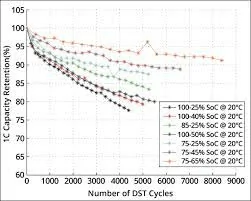
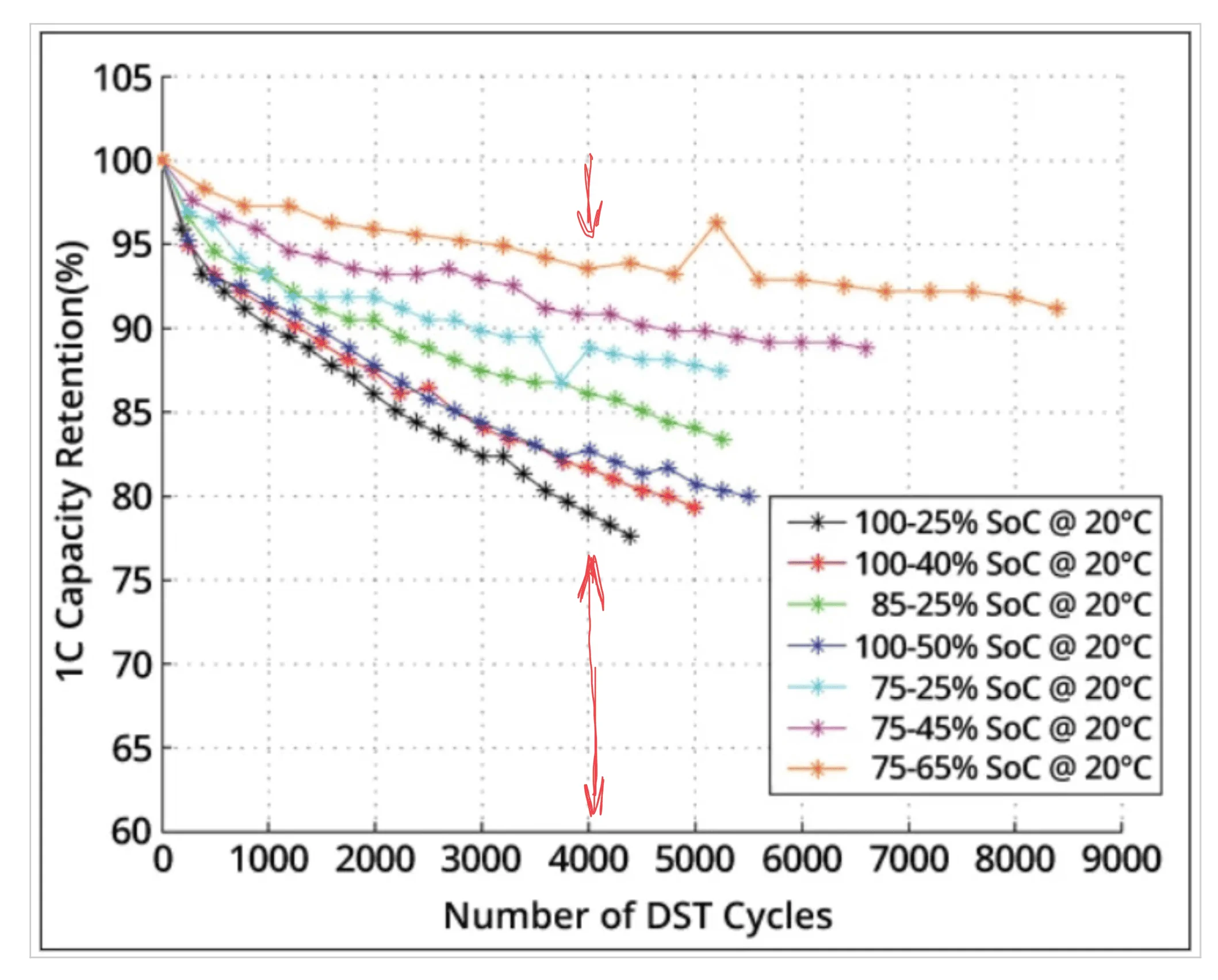
Trying to make sure I understand this correctly. Looking at 4000 DST cycles. Does this mean if we charge and discharge from 25% SOC to 100% SOC 4000 times we are left with around 78% of battery capacity and if we charge and discharge from 65% to 75% 4000 times we are left with around 94% of the capacity?

Tesla Cybertruck 20/80 Li Ion Charging 1697951688440
 

JBee

Well-known member
First Name
JB
Joined
Nov 22, 2019
Threads
18
Messages
4,913
Reaction score
6,362
Location
Australia
Vehicles
Cybertruck
Occupation
. Professional Hobbyist
Country flag
Trying to make sure I understand this correctly. Looking at 4000 DST cycles. Does this mean if we charge and discharge from 25% SOC to 100% SOC 4000 times we are left with around 78% of battery capacity and if we charge and discharge from 65% to 75% 4000 times we are left with around 94% of the capacity?

1697951688440.png
Yes it's about 16% worse in comparison. But you also get half the amount of cycles in comparison too, which means the total amount of miles driven are with a higher capacity pack (should you need it) and you get more mile per pack as well.

Note that capacity degradation is related to reduced cycle life as well, because both share the same cause. If you can, you should use the part of the SoC that reduces the likelihood of degradation. That "optimal" point is around the 70% SoC mark and one should try to add SoC for range on either side of that point, with a bias to the lower SoC. This is not always practical, in that you might be travelling without access to home/destination charging, or have long distances between SC.

But "if" your base load of driving is commuting and charging from home you can reduce the degradation by optimizing you commute and charging to the 70% SoC point.

There's another factor her that with older vehicles that already have several hundred cycles, that you should also bump up the "min" 20% SoC limit to a higher 25% or more limit. Cell expansion increases in the lower SoC under 20%, but only increases slower in the top of the SoC overall (over 80%). This means with an older battery you should gradually reduce how much low SoC you use. This also gives a significant improvement on cycle life, and extends the range capacity for those intermittent times you actually need it.

It's important to understand that intermittent use of the full SoC is much better than continuous use of the full SOC. It's a bit like a balloon, the more times you inflate it full, the floppier it becomes.

BTW a lot of this is top and bottom lopping is already included in the BMS to get the performance we have, but even less cell degradation can be achieved if you cycle often but only a low amount of SoC.
 

Crissa

Well-known member
First Name
Crissa
Joined
Jul 8, 2020
Threads
138
Messages
19,571
Reaction score
31,475
Location
Santa Cruz
Vehicles
2014 Zero S, 2013 Mazda 3
Country flag
Trying to make sure I understand this correctly. Looking at 4000 DST cycles. Does this mean if we charge and discharge from 25% SOC to 100% SOC 4000 times we are left with around 78% of battery capacity and if we charge and discharge from 65% to 75% 4000 times we are left with around 94% of the capacity?

1697951688440.webp
These cycles don't represent the same amount of energy.

Each Cycle of the 75%-65% cycles represents the use of 13% of the energy of 100-25%, and hence, you'd need more than 7 times as many cycles to have used the same amount of energy.

So you'd need to cycle over 30,000 times 75-65 to represent the same amount of energy (or miles) as 4000 cycles 100-25 does.

So did you really save anything?

-Crissa
 

JBee

Well-known member
First Name
JB
Joined
Nov 22, 2019
Threads
18
Messages
4,913
Reaction score
6,362
Location
Australia
Vehicles
Cybertruck
Occupation
. Professional Hobbyist
Country flag
These cycles don't represent the same amount of energy.

Each Cycle of the 75%-65% cycles represents the use of 13% of the energy of 100-25%, and hence, you'd need more than 7 times as many cycles to have used the same amount of energy.

So you'd need to cycle over 30,000 times 75-65 to represent the same amount of energy (or miles) as 4000 cycles 100-25 does.

So did you really save anything?

-Crissa
Yes you do, if you just use the right comparisons and not the extremes, and you consider that it's not a strict comparison of either or, rather the total mix of discharging/charging profiles that hover around the 70% mark that yields the best results for both cycle range and longevity. The 80/20 does the same thing, just less specific.
 

JBee

Well-known member
First Name
JB
Joined
Nov 22, 2019
Threads
18
Messages
4,913
Reaction score
6,362
Location
Australia
Vehicles
Cybertruck
Occupation
. Professional Hobbyist
Country flag
For example using the data from that graph, using a DoD of 60% on both, one starting at 100%, the other from 85%, results in a 12% total life time cell range improvement for the 85%.

I've been looking around for more finer res data, or an already pre-made heat map that demonstrates the relationship between DoD (Depth of discharge) vs Cycle life and range. A heat map would better illustrate which part of the SoC to use for the desired result. Does anyone have any links to resources like that, to shorten my search?

I have my own table with numbers derived from some graphs, but I was hoping to find something more specific, preferably with more data around C-rates used to achieve the DoD and how those C rates affect the DoD cycle. The aim of this would be to produce a simple bar graph to display driving recommendations, to show best driving habits to achieve best range, least travel time (incl charging), best cycle life range based on DoD for commute and a bunch of others.

The intention of this would be to simply create a widget that gives the driver a real time indicator of how best to drive and charge to reach certain EV specific goals that a user could specify. In general there is a lack of "driver aids" that would further improve EV performance, all for the low cost of simply "knowing" what to do, by having some math calculating the probabilities in the back ground. This is similar to what Mercedes does with terrain prediction to reduce consumption.

Tesla has nothing like that yet as a user interface. Maybe FSD will, but I'd like to see it too at least.
Sponsored

 
Last edited:


Top