
Sponsored

Some very apparent steer-by-wire action!

Baldey

Well-known member
First Name
Jenia
Joined
Feb 24, 2023
Threads
10
Messages
387
Reaction score
666
Location
Colorado
Vehicles
tesla M3, 2025 CT
Occupation
QA automation
Country flag
Not quite sure what doesn't make sense, but maybe it's because you think SBW has latency? It doesn't, in fact to have a progressive variable rate steering, you have to accelerate the wheel angle faster than the steering wheel itself.

The point of it is to have finer angle control when going fast and straight, and more angle at lock for turning around when slow.

The main reason to have the rear SBW is to avoid long mechanical shafts going from the steering wheel to the rear rack. Also the rear steering has much less angle than the front, and it changes steering direction depending on vehicle speed. At slower speeds it steers opposite to the front for a smaller turning radius, and in parallel with front at highway speeds up until a certain angle. This also helps get rid of steering induced trailer sway. Plenty of videos about it on utube.
And i've seen em all, my favorite by engineering explained. So what makes you say that SBW will not have latency? All current implementations have a delay...

Maybe its a misunderstanding of the word? progressive steering having to amplify driver input has no bearing on the latency of the system.. Latency means the delay before executing a command, generally caused by information trickling down the system and play in mechanical linkages. You can still have progressive steering, but your inputs will be delayed by a quarter of a second or so..

Lexus tried and failed to fix this, "At slow or medium speeds the feedback latency isn’t noticeable, but get above 60 and it’s perceptible enough to limit confidence" . Toyota and nisan tried and failed too.. Not sure how F1 implements the tech to be responsive, but automakers have yet to crack that egg.. Though i am sure Tesla will do it right, it is just software after-all and Tesla is great at that. Just might take a few updates..
Sponsored

 

CyberGus

Well-known member
First Name
Gus
Joined
May 22, 2021
Threads
91
Messages
10,236
Reaction score
33,887
Location
Austin, TX
Vehicles
1981 DeLorean, 2024 Cybertruck
Occupation
IT Specialist
Country flag
Not quite sure what doesn't make sense, but maybe it's because you think SBW has latency? It doesn't, in fact to have a progressive variable rate steering, you have to accelerate the wheel angle faster than the steering wheel itself.
Not sure what you're thinking in terms of "latency", but for anything "by wire" there will always be a non-zero delay between user input and the resulting effect.


PilotPete

Well-known member
First Name
Pete
Joined
May 8, 2023
Threads
12
Messages
1,578
Reaction score
3,969
Vehicles
Porsche, BMW, M3LR on order
Occupation
Chief Pilot
Country flag
And i've seen em all, my favorite by engineering explained. So what makes you say that SBW will not have latency? All current implementations have a delay...
This trick isn’t new. The control by wire systems out there today have such low latencies, they are below that of human detection. THAT is the same as “no latency” response time. We’ve had FBW for enough time now to understand latency and how to adapt for it. We;ve also had processor and network improvements that have rendered the latency issues virtually non-issues. And latency has a far greater impact on fight, as the distances are far far greater, the commands are far more complex and require far more processor time. Where technology lives today, the sidewall deflection and loading is a greater delay while driving than the systems. (Even today’s power assist systems have a delay greater than what could be in SbW.
 

MonkeyDeLuffy

Well-known member
Joined
Mar 7, 2023
Threads
3
Messages
232
Reaction score
368
Location
BayArea
Vehicles
Maverick
Occupation
Math In-and-Out
Country flag
Why so blunt(?)
Can't say I am not disappointed with the battery and exoskeleton execution on CT. I have been a bit negative ever since. Hey, the end of CT story is not here yet, is that good news or not? Man, waiting for CT is like prom night, you are convinced you know what is coming and going meanwhile you expect something unplanned to happen. And regardless of excitement from the uncertainty or comfort of assurance, you can never go back in time to perfect your experience in any way.
 

PilotPete

Well-known member
First Name
Pete
Joined
May 8, 2023
Threads
12
Messages
1,578
Reaction score
3,969
Vehicles
Porsche, BMW, M3LR on order
Occupation
Chief Pilot
Country flag
Can't say I am not disappointed with the battery and exoskeleton execution on CT. I have been a bit negative ever since.
With all the “Exo” discussions here, I went and rewatched the unveil event. EM was very clear what he meant in the unveil. He said the body on frame treated the cab and the bed as extra weight “like a sack of potatoes” and then he said they were moving to an exoskeleton. He said body on frame was how biplanes were made, but that he was moving to a monocoque design, like airplanes are made today, with stressed skin. ”We’re moving the mass to the outside.” He NEVER said there wouldn’t be anything under the skin, just that the skin would be a stressed member. Places today have ribs and stringers, to which the skin is attached, and is under load. No different than the castings in the CT to which the skin is attached. Inner skin (the pressure vessel), hidden structure, outer stressed skin. The CT has a hidden structure in the shape of the castings, and to that an outer stressed skin is attached.

Based on what he ACTUALLY said at the reveal, THE DESIGN AND DEFINITION OF THE EXOSKELETON HAS NOT CHANGED!

If anyone is “disappointed” in how the truck was designed, then you need to look at how you might have misunderstood what he said, and how you made assumptions as to what he meant. I’m sorry, but there is a ton of misunderstanding about what he said and meant. Look around 7:00 for the first mention of it. I didn’t watch the whole thing.


wtibbit

Well-known member
First Name
Wayne
Joined
Aug 27, 2020
Threads
12
Messages
819
Reaction score
1,617
Location
DFW
Vehicles
Cybertruck AWD FS, Mercedes sedan, Corvette coupe, 1968 Cougar XR-7
Occupation
Retired Engineering Program Director
Country flag
Mechanically implemented variable ratio steering sy
This trick isn’t new. The control by wire systems out there today have such low latencies, they are below that of human detection. THAT is the same as “no latency” response time. We’ve had FBW for enough time now to understand latency and how to adapt for it. We;ve also had processor and network improvements that have rendered the latency issues virtually non-issues. And latency has a far greater impact on fight, as the distances are far far greater, the commands are far more complex and require far more processor time. Where technology lives today, the sidewall deflection and loading is a greater delay while driving than the systems. (Even today’s power assist systems have a delay greater than what could be in SbW.
Pete is correct. Here is a research paper from IEEE that - among other insights - uses data and analyses to establish the major contributors of steer by wire system latency. One of its conclusions: "...the dynamic behavior of the Steering Rack Unit (which includes everything from the steering wheel to the road wheels and tires) is dominated by the viscoelastic wheel attachments." Those elements and the electromechanical actuators and sensors were modeled for a typical SBW system. Interestingly, the data transmission and computation speeds are so fast they were not included in the model.

https://ieeexplore.ieee.org/document/10021591
 

JBee

Well-known member
First Name
JB
Joined
Nov 22, 2019
Threads
18
Messages
4,913
Reaction score
6,362
Location
Australia
Vehicles
Cybertruck
Occupation
. Professional Hobbyist
Country flag
So what makes you say that SBW will not have latency? All current implementations have a delay...
Not sure what you're thinking in terms of "latency", but for anything "by wire" there will always be a non-zero delay between user input and the resulting effect.
I think pilotpete and wtibbits posts answer the latency question, but I just wanted to add that Toyota/Lexus implementation that EE showed is a particularly bad high latency example. That should not be considered the norm, neither should it be allowed in vehicles. The latency there is a few 100ms behind, which is silly long.

In the FPV drone world we live with 400Hz control loops (input commands are 400times a second/2.5ms) and accordingly they are nigh in-perceivable, despite also going through a radio transmitter and receiver as well as two controllers, an autopilot to translate etc. Measured control loop latencies are under 10ms in good systems, to the point that the video transmission of pictures back to the googles produces more latency, even though it's only 1-2 video frames out.

That's also why until more recently, most FPV was flown with analog video, that is essentially "phased locked loop" between the transmitter and receiver, meaning that the oscillation of the signal being transmitted was at the same time the receiver was getting it, and you had the least possible delay between light entering analog camera and exiting the analog screen in the googles. Even now the best digital transmission systems add another frame or so in latency because of digital processing inbetween, even though they are now running custom IC's dedicated to reduce latency. But that extra resolution and interference immunity is more beneficial than loosing an extra frame in time, so together with the lowered prices over the years is becoming more popular.

Here is a good reaction speed test to see how "low latency" 2 digit ms control latency is in comparison to our own reaction times. (Spoiler: we are an order of magnitude worse)

https://humanbenchmark.com/tests/reactiontime

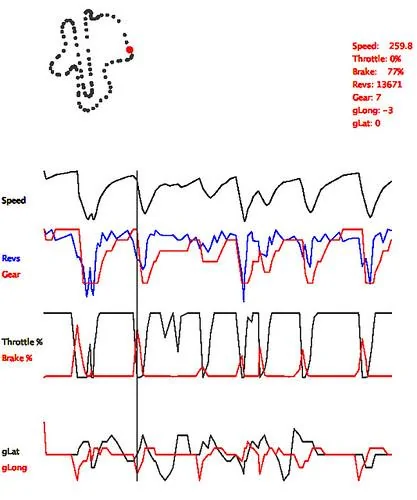
Another thing to mention here is that humans also have "predictive" capabilities that can be learnt. This means that even though the control system has latency, a person can steer etc ahead of time in anticipation of the event occurring, instead of during the event, to compensate for the latency in the control. This is why professional drivers can reduce lap times by out-braking others on the track, in that they can accurately predict where to start braking at the maximum rate before a corner to get to the corner entry speed, despite the vehicle not being able to accurately track the control input because of vehicle physics and inertia. Doing so means that you spend the least amount of time braking, and spend a higher percentage of time on the track at a higher speed, resulting in a higher average speed overall and the shortest lap times. (Sorry but this isn't really a skill they use much in the Indy500 on a loop!) Funnily enough, like on a PC racing simulator using a keyboard, you can be pretty fast around a track with just a digital on/off switch for accelerator and braking, if you train that technique. Have a look at how steep the throttle/brake graph is here, in comparison to speed and acceleration forces that result. They are always going from maximum acceleration to maximum deceleration of available traction.


Tesla Cybertruck Some very apparent steer-by-wire action! 4501417316_1f68b4b0a8


If you consider the low latency of GPU processing of near real time game rendering, you can sort of get a feel for just how crazy fast processing and control is nowadays, way beyond human perception. So although there is a measurable latency, for all intents and purposes in the context of human capability, it has a negligible impact of control loop performance given our own high latencies and variablities.

Just to come back to the SBW in the CT, my comment regarding the progressive steering nature, of steering more than the steering input so that you have steering lock within one rotation of the steering wheel, this is actually complementary to human steering behaviour. I found this t be the case on my Landcruiser that had electrically assisted mechanical variable rate steering. Often the center dead-band on steering wheels at higher speed (the area where you can move the steering with little steering output) means you often feel like there is no to little output, so you often jerk the steering wheel to get a response. Over time though, you get used to responsiveness outside of the dead-band, and more often than not you end up with better steering inputs overall, because the steering ratio near the center allows for better fine control, whilst the ends allowing for more cornering with less input, and because that typically happens at lower speeds, means a smoother driving experience overall as you don't have to fumble over the steering wheel at full lock with uncoordinated hand movements.
 

JBee

Well-known member
First Name
JB
Joined
Nov 22, 2019
Threads
18
Messages
4,913
Reaction score
6,362
Location
Australia
Vehicles
Cybertruck
Occupation
. Professional Hobbyist
Country flag
With all the “Exo” discussions here, I went and rewatched the unveil event. EM was very clear what he meant in the unveil. He said the body on frame treated the cab and the bed as extra weight “like a sack of potatoes” and then he said they were moving to an exoskeleton. He said body on frame was how biplanes were made, but that he was moving to a monocoque design, like airplanes are made today, with stressed skin. ”We’re moving the mass to the outside.” He NEVER said there wouldn’t be anything under the skin, just that the skin would be a stressed member. Places today have ribs and stringers, to which the skin is attached, and is under load. No different than the castings in the CT to which the skin is attached. Inner skin (the pressure vessel), hidden structure, outer stressed skin. The CT has a hidden structure in the shape of the castings, and to that an outer stressed skin is attached.

Based on what he ACTUALLY said at the reveal, THE DESIGN AND DEFINITION OF THE EXOSKELETON HAS NOT CHANGED!

If anyone is “disappointed” in how the truck was designed, then you need to look at how you might have misunderstood what he said, and how you made assumptions as to what he meant. I’m sorry, but there is a ton of misunderstanding about what he said and meant. Look around 7:00 for the first mention of it. I didn’t watch the whole thing.

I'll leave commentary on that one to the many dedicated threads were it was discussed. :)

Not... but just briefly in a condensed form: :eek:

The design has changed since reveal and the "exo" trigger word barely applies, except for the doors and opening panels, which quite literally are flapping in the wind on the outside of the main frame. There are no meaningful external stainless steel stressed skin structures in the CT design whilst in "Normal" operation, as was first anticipated by what EM said. In fact since the removal of the sail storage, only the rear quarter panels could have any meaningful structural benefit. If he thought it would be different and the design is changed, or we understood it wrong, is a different discussion, but the technical aspect of the recent CT design is fairly clear.

It's important to differentiate between "operation loads" (like CoG from mass distribution) and "failure loads" like crash impacts with permanent plastic deformation of materials, in the system design. For failure loads the skin is "structural" in that it protects occupants from impact ingress by deforming under external compression. But in operational mode, or "load carrying" the skin plays a minor roll, if any at all, because of the design of the front and rear casts and suspension.

This is because unlike a stressed skin structure on a aircraft, there are virtually no "load paths" where loads are even presented to the exterior skin on the CT. In a plane lift is created by the wings to lift the aircraft against gravity, which the aircraft has to allow for and is distributed through the fuselage, with load paths from wing tip to wing tip(like putting fuel in wing tanks, with jet engines and undercarriages, to reduce load near the fuselage/wing interface). But in a car if the skin is not experiencing operational loads then how can it support them?

This is because most of the operational load paths for driving exist between the 4 suspension arms and springs, because this is where most of the vehicle mass is supported from, and where tyre induced forces come through the suspension, due to changes in acceleration* that upsets the steady state inertia of the vehicle. (*This is multi vector acceleration that includes bumps, cornering and braking) A wheeled vehicle simply cannot interact with the environment other than through the tyre patch, so all forces must flow through there. Wings on a vehicle are typically there to add downforce, so add to forces applied to the tyre patch through the suspension, and aerodynamic drag is structurally insignificant in car operational velocities in comparison to mass carrying capability. So for the skin to have any meaningful contribution to supporting operational load, then that part of the vehicle must also experience some sort of deflection from a force that acted on it. However, if no force can act on it, it's safe to assume that it carries no load, and accordingly doesn't form meaningful supportive part of the vehicle structure.

Simply, no structure is required where there is no load or force to counteract, and it makes no sense to redistribute a load to make use of an external structure that is outside of the load path, and that would in turn increase deflection without significant additional material reinforcement, let alone to do so that one can use the "exo" advertising jargon/faulty terminology.

BTW I don't really care about the use of the term exoskeleton, provided it doesn't skew the perception of how it is in reality, by invoking false analogies of crabs. ;)
 

PilotPete

Well-known member
First Name
Pete
Joined
May 8, 2023
Threads
12
Messages
1,578
Reaction score
3,969
Vehicles
Porsche, BMW, M3LR on order
Occupation
Chief Pilot
Country flag
I'll leave commentary on that one to the many dedicated threads were it was discussed. :)

Not... but just briefly in a condensed form: :eek:

The design has changed since reveal and the "exo" trigger word barely applies, except for the doors and opening panels, which quite literally are flapping in the wind on the outside of the main frame. There are no meaningful external stainless steel stressed skin structures in the CT design whilst in "Normal" operation, as was first anticipated by what EM said. In fact since the removal of the sail storage, only the rear quarter panels could have any meaningful structural benefit. If he thought it would be different and the design is changed, or we understood it wrong, is a different discussion, but the technical aspect of the recent CT design is fairly clear.

It's important to differentiate between "operation loads" (like CoG from mass distribution) and "failure loads" like crash impacts with permanent plastic deformation of materials, in the system design. For failure loads the skin is "structural" in that it protects occupants from impact ingress by deforming under external compression. But in operational mode, or "load carrying" the skin plays a minor roll, if any at all, because of the design of the front and rear casts and suspension.

This is because unlike a stressed skin structure on a aircraft, there are virtually no "load paths" where loads are even presented to the exterior skin on the CT. In a plane lift is created by the wings to lift the aircraft against gravity, which the aircraft has to allow for and is distributed through the fuselage, with load paths from wing tip to wing tip(like putting fuel in wing tanks, with jet engines and undercarriages, to reduce load near the fuselage/wing interface). But in a car if the skin is not experiencing operational loads then how can it support them?

This is because most of the operational load paths for driving exist between the 4 suspension arms and springs, because this is where most of the vehicle mass is supported from, and where tyre induced forces come through the suspension, due to changes in acceleration* that upsets the steady state inertia of the vehicle. (*This is multi vector acceleration that includes bumps, cornering and braking) A wheeled vehicle simply cannot interact with the environment other than through the tyre patch, so all forces must flow through there. Wings on a vehicle are typically there to add downforce, so add to forces applied to the tyre patch through the suspension, and aerodynamic drag is structurally insignificant in car operational velocities in comparison to mass carrying capability. So for the skin to have any meaningful contribution to supporting operational load, then that part of the vehicle must also experience some sort of deflection from a force that acted on it. However, if no force can act on it, it's safe to assume that it carries no load, and accordingly doesn't form meaningful supportive part of the vehicle structure.

Simply, no structure is required where there is no load or force to counteract, and it makes no sense to redistribute a load to make use of an external structure that is outside of the load path, and that would in turn increase deflection without significant additional material reinforcement, let alone to do so that one can use the "exo" advertising jargon/faulty terminology.

BTW I don't really care about the use of the term exoskeleton, provided it doesn't skew the perception of how it is in reality, by invoking false analogies of crabs. ;)
I hope I understood your point correctly, if I’m way off, forgive me.

I think the body and skin do bear a load on the CT. Between front and rear suspension, the body has to support the mass. In a legacy truck, this is done by the ladder frame. In the CT, I understand that you think the castings carry everything. No doubt, I agree they carry a load, but I don’t believe that they carry 100% of the load. Regardless, EM’s comment that they were shifting the mass from the frame to the outside still holds true, regardless of either belief. And in the area where the ladder frame is the weakest (torsional rigidity), this design beats it like a rented mule. I also believe that this design does a better job of allowing the suspension to handle weight shifts during rapid accel/decel in every direction.

Wings aside, listen to what he said about the modern monocoque. And that is exactly what it appears Tesla has done with the CT, making a fuselage.


cvalue13

Well-known member
Joined
Aug 17, 2022
Threads
74
Messages
7,153
Reaction score
13,769
Location
Austin, TX
Vehicles
F150L
Occupation
Fun-employed
Country flag
Based on what he ACTUALLY said at the reveal, THE DESIGN AND DEFINITION OF THE EXOSKELETON HAS NOT CHANGED!
i generally agree with your comments above to the extent it implies people could have misinterpreted Musk’s statements

but I don’t think there’s any basis to say Musk’s comments were clear regarding the plan and whether it’s been unchanged

after all, we only got to this point in the debate because his comments were unclear, and experts in the field - especially Munro - felt his nomenclature was signaling something quite different than what we’ve now seen

Musk’s comments were ambiguous, and rational and experienced folks reasonably interpreted them to suggest a design we don’t see now

what was in Musk’s mind at the time may never be known
 

JBee

Well-known member
First Name
JB
Joined
Nov 22, 2019
Threads
18
Messages
4,913
Reaction score
6,362
Location
Australia
Vehicles
Cybertruck
Occupation
. Professional Hobbyist
Country flag
I hope I understood your point correctly, if I’m way off, forgive me.

I think the body and skin do bear a load on the CT. Between front and rear suspension, the body has to support the mass. In a legacy truck, this is done by the ladder frame. In the CT, I understand that you think the castings carry everything. No doubt, I agree they carry a load, but I don’t believe that they carry 100% of the load.
No worries. We might have to go into some detail after all so I can explain it better, step by step.

I would like to at first clarify which "skin" parts in particular are actually attached to the underlying body to be useful structurally, as there are various parts of the vehicle that are structural and other that are not, depending on the load path.

The body (in white) does bear load, but the skin does not, because there is no load on the skin for it to bear.

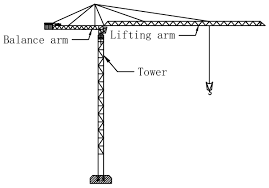
Imagine a crane that is lifting something, half way along the lifting arm like in this diagram.

Tesla Cybertruck Some very apparent steer-by-wire action! 1696338654428


What added structural advantage does the remainder of the lifting arm provide to the crane, that extends to the right, past the point the load is attached in it's current position?

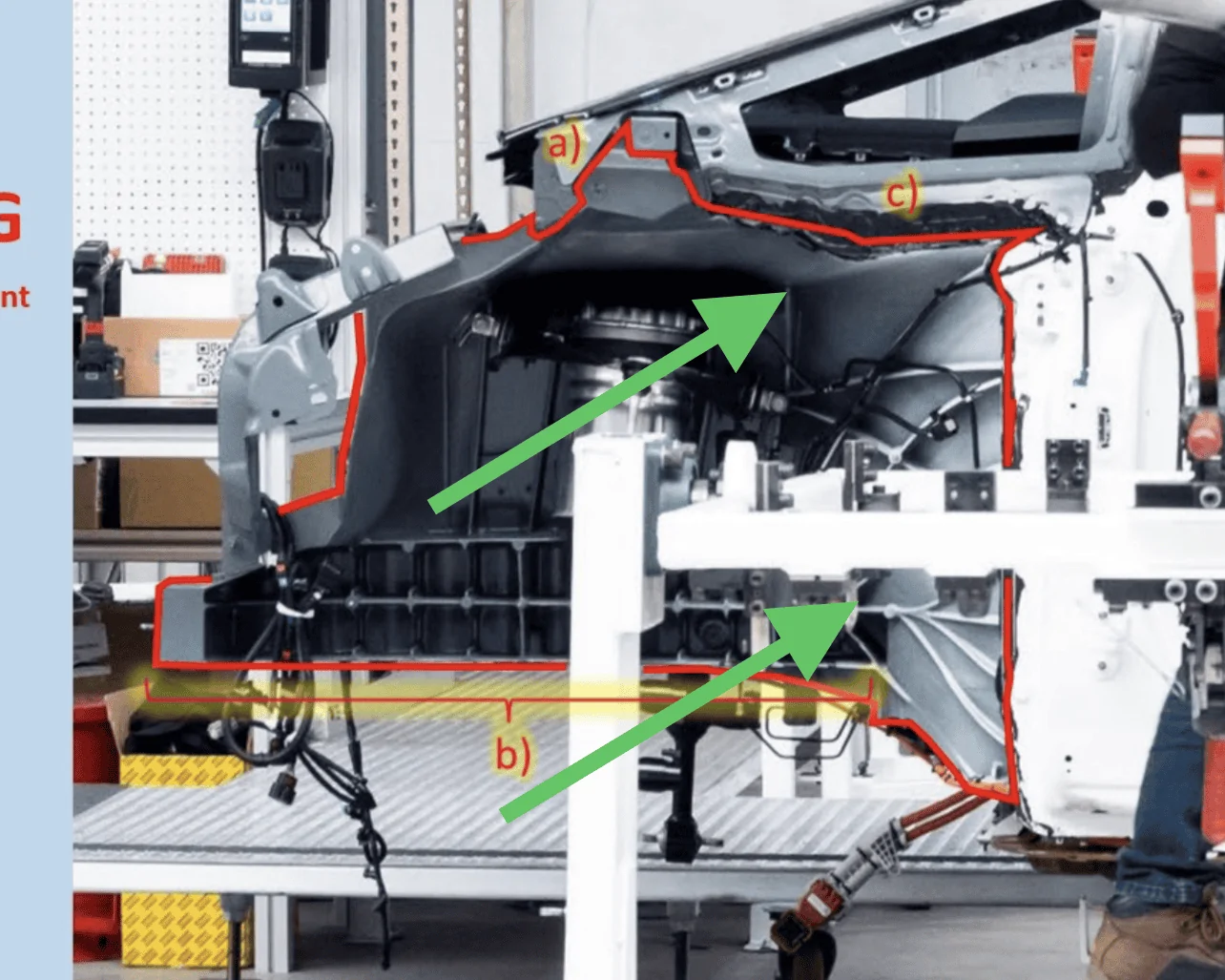
Likewise, the body in white (BIW) is already structurally sound and self supporting, without any stainless "skins" attached:

Tesla Cybertruck Some very apparent steer-by-wire action! 1696338654428


The above shows front and rear cast and cabin frame, probably without the structural battery underneath. Now if you add to that every "moving" stainless panel to the frame, being the doors and frunk, and then the top glass windscreen and the rear windscreen, and the structural battery from underneath, you will end up with only the four quarter fenders missing, one on each corner that are actually still made of the stainless steel skin.

The components in that BIW structure will support most of the load by itself without any skin attached however, only the fender quarter panels are stationary, and can actually be rigidly be attached so that they could carry a load together with the BIW. That is "if" there was a load at that point they could carry, as per the crane example.

So lets explore where the loads originate in comparison to the fenders, as to identify what loads, if any, could be supported by the fenders:

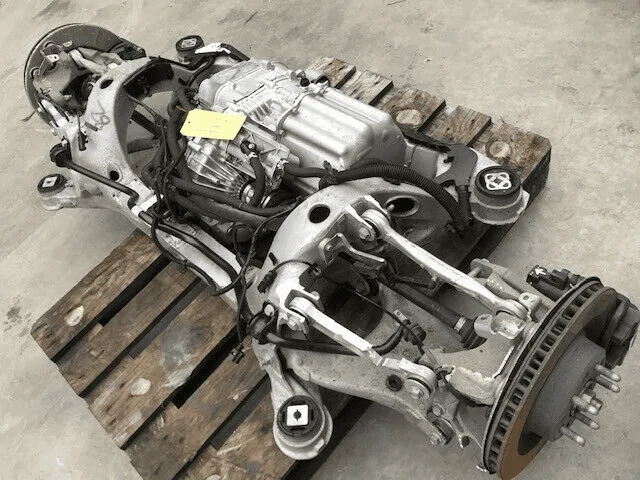
The front fender is external of any load, as you can see the front cast has the drive train sub-assembly points, that also supports the suspension. The fender does not offer any meaningful geometry to intercept the load from between the wheel and the frame from the suspension, to the point the suspension is not connected to the fender in any way. Note the sub assembly is attached to the frame on the inside of the suspension arms, with the airspring riser being supported into the top of the front cast recess, that is located directly underneath the a-pillar of the cabin frame and windscreen. (which you can see in the second picture below)

Tesla Cybertruck Some very apparent steer-by-wire action! 1696329050237


Tesla Cybertruck Some very apparent steer-by-wire action! 1696330073022


Try to imagine from where a operational load/force can be applied to the front fender, or even harder where a force should originate from on the vehicle in it's normal state, that then needs to find a path to the suspension parts. You could lean on the fender, sit on the fender, maybe place a cement bag on the fender, and the fender would have to resist that force. But is that where you would load the CT? Unlikely.

You could even twist the vehicle for torsion, but those forces are only directly in between the suspension assemblies that is attached internally to the cast, cabin frame and structural battery, and as such would only influence the relative force on each wheel, through those parts, but not something that lays outside of the load path, being the fender. In the front there is little to no load to support in the vicinity of the fender, considering that the HVAC and frunk sit inside the cast frame, so would it be beneficial to have a meaningful rigid connection from the cast to distribute load through the fender? No it's not, and that is why you don't see very much in the way of connection points on the cast to connect the fender. The front fender has a bunch of other roles, (aero, wheel guard etc) but structural support is not one of them. In a failure mode, like for crash impact protection, all the skin panels play a roll as they are compressed against the BIW, so the fender is definitely doing something, so it's worth having, but it is not supporting the vehicle mass structurally.

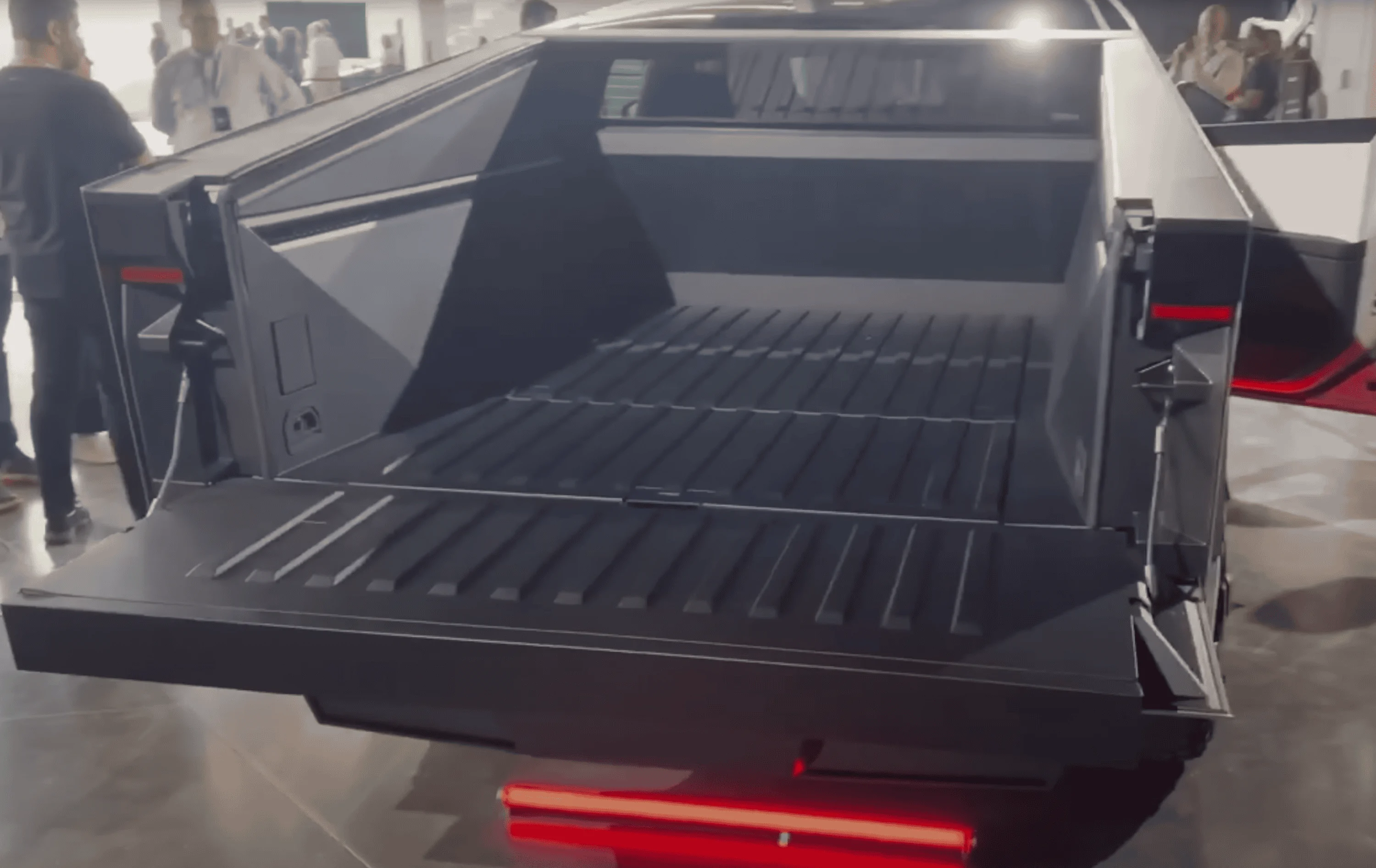
In the rear it is a little different, in that depending on where the bed is loaded there might be some addition force on the rear fender, or rear sail panel. Originally this was split to house storage behind it, but now it's likely without storage. However, as you can see in the picture below the cast structure is along the internal wall of the bed, not the external wall of the CT. As such it also doesn't have any meaningful interconnection to the skin to transfer forces through the fender. In the rear of the cast you can actually see the mounting points for the tailgate hinge and locks if you compare the two photos below.

Tesla Cybertruck Some very apparent steer-by-wire action! ertruck-body-shell-frame-reveal-giga-factory-texas


Tesla Cybertruck Some very apparent steer-by-wire action! CT Open Bed Dimensions


The skins, as are the door skins, a quite a distance from the cabin frame and casts. But once again, lets go back to where the load/force originated from, and where it has to go to to get to the wheels.

The bed itself would connected to the cast, and I think it is sitting on top of the flat spot next to the rear wheel arches, along with across the front under the bed front wall (midgate), and spanned across the rear tailgate. Like a pallet. The point here is that directly underneath those flat spots near the wheel arch, are also the suspension springs for the rear axle, where all the load from the bed must go anyway to get to the ground. So the fastest route for load in the bed to be supported by the wheels is through the suspension, the cast and then the bed that sits on the cast. The fender is not in between the load and the suspension, so no load will be transferred out to the fender, and then back into the cast and suspension down to the wheel. (Once again like the crane example above)

Now in torsion, we have the same as with the front fender, in that the force is between the wheels only, until that time that one wheel leaves the ground, or the body of the vehicle touches the ground by over compressing the suspension or being wedged by the ground. Once again the load is inside of the lifting arm, and the fender plays no role until the outside of the vehicle touches the ground which will result in damage of the vehicle like any other vehicle.

In fact this highlights another reason "not" to connect the quarter panels to the casts to structurally transfer load, and that is that the stainless steel skin sheet is fairly two dimensional, in that it barely has any depth in it's geometry, unlike a stressed skin aircraft fuselage that is fully circular, the CT skin is just a flat plane. This means that "if" a load was put on it unevenly, it's likely that it would result in enough twisting of the skin, that you could visibly see it in the reflective surface of the CT.

Either way, I don't see any advantage whatsoever, in trying to get the skin, which is outside of the suspension, to carry any load of the vehicle. Neither do I see any meaningful load being transferable to the suspension via the skin.

I'm curious if you can find one for us to discuss.

Regardless, EM’s comment that they were shifting the mass from the frame to the outside still holds true, regardless of either belief. And in the area where the ladder frame is the weakest (torsional rigidity), this design beats it like a rented mule. I also believe that this design does a better job of allowing the suspension to handle weight shifts during rapid accel/decel in every direction.

Wings aside, listen to what he said about the modern monocoque. And that is exactly what it appears Tesla has done with the CT, making a fuselage.
Specifically, he has shifted mass from a conventional chassis frame that is common in most trucks, to a unibody/monocoque body design, like the BIW CT shown above. But this is far from new, because every unibody has done this before for decades, and the cabin and front and rear assemblies (now casts with Teslas) have always formed their primary structure.

I don't seek to diminish the result of the CT design in any way, only to highlight that the skin plays no important role in it's structure under operational loads, but rather only as crash protection in a failure mode.

The trick, more than everything here, is that the "combination" of all these changes has resulted in the CT design, and that optimisations like the structural battery, or castings have done far more for rigidity and stiffness, and load carrying capacity than the skin on the fenders.

We could hark on here further, about "if" moving the mass from the chassis to the skin helped structurally, more than some other internal space frame or actual stressed member fuselage, which would by far outperform the CT at a lower total weight. For example the total of the CT SS 3mm skin is nearly twice as much weight as a stripped F150 chassis frame.

That's not even hard to do to, but will it have all the openings, and functions, and repair ability, or ease of manufacturing and assembly for all the other components that are needed for a fully functional vehicle. No it wouldn't. Like every design, it's just going to be the best possible compromise to accommodate all the design priorities of that product, for this iteration of it.

And on that note, I haven't been this "excited" by car developments, since the advent of hybrids decades ago. Now what EM wants to call it, or what he thought is was, or what we thought it was, well that's not the same thing as what it actually is at this time, so I'm fine in saying it is exactly what EM wanted, but on reveal what he wanted, wasn't what we thought he said! :p

BTW maybe we should move this back to one of the exo threads...

https://www.cybertruckownersclub.com/forum/threads/yes-exoskeleton.8366/
 
Last edited:

JBee

Well-known member
First Name
JB
Joined
Nov 22, 2019
Threads
18
Messages
4,913
Reaction score
6,362
Location
Australia
Vehicles
Cybertruck
Occupation
. Professional Hobbyist
Country flag
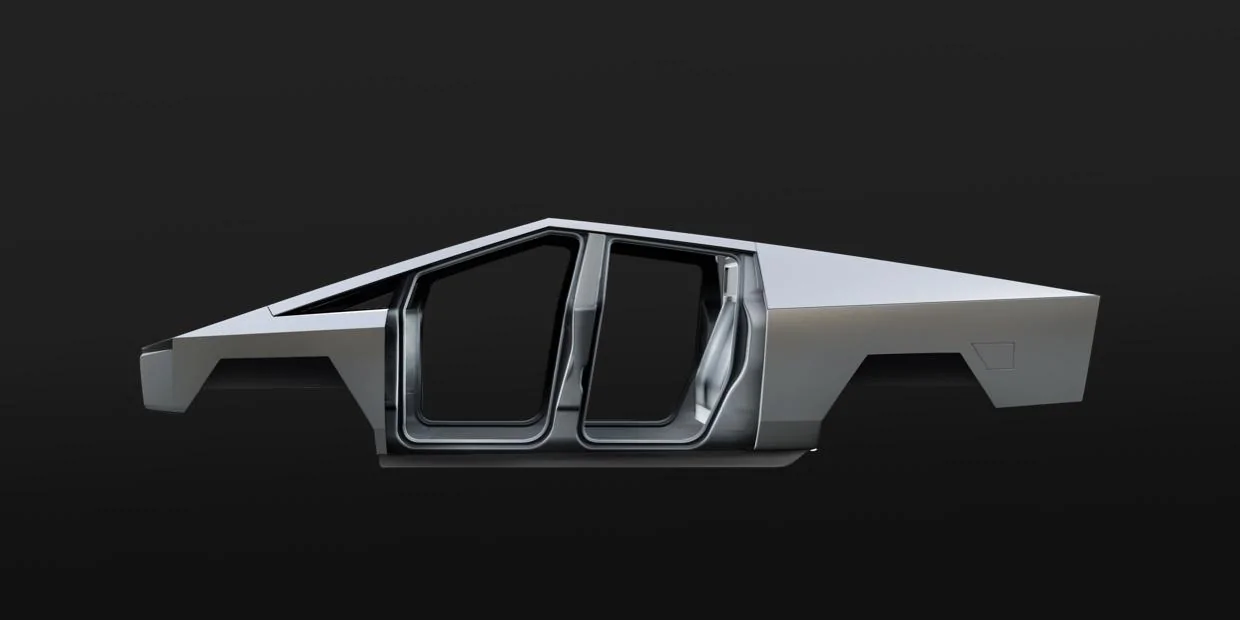
There is no evidence the design has changed. The render they shared on reveal night has the same cabin structure we're seeing on current Cybertrucks:

Tesla Cybertruck Some very apparent steer-by-wire action! {filename}
That image shows no front and rear casts whatsoever, nor any definition of a structural battery pack, both of which do more than any skin surface on the vehicle.

It's just a placeholder to show the "intent" of the design, and it's form, but in no way indicates if the exterior is structural or not.

As for changes, we know it's not the same length, not the same angles etc, so yes it has changed.
To the better as far as I can tell. ;)
 

CyberGus

Well-known member
First Name
Gus
Joined
May 22, 2021
Threads
91
Messages
10,236
Reaction score
33,887
Location
Austin, TX
Vehicles
1981 DeLorean, 2024 Cybertruck
Occupation
IT Specialist
Country flag
The body (in white) does bear load, but the skin does not, because there is no load on the skin for it to bear.
You're assuming that all loads apply force at 90Âş to the ground, equally across all wheels. Lateral and unequal forces will cause the body to twist, which is resisted by exterior panels and glass.


Top