Sponsored

Towing Range Numbers?

cvalue13

Well-known member
Joined
Aug 17, 2022
Threads
74
Messages
7,153
Reaction score
13,769
Location
Austin, TX
Vehicles
F150L
Occupation
Fun-employed
Country flag
I agree that the more aerodynamic/lighter/lower profile combination (1.3-1.8mi/kwh) yield better results than a larger/heavier (.9-1.1mi/kwh) combination. You initially quoted large (aero wise) so that is why I did not agree, most of your examples were not large as proven by the single axle/lower profile and/or streamline configuration.
Absolutely nobody trailers to 0% SOC and very few charge to 100% especially when out on the road so there is no point in telling someone they can go X distance if they use the full capacity of the battery. Seriously who goes to 0% SOC while towing?
I would love to see your initial claims be practically attainable but I just don't think it is viable with a truly large load.
Agree to disagree I guess, but I was just speaking from my experience towing a multitude of different trailer combinations/weights & other large trailer examples online. Most of the examples you presented are only a fraction of the CT tow capacity/capability and extrapolated to 0% SOC.
For practical real world use 80% of full capacity is a much more realistic amount to work off of especially when towing.
I don't know that we disagree much, so much as approach this from a different set of assumptions.

For example, your assumption of what I meant by "large" and what you mean by "truly large load."

You sound like you do a lot of towing. Perhaps, for you, something like a 7,500lb trailer (on one end of the spectrum) or a 20' single axel camper isn't "truly large."

But my working assumption, is that a person looking to buy a truck because they desire to regularly and long-distance tow things that you appear to consider "truly large," they're probably all-around best served not purchasing a true 1/2 ton truck (that is, not counting those "1/2 ton" trucks that can be optioned out to operate well within 3/4 ton territory).

Not because a 1/2 ton *cant* do it occasionally (especially if piloted by someone like you). Instead that it begins to look like a buyer expecting that repeated use case isn't choosing the best and safest tool for the job, not that the tool is incapable of doing the job.

So yes, I assume "large" for a squarely 1/2 truck like this (or the Lightning), is more along the lines of what I've shown.

If instead you or others reading this were planning to tow an eg 32" north trail king buds, then reasonable people may disagree that they're choosing the right tool for the job, CT range or not.


ALL THAT SAID, you seem to disagree on that point:

Most of the examples you presented are only a fraction of the CT tow capacity/capability and extrapolated to 0% SOC.

I guess I just don't think a eg 32buds is in the CT's towing "sweet spot" while what I've shown are a "fraction" of the tow capacity, in practical terms.

A GVWR of 9,000lbs on an 11K max is done all the time, sure. Knocking the CT payload down to e.g. 1,100-1,500lbs is done all the time, sure.

But is it done all the time by people who pull that so regularly it makes or breaks what truck they buy?

and extrapolated to 0% SOC.
This particular point seems like goalpost moving to me. I mean, let's either talk in terms of total range or lets talk in terms of your preferred distance between refuels.

But seems we were talking in terms of total range, and you just don't like that framing, that's fine.


End of the day, the CT is the equivalent of an ICE F150 with a max fuel capacity of 13 gallons, and squarely 1/2 ton capabilities.

And here's what our helpful conversation has taught me: that last point above means, if someone comes asking if they can tow with it, I'm just going to assume they're not reasonably asking whether they can tow nt32'buds and not have to refuel often.
Sponsored


 
  • Like
Reactions: VDR

Wraven

Well-known member
First Name
Doug
Joined
Oct 19, 2023
Threads
14
Messages
372
Reaction score
798
Location
San Antonio Texas
Vehicles
Foundations CyberBeast, M3P
Country flag
Good video of a CT towing another off-road electric vehicle (3k lbs) with a flat towing attachment, so not a great test since there is no tongue weight - but I'll take it since it's slim pickings at present:


This is a tri-motor Cyberbeast model with AT tires - so only 301 miles rated range. From what I heard, they were consuming an average of about 800wh/mile when towing this vehicle. So since we know that the CT battery is 123kw from prior testing - that's 123000wh. 123000/800=153.75 miles using the entire pack if my math is right. If we assume you use 80% of the pack - for example going from 90% to 10% towing over a longer range using SC stations - that'd be 123 miles per charge towing under this load. This was only 3k lbs with zero tongue weight - I'd surmise moving up to 8-10k lbs would require much higher wh/mile consumption - but we'll have to wait and see.
I think its important to note that the Brawley might only weight 3500 pounds but it also "charges" while its being towed, which means it has some regenerative effect. I'm not sure what the resistance is of this feature, but it might not be accurate to say this is *just* a 3500 pound load. The passive regenerative effect might be creating a lot drag on its own. (Or not..but not sure)

https://vanderhallusa.com/models-brawley-off-road-utv/
 

HaulingAss

Well-known member
Joined
Oct 3, 2020
Threads
28
Messages
10,308
Reaction score
20,718
Location
Western Washington, USA
Vehicles
Cybertruck DM, 2010 F-150, 2018 Performance Model 3, 2024 Performance Model 3
Country flag
That's absolutely true for most tow vehicles, but is all but, or completely eliminated, with rear wheel steering vehicles that use In-Phase steering at higher speeds. So long as the steering angle of the rear wheels is equal to that of the front wheels, the hitch point tracks in the direction of the turn, without that moment arm, counter steer, that most bumper pull trailers experience.

CyberTruck can greatly reduce the sway that is induced with quick evasive maneuvers. It'll be as rock solid as a 5th wheel or goose-ball hitch.
True. I didn't even want to introduce rear-wheel steering because it's performance is software dependent, and I don't have any way to know how it's programmed (until I try it out myself). Theoretically, it will be a big advantage in reducing the chances of a trailer sway event getting out of hand, at best it will completely eliminate this kind of accident, even with people towing things in a way they shouldn't. I doubt the software is fully developed and tuned to perfection yet so I was focussing on the inherent physical characteristics that give the Cybertruck advantages over traditional pickups.
 

HaulingAss

Well-known member
Joined
Oct 3, 2020
Threads
28
Messages
10,308
Reaction score
20,718
Location
Western Washington, USA
Vehicles
Cybertruck DM, 2010 F-150, 2018 Performance Model 3, 2024 Performance Model 3
Country flag
Having owned both a 2012 RAM 1500 CC with the rear coil over suspension and a 2018 RAM 1500 CC with the four corner air suspension and having towed the same boat/trailer with both trucks, I can definitely attest to the fact that the air suspension does exactly what you are saying - it provides better stability when towing without doubt, in part by reducing rear squat and keeping the truck level while towing. It also makes it a bit easier to mount the trailer onto the ball using entry/exit mode (lowest air suspension setting).

I don’t think I would ever purchase another pickup in the same class without an air suspension after having owned and towed with both.
Exactly. It certainly helps with the edge towing cases.

Obviously, with a big enough load to require enough tongue weight, a weight distributing hitch will still be required, but the auto levelling suspension will still be a net benefit, even with trailers requiring weight distribution hitches.


HaulingAss

Well-known member
Joined
Oct 3, 2020
Threads
28
Messages
10,308
Reaction score
20,718
Location
Western Washington, USA
Vehicles
Cybertruck DM, 2010 F-150, 2018 Performance Model 3, 2024 Performance Model 3
Country flag
I think its important to note that the Brawley might only weight 3500 pounds but it also "charges" while its being towed, which means it has some regenerative effect. I'm not sure what the resistance is of this feature, but it might not be accurate to say this is *just* a 3500 pound load. The passive regenerative effect might be creating a lot drag on its own. (Or not..but not sure)

https://vanderhallusa.com/models-brawley-off-road-utv/
Very good observation in light of people claiming the Cybertruck tow efficiency sucked on that run. The fact is, the unknows are too significant to make any sense of the towing efficency on that run relative to towing any other trailer.

I could only guess how much regen that Brawley has at highway speeds but it's going to cause very significant drag. The exact amount that it impacted the towing consumption is not very complicated to roughly estimate if you know how many kWh the Brawley gained over the trip.

For example, let's say the Brawley charged 10 kWh for the round trip.

Just multiply that 10 kWh by the reciprical of the efficiency of the regen, including losses of tires on the pavement (I would estimate about 70% efficieny overall, maybe as low as 60% at the extreme), and multiply that result by the efficiency of the Cybertruck in converting battery energy into propulsive energy (I would estimate 80% under towing loads, including tire friction and additional hysteresis losses).

That comes out to roughly 17.9 kWh of battery charge level loss due to regen charging the Brawley, or half that amount if the Brawley only gained 5 kWh of charge. I have no idea how much it actually charged, how far the round trip was, etc. I'm just throwing those numbers out there to illustrate that the losses from tow-charging a flat towed EV are going to be much greater than the towing losses if the vehicle was free-wheeling.
 

HaulingAss

Well-known member
Joined
Oct 3, 2020
Threads
28
Messages
10,308
Reaction score
20,718
Location
Western Washington, USA
Vehicles
Cybertruck DM, 2010 F-150, 2018 Performance Model 3, 2024 Performance Model 3
Country flag
You can't take every statement literally and not every "expert" is as much of an expert as they would have you believe.

I never implied a self-leveling suspension could replace a load-leveling hitch. But it's undeniable that it helps transfer weight to the front, simply due to geometry (amongst other things) by preventing rear end sag.

Said another way, the Cybertrucks self-leveling function while towing will make a weight distribution hitch perform better. And a similar improvement will be noted with loads that are not quite heavy enough (don't have enough tongue weight) to require a weight distribution hitch.

Any "expert" that says otherwise, who says a self-leveling suspension cannot cause more weight to ride on the front end, doesn't know what they are talking about.
 

Woodrick

Well-known member
First Name
Ed
Joined
Dec 30, 2023
Threads
6
Messages
4,786
Reaction score
4,762
Location
Gainesville Ga
Vehicles
Model 3, Model Y, Cybertruck AWD
Occupation
Consultant
Country flag
True. I didn't even want to introduce rear-wheel steering because it's performance is software dependent, and I don't have any way to know how it's programmed (until I try it out myself). Theoretically, it will be a big advantage in reducing the chances of a trailer sway event getting out of hand, at best it will completely eliminate this kind of accident, even with people towing things in a way they shouldn't. I doubt the software is fully developed and tuned to perfection yet so I was focussing on the inherent physical characteristics that give the Cybertruck advantages over traditional pickups.
I didn't think that Rear Steering was used at higher speeds.
I've always found that a trailer swaying event is best handled by tapping the trailer brakes. (not the tow vehicle brakes)
And while it probably isn't there now, that could be an option that Tesla adds in tow mode. And it possibly could even be an automatic feature.
 

cvalue13

Well-known member
Joined
Aug 17, 2022
Threads
74
Messages
7,153
Reaction score
13,769
Location
Austin, TX
Vehicles
F150L
Occupation
Fun-employed
Country flag
I didn't think that Rear Steering was used at higher speeds.
I've always found that a trailer swaying event is best handled by tapping the trailer brakes. (not the tow vehicle brakes)
Rear steering providing stabalization in towing is basically 1/2 the reason for adding it to the Cybertruck

There are aftermarket outfitters that put rear wheel steering on trucks only for purpose of towing stability/agility.


Woodrick

Well-known member
First Name
Ed
Joined
Dec 30, 2023
Threads
6
Messages
4,786
Reaction score
4,762
Location
Gainesville Ga
Vehicles
Model 3, Model Y, Cybertruck AWD
Occupation
Consultant
Country flag
You can't take every statement literally and not every "expert" is as much of an expert as they would have you believe.

I never implied a self-leveling suspension could replace a load-leveling hitch. But it's undeniable that it helps transfer weight to the front, simply due to geometry (amongst other things) by preventing rear end sag.

Said another way, the Cybertrucks self-leveling function while towing will make a weight distribution hitch perform better. And a similar improvement will be noted with loads that are not quite heavy enough (don't have enough tongue weight) to require a weight distribution hitch.

Any "expert" that says otherwise, who says a self-leveling suspension cannot cause more weight to ride on the front end, doesn't know what they are talking about.
In my book, rear end sag is caused by improper levelling / weight distribution.
Assuming that the hitch / tongue / receiver are all placed at the correct level, jacking up the rear wheels only seem to make the issue worse to me.


HitchHiker71

Well-known member
First Name
Craig
Joined
Dec 7, 2019
Threads
0
Messages
67
Reaction score
104
Location
Delaware
Vehicles
2018 RAM 1500 Limited Tungsten Edition
Occupation
IT Director
Country flag
I didn't think that Rear Steering was used at higher speeds.
I've always found that a trailer swaying event is best handled by tapping the trailer brakes. (not the tow vehicle brakes)
And while it probably isn't there now, that could be an option that Tesla adds in tow mode. And it possibly could even be an automatic feature.
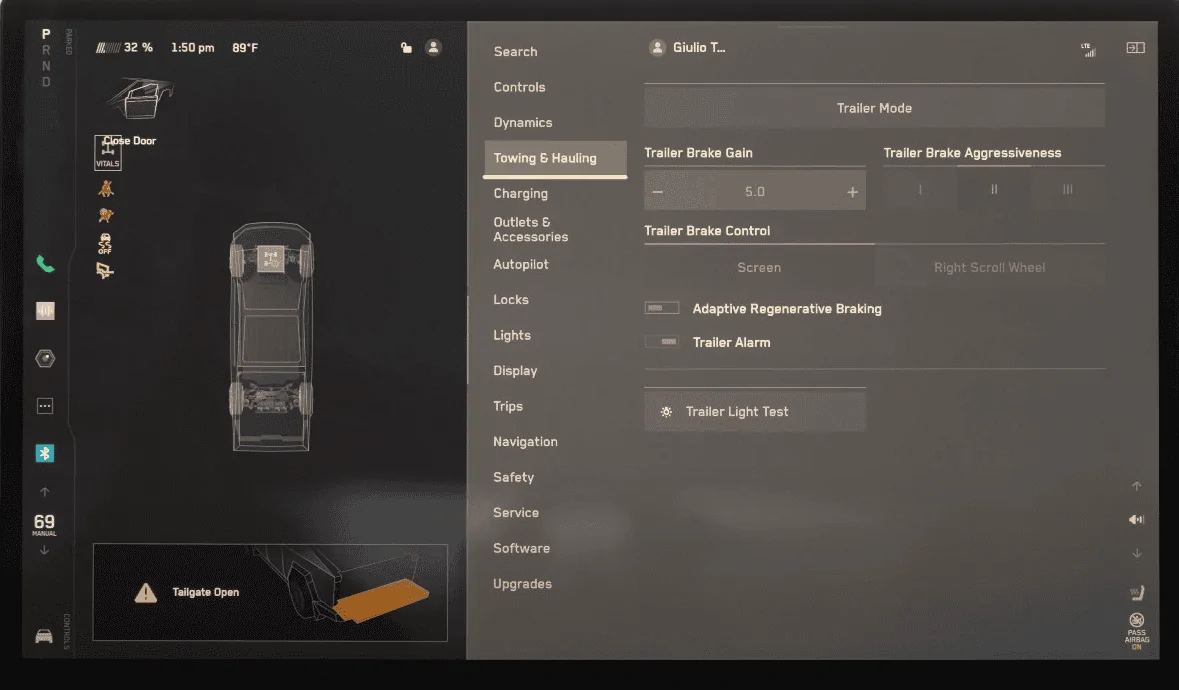
We don't yet know if CT rear steering is used when in tow/haul mode - at least I've not seen any videos that address this question either way. We do know that the CT uses rear steering above a certain speed (IDR at what speed it switches over) to facilitate smoother/faster lane changes as the rear wheels turn in the same direction as the front wheels (basically a minor crab walk mode). This should help lessen the potential for sway events IMHO. The CT does have a TBC inbuilt in the GUI.

Tesla Cybertruck Towing Range Numbers? 1704904438793
 

HaulingAss

Well-known member
Joined
Oct 3, 2020
Threads
28
Messages
10,308
Reaction score
20,718
Location
Western Washington, USA
Vehicles
Cybertruck DM, 2010 F-150, 2018 Performance Model 3, 2024 Performance Model 3
Country flag
I didn't think that Rear Steering was used at higher speeds.
I've always found that a trailer swaying event is best handled by tapping the trailer brakes. (not the tow vehicle brakes)
And while it probably isn't there now, that could be an option that Tesla adds in tow mode. And it possibly could even be an automatic feature.
We know rear-steering is used at highways speeds, the rear wheels have a cross-over point at mid-range speeds, at slow speeds they turn opposite the front, at highway speeds they turn the same direction as the front wheels. This is nothing new, other vehicles have done this before and the towing stability advantage when making lane changes or evasive manuvers is real and well-established. Increased maneuverability and stability at speed will prevent many accidents.

People accustomed to pushing the towing limits on body-on-frame trucks are going to be shocked how rock-solid the Cybertruck tows heavy loads. A stiff chassis is a huge advantage when towing near the limit and the Cybertruck has that to the extreme (chassis stiffness is always measured by the manufacturer for reasons of discovering potential metal fatige issues). A flexy chassis will often encourage and amplify any oscillations that may develop for whatever reason. If the natural resonance of the chassis just happens to match that of the trailer, LOOK OUT! The more rigid the chassis is, the more it is immune to amplifying these oscillations.

The physics of towing only cares about physical reality.
 

HitchHiker71

Well-known member
First Name
Craig
Joined
Dec 7, 2019
Threads
0
Messages
67
Reaction score
104
Location
Delaware
Vehicles
2018 RAM 1500 Limited Tungsten Edition
Occupation
IT Director
Country flag
I think its important to note that the Brawley might only weight 3500 pounds but it also "charges" while its being towed, which means it has some regenerative effect. I'm not sure what the resistance is of this feature, but it might not be accurate to say this is *just* a 3500 pound load. The passive regenerative effect might be creating a lot drag on its own. (Or not..but not sure)

https://vanderhallusa.com/models-brawley-off-road-utv/
Does anyone know how the Brawley charges via regen when being towed? I'd assume, emphasis on the assume part, that how this would work is that when the CT decelerates - the Brawley uses it's regen function instead of "trailer braking" per se, but that's just a SWAG on my part to be clear. If so, then other than the rolling resistance item, it's not actually using the regen unless the CT is doing the same basically - which wouldn't really add any additional resistance beyond the rolling resistance. That said, there are certainly variables in play that make this one case anecdotal - but right now it's all we have to go on unfortunately. Hopefully TFLEV get ahold of a CT sooner rather than later to run their EV towing tests. I believe they have a dual motor CT on order but I have no idea where they are in line.
Sponsored


Top