
S.H.Peterson
Well-known member
- First Name
- Scott
- Joined
- Mar 23, 2023
- Threads
- 11
- Messages
- 270
- Reaction score
- 453
- Location
- Alabama
- Vehicles
- Currently Dodge Truck owner
- Occupation
- Insurance

..we have some true autists on here!
Sponsored
ok, manUsing the grid on the floor is better than measuring a part and extending it over the image, but we don't know how big the squares are. Probably a foot, but they could also be 12" squares + 1cm lines.
Tiles have grout lines, do they not? 1/4" grout line is pretty standard. 15 grout lines = +3.75"Since in other threads, people are quite accepting and unskeptical (relevant to here) r grading using the on-floor grid marks as reference…

… I’ll use the same methodology in that other thread, which is to assume the test center’s grid pattern on the floor are a 12” grid.
This is a good and reasonable assumption, and I believe it is a 12” grid. However, I believe the grid is used for placing test equipment objects on the floor in known locations as well as being able to roughly measure the distance any debris travels, etc. In other words, the floor grid is not optimized for truck measurements. They do this only for rough measure (or else the grid itself wouldn’t have such thick/error-prone lines for lower detail)
This, and the fact that it’s difficult to extrapolate from the floor to places high on the truck, are reasons I didn’t rely on on the floor directly in my work. But I’ll come back to that “inaccuracy” and the effect it would have on measurement.
But since it’s now being taken seriously elsewhere, and it’s still instructive here, let’s do eet!
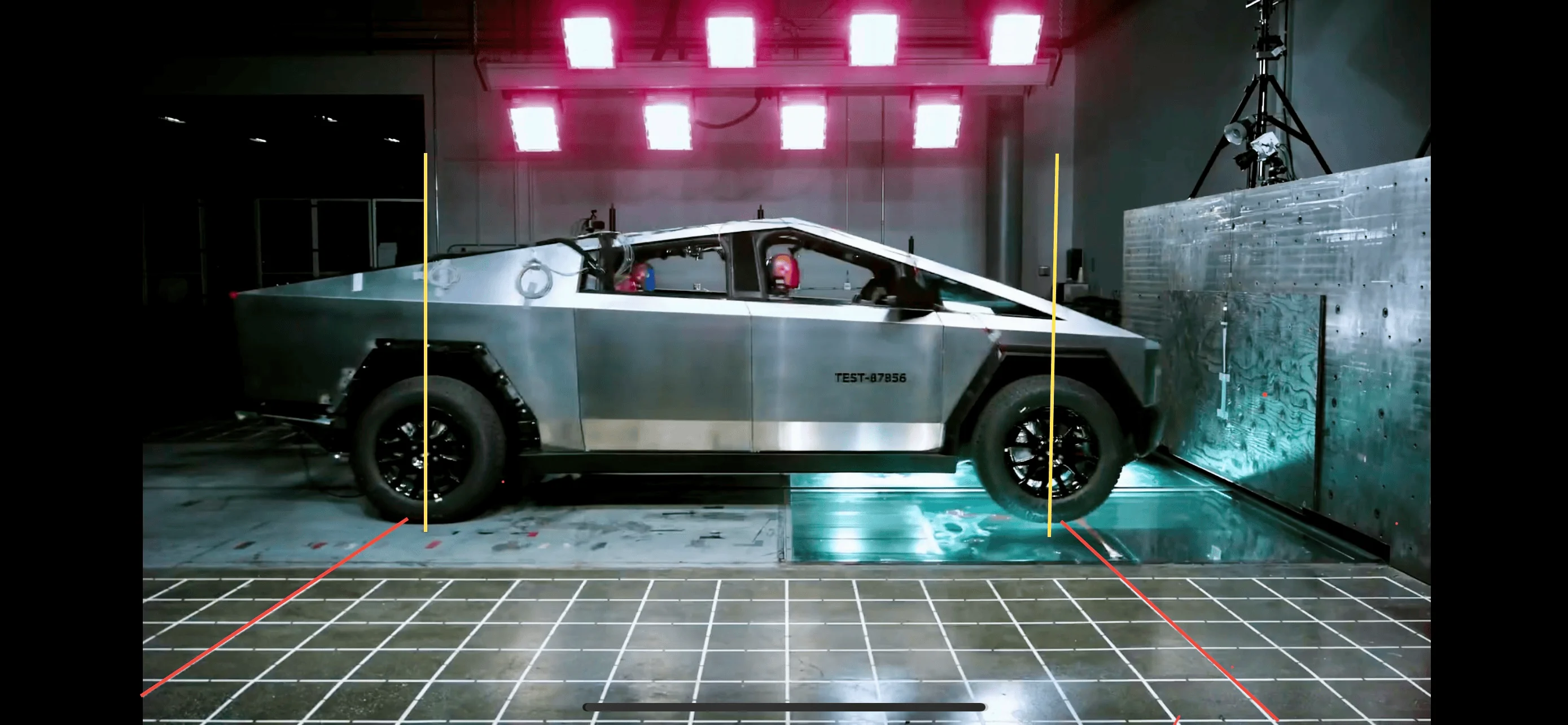
In the following photo, I selected a frame where
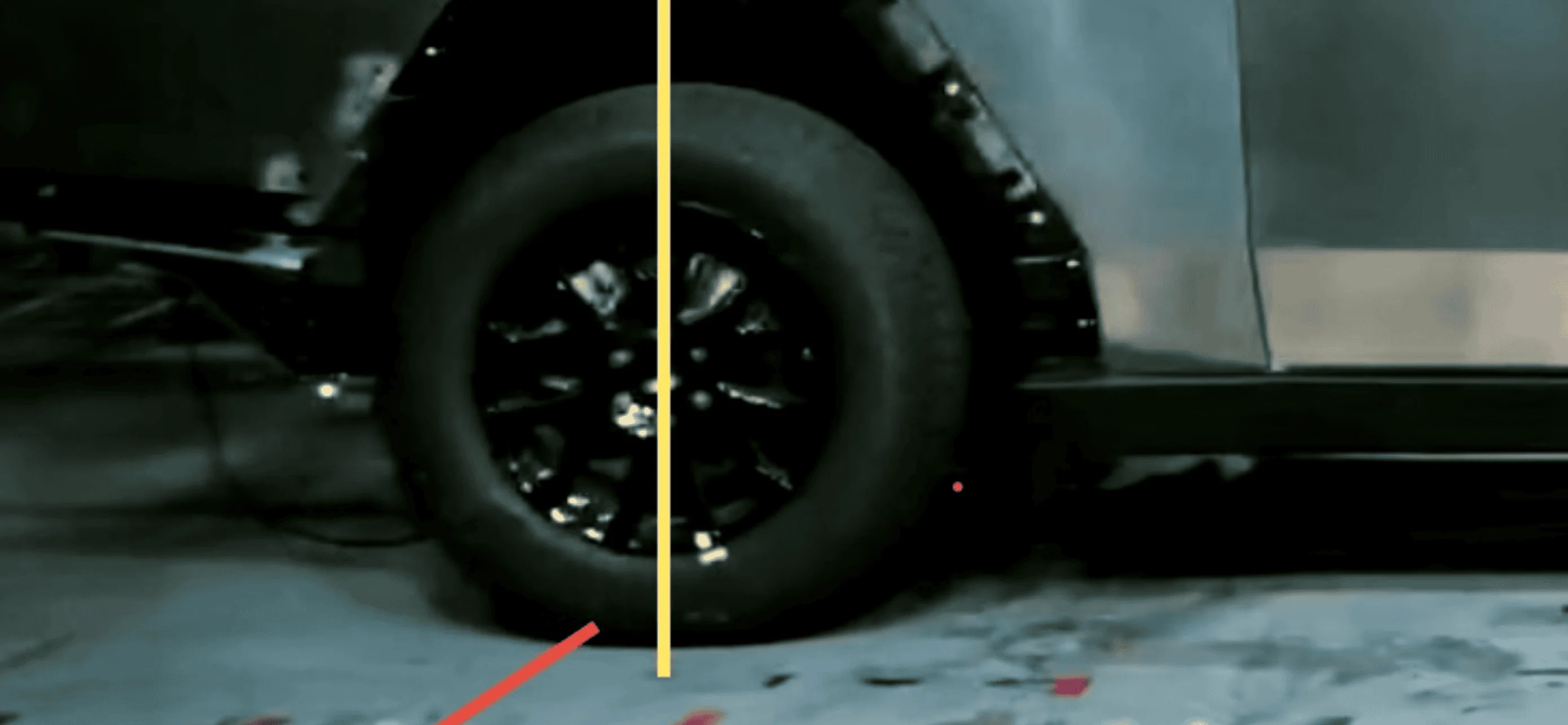
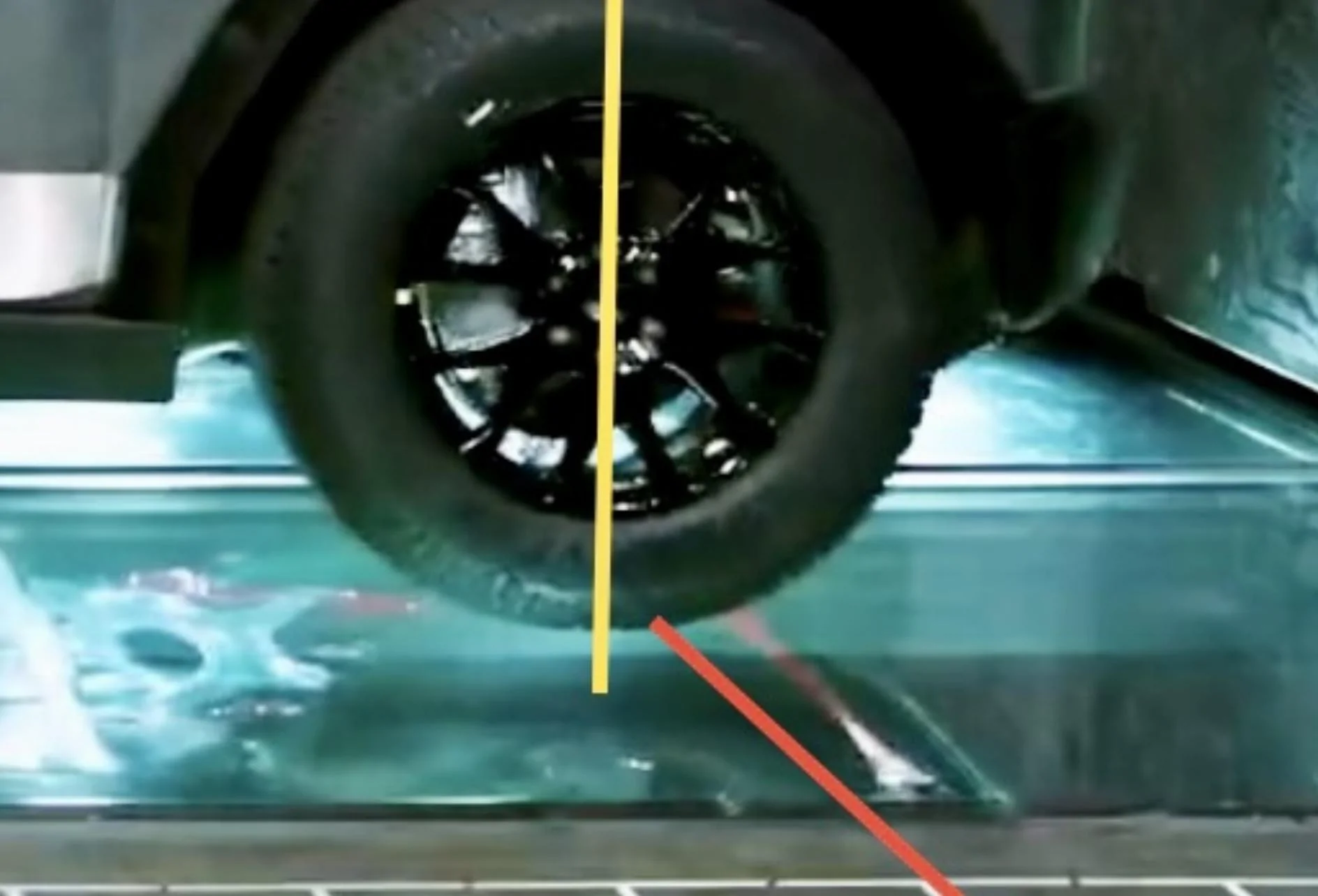
(1) the CT rim’s bolt patterns each had a pair straight up and down, from which to reference and confirm the centerline of the tire set and a vertical line to the floor (yellow lines below), and
(2) both wheels were as near as possible to a pair of the floor’s grid lines (red lines below)
here’s that photo followed by the relevant detail pics at the floor


Now let’s run those numbers.
The red lines above are 12 grid squares apart, or 144” apart.
The wheel center lines are (take your pick, folks, but) I’ll call it “about” 2” behind the front most wheel, and “about” 2” in front of the rearmost wheel.
Weird, using the ground grid marks assumed to be 12”, that amounts to a CT wheelbase of just at 140” (+/- 1-2”). Definitely not 149.9” (the unveil stat for wheelbase) - 10” shorter nose-tail than unveil.
Sounds so familiar:

It’s almost as if someone has thought through this.
Two additional opportunities while we’re here:
(1) if your (@Ogre @Crissa @TheLastStarfighter ) insistent misunderstanding of radial distortions we’re correct when using the floor grid as reference: it would mean that in the above photo the in-photo wheelbases would appear further distant from each other than actual in-world measurements, so the CT wheelbase in-world would be even smaller than ~140” … but don’t worry, that’s not how these pictures work!
(2) going back to this attempt at overhead measurement:
Despite in this thread all insistence on distortions of perspective, etc., over in that thread someone takes the grid from the floor then uses it to measure an object (the CT waistline/max length) we know to be ~4’ above the floor, and arrives at a measure of 220” - to which the same sort of person who is incredulous in this thread respond’s that it’s “exactly right” … despite the unveil stat stating the length is 231.7” - so 12” shorter.
Here again, if your (@Ogre @Crissa @TheLastStarfighter ) insistent misunderstanding of radial distortions we’re correct when using the floor grid as reference: it would mean that in the above photo the in-photo nose-tail length would appear further distant from each other than actual in-world measurements, so the CT nose-tail length in-world would be even smaller than ~220” … but don’t worry, that’s not how these pictures work!
And my numbers for nose-tail are a hair longer, at 222” (but +/-1-2”) - go figure.
Let’s then summarize and find a few more interesting cross-confirmations. Using the grid as measurement reference as gospel, we’ve determined (1) the wheelbase is ~140” (identical to mine) and (2) according to the other thread’s overhead measurement, the total nose-tail length is 220” (222” according to mine)
Since using and assuming the floor grid line as gospel, we’ve determined:
(A) the CT wheelbase is ~140” (~identical to my measurements), and 10” shorter than unveil stats (149.9”), but if material radial distortion is at play the in-world measure would be less than 140” wheelbase (but don’t worry, that’s not how these picture work)
(B) the CT nose-tail is ~220” (2” shorter than my measurements), and so 12-10” shorter than unveil stats (231.7”), but if material radial distortion is at play the in-world measure would be less than 220”-222” (but don’t worry, that’s not how these pictures work)
(3) let’s for sh*t’s and giggle’s see how those two reduced proportions would be roughly proportionate to unveil bed length stats
And we’re Tesla to have also proportionately shrunk the bed between 9.3% and 4.2%, from known on-stage max bed depth (6.5’) you get about a 6’ deep bed (at floor).
- 149.9” (unveil wb) -> (140” crash wb) = -9.3% reduction in wb length
- 231.7” (unveil total length) -> (222” crash total length) = -4.2% shrink


Not at all. I also don't care if you are right or not. I'm just pointing out that you are drawing conclusions using assumptions in all of your calculations and there is likely some error.ok, man
it’s “better” you say, and then I just showed you in detail how it results in ~identical outputs as my (“better,” btw) methodology - which you had previously critiqued (without basis) to no end
You decide to simply ignore the thrust of all that, despite all your prior critiques that are (A) shown as also incorrect via the on-floor method, and (B) now up against the agreement of both methodologies, which tends to cross-confirm both methods
at this point you’re so clearly being indignant on principal and despite reason or contrary evidence, that it’s reduced to mere trolling behavior
Yeah, that was my first thought. Not sure if they are tiles or drawn lines though. In either case, if the interior of the square is a foot you'd have to add the width of the lines to the distance, and it would be what you are saying here.Tiles have grout lines, do they not? 1/4" grout line is pretty standard. 15 grout lines = +3.75"

You can test that theory of the squares not being 12" by finding out what the guesti-mate becomes using the alternate square sizes. The CT dimensions become either absurdly small or large for the alternate sizes.Using the grid on the floor is better than measuring a part and extending it over the image, but we don't know how big the squares are. Probably a foot, but they could also be 12" squares + 1cm lines.
you’re only describing one of only several reasons I didn’t use the on-floor grid as the basis of my original approachTiles have grout lines, do they not? 1/4" grout line is pretty standard. 15 grout lines = +3.75"



https://www.3m.com/3M/en_US/bonding...nce-of-adhesion/categorizing-surface-energy/#Maybe the tape wouldn’t stick to the stainless
But like...I think this isnt ridiculous at all. It's the best info this site has sleuthed out in a long time.


I'm pretty sure the squares are 12" by 12". The question is whether that's inside the line, outside or in the middle. You lose me on the cart.You can test that theory of the squares not being 12" by finding out what the guesti-mate becomes using the alternate square sizes. The CT dimensions become either absurdly small or large for the alternate sizes.
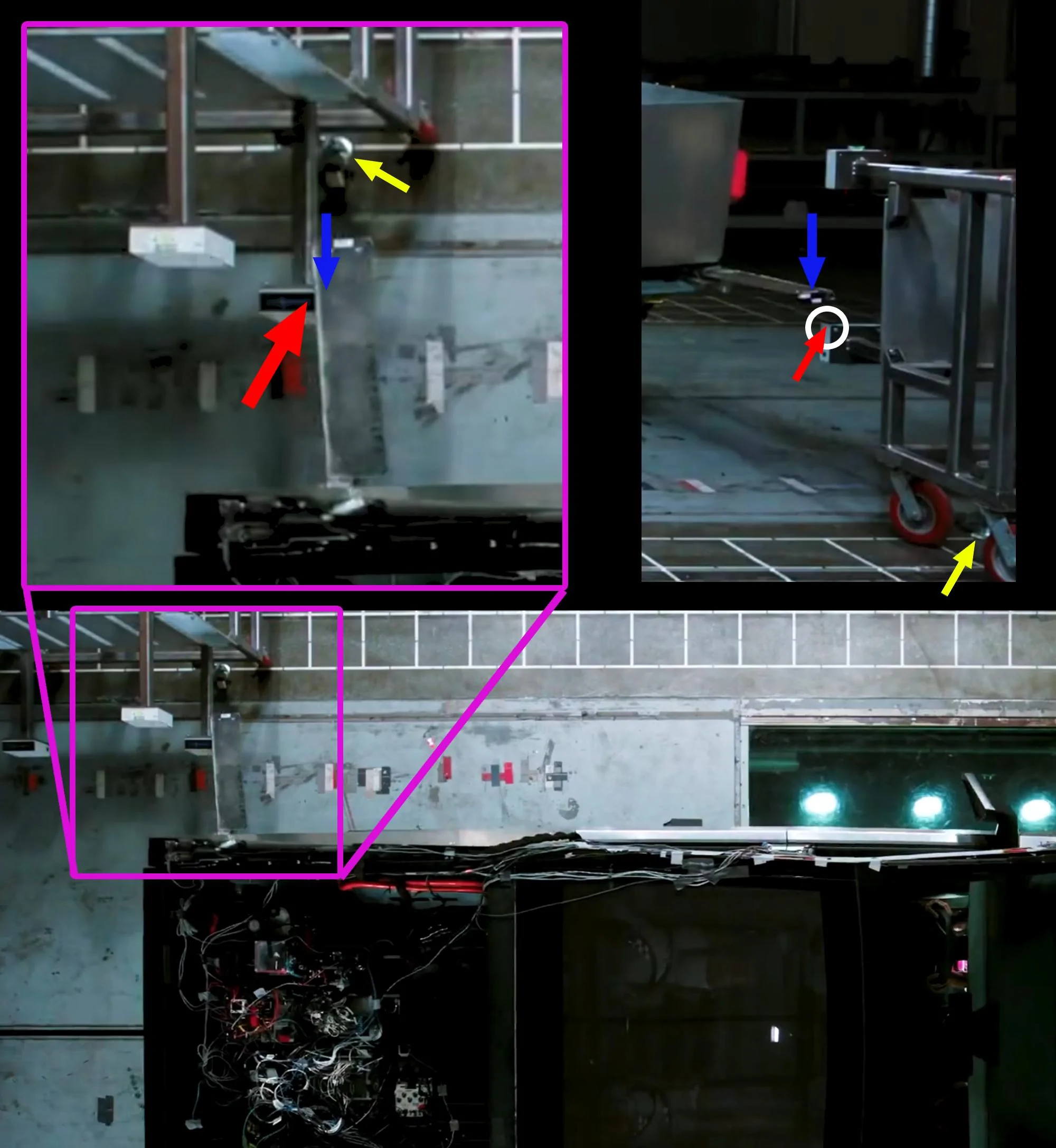
Even by using what you see one thing is for certain that is a dead giveaway and removes all doubt that the CT is shorter than 231 inches.

The lower box on the cart (red arrow) is the dead giveaway. Specifically, the part circled in white. With the overhead camera view, if you look at the yellow arrow you see where the cart leg touches the floor. That yellow arrow is the absolute hard limit for the length of the CT because three things must be true:
1) That cart leg touches the floor and provides its exact location relative to the wall.
2) Looking at where the box is located on the cart (red arrow) relative to the cart leg (yellow arrow). The corner of that box (white circle) is between the wall and the cart leg.
3) It is absolutely impossible for the bumper bar (blue arrow) to obscure the corner of the box from the overhead camera without, at the very least, passing beyond it and over the top corner.
For me, I narrowed the longest possible length of the CT to be floor grid 18<--->19 where the cart leg touches the floor.
What we know—the size is definitely NOT more than 231". For me it adds up in my tiny brain that it's 220"-225" in length.
You'll say, using my logic, you still don't know the size of the grid squares. But, when you use any other size than 12 inches, and proofing against other features on the truck, it instantly produces nonsense feature sizes. The length becomes ridiculously long/short, the tires become tiny, the bed becomes too small to even compete with a wheelbarrow, etc.
But oddly, the BAW always stays the same size.