Sponsored

20/80 Li Ion Charging

punkt

Active member
First Name
Dave
Joined
Nov 17, 2019
Threads
0
Messages
31
Reaction score
34
Location
Van Nuys
Vehicles
F150
Country flag
LFP batteries in the M3 contain a note that they SHOULD be charged to 100%, not 80%. NMC batteries (like the 4680) are the ones Tesla sets a lower daily charge to by default.

There is a company that drives between LA and SFO and the almost exclusively use superchargers. Their batteries SHOULD be worthless after 100,000 miles, according to “common knowledge” and the interwebthing, but they’re not. They’re far closer to brand new than any of the projections. In fact, all Tesla’s data is indicating battery performance far better than expected.
What's the name of the company that runs between SFO and LA?
Sponsored


Diehard

Well-known member
First Name
D
Joined
Dec 5, 2020
Threads
23
Messages
2,127
Reaction score
4,257
Location
U.S.A.
Vehicles
Olds Aurora V8, Saturn Sky redline, Lightning, CT2
Country flag
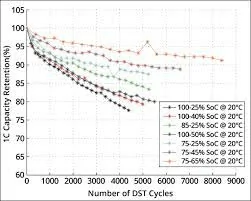
These cycles don't represent the same amount of energy.

Each Cycle of the 75%-65% cycles represents the use of 13% of the energy of 100-25%, and hence, you'd need more than 7 times as many cycles to have used the same amount of energy.

So you'd need to cycle over 30,000 times 75-65 to represent the same amount of energy (or miles) as 4000 cycles 100-25 does.

So did you really save anything?

-Crissa
This is exactly how I saw the graph but I thought I must be missing something with all the conclusions different articles draw from it. If you look at the slope of orange line, with the same amount of energy or mileage (which is what most people are interested in), it should end up with the same degradation or even worse than the black line. So I though, DST must mean for the same amount of energy (more cycles). Apparently not.

If I remember correctly Out Of of Spec guy was saying he keeps his between 20% to 50%. Others say 50%-70% or 20% to 80%. Rivian recommends 70% max charge for daily use. I have been keeping it 30%-70% with most of it’s time spent around 50% with almost all so far slow charging (20-30 Kw AC). Even with all that, my battery health after 6K miles has dropped to 98%. Ford has already replaced some battery modules for others so I have a feeling, the flaws in manufacturing may have more of an impact on my battery health than my behavior.
 
Last edited:

Diehard

Well-known member
First Name
D
Joined
Dec 5, 2020
Threads
23
Messages
2,127
Reaction score
4,257
Location
U.S.A.
Vehicles
Olds Aurora V8, Saturn Sky redline, Lightning, CT2
Country flag
I've been looking around for more finer res data, or an already pre-made heat map that demonstrates the relationship between DoD (Depth of discharge) vs Cycle life and range. A heat map would better illustrate which part of the SoC to use for the desired result. Does anyone have any links to resources like that, to shorten my search?
That would be really cool to see.
 

CyberGus

Well-known member
First Name
Gus
Joined
May 22, 2021
Threads
91
Messages
10,236
Reaction score
33,888
Location
Austin, TX
Vehicles
1981 DeLorean, 2024 Cybertruck
Occupation
IT Specialist
Country flag
Calendar degradation is highest initially, and then tapers off. You should expect to see a noticeable drop of range within the first year or so, but that rate does not project forward.
 

Diehard

Well-known member
First Name
D
Joined
Dec 5, 2020
Threads
23
Messages
2,127
Reaction score
4,257
Location
U.S.A.
Vehicles
Olds Aurora V8, Saturn Sky redline, Lightning, CT2
Country flag
Calendar degradation is highest initially, and then tapers off. You should expect to see a noticeable drop of range within the first year or so, but that rate does not project forward.
EU is requiring mobile phone manufacturers to design phones so batteries can be replaced by an moron (not in those words). I wonder how long it will take for the same requirements for EVs. So instead of stressing about when end of life for our disposable BEVs will be, we just drive it with the comfort that we can always replace a faulty module easily regardless of chemistry or brand. I know our law makers will never have our backs like that but if it happens in UK, once Chinese, Koreans and Japanese start making cars like that, our kids may be driving cars they can actually maintain.


davelloydbrown

Well-known member
First Name
Dave
Joined
Feb 13, 2022
Threads
7
Messages
548
Reaction score
617
Location
Canada
Vehicles
model 3, silverado
Occupation
veterinarian - retired
Country flag
My research over the years has found that Li Ion batteries charged to 80% maximum and discharged to no more than 20% have an ‘indefinite’ lifespan. I understand there are many other factors but that this is a fundamental of this battery chemistry.
Will CT (or do any Teslas) allow programming for an 80/20 regimen?
If so… and this is recommended to maintain battery pack life, the a 500 mile range CT would be reduced to a functional range of 60% of that or 300 miles. And a 300 mile range CT would be reduced to 180 miles if these ship with Li Ion packs.
Im having a hard time with this functionality against hybrid tech.
Thoughts?
I have a 2018 M3 and when I first got it i had some long trips over a short period of time so I would charge to 100% (and a couple of times down to 0%). I would get a message that this would lead to degradation of the battery.

Pretty much all of the time now I try to stay between 20 and 80% and as far as I can tell there is no degradation to the battery (when it is full it reads 500 km or 300 mi). I will still charge to 100% when I am going on a long trip, however this is infrequent.

When I first got it, like I said, it got down to 0% and I still made it home so I am pretty sure that the tesla's keep some reserve below 0% so this would also lead to less degradation.

I agree with the need for a 500 mi battery especially if you are towing or driving in cold weather. But you would be amazed at how much of your driving is relatively short distances and you only need to charge 100% rarely.
 

CyberGus

Well-known member
First Name
Gus
Joined
May 22, 2021
Threads
91
Messages
10,236
Reaction score
33,888
Location
Austin, TX
Vehicles
1981 DeLorean, 2024 Cybertruck
Occupation
IT Specialist
Country flag
EU is requiring mobile phone manufacturers to design phones so batteries can be replaced by an moron (not in those words). I wonder how long it will take for the same requirements for EVs. So instead of stressing about when end of life for our disposable BEVs will be, we just drive it with the comfort that we can always replace a faulty module easily regardless of chemistry or brand. I know our law makers will never have our backs like that but if it happens in UK, once Chinese, Koreans and Japanese start making cars like that, our kids may be driving cars they can actually maintain.
When consumers are empowered to swap their own batteries, most of them end up in the landfill.

When Apple replaces my phone battery, 100% of them are recycled.
 

BayouCityBob

Well-known member
Joined
Apr 14, 2022
Threads
24
Messages
495
Reaction score
1,569
Location
Texas
Vehicles
2018 Model 3
Country flag
No this will damage your pack. you should never go to a low state of charge (SoC) if you can avoid it, and if so not keep it there for a long period before recharging.

1698033999738.png
No no no. This discussion re this chart is going seriously awry. You can read the source material here at battery university.

It is not best to charge and discharge between 75% - 65%. As the source explains, you would only get 60% of the miles if you did that versus running from 75% - 25%. Moreover, you would get one third more miles by running 85% - 25% cycle.
  • Case 1: 75–65% SoC offers longest cycle life but delivers only 90,000 energy units (EU). Utilizes 10% of battery.
  • Case 2: 75–25% SoC has 3,000 cycles (to 90% capacity) and delivers 150,000 EU. Utilizes 50% of battery. (EV battery, new.)
  • Case 3: 85–25% SoC has 2,000 cycles. Delivers 120,000 EU. Uses 60% of battery.
Your objective is energy units (i.e. miles drive) not cycles. However...
  • Please note that this chart is not indicative of much of anything. It is a first generation poj Nissan Leaf battery without active thermal management.
  • This is not how battery cycles are typically reported (hence the DST modifier for the stress test). When you see something like a "1,000 cycle life expectancy" before dropping to 90% that means 1,000 x the usable KWH not 1,000 plug-in times.
  • A typical Tesla pack will deliver 1,000 x available Energy Units (300,000+ miles on a CT) and still have 90% capacity even if you DCFC a lot and even if you charge fairly frequently to 90%
  • Key takeaway: In long range EVs, Cycling is not a significant cause of degradation don't worry about it, follow OEM guidelines.
As @CyberGus noted above, holding the battery at a high state of charge causes significant increase in degradation. This is why phone batteries die so quickly (and why Apple, for example, has created a software fix to hold the final morning charge until shortly before you wake up).
As @CyberGus also noted, the much bigger factor is calendar aging. At least for the first few years. Nothing you can do about that.

One of the biggest problems is that there are almost no decent end-of-line QC testing procedures for cells. Cannot say how I know this but... one OEM (not Tesla) leaves cells sitting in inventory for 60 days and then retests current and voltage to weed out infant mortality problems from a large manufacturer because the EOL QC tells you so little about the actual cell. The good news is that there are new technologies coming to market to address this QC problem. The biggest bump in battery longevity in next few years will, IMO, be ensuring that all of the batteries going into a pack are top quality units.

Battery university is the place to go for high quality information on all things battery
 

Oakland_baby

Member
First Name
Mark
Joined
Aug 8, 2020
Threads
0
Messages
11
Reaction score
10
Location
Walnut Creek, CA
Vehicles
Kia, Chevy, cybertruck
Country flag
You should probably give up your Cybertruck reservation. I'll get mine and let you know how it works after 10 years.


Diehard

Well-known member
First Name
D
Joined
Dec 5, 2020
Threads
23
Messages
2,127
Reaction score
4,257
Location
U.S.A.
Vehicles
Olds Aurora V8, Saturn Sky redline, Lightning, CT2
Country flag
When consumers are empowered to swap their own batteries, most of them end up in the landfill.

When Apple replaces my phone battery, 100% of them are recycled.
when apple replaces the batteries a lot more phones (with their batteries) end up in landfill.

Edit: I for one kept the phones I could replace the batteries for myself a lot longer. Any extra cost or effort to replace the battery pushed me to junk the whole thing and buy a new unit. I doubt I am the only one operating this way. And I doubt manufacturers don’t know that.
 
Last edited:

JBee

Well-known member
First Name
JB
Joined
Nov 22, 2019
Threads
18
Messages
4,913
Reaction score
6,362
Location
Australia
Vehicles
Cybertruck
Occupation
. Professional Hobbyist
Country flag
This is exactly how I saw the graph but I thought I must be missing something with all the conclusions different articles draw from it. If you look at the slope of orange line, with the same amount of energy or mileage (which is what most people are interested in), it should end up with the same degradation or even worse than the black line. So I though, DST must mean for the same amount of energy (more cycles). Apparently not.

If I remember correctly Out Of of Spec guy was saying he keeps his between 20% to 50%. Others say 50%-70% or 20% to 80%. Rivian recommends 70% max charge for daily use. I have been keeping it 30%-70% with most of it’s time spent around 50% with almost all so far slow charging (20-30 Kw AC). Even with all that, my battery health after 6K miles has dropped to 98%. Ford has already replaced some battery modules for others so I have a feeling, the flaws in manufacturing may have more of an impact on my battery health than my behavior.
You'll find that the degradation is also not linear, with a fair bit happening just after delivery of brand new cells as they stabilise. That means the 2% loss you have seen so far will not necessarily continue at that rate as the curve flattens out, until the end where it dives off the edge.
 

kbolt

Well-known member
Joined
Oct 15, 2021
Threads
16
Messages
748
Reaction score
1,101
Location
SLC
Vehicles
Model Y
Country flag
I wish that graph also came with an explanation of what a cycle is. Because I read that a cycle is charging from 0-100% and Tesla batteries were rated for over 10,000 cycles.

The same thing said that if you charge from 20-80% that is a half cycle so you could charge twice from 20-80 and have the same wear on the battery as if you had charged once from 0-100. So if that's the case then 45-75 might be like a quarter cycle or maybe even an eighth cycle in which case you would probably get more miles per cycle.

Otherwise the graph isn't normalized and should have a number of miles driven at different degradation milestones. This way we could see "at 100k miles driven you will have 93% battery vs 83% battery capacity" or whatever it is.
 

JBee

Well-known member
First Name
JB
Joined
Nov 22, 2019
Threads
18
Messages
4,913
Reaction score
6,362
Location
Australia
Vehicles
Cybertruck
Occupation
. Professional Hobbyist
Country flag
No no no. This discussion re this chart is going seriously awry. You can read the source material here at battery university.

It is not best to charge and discharge between 75% - 65%. As the source explains, you would only get 60% of the miles if you did that versus running from 75% - 25%. Moreover, you would get one third more miles by running 85% - 25% cycle.
  • Case 1: 75–65% SoC offers longest cycle life but delivers only 90,000 energy units (EU). Utilizes 10% of battery.
  • Case 2: 75–25% SoC has 3,000 cycles (to 90% capacity) and delivers 150,000 EU. Utilizes 50% of battery. (EV battery, new.)
  • Case 3: 85–25% SoC has 2,000 cycles. Delivers 120,000 EU. Uses 60% of battery.
Your objective is energy units (i.e. miles drive) not cycles. However...
  • Please note that this chart is not indicative of much of anything. It is a first generation poj Nissan Leaf battery without active thermal management.
  • This is not how battery cycles are typically reported (hence the DST modifier for the stress test). When you see something like a "1,000 cycle life expectancy" before dropping to 90% that means 1,000 x the usable KWH not 1,000 plug-in times.
  • A typical Tesla pack will deliver 1,000 x available Energy Units (300,000+ miles on a CT) and still have 90% capacity even if you DCFC a lot and even if you charge fairly frequently to 90%
  • Key takeaway: In long range EVs, Cycling is not a significant cause of degradation don't worry about it, follow OEM guidelines.
As @CyberGus noted above, holding the battery at a high state of charge causes significant increase in degradation. This is why phone batteries die so quickly (and why Apple, for example, has created a software fix to hold the final morning charge until shortly before you wake up).
As @CyberGus also noted, the much bigger factor is calendar aging. At least for the first few years. Nothing you can do about that.

One of the biggest problems is that there are almost no decent end-of-line QC testing procedures for cells. Cannot say how I know this but... one OEM (not Tesla) leaves cells sitting in inventory for 60 days and then retests current and voltage to weed out infant mortality problems from a large manufacturer because the EOL QC tells you so little about the actual cell. The good news is that there are new technologies coming to market to address this QC problem. The biggest bump in battery longevity in next few years will, IMO, be ensuring that all of the batteries going into a pack are top quality units.

Battery university is the place to go for high quality information on all things battery
I didn't realise where the chart came from, I found it via a google image search and haven't seen the battery university site before. The chart is actually from a another study though?

But I don't think we disagree as much as you think.

I calculated the resulting total cell life range roughly from the graph lines of the respective cycle life in my post here:

For example using the data from that graph, using a DoD of 60% on both, one starting at 100%, the other from 85%, results in a 12% total life time cell range improvement for the 85%.
That is similar lifetime range % to the case quotes on battery university. What I didn't correlate yet was that there is not only a upper preferred limit for DoD but also a lower DoD limit, under which total energy was less over the lifetime of the cell. Sorry about that, but I'd like to know where that is now too. ?

But my interest at looking at it was to go bit further and create a heat map where it's easy to identify which parts of the battery SoC are less affected by DoD. That is to say for example, is it better to cycle 50% of SoC from 75% or 80%, and then add how much the C rate of charge/discharge adds to that (as this applies to SC/home charging), along with a temperature overlay.

I note that the graph is only at a fixed 1C, which is fairly typical for SC, but not at home charging, neither for driving. That was also data I was looking for. Do you have that on the battery university somewhere as well you can link too?

Also there is a comment on the page you linked to:

Experiment: Chalmers University of Technology, Sweden, reports that using a reduced charge level of 50% SOC increases the lifetime expectancy of the vehicle Li-ion battery by 44–130%.

But it doesn't go into any further detail. I expect that the 80/20 theory holds true for most OEM guidelines, but does that mean any further optimisation is fruitless, by digging further into the data? It would be nice to find something where this work has already been done if you have a link. Sometimes google/duckduck/etc search optimisations are useless. ?

BTW why doesn't the graph used line up with the case numbers data in the commentary underneath it? 75-25% is around 5200 cycles on the graph but only 3000 cycles in the "case 2" comment, same with 85-25% with 5200 on the graph, but only 2000cycles in the "Case 3" comment?

If the case's aren't represented in the graph then why use it?

Also I'd like to investigate the differences between chemistries too.
Any guidance or links appreciated.
 

Diehard

Well-known member
First Name
D
Joined
Dec 5, 2020
Threads
23
Messages
2,127
Reaction score
4,257
Location
U.S.A.
Vehicles
Olds Aurora V8, Saturn Sky redline, Lightning, CT2
Country flag
I wish that graph also came with an explanation of what a cycle is. Because I read that a cycle is charging from 0-100% and Tesla batteries were rated for over 10,000 cycles.

The same thing said that if you charge from 20-80% that is a half cycle so you could charge twice from 20-80 and have the same wear on the battery as if you had charged once from 0-100. So if that's the case then 45-75 might be like a quarter cycle or maybe even an eighth cycle in which case you would probably get more miles per cycle.

Otherwise the graph isn't normalized and should have a number of miles driven at different degradation milestones. This way we could see "at 100k miles driven you will have 93% battery vs 83% battery capacity" or whatever it is.
It would be nice to see the relative impact of all variables on the same graph. Fisker ocean limits boost mode (hard acceleration) to 500 for each vehicle. Not sure how much of it is to limit the damage to mechanical components but I suspect a lot of it is to protect the battery.

Not knowing the impact, when some dude in an ICE sport car pushes my stupid button, I only accelerate enough to keep my nose ahead of him ( won’t go for maximum acceleration). Kinda like managed stupid mode to give the other guy some hope and preserve the battery at the same time.
Sponsored


Top