
Sponsored

JBee

Well-known member
First Name
JB
Joined
Nov 22, 2019
Threads
18
Messages
4,913
Reaction score
6,362
Location
Australia
Vehicles
Cybertruck
Occupation
. Professional Hobbyist
Country flag
faik, Land Rover really the only ones to figure out adjustable air suspension for off-road articulation

took them several decades to dial in

that cheat-sheet in hand, I’ll be surprised if Tesla doesn’t get it dialed in quickly
Yeah Land Rover have been doing it for a while, and even the Mercedes G Class or Unimog are great examples of how it can be done.

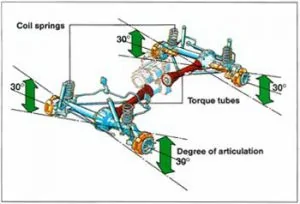
With the Unimog it cheats a little when it comes to wheel articulation, in that it uses torque tubes around the center driveshafts to the front and rear, that allow 30' of articulation each axle. It needs a special frame for the rear bed, that is seperate from the cabin so that it can do this.

Essentially, this means it has more wheel articulation than it actually has suspension travel. This is because the body itself articulates, over the top of the suspension springs themselves.
Tesla Cybertruck Actual Off-Road Testing: climbing & descending (@ Hollister Hill RSVA - 10/23/23) tent%2Fuploads%2F2017%2F05%2Farticulation1-300x204


We used to sell these as expedition vehicles in Europe way before van life was a thing in the 1990's. Along with importing the Aussie equivalent to Europe.

Another big advantage of the unimog was the portal axles, that put the final drive ratio at the wheels, meaning all the driveshafts were lightweight and ran at higher rpm, with all thetorque being generated at the wheels themselves. The design also gave it the best clearance, because it also lift the axle diffs off the ground.

Tesla Cybertruck Actual Off-Road Testing: climbing & descending (@ Hollister Hill RSVA - 10/23/23) tent%2Fuploads%2F2017%2F05%2Farticulation1-300x204


So on a rigid body vehicle, like the CT, all of the articulation has to come from the suspension, but that is not always the best way to achieve off-road articulation, as the springs act to concentrate the force on the two highest wheels. You really need cross linked airsprings to counter this, and a way to disable the sway bars.

So if Tesla doesn't get this all right, or bring out a Baja edition or something, there's going to be a big demand to get suspension and diff mods done for it in the future. ;)

Ah yeah we must not forget CTIS as well. Apparently Tesla hired the Unimog CTIS engineer last year already.
Sponsored


Setok

Well-known member
Joined
May 1, 2023
Threads
8
Messages
363
Reaction score
568
Location
Finland
Vehicles
Land Rover Defender, Jeep Avenger EV, Tesla Model 3
Country flag
My spouse peered over at this and asked, 'who would know best about locking axles being useful' then she said 'military!' then she ran off to figure out what vehicles the military uses that have locking axles...

'Marines on beaches and multi-axle trucks,' she came back with. 'That is all I can find.'

The only reason you use locking axles is because you don't care about cornering, you only want to scrabble forward or backwards. There's no reason a truck with motor per wheel cannot simulate it.

Besides, experience with the vehicle and track overcomes alot of slip. Knowing where to put your tires is just, the most important thing.

Having a locking differential won't stop you from spinning your tires if you put them in the wrong spots with the wrong torque.

-Crissa
Unfortunately I believe you are wrong. A motor per wheel cannot simulate it. This takes a bit of thought to realise (I believed wrongly as well, at first). The key to realise is that the same torque, when applied on a wheel with low or no traction, will spin it fast, while the wheel on solid concrete will move forwards at a steady pace. WIth a locked differential torque is not sent equally and separately to both wheels, but interestingly is sent to the wheel with most traction. Instantly (due to physics). This cannot be really replicated with computers and motors, as for the system to realise that torque should not be sent to a wheel with less traction, the wheel has to slip. Otherwise you'd need some kind of probe to figure out the wheel is going to slip. It still means the other wheel can drive the vehicle forward, but the slipping wheel can dig down into material of weak traction (mud, snow etc), which can result in the vehicle being stuck (you'll be surprised how little snow is needed for that to happen), or slipping sideways.

A locked differential will absolutely stop your wheels from spinning, as long as even one wheel has enough traction to move the vehicle. The others will not slip, but merely turn at the same speed.

Most military work is driving from A to B. Sometimes over rough terrain, yes, but not necessarily always on the trickiest offroad. Plus those vehicles are driven by all kinds of random people who will often not have any clue how to use locks. So possibly the decision is the risk is not worth it, as keeping a lock on when driving on asphalt can damage the transmission. Then again militaries that use old Defenders have central diff locks, and those using G Wagons may additionally have rear locks. So perhaps only things like Humvees don't have them (I'm honestly not sure)?
 

papajamaliciousness

Well-known member
First Name
Peter
Joined
Feb 22, 2022
Threads
0
Messages
95
Reaction score
119
Location
Michigan
Vehicles
2012 Subaru Outback
Occupation
lawyer
Country flag
Sounds like basic tires trying to do off road stuff. Grabbing that dry dusty concrete, not easy.
Yeah. Why didn't they put good tires on it. From the way the guy rocked the truck back and forth I thought he knew what he was doing.

But those look like the wrong tires for offroad.
 

JBee

Well-known member
First Name
JB
Joined
Nov 22, 2019
Threads
18
Messages
4,913
Reaction score
6,362
Location
Australia
Vehicles
Cybertruck
Occupation
. Professional Hobbyist
Country flag
Unfortunately I believe you are wrong. A motor per wheel cannot simulate it. This takes a bit of thought to realise (I believed wrongly as well, at first). The key to realise is that the same torque, when applied on a wheel with low or no traction, will spin it fast, while the wheel on solid concrete will move forwards at a steady pace. WIth a locked differential torque is not sent equally and separately to both wheels, but interestingly is sent to the wheel with most traction. Instantly (due to physics). This cannot be really replicated with computers and motors, as for the system to realise that torque should not be sent to a wheel with less traction, the wheel has to slip. Otherwise you'd need some kind of probe to figure out the wheel is going to slip. It still means the other wheel can drive the vehicle forward, but the slipping wheel can dig down into material of weak traction (mud, snow etc), which can result in the vehicle being stuck (you'll be surprised how little snow is needed for that to happen), or slipping sideways.

A locked differential will absolutely stop your wheels from spinning, as long as even one wheel has enough traction to move the vehicle. The others will not slip, but merely turn at the same speed.

Most military work is driving from A to B. Sometimes over rough terrain, yes, but not necessarily always on the trickiest offroad. Plus those vehicles are driven by all kinds of random people who will often not have any clue how to use locks. So possibly the decision is the risk is not worth it, as keeping a lock on when driving on asphalt can damage the transmission. Then again militaries that use old Defenders have central diff locks, and those using G Wagons may additionally have rear locks. So perhaps only things like Humvees don't have them (I'm honestly not sure)?
Yep that pretty much sums it up.

A mechanical lock on both front and rear (and middle if you have a middle diff like most full time 4x4) means each wheel is turning synchronized with each other wheel, regardless of if that wheel has traction or not.

Most importantly this means that every bit of forward thrust produced by the wheels is produced at the same time and at the same speed. Wheel torque is distributed in "real-time" and only offset by the amount of twist and slack in the driveshafts.

Consider this scenario: If you would have a 4 wheel vehicle, and two of the wheels spin at say 10RPM and the other two at 15RPM, then what is the rate of forward motion? Sometimes 10 or 15RPM, but not 12.5RPM, meaning that the faster wheels are working against the slower ones.

Now with a motor per wheel the "syncronisation" of the wheels should technically be possible, but to do so means you need very high sensor feedback to modulate the motor inverter output to match the torque load on each wheel. This would have to be in the ms control loop range. A locking differential on each the front and rear motor on a DM CT, would be much simpler and likely perform better than a QM in low speed rock crawling situations with high wheel articulation, however, in other off-road conditions, a QM with torque vectoring would operate better when you need more wheel slip and need to steer.

In the end from a control perspective, so long you can basically "look" (aka sense) at the ground in relation to the vehicle, and see what direction and velocity you have, you should be able to calculate exactly the wheel position from a rotary encoder etc, and steering angle sensor, and then use the motor controller to observe current (torque) and then limit switching frequency to lock in a rpm that matches what movement it is doing across the ground. This will however only work if it can maintain the right amount of torque per wheel, so it's likely that either a high ratio gearing needs to be used per wheel (like a portal axle) or that it is a high power motor that can achieve full torque at low RPM.

This differs considerably in complexity from a normal ICE, with just one motor and a low range gear, where with lockers you can have every bit of torque from the engine going to any one wheel or any combination of them in an instant mechanically. That's why if you have a how power ICE you can snap shafts.

Technically, without lockers, a dual motor Cybertruck is only a 2WD, with one front and one rear driven wheel only. A Tri-motor is only 3WD without locker, and only a QM is really 4WD. Traction control really doesn't cut it, but for many less serious users they probably won't know how it is meant to be, so unless they experience lockers wouldn't understand just how much better they are.

My suspension comments also come into consideration here as well, because if you can't get your wheels on the ground, you really don't have a 4x4 anyway. More like a AWD. But even there, my son has a modded sub 4sec WRX, and that comes standard with a rear LSD to get that power down. So definitely useful.


Bill837

Well-known member
First Name
Bill
Joined
Sep 21, 2023
Threads
5
Messages
264
Reaction score
541
Location
Southern Maryland
Vehicles
2020 Z4, 2015 Cherokee Trailhawk, 2008 R1200RT
Occupation
Aviation Weapons/Systems
Country flag
Yeah. Why didn't they put good tires on it. From the way the guy rocked the truck back and forth I thought he knew what he was doing.

But those look like the wrong tires for offroad.
Because you test what you are selling. And the tires they sell are going to be a compromise between efficiency and performance, both on road and off.
 

seanrarey

Member
First Name
Sean
Joined
Mar 14, 2020
Threads
0
Messages
17
Reaction score
39
Location
Galice, Oregon
Vehicles
Cadilac ELR
Occupation
Retired
Country flag
I was really speaking to your point about lockers being common in 1/2 ton pickups. I can see LSDs being common, but I don't really think lockers are, but maybe I'm wrong.
Ford Chevy and Dodge all offer rear locker options for virtually every 4x4 pickup they sell.
 

seanrarey

Member
First Name
Sean
Joined
Mar 14, 2020
Threads
0
Messages
17
Reaction score
39
Location
Galice, Oregon
Vehicles
Cadilac ELR
Occupation
Retired
Country flag
Those who believe that a motor on each wheel can "simulate" a locker are being proven way wrong with the Hummer and the Rivian quad motor.

The QM Rivian behaves so badly in low mu situations and low speed obstacles that I traded it for a loss for a new dual motor Enduro version, because dual motors with traction control is much better than that quad motor disaster. Based on this, because I am an off-roader, I will _not_ be selecting the TriMotor version of the Tesla!
 

papajamaliciousness

Well-known member
First Name
Peter
Joined
Feb 22, 2022
Threads
0
Messages
95
Reaction score
119
Location
Michigan
Vehicles
2012 Subaru Outback
Occupation
lawyer
Country flag
Because you test what you are selling. And the tires they sell are going to be a compromise between efficiency and performance, both on road and off.

Maybe. But it's basically not offroading at all if you don't put offroading tires on it. It's like testing a boat without putting it in the water. Someone in the decision making process does not know about offroading. It's actually a bad sign for the truck because it suggests they also don't know the importance of adjusting air pressure and they really could have made an extremely cool truck by offering the ability to adjust air pressure from inside the cab like military vehicles and this suggests someone in a position to make decisions doesn't know the right questions to ask.
 

HaulingAss

Well-known member
Joined
Oct 3, 2020
Threads
28
Messages
10,425
Reaction score
20,952
Location
Western Washington, USA
Vehicles
Cybertruck DM, 2010 F-150, 2018 Performance Model 3, 2024 Performance Model 3
Country flag
Those who believe that a motor on each wheel can "simulate" a locker are being proven way wrong with the Hummer and the Rivian quad motor.
Let's remain logical here! Just because a vehicle has individual motors for each wheel, doesn't mean they actually implemented a simulated locking differential mode. This is basic logic 101. :rolleyes:

A true simulated locker would have the motors on the same axle electronically synchronized. This can be done without any additional hardware because the motors already have high resolution position sensors used by the motor controller.


JBee

Well-known member
First Name
JB
Joined
Nov 22, 2019
Threads
18
Messages
4,913
Reaction score
6,362
Location
Australia
Vehicles
Cybertruck
Occupation
. Professional Hobbyist
Country flag
Those who believe that a motor on each wheel can "simulate" a locker are being proven way wrong with the Hummer and the Rivian quad motor.

The QM Rivian behaves so badly in low mu situations and low speed obstacles that I traded it for a loss for a new dual motor Enduro version, because dual motors with traction control is much better than that quad motor disaster. Based on this, because I am an off-roader, I will _not_ be selecting the TriMotor version of the Tesla!
Do you happen to know what sort of wheel torque the Rivian QM was making?

Was it equally poor in loose sand as in rock climbing, and did it prefer certain surfaces?
 

seanrarey

Member
First Name
Sean
Joined
Mar 14, 2020
Threads
0
Messages
17
Reaction score
39
Location
Galice, Oregon
Vehicles
Cadilac ELR
Occupation
Retired
Country flag
Let's remain logical here! Just because a vehicle has individual motors for each wheel, doesn't mean they actually implemented a simulated locking differential mode. This is basic logic 101. :rolleyes:

A true simulated locker would have the motors on the same axle electronically synchronized. This can be done without any additional hardware because the motors already have high resolution position sensors used by the motor controller.
Well yes, if you connect them, you solve the problem lol.
 

seanrarey

Member
First Name
Sean
Joined
Mar 14, 2020
Threads
0
Messages
17
Reaction score
39
Location
Galice, Oregon
Vehicles
Cadilac ELR
Occupation
Retired
Country flag
Do you happen to know what sort of wheel torque the Rivian QM was making?

Was it equally poor in loose sand as in rock climbing, and did it prefer certain surfaces?
There are dozens of pages of why the engineers were wrong, and why in practice it is a failed concept on the Rivian forums. TFL's recent shootout with a lowly Chevy trail Boss shows just how anemic the poor quad motor is. The dual motor with differentials pulls itself over that type of obstacle with no fuss whatsoever.

However, separate motors on each wheel causes a problem far greater than being unable to act like a "true locker". When decelerating down a slippery bank or an off camber icy situation in my differential equipped vehicle, I can open them up, and allow the wheel with the most traction to maintain my lateral stability. I can use the wheels with the least traction to either increase or decrease my speed, without compromising my lateral stability. By design, differential equipped vehicles are inherently laterally stable because of this.

You absolutely, utterly give this up if the wheels are not connected with a differential to use physics in this way. The result is a vehicle that will suddenly and wildly yaw sideways at the worst possible moment. When on the trail, we have to treat quad motor rivians the same as the spooled Yoda's, and actually winch them down into and out of certain obstacles because of their lack of lateral stability.

I never understood people who used Lincoln lockers for this reason, and it is even more egregious in a production vehicle.
 

seanrarey

Member
First Name
Sean
Joined
Mar 14, 2020
Threads
0
Messages
17
Reaction score
39
Location
Galice, Oregon
Vehicles
Cadilac ELR
Occupation
Retired
Country flag
Wonder if they can just program the 4x4 functions via software.
They sure are trying. The Rivian is getting more and more drive modes to try to compensate for the lack of the differential, but to date they are not remotely close.

You are trying to replace action with reaction. It puts a software model on its back foot to begin with. Add the very real complication that an electric motor is not very happy at Its very very lowest Rpms, and you get a vehicle that struggles badly on those types of obstacles.

I have hundreds of hours off-roading with various Rivians, Hummer EVs and even a lightning in the last year. I know my eyes have been opened, and with everything we have done and tested, I am 100% back in the "motor connected to a differential camp". You have all the wonderful capabilities that an open differential gives you, to include inherent lateral stability, and when you lock it up, you have a true locker, that is not trying to guess the surface that it is on a thousand times a second. It's simply drives the vehicle forward, no fuss, no muss.
Sponsored


Top