JBee
Well-known member
- First Name
- JB
- Joined
- Nov 22, 2019
- Threads
- 18
- Messages
- 4,913
- Reaction score
- 6,362
- Location
- Australia
- Vehicles
- Cybertruck
- Occupation
- . Professional Hobbyist

I think the CT will have less of a skirt, because the structural pack is lower, making the CT cabin potentially lower. But the offset here is that the CT roof apex is higher in to keep the angular design aesthetic, meaning it might be a similar body height.you think the Lightning has less frontal area??
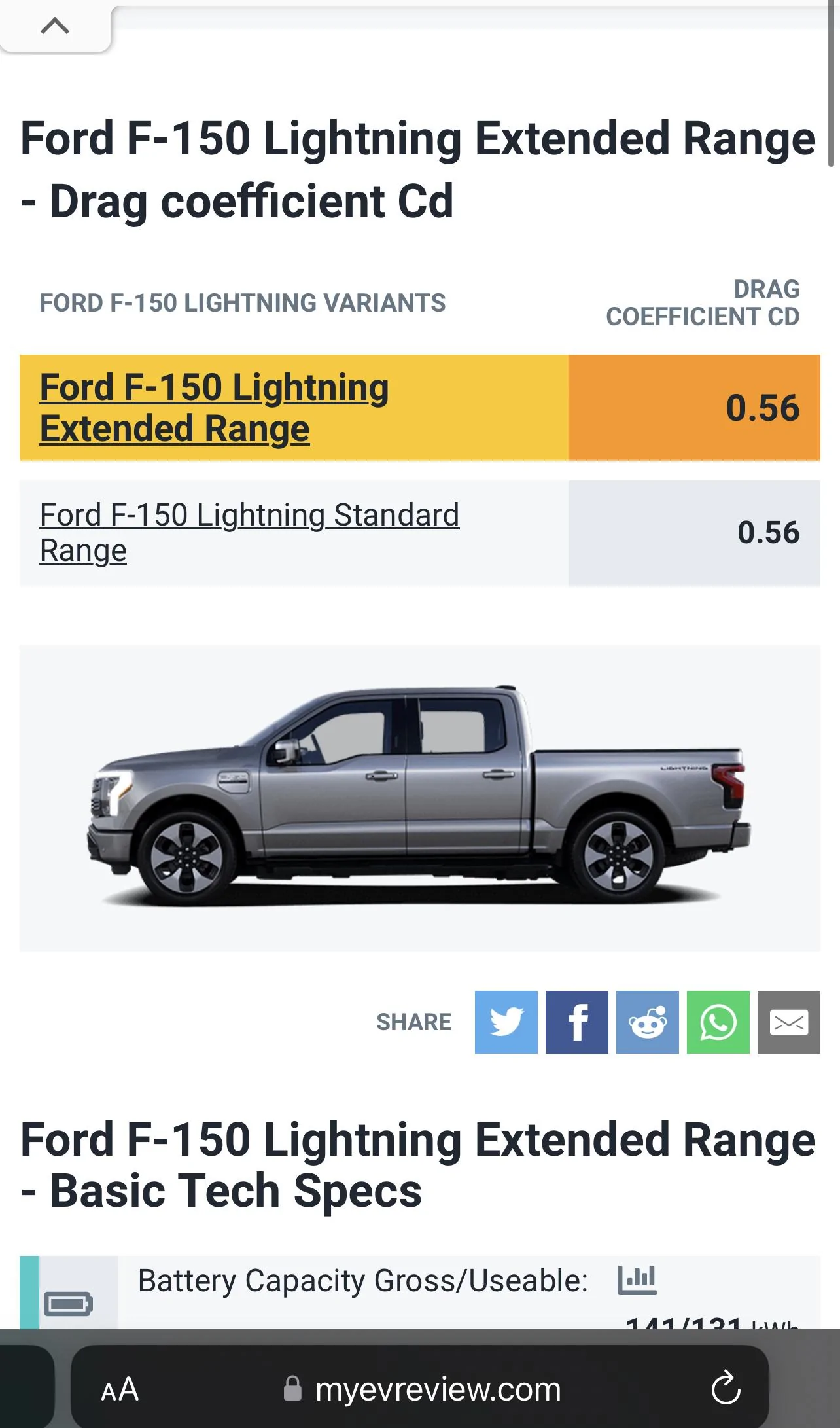
0.56 is the only value I can find online, which is both as hood and bad a source as for any other

not sure, as I also see the 0.56 elsewhere attributed to the Raptor, by one of those folks who did rough modeling of the CT vs, early on
Car & Driver has an article that proclaims the Lightning Cd is 4% better than a standard F150
Everything else online are companies that sell ‘aerodynamic’ bed covers, etc, just claiming to make ace better
I see no way it’s in the 0.3Xs, but wouldn’t be surprised if it’s not in the 5s
In any event, the F150 is Certainly less slippery than the CT, and the vertical surface area is way taller - like 9”+
Note here the body "height" aerodynamically, is not the height from the roof to the ground, rather from the roof to the vehicle underbody, air passes underneath the vehicle as well, meaning, that that the underfloor surface becomes an important feature for drag, especially so whilst considering compression from wing in ground effects, and vehicle rake (lean forwards) that is the primary source of both lift and downforce on most vehicles. You could in fact use the CT air-suspension to optimise these whilst driving, with a "cruise mode" that produces no up or down force, and no induced drag, and a "performance mode" that leans forward cheater style like on the MSP.
In general the rule for god aerodynamics is simply to move the air around the vehicle in such a way that disturbs the air the least possible way. That means take the air, separate it to pass the vehicle through it, and then recombine it back to how it was before. Any extra air "movement" caused is either producing lift, downforce or drag, or any combination of these forces, that in turn reduce forward efficiency.
With that as a reference point, the front shape of the vehicle can be less important the the rear shape of the vehicle, in that a water droplet is blunt and bulbous at the front and has a tail at the end to bring the airflow back together. Note here that both the vehicle and the droplet are moving through the air, and the air is not moving over them. The distinction is important whilst considering airflow under the vehicle.
The point I want to make here, is that the front shape of the vehicle, including the rake of the Lightning windscreen, the different surfaces and how they interact, surface roughness conditions etc, are all included as components of the tested Cd value, and need not be considered after that value has been established. The Cd is the drag coefficient for that object including all of these factors.
The other variable here is the sectional front area, being the largest cross section of the vehicle, anywhere along the length of the vehicle. In this case it would be somewhere where the roof apex is, that also has the widest width nearby. In the case of the Lightning this would also be in the cab area.
For example: if we take two different frontal section areas with the same Cd we will get a lower and a higher drag component. Likewise if we have the same front section area and have two different drag numbers, we get lower and higher drag forces.
In the case of the CT vs Lightning, I expect the CT to be better from the general shape, especially the rear, but not by such a large amount.
Just roughly, a Lightning at 60mph with 0.34Cd would have rolling resistance of about 8hp and aero drag of around 16hp. At 0.56Cd that would be 26hp (19kW) for drag alone or 125Wh/mile extra drag than the CT at the same frontal area.
I think that doesn't correlate well with the pack sizes, in that if the Lightning has such a bad Cd and is potentially larger sectional area, it should actually have a worse range than it does. I expect the erroneous high Cd statement to be the most likely culprit, simply because there are no such significant margins in the rest of the system efficiency to compensate for the extra drag to get those ranges.
Sponsored


 a whole tenth you’d think at least