
Cybergirl
Well-known member
- Joined
- Jul 3, 2020
- Threads
- 40
- Messages
- 872
- Reaction score
- 2,933
- Location
- Illinois and Arizona
- Vehicles
- Tesla Model Y LR, Model Y SR, Cybertruck AWD FS

- Thread starter
- #1
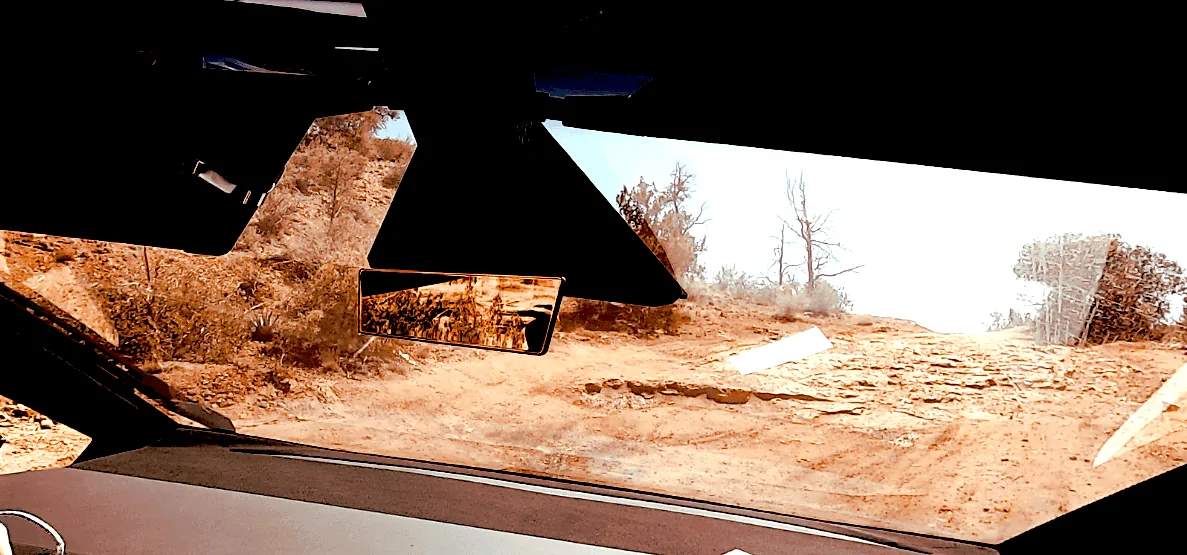
It's classified "Moderate", but for a newbie off-roader like me it felt worse. The 11.2 mile loop included some steep rocky sections that put me to the test. The recent rains left muddy water filled holes all along the trail. Almost every vehicle on the trail was a UTV (Razors). Needless to say, my presence created a lot of interest (all positive).

I was very pleased with how the Cybertruck handled the trail. I had it in "Off Road" mode and "Very High" to clear the wicked rocky sections. I left the front and rear plastic air deflectors on, and they suffered no damage. It's not the kind of off-roading I expect to do a lot of, but I wanted to see what the Cybertruck was capable of. I don't plan to drive "Difficult" trails, but I think the Cybertruck would traverse them fine with locking differentials.

I blocked the opening a the base of the tailgate where road dust entered the vault on my Swansea trip the week before. There was no dust in the vault after driving 6 miles on the dusty F.S. road 525 at 30 mph.
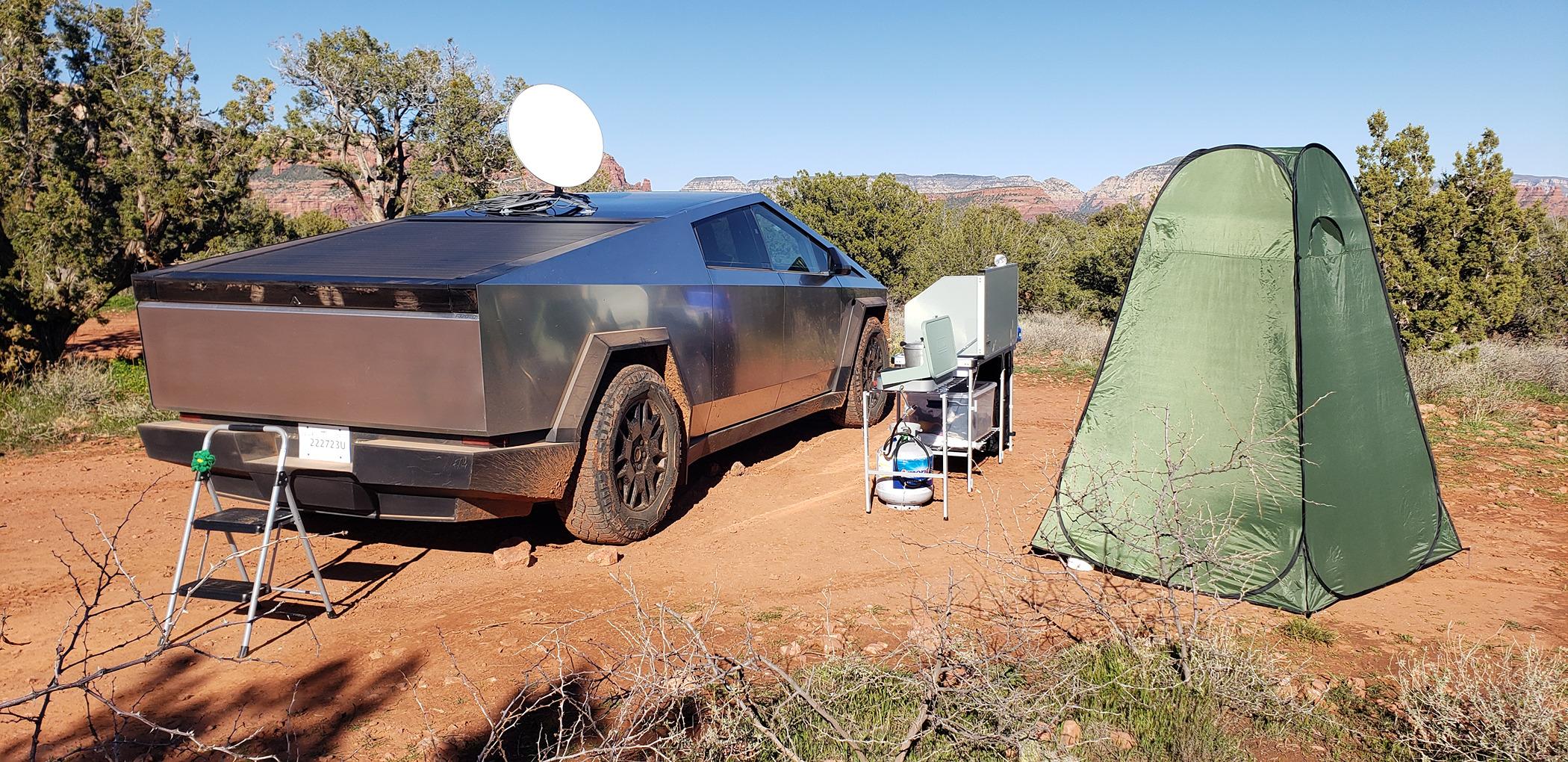
We camped the first night in the Dead Horse Ranch State Park in Cottonwood, and the second night in the dispersed camping sites along F.S. 525. The area is hardly an 'out of the way' place, though. Sedona is a very popular destination for tourists.
Lessons learned on this trip:
1) Don't depend on charging at campgrounds from their electric 50/30/20 Amp pedestals. I arrived at Dead Horse with 9% battery. I connected to the campsite's 240V 14-50 outlet. The blinking green light on the NACS plug indicated that charging had begun, but the CT's display showed that only 6A (1400W) was being delivered, the same as from the 120V outlet. The park staff there had no explanation. I drove 42 miles round trip to Oak Creek to Supercharge to 60% (74 kW) to have enough battery to get through the night and to continue the trip the next day.
BTW, it turns out that the problem was not the campground network, but the Cybertruck itself. Although the CT appeared to be charging normally (green LED blinking on the NACS plug), current was not making its way into the battery (stuck relay?). The problem is intermittent. When I got home and tried to Level 2 charge with the mobile connector, it failed the same way, but the next day everything worked normally. Tesla recommended monitoring the situation and informing them of any similar failures that occur.
2) With 2 people sleeping in the vault, CO2 builds up to an unhealthy level. Just opening the tonneau cover a couple of inches gave plenty of ventilation to overcome that problem. If the rear window could be opened (it can't), I think that would also provide sufficient air exchange.
3) Charging the battery on back country, off road trips is a challenge, especially out west. I'll need multiple means of charging beyond widely dispersed Tesla Superchargers. Campground 50A electric sites are great when they work while charging from a 120V outlet at a campground is painfully slow at 1400W. My propane generator will top out at 3700W, but there's the issue of noise that limits when it can be run. Solar is quiet, but also slow and dependent on ample sunshine.
4) The efficiency and range of the CT is quite good. The round trip totalled 605 miles with an overall efficiency of 440 Wh/mi. The change in elevation was approximately 7000 feet. I limited my driving to 70 - 75 mph on the interstate. Driving temperatures ranged from 50 to 84 degrees F.
5) My Supercharging expenses totalled $81.06 for 193 kWh or $0.14/mi. I spent 2.5 hours Supercharging at an average charging speed of 77 kW.
6) Using an electric blanket to keep warm at night works great. I highly recommend this one.
7) Off roading is hard on a vehicle. Although the stainless steel exterior is impervious to trail damage, it's not true of the plastic wheel flares, mirrors, bumpers, etc. They scratch very easily, and there's no way to remedy the damage except to replaced the parts.
8) Prepare for a good cleaning of your truck after an off road trip like this one. I stopped at a car wash to get the thick mud removed from the wheels, wheel wells, bumpers, and underside using a power washer, but I spend a couple of hours at home getting the truck completely clean.
9) If you don't like people coming up to you asking questions and wanting to take pictures of your truck, you might want to consider buying a Rivian. I don't mind for the most part. It's an opportunity to correct all the misconceptions people have about electric vehicles, and particularly Tesla EVs. There are times, however, when you wish people would just stay away.
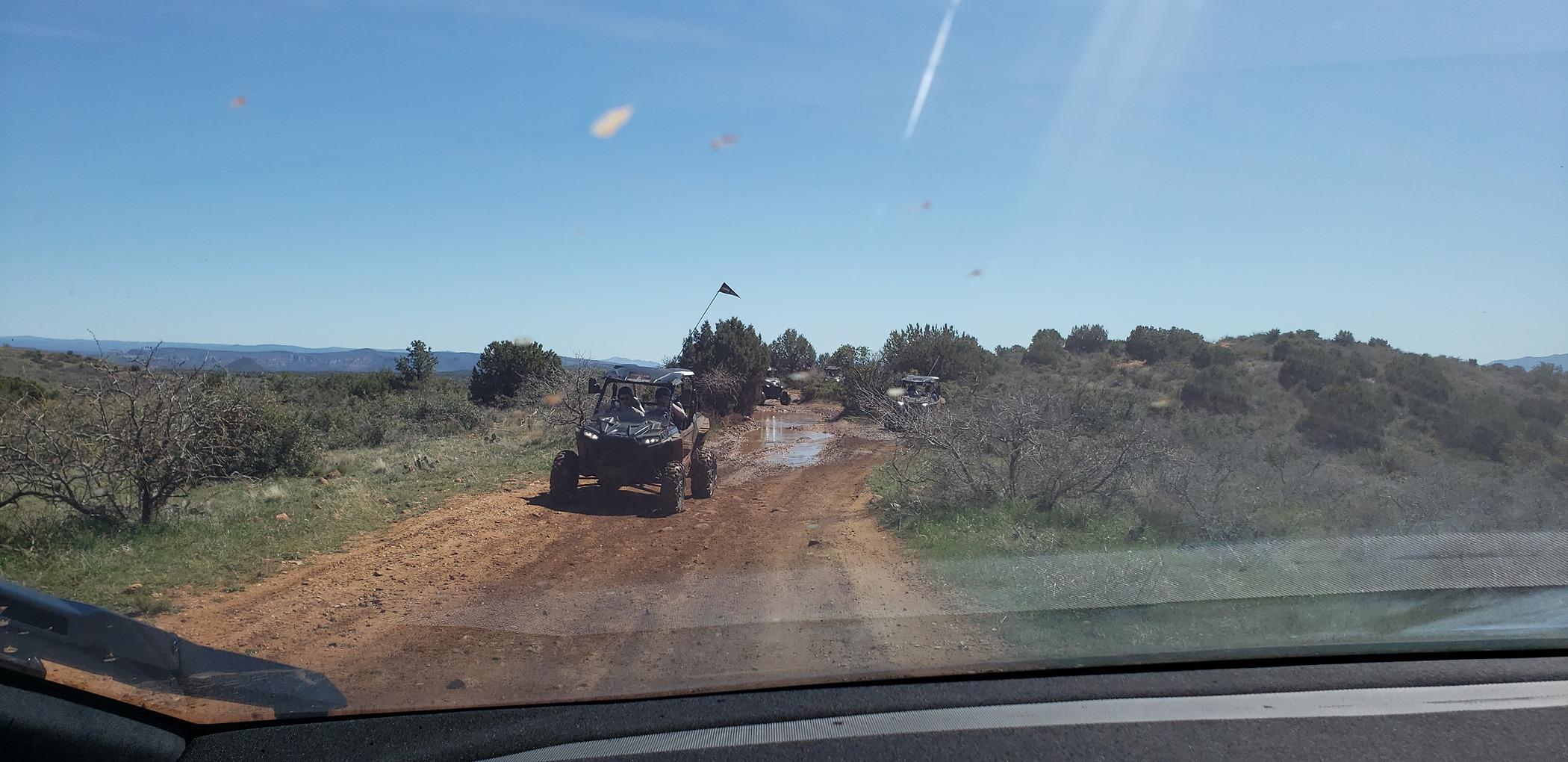
I was very pleased with how the Cybertruck handled the trail. I had it in "Off Road" mode and "Very High" to clear the wicked rocky sections. I left the front and rear plastic air deflectors on, and they suffered no damage. It's not the kind of off-roading I expect to do a lot of, but I wanted to see what the Cybertruck was capable of. I don't plan to drive "Difficult" trails, but I think the Cybertruck would traverse them fine with locking differentials.
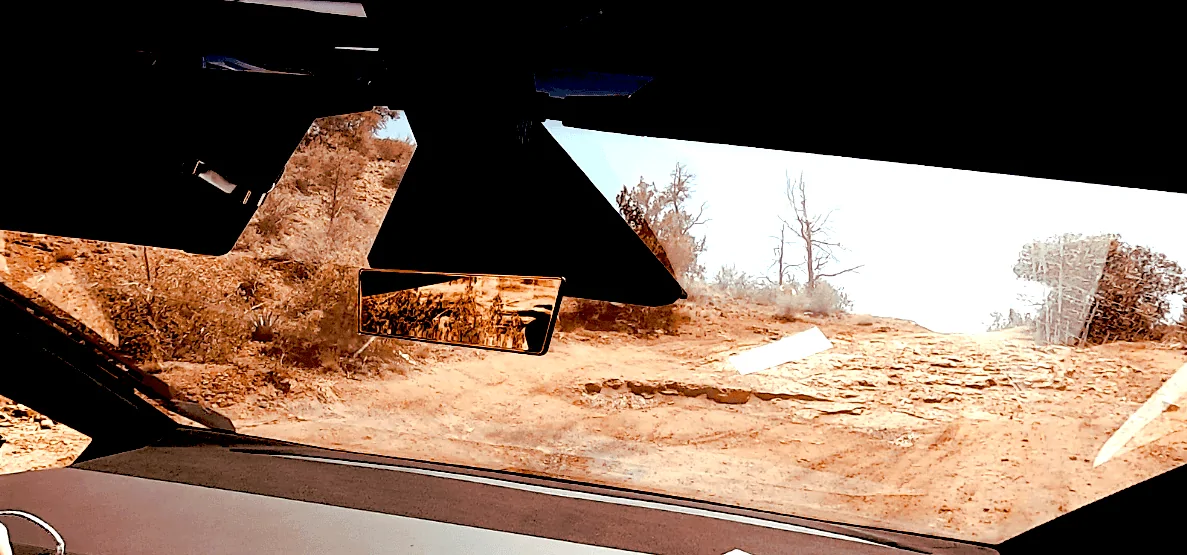
I blocked the opening a the base of the tailgate where road dust entered the vault on my Swansea trip the week before. There was no dust in the vault after driving 6 miles on the dusty F.S. road 525 at 30 mph.
We camped the first night in the Dead Horse Ranch State Park in Cottonwood, and the second night in the dispersed camping sites along F.S. 525. The area is hardly an 'out of the way' place, though. Sedona is a very popular destination for tourists.
Lessons learned on this trip:
1) Don't depend on charging at campgrounds from their electric 50/30/20 Amp pedestals. I arrived at Dead Horse with 9% battery. I connected to the campsite's 240V 14-50 outlet. The blinking green light on the NACS plug indicated that charging had begun, but the CT's display showed that only 6A (1400W) was being delivered, the same as from the 120V outlet. The park staff there had no explanation. I drove 42 miles round trip to Oak Creek to Supercharge to 60% (74 kW) to have enough battery to get through the night and to continue the trip the next day.
BTW, it turns out that the problem was not the campground network, but the Cybertruck itself. Although the CT appeared to be charging normally (green LED blinking on the NACS plug), current was not making its way into the battery (stuck relay?). The problem is intermittent. When I got home and tried to Level 2 charge with the mobile connector, it failed the same way, but the next day everything worked normally. Tesla recommended monitoring the situation and informing them of any similar failures that occur.
2) With 2 people sleeping in the vault, CO2 builds up to an unhealthy level. Just opening the tonneau cover a couple of inches gave plenty of ventilation to overcome that problem. If the rear window could be opened (it can't), I think that would also provide sufficient air exchange.
3) Charging the battery on back country, off road trips is a challenge, especially out west. I'll need multiple means of charging beyond widely dispersed Tesla Superchargers. Campground 50A electric sites are great when they work while charging from a 120V outlet at a campground is painfully slow at 1400W. My propane generator will top out at 3700W, but there's the issue of noise that limits when it can be run. Solar is quiet, but also slow and dependent on ample sunshine.
4) The efficiency and range of the CT is quite good. The round trip totalled 605 miles with an overall efficiency of 440 Wh/mi. The change in elevation was approximately 7000 feet. I limited my driving to 70 - 75 mph on the interstate. Driving temperatures ranged from 50 to 84 degrees F.
5) My Supercharging expenses totalled $81.06 for 193 kWh or $0.14/mi. I spent 2.5 hours Supercharging at an average charging speed of 77 kW.
6) Using an electric blanket to keep warm at night works great. I highly recommend this one.
7) Off roading is hard on a vehicle. Although the stainless steel exterior is impervious to trail damage, it's not true of the plastic wheel flares, mirrors, bumpers, etc. They scratch very easily, and there's no way to remedy the damage except to replaced the parts.
8) Prepare for a good cleaning of your truck after an off road trip like this one. I stopped at a car wash to get the thick mud removed from the wheels, wheel wells, bumpers, and underside using a power washer, but I spend a couple of hours at home getting the truck completely clean.
9) If you don't like people coming up to you asking questions and wanting to take pictures of your truck, you might want to consider buying a Rivian. I don't mind for the most part. It's an opportunity to correct all the misconceptions people have about electric vehicles, and particularly Tesla EVs. There are times, however, when you wish people would just stay away.
Sponsored
Last edited by a moderator: