Sponsored

WHIZZARD OF OZ

Well-known member
First Name
Ivan
Joined
Mar 11, 2021
Threads
1
Messages
2,288
Reaction score
2,090
Location
Australia
Vehicles
VW Up!
Occupation
Electric Wheelchair Builder
Country flag
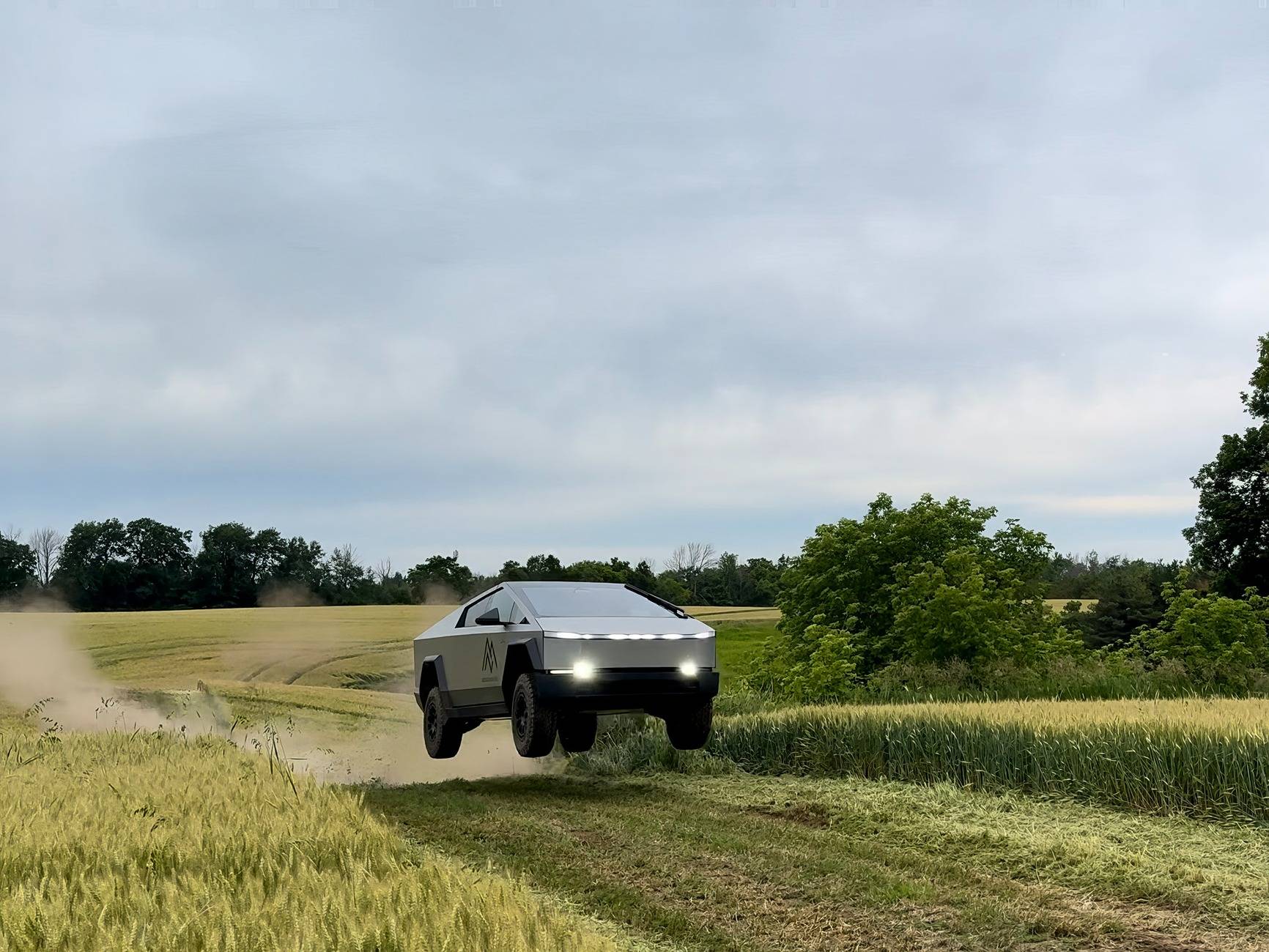
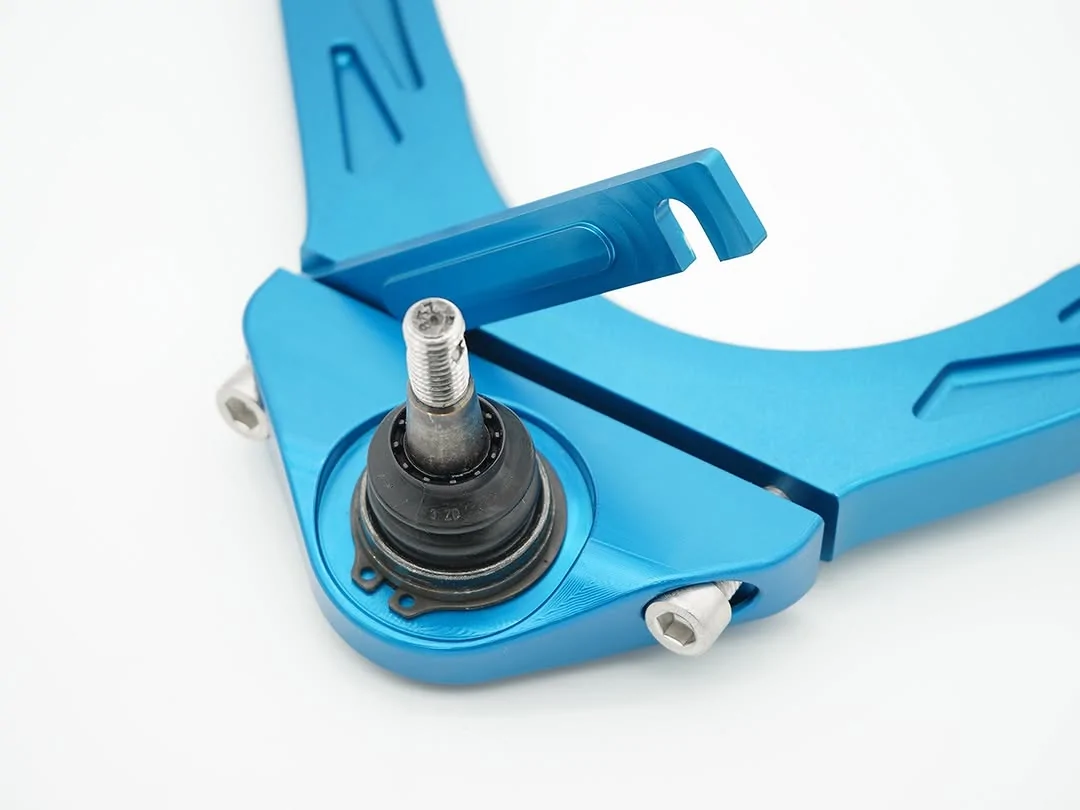
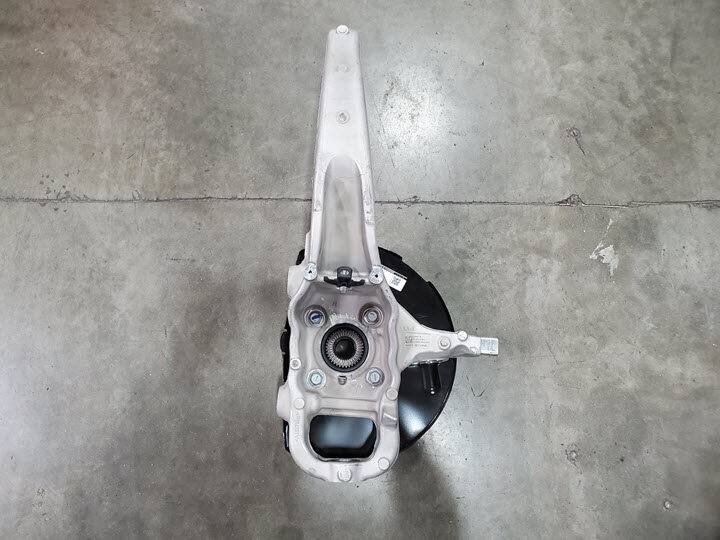
Back when we took our Cybertruck for a torture-test jumping run at the farm - yes, that video from last year - we finally managed to break something after enough jumps with a 7000 lb truck. Eventually, a factory stamped steel front upper control arm bent. Frankly, it was a matter of time. In finding the limits of the Cybertruck, we set our sights on addressing the first thing that we were able to destroy. Months later, we have this.

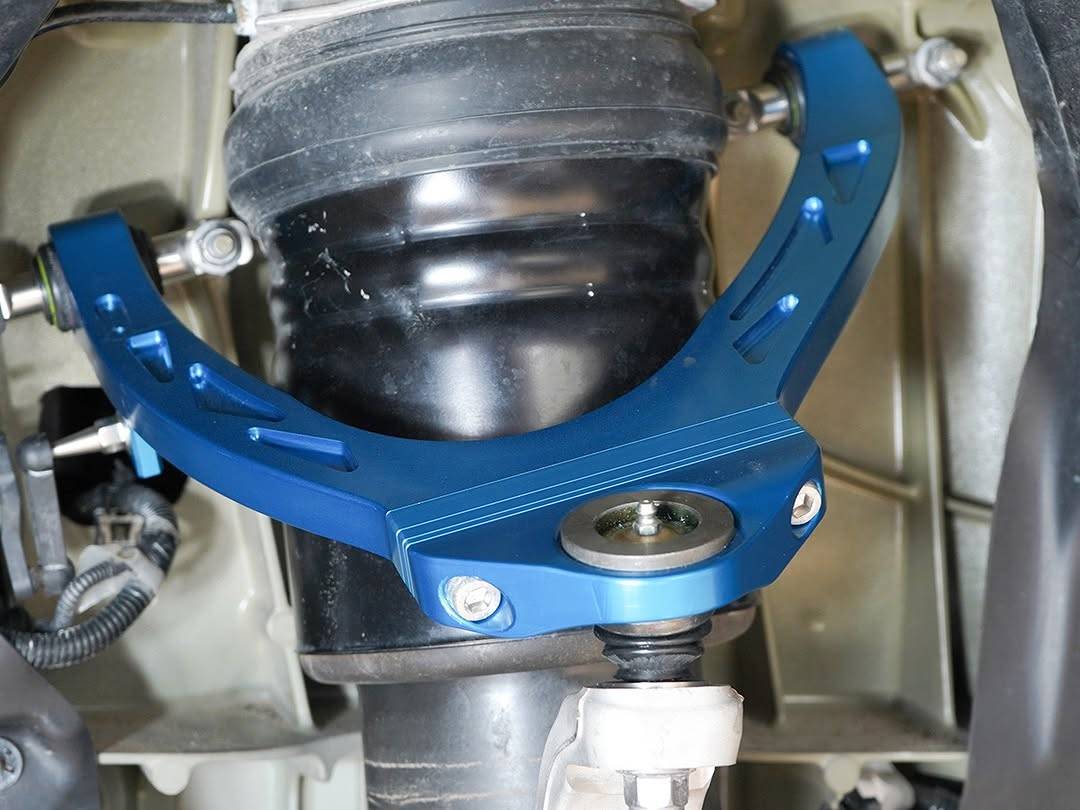
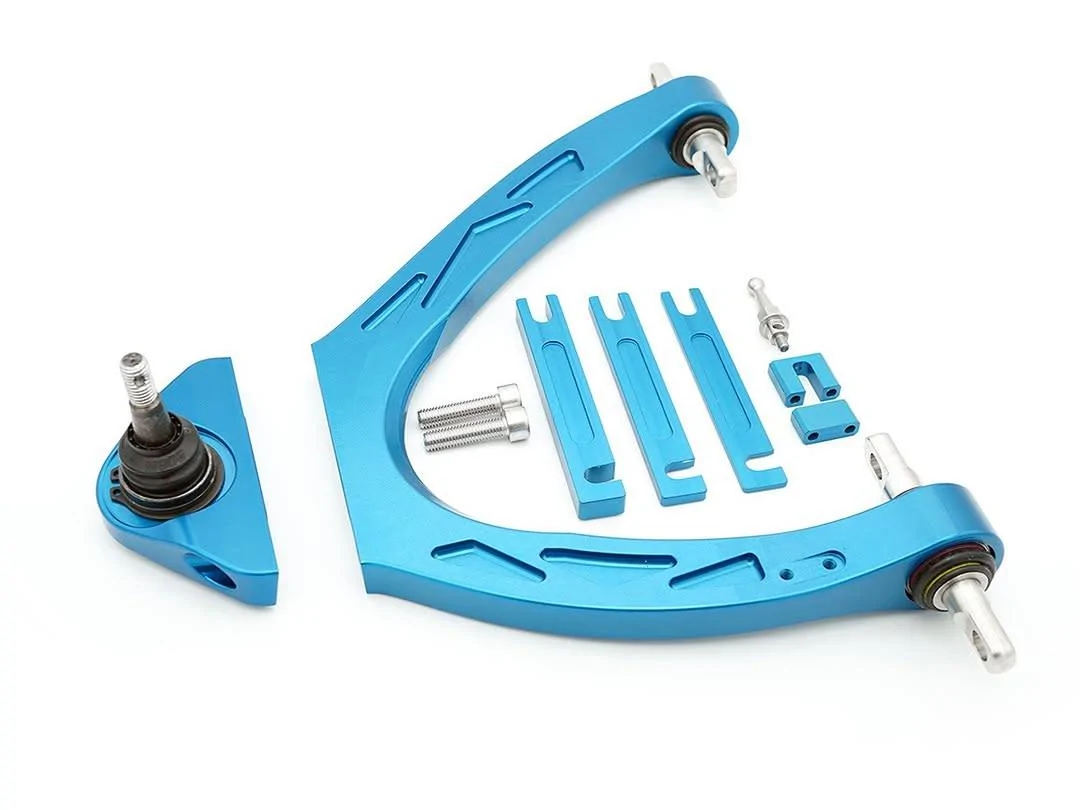
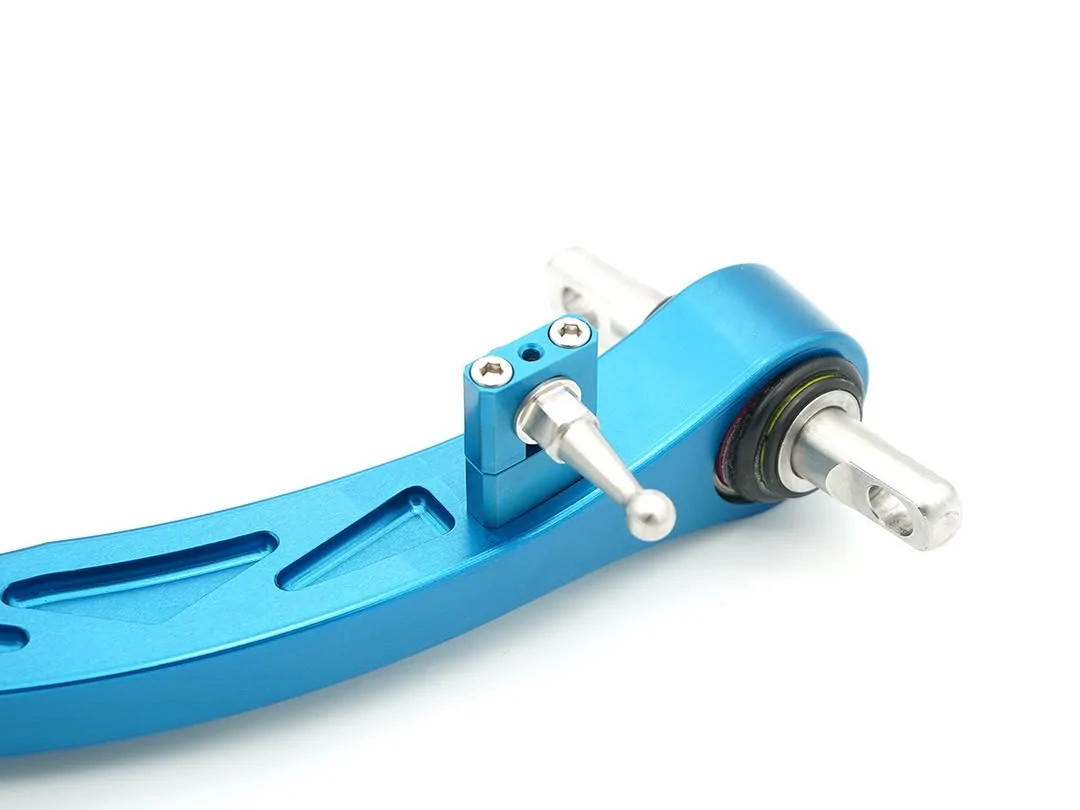
The billet MPP "Flight Grade" Cybertruck FUCA is complete with adjustable height provisions, sealed spherical bearings, and the same infinitely repeatable camber adjustment system as our popular FUCAs for the Model 3/Y. While it would have been easy to put some open spherical bearings on the inboard end, we opted to keep sealed bearings and ball joints throughout to ensure that these arms would endure the test of time, and not leave your truck squeaking and creaking over every bump a few years down the road. These sealed spherical bearings and ball joints come from high-end European cars, and these joints are designed to last for tens if not hundreds of thousands of miles without degradation.

While there will surely be some cheaper (and sometimes more expensive!) options available in the future, we are confident none will be as easy to adjust as ours or be as quiet and smooth on the street.

This product exists and is installed on our shop Cybertruck. We're now ready for pre-orders for our first production run! This isn't just a rendering with an unknown availability date!

https://www.mountainpassperformance...ront-upper-control-arms-for-tesla-cybertruck/

Photo 2024-06-29, 11 46 40 AM-aituned-enhance-2.6x.jpeg


CybertruckFUCA4.jpg


CybertruckFUCA3.jpg


CybertruckFUCA2.jpg


CT-FUCA-Shims.jpg
LOVE IT, LOVE IT, LOVE IT!!!!!!

Did l mention l LOVE IT?!?!?!?
Sponsored

 

Gene

Well-known member
First Name
Gene
Joined
Apr 5, 2023
Threads
5
Messages
108
Reaction score
379
Location
Santa Barbara, CA
Vehicles
Tesla Model Y.
Occupation
Investor
Country flag
The arms look beefy enough but it appears that the two small bolts holding the ball joint to the A-arm would be subject to immense stress over time.

I wonder if installing a set will void your factory warranty if front suspension issues arise.
I agree with you, as a retired professional auto mechanic those two bolts scare the crap out of me. Thankfully there are dowels to help mate the pieces but some high grade nuts at the back end of the bolts rather than just threaded billet scares the crap out of me. Those bolts backing out at highway speed and under braking could cost you your life.
 

TeslaKen

Well-known member
First Name
Ken
Joined
Apr 26, 2024
Threads
108
Messages
1,245
Reaction score
1,698
Location
Overland Park
Website
www.halocybertruck.com
Vehicles
Cyberbeast, M3PD+, GT4, XK140OTS
Occupation
Currently Occupied
Country flag
What colors do they come in??

Fwiw my 1956 Jaguar uses shims for camber adjustment, nothing new in that regard other than you don't find many shops that do alignments familiar with using shims anymore, but the good ones should still know....
 

PungoteagueDave

Well-known member
First Name
David
Joined
Mar 2, 2025
Threads
2
Messages
933
Reaction score
1,011
Location
Boynton Beach
Vehicles
‘25 Tesla Cybertruck, ‘26 Tesla MY Launch, ‘13 Porsche C4S, ‘26 BMW R1300 GSA
Occupation
retired
Country flag
Until shown otherwise, this seems a solution looking for a problem. Please show us the broken pieces.
 

mcm4ss

Well-known member
First Name
Matt
Joined
Jun 21, 2024
Threads
22
Messages
244
Reaction score
433
Location
Oregon
Vehicles
Cybertruck and 7 others
Occupation
Landscaper
Country flag
how much testing have you done with this design? Did you push it as hard as the stock components? How do those bolts work over time? Something we have to keep checking and tightening?


mcm4ss

Well-known member
First Name
Matt
Joined
Jun 21, 2024
Threads
22
Messages
244
Reaction score
433
Location
Oregon
Vehicles
Cybertruck and 7 others
Occupation
Landscaper
Country flag
I know I just asked a few questions but wanted to point out These are the type of parts I have been anticipating and waiting on with this truck. It is like having a huge oversized RC rig I get to ride in and drive. This got my heart racing.
 

The Duke

Well-known member
Joined
Sep 26, 2024
Threads
7
Messages
74
Reaction score
114
Location
Fremont, CA
Vehicles
Model S, CyberTruck
Occupation
Engineer (retired)
Country flag

Nexus6

Well-known member
First Name
Mike
Joined
Jan 22, 2024
Threads
17
Messages
318
Reaction score
464
Location
Malibu
Website
x.com
Vehicles
CyberBeast, Model X, Chevy Colorado Bison, Chevy Suburban 2500
Occupation
G700/800 Pilot
Country flag
I agree with you, as a retired professional auto mechanic those two bolts scare the crap out of me. Thankfully there are dowels to help mate the pieces but some high grade nuts at the back end of the bolts rather than just threaded billet scares the crap out of me. Those bolts backing out at highway speed and under braking could cost you your life.
I second the concern with those two bolts. Are they Grade 8 or 10.9?
 
OP
OP
MountainPassPerformance

MountainPassPerformance

Well-known member
Site Sponsor
First Name
Sasha
Joined
Dec 21, 2023
Threads
7
Messages
56
Reaction score
155
Location
Canada
Vehicles
Founder's Edition Cybertruck Dual Motor
Country flag
I agree with you, as a retired professional auto mechanic those two bolts scare the crap out of me. Thankfully there are dowels to help mate the pieces but some high grade nuts at the back end of the bolts rather than just threaded billet scares the crap out of me. Those bolts backing out at highway speed and under braking could cost you your life.
This post needs more fear mongering!

Here are some relevant facts:

  • We've tested the threads on our Model 3 FUCAs and the high grade bolts we use broke first every time as long as our minimum required thread depth is respected.
  • The bolts don't ever back off if torqued properly - we have hundreds, or thousands of arms of this design in service on the Model 3/Y/S, along with our 350z racecar which corners at 3G's laterally at speeds of over 230km/h
  • This is no different than any other suspension bolt backing off, such as the Model 3 front lower control arms which were falling out of Tesla Model 3's left right and center early on, and I don't know if anyone dying from that!

I second the concern with those two bolts. Are they Grade 8 or 10.9?
If these bolts scare you, I can only imagine how you feel about lug nuts! Imagine if those were left loose!!!

The bolts in use here are rated for 170,000 PSI tensile strength, meaning that to break them, you would need to exert a force of ~33,000 lbs.

There are two primary failure modes:

Shear (caused by braking) - this is limited by tire grip, and isn't high enough to even worry about. This load is also supported by the dowels. This "highway braking" case hardly loads the bolts at all.

Compression / Bending - this is caused when the damper is fully compressed and is carrying all of the load from the vehicle after landing from a jump or G-out compression.

This is the case that bends the factory arm. This is the case that would load these bolts the most. In this case, many other components would also possibly break. You would know you just did serious damage to the vehicle at more than 4G's vertical.

At 4G vertical, the force on one corner of the truck would be approx 8200lbs.

That's 8200lbs trying to push and pull every suspension arm in an effort to get the wheel and tire further up inside the wheel well. The bottom suspension arms are pulled on, and the top upper control arm is being compressed as physics tries to achieve its goal.

In an ideal scenario, the forces would all be in an entirely straight line, meaning the arm would never fail. In reality though, the center of force on the OEM balljoint is slightly offset from the very thin plane of the OE stamped steel arm. For this reason, the outside bit of the arm bends up - shortening, adding camber, and moving the tire up (or the vehicle down, however you like to imagine it).

With our arm, we first have far more thickness, so we have orders of magnitude more stiffness in bending. Secondly, the bending force is quite minor to begin with!

Tesla Cybertruck **NEW** MPP "Flight Grade" Billet Front Upper Control Arms for Cybertrucks 1743530487307-h


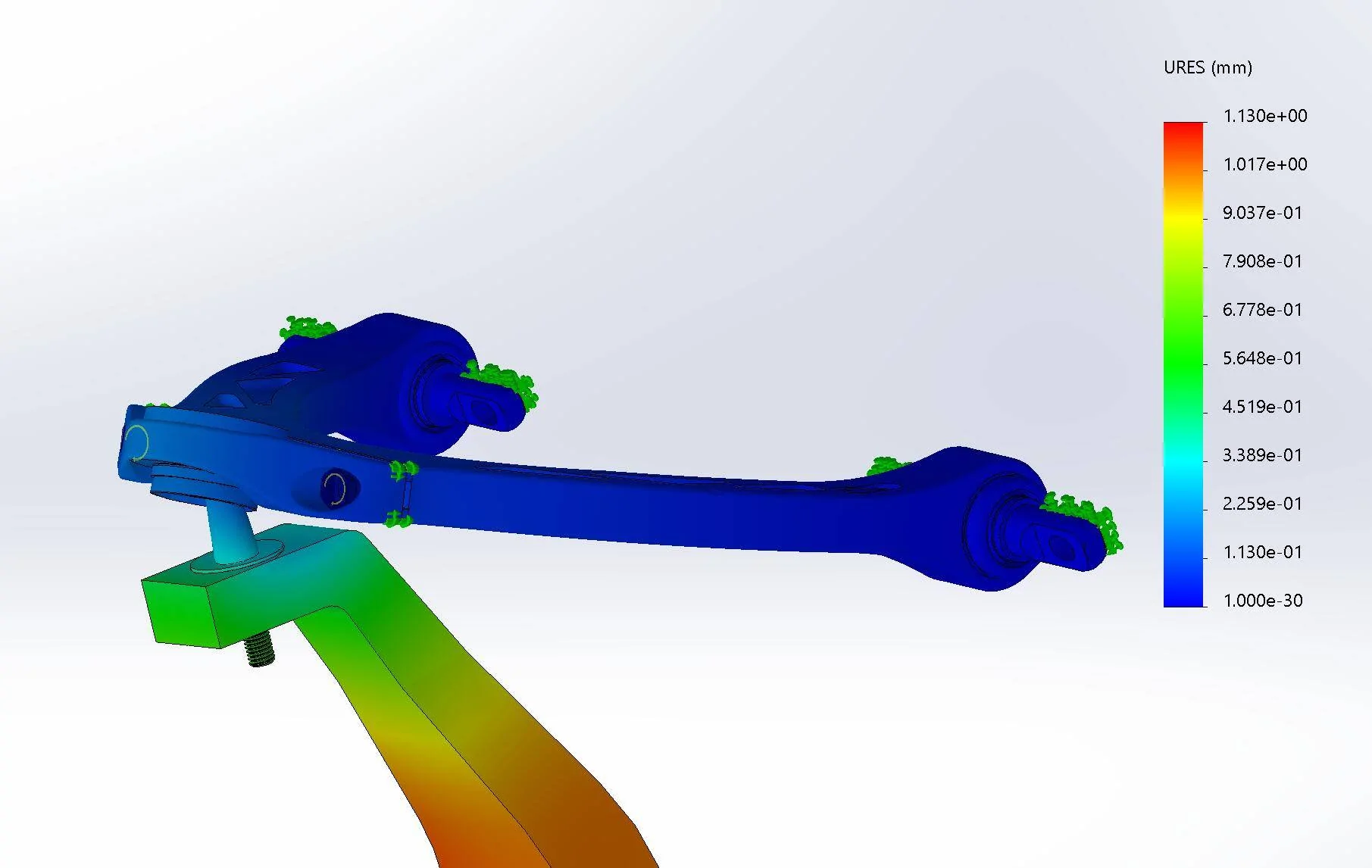
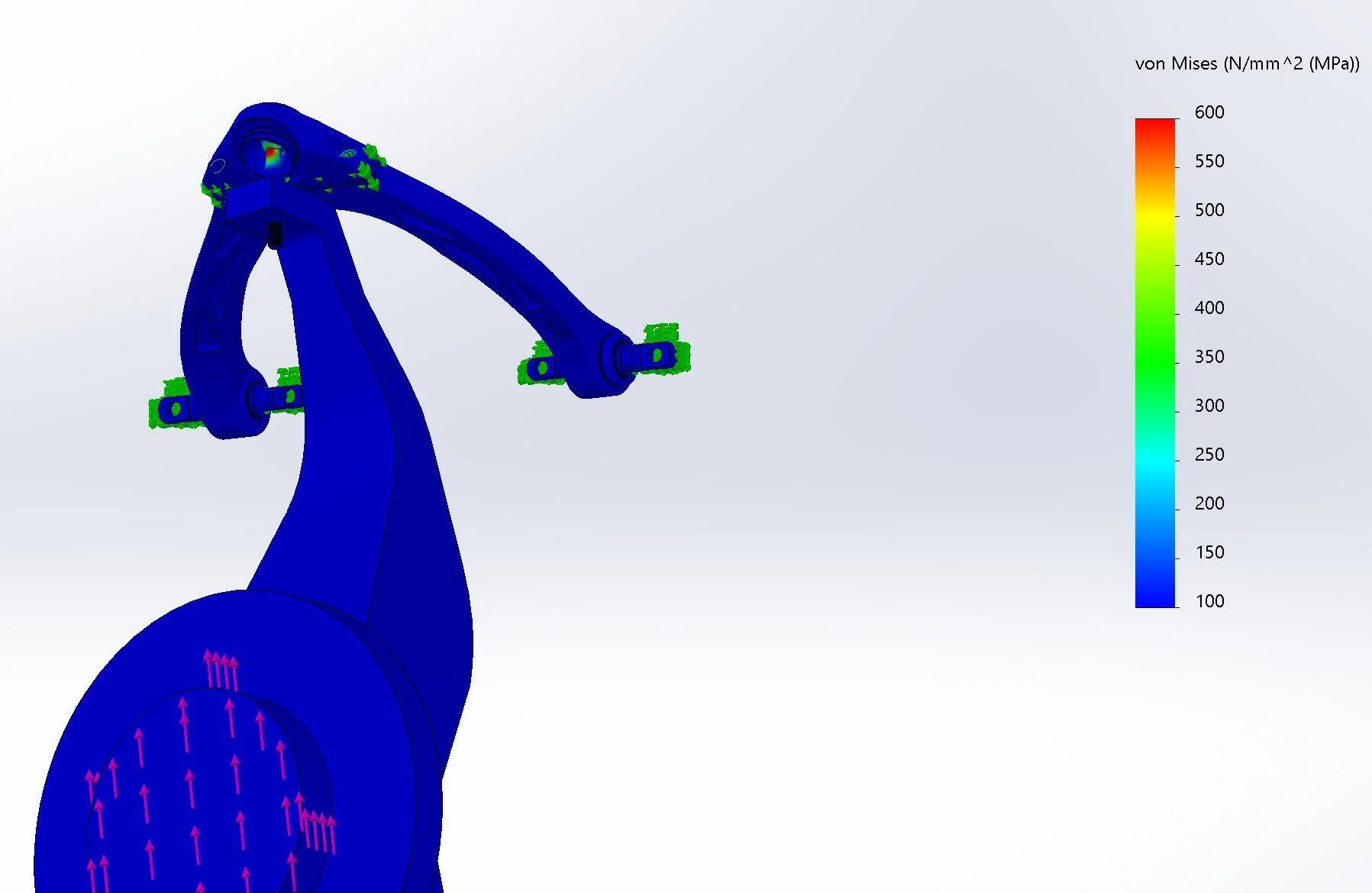
FEA shows that the Balljoint is the weak link, which is logical if you look at the cross section of it, and the way the forces are bending it. Just because it's hidden under a rubber boot doesn't mean it's not there!

Tesla Cybertruck **NEW** MPP "Flight Grade" Billet Front Upper Control Arms for Cybertrucks 1743530641028-mi


If these ball-joints can take these kinds of loads in direct bending, our bolts have nothing to worry about - as the main component of that load is in compression (literally giving the bolt a break from its normal job of being stretched!)

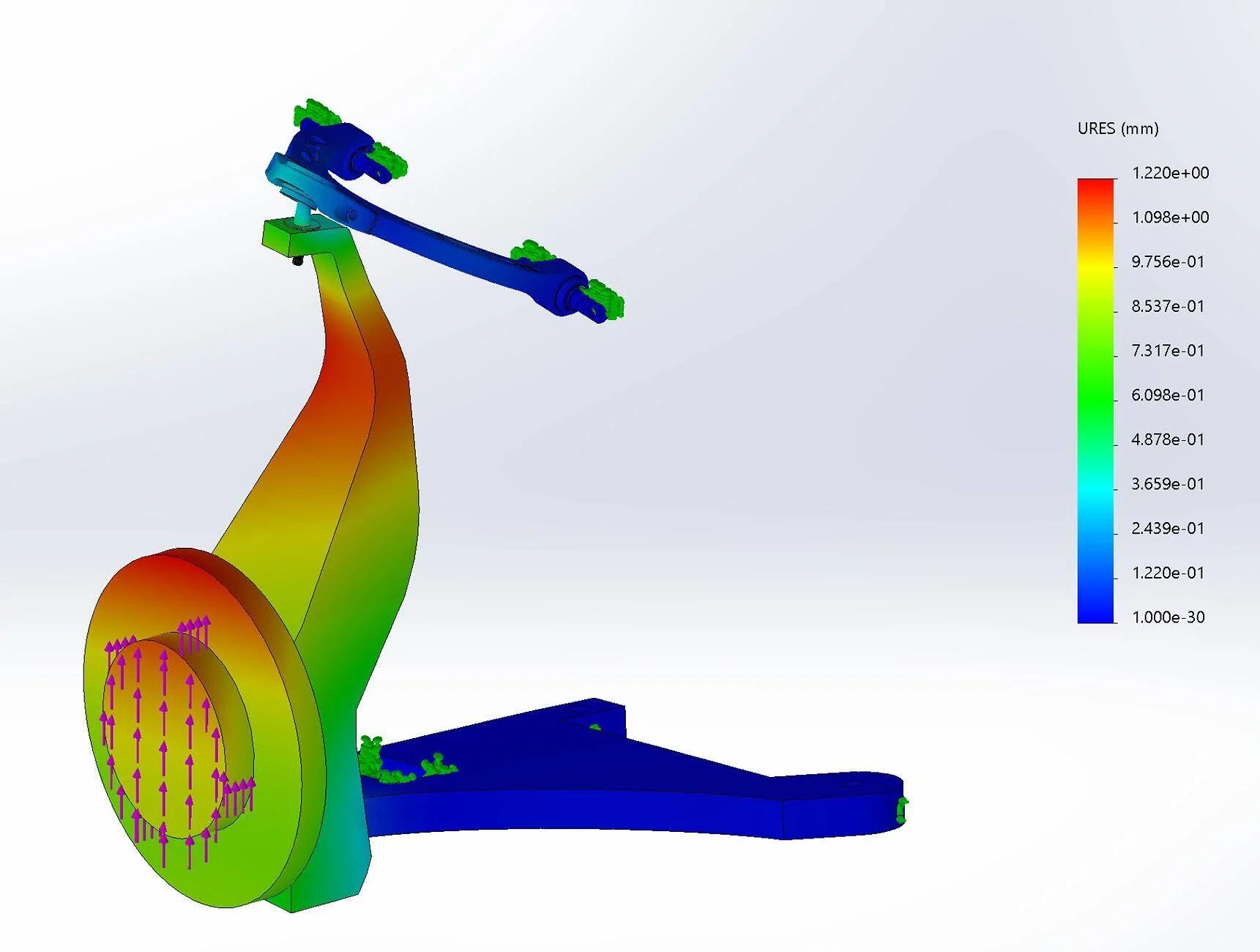
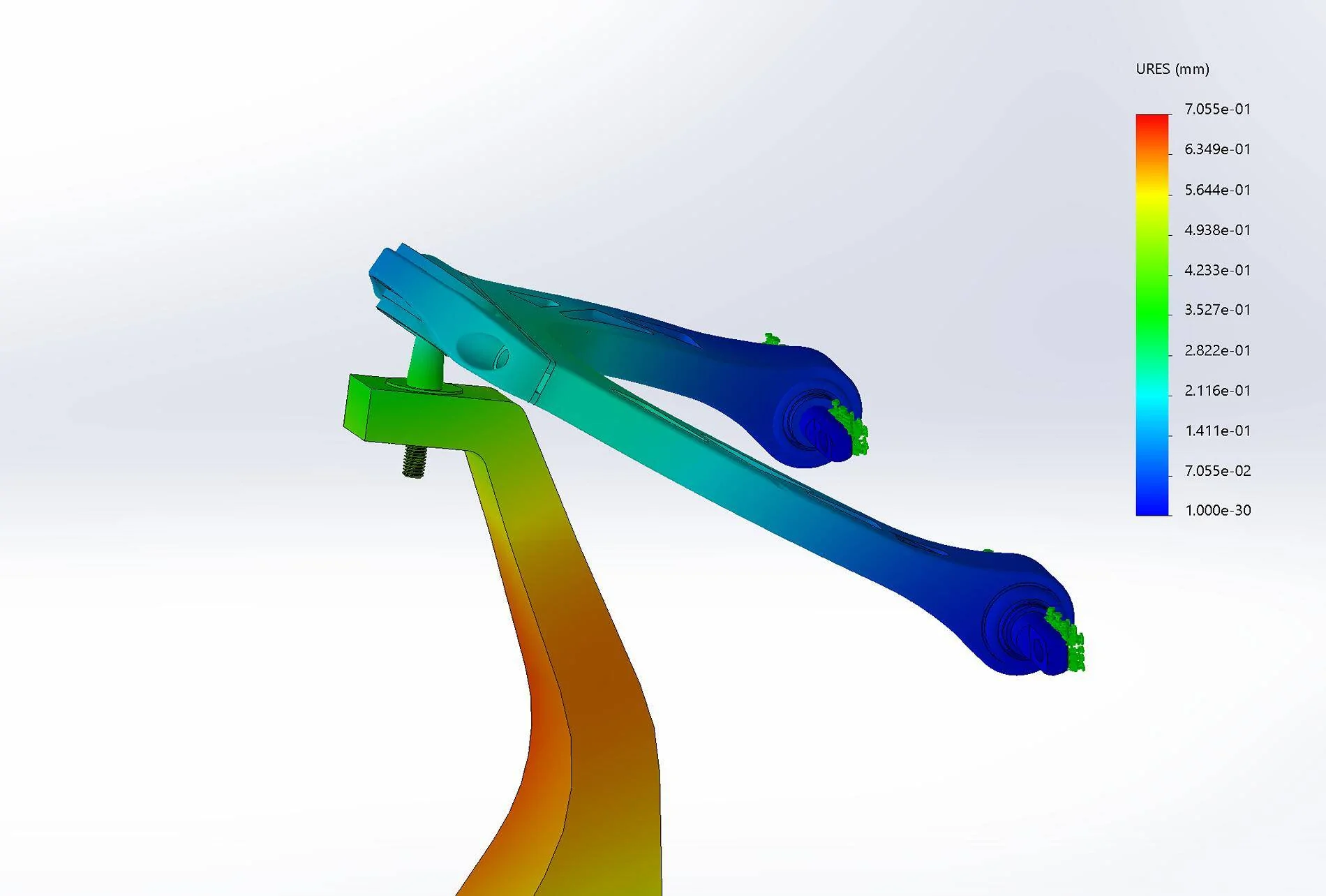
If you look closely, the knuckle itself is flexing more than the upper control arm. The upper control arm really doesn't face a lot of load compared to the knuckle in a compression event:

Tesla Cybertruck **NEW** MPP "Flight Grade" Billet Front Upper Control Arms for Cybertrucks 1743529762107-xg


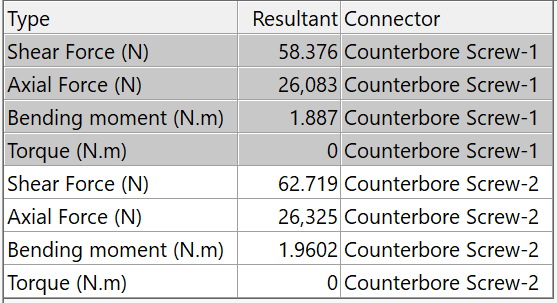
Finally, you can see the loads on the bolts are next to nothing in this worst case scenario:

The Axial Force value is compressing the bolts - not pulling on them!

Tesla Cybertruck **NEW** MPP "Flight Grade" Billet Front Upper Control Arms for Cybertrucks 1743530716620-q7


Of course, the math could be wrong, the process could be wrong, or something unexpected could be wrong; this is what testing is for!

It's a complicated part to model as the way the forces act on the arm change with the angle of the arm itself - this is likely why the OE arm designers thought it would be OK. At normal ride height, it's likely fine. At full compression, with the arm at a very steep angle, it could have been a different story!

Anyways, hopefully this post clears up a little bit of this keyboard expert nonsense. It's fine to have questions, but I would hope we've proven over the years that we're here to make good parts for a community we're passionate about. That passion isn't infinite, though, and it's getting more toxic by the minute in here! Oh internet. How we miss the days of the early 2000's when it was just everyone supporting each other to build cool cars.

Tesla Cybertruck **NEW** MPP "Flight Grade" Billet Front Upper Control Arms for Cybertrucks 1743529147066-rd


Nexus6

Well-known member
First Name
Mike
Joined
Jan 22, 2024
Threads
17
Messages
318
Reaction score
464
Location
Malibu
Website
x.com
Vehicles
CyberBeast, Model X, Chevy Colorado Bison, Chevy Suburban 2500
Occupation
G700/800 Pilot
Country flag
This post needs more fear mongering!

Here are some relevant facts:

  • We've tested the threads on our Model 3 FUCAs and the high grade bolts we use broke first every time as long as our minimum required thread depth is respected.
  • The bolts don't ever back off if torqued properly - we have hundreds, or thousands of arms of this design in service on the Model 3/Y/S, along with our 350z racecar which corners at 3G's laterally at speeds of over 230km/h
  • This is no different than any other suspension bolt backing off, such as the Model 3 front lower control arms which were falling out of Tesla Model 3's left right and center early on, and I don't know if anyone dying from that!


If these bolts scare you, I can only imagine how you feel about lug nuts! Imagine if those were left loose!!!

The bolts in use here are rated for 170,000 PSI tensile strength, meaning that to break them, you would need to exert a force of ~33,000 lbs.

There are two primary failure modes:

Shear (caused by braking) - this is limited by tire grip, and isn't high enough to even worry about. This load is also supported by the dowels. This "highway braking" case hardly loads the bolts at all.

Compression / Bending - this is caused when the damper is fully compressed and is carrying all of the load from the vehicle after landing from a jump or G-out compression.

This is the case that bends the factory arm. This is the case that would load these bolts the most. In this case, many other components would also possibly break. You would know you just did serious damage to the vehicle at more than 4G's vertical.

At 4G vertical, the force on one corner of the truck would be approx 8200lbs.

That's 8200lbs trying to push and pull every suspension arm in an effort to get the wheel and tire further up inside the wheel well. The bottom suspension arms are pulled on, and the top upper control arm is being compressed as physics tries to achieve its goal.

In an ideal scenario, the forces would all be in an entirely straight line, meaning the arm would never fail. In reality though, the center of force on the OEM balljoint is slightly offset from the very thin plane of the OE stamped steel arm. For this reason, the outside bit of the arm bends up - shortening, adding camber, and moving the tire up (or the vehicle down, however you like to imagine it).

With our arm, we first have far more thickness, so we have orders of magnitude more stiffness in bending. Secondly, the bending force is quite minor to begin with!

1743530487307-he.jpg


FEA shows that the Balljoint is the weak link, which is logical if you look at the cross section of it, and the way the forces are bending it. Just because it's hidden under a rubber boot doesn't mean it's not there!

1743530641028-mi.jpg


If these ball-joints can take these kinds of loads in direct bending, our bolts have nothing to worry about - as the main component of that load is in compression (literally giving the bolt a break from its normal job of being stretched!)

If you look closely, the knuckle itself is flexing more than the upper control arm. The upper control arm really doesn't face a lot of load compared to the knuckle in a compression event:

1743529762107-xg.jpg


Finally, you can see the loads on the bolts are next to nothing in this worst case scenario:

The Axial Force value is compressing the bolts - not pulling on them!

1743530716620-q7.png


Of course, the math could be wrong, the process could be wrong, or something unexpected could be wrong; this is what testing is for!

It's a complicated part to model as the way the forces act on the arm change with the angle of the arm itself - this is likely why the OE arm designers thought it would be OK. At normal ride height, it's likely fine. At full compression, with the arm at a very steep angle, it could have been a different story!

Anyways, hopefully this post clears up a little bit of this keyboard expert nonsense. It's fine to have questions, but I would hope we've proven over the years that we're here to make good parts for a community we're passionate about. That passion isn't infinite, though, and it's getting more toxic by the minute in here! Oh internet. How we miss the days of the early 2000's when it was just everyone supporting each other to build cool cars.

1743529147066-rd.jpg
Very cool stuff. More than answered my questions. I was just concerned about the shear load on the two bolts just wanted to know what Grade Bolts were being used.
 
OP
OP
MountainPassPerformance

MountainPassPerformance

Well-known member
Site Sponsor
First Name
Sasha
Joined
Dec 21, 2023
Threads
7
Messages
56
Reaction score
155
Location
Canada
Vehicles
Founder's Edition Cybertruck Dual Motor
Country flag
how much testing have you done with this design? Did you push it as hard as the stock components? How do those bolts work over time? Something we have to keep checking and tightening?
We haven't jumped the truck with them in yet, but all the other testing we could muster has been done.

This is a tried and tested design, once the FUCA bolts are tightened to spec, you don't need to worry about them.

However, for performance vehicles that are thrashed, we always recommend doing spot checks and using a paint-marker to paintmark all important fasteners to see if they are working loose, as part of your pre-event maintenance!

@Nexus6 - Yes, sorry that comment was meant for @Gene!

Regarding the bent OEM arm - you can find a whole thread about that here. I'll see if we still have the OE arm we bent, we may have thrown it out.
 

CyberGus

Well-known member
First Name
Gus
Joined
May 22, 2021
Threads
91
Messages
10,245
Reaction score
33,907
Location
Austin, TX
Vehicles
1981 DeLorean, 2024 Cybertruck
Occupation
IT Specialist
Country flag
With all things warranty, YMMV.

Someone on TMC was complaining that a Tesla service center void their warranty because they had replaced their tires. What??!

It turns out they had switched to a different size tire, which changes the suspension geometry, and they were in the shop for... a suspension problem. Tesla could reasonably argue that the altered geometry contributed to the problem.
 

2000prerunner

Well-known member
First Name
Steve
Joined
May 11, 2021
Threads
0
Messages
85
Reaction score
156
Location
San Diego, CA
Vehicles
2018 Toyota Tacoma
Occupation
BSer
Country flag
This post needs more fear mongering!

Here are some relevant facts:

  • We've tested the threads on our Model 3 FUCAs and the high grade bolts we use broke first every time as long as our minimum required thread depth is respected.
  • The bolts don't ever back off if torqued properly - we have hundreds, or thousands of arms of this design in service on the Model 3/Y/S, along with our 350z racecar which corners at 3G's laterally at speeds of over 230km/h
  • This is no different than any other suspension bolt backing off, such as the Model 3 front lower control arms which were falling out of Tesla Model 3's left right and center early on, and I don't know if anyone dying from that!


If these bolts scare you, I can only imagine how you feel about lug nuts! Imagine if those were left loose!!!

The bolts in use here are rated for 170,000 PSI tensile strength, meaning that to break them, you would need to exert a force of ~33,000 lbs.

There are two primary failure modes:

Shear (caused by braking) - this is limited by tire grip, and isn't high enough to even worry about. This load is also supported by the dowels. This "highway braking" case hardly loads the bolts at all.

Compression / Bending - this is caused when the damper is fully compressed and is carrying all of the load from the vehicle after landing from a jump or G-out compression.

This is the case that bends the factory arm. This is the case that would load these bolts the most. In this case, many other components would also possibly break. You would know you just did serious damage to the vehicle at more than 4G's vertical.

At 4G vertical, the force on one corner of the truck would be approx 8200lbs.

That's 8200lbs trying to push and pull every suspension arm in an effort to get the wheel and tire further up inside the wheel well. The bottom suspension arms are pulled on, and the top upper control arm is being compressed as physics tries to achieve its goal.

In an ideal scenario, the forces would all be in an entirely straight line, meaning the arm would never fail. In reality though, the center of force on the OEM balljoint is slightly offset from the very thin plane of the OE stamped steel arm. For this reason, the outside bit of the arm bends up - shortening, adding camber, and moving the tire up (or the vehicle down, however you like to imagine it).

With our arm, we first have far more thickness, so we have orders of magnitude more stiffness in bending. Secondly, the bending force is quite minor to begin with!

1743530487307-he.webp


FEA shows that the Balljoint is the weak link, which is logical if you look at the cross section of it, and the way the forces are bending it. Just because it's hidden under a rubber boot doesn't mean it's not there!

1743530641028-mi.webp


If these ball-joints can take these kinds of loads in direct bending, our bolts have nothing to worry about - as the main component of that load is in compression (literally giving the bolt a break from its normal job of being stretched!)

If you look closely, the knuckle itself is flexing more than the upper control arm. The upper control arm really doesn't face a lot of load compared to the knuckle in a compression event:

1743529762107-xg.webp


Finally, you can see the loads on the bolts are next to nothing in this worst case scenario:

The Axial Force value is compressing the bolts - not pulling on them!

1743530716620-q7.png


Of course, the math could be wrong, the process could be wrong, or something unexpected could be wrong; this is what testing is for!

It's a complicated part to model as the way the forces act on the arm change with the angle of the arm itself - this is likely why the OE arm designers thought it would be OK. At normal ride height, it's likely fine. At full compression, with the arm at a very steep angle, it could have been a different story!

Anyways, hopefully this post clears up a little bit of this keyboard expert nonsense. It's fine to have questions, but I would hope we've proven over the years that we're here to make good parts for a community we're passionate about. That passion isn't infinite, though, and it's getting more toxic by the minute in here! Oh internet. How we miss the days of the early 2000's when it was just everyone supporting each other to build cool cars.

1743529147066-rd.webp
Too bad you guys are not located in Southern California, with so many off-road testing grounds like Baja , Johnson Valley, glamis , ocotillo wells , Barstow … The aftermarket upper control arm industry for trucks/suvs is massive especially for off-road applications. From affordable tubular steel + ball joint options to heavy duty 7000 series aluminum upper arms with big 7/8 heim joints + 1.25” uniballs with stainless misalignment spacers the sky is the limit for all pick up trucks. I just hope all your testing and modeling is not based off track or street car specs and expected loading. Otherwise you’re gonna see a lot of bent or failed control arms with real world testing. Hard to model what forces a control arm will see when some customer mashes through a set of whoops out in the desert, trying to impress people. Maybe they have offset wheels or 37 inch heavy tires.? Maybe their cyber truck was launched in the air and now it’s nose diving into the ground so the forces aren’t coming where you think they are. Just saying, aftermarket suspension and upper control arm industry is so tried and true. Hope some lessons were learned from all that has been done already. Idk , maybe give someone like Camburg a call and have a chat about things ? Just based off all the long travel kits and vehicles I have modified for off-road use, I probably wouldn’t run that upper control arm. That looks like a beefier version of a model 3 track application control arm. Just sayin …. Test your trucks where the customers will be using them and how they will be using them. Set up your vendor tent out here with the rest of them in the desert on race day. ;)

Edit : I run your control arms, lower arm uniball pivot replacement, sway bars, and shock packages on both my model 3s fyi. You guys know what you’re doing for track applications. But 4 my CT…. I’ll probably wait and see what someone like camburg, Kibbe tech, or others come out with for a truck. They’ve been doing that for many decades and the results speak for themselves.
 
Last edited:
OP
OP
MountainPassPerformance

MountainPassPerformance

Well-known member
Site Sponsor
First Name
Sasha
Joined
Dec 21, 2023
Threads
7
Messages
56
Reaction score
155
Location
Canada
Vehicles
Founder's Edition Cybertruck Dual Motor
Country flag
Too bad you guys are not located in Southern California, with so many off-road testing grounds like Baja , Johnson Valley, glamis , ocotillo wells , Barstow … The aftermarket upper control arm industry for trucks/suvs is massive especially for off-road applications. From affordable tubular steel + ball joint options to heavy duty 7000 series aluminum upper arms with big 7/8 heim joints + 1.25” uniballs with stainless misalignment spacers the sky is the limit for all pick up trucks. I just hope all your testing and modeling is not based off track or street car specs and expected loading. Otherwise you’re gonna see a lot of bent or failed control arms with real world testing. Hard to model what forces a control arm will see when some customer mashes through a set of whoops out in the desert, trying to impress people. Maybe they have offset wheels or 37 inch heavy tires.? Maybe their cyber truck was launched in the air and now it’s nose diving into the ground so the forces aren’t coming where you think they are. Just saying, aftermarket suspension and upper control arm industry is so tried and true. Hope some lessons were learned from all that has been done already. Idk , maybe give someone like Camburg a call and have a chat about things ? Just based off all the long travel kits and vehicles I have modified for off-road use, I probably wouldn’t run that upper control arm. That looks like a beefier version of a model 3 track application control arm. Just sayin …. Test your trucks where the customers will be using them and how they will be using them. Set up your vendor tent out here with the rest of them in the desert on race day. ;)

Edit : I run your control arms, lower arm uniball pivot replacement, sway bars, and shock packages on both my model 3s fyi. You guys know what you’re doing for track applications. But 4 my CT…. I’ll probably wait and see what someone like camburg, Kibbe tech, or others come out with for a truck. They’ve been doing that for many decades and the results speak for themselves.
I'm glad you mentioned Camburg.

And first of all - thanks for supporting MPP and running out products!

You'll notice a few things on an arm like Camburg's - first of all, this part needs to be removed from the car to adjust camber. That's a major waste of time, and any alignment shop would want to kill you if you brought them an arm like this.

Secondly, the arms use exposed spherical bearings. Great for race trucks that have regular maintenance. Not so great for daily driven silent electric vehicles. Once those joints start to wear out and creak and clunk, you'll be pulling your hair out and wanting to put back the OEM parts! Not a problem for an ICE truck with a loud exhaust.

Third - you'll see that those arms are simple "2D" shapes. They don't have any fancy contouring to them, which all of our parts can have due to the simple fact that we have a 5-axis CNC and put in the work to design and machine organic shapes that best serve the purpose. This is how we can offer complex parts at a lower price to a shop like Camburg.

In the case of our outer balljoint carrier, there are a lot of different shapes in that part that are necessary to properly align the balljoint to the path of travel.

Lastly - the Camburg arm has a specially designed outer spherical to allow for maximum articulation of the balljoint. This is especially important for trucks with short upper arms. One of the features of our arm is that we can offer different outer balljoint carriers - for example, if people start going really crazy and wearing out or bending tie rods, it's a simple upgrade to make a beefed up, no-compromises outer carrier with a motorsport joint rather than an OE tie rod. This would be a cheap upgrade and you could even swap back to the OEM ball joints (which would likely be quieter) if desired.

So while we're happy to look at other products and admit where we have shortcomings, in this particular case, I only see benefits to the features we've added to our arms compared to the standard "top of the line" offerings in the truck community.

We'd appreciate you giving our parts a try for off-road use. We're confident you'll have the same great experience you have with our track/road car parts. And if you ever have a problem, you can trust that we'll address the issue and fix it.

As the Cybertruck community "grows" and gets more aggressive off-roading, our parts catalogue will grow to meet the demand. We obviously are not going to be building full-out trophy truck parts where there is no market demand. That's just not good business.

I also highly doubt you're going to see any of the companies you mentioned building up any parts until the demand is established, and many trucks are out running around in the desert.

I'll finish by saying - a lot of thought went into the design of these arms. They were fully modelled along with the rest of the Cybertruck suspension, we checked every aspect of the design we could - including running way more travel than the OEM air suspension can run. It's been a massive undertaking making these - they are by no means just a quick copy/paste of our Model 3 or Model S arms.
Sponsored


Top