
HaulingAss
Well-known member
- Joined
- Oct 3, 2020
- Threads
- 28
- Messages
- 10,340
- Reaction score
- 20,778
- Location
- Western Washington, USA
- Vehicles
- Cybertruck DM, 2010 F-150, 2018 Performance Model 3, 2024 Performance Model 3

That's what the solar "generator" battery is for. I only use the term "solar generator" because it's so common in the industry to call battery storage systems "battery generators" or "solar generators" even though I don't think it's very accurate or descriptive. I trust you know the basics.Everyone seems to be missing some basics here.
Teslas charge off of AC voltage (except for the humongous DC Fast Charging).
The slowest acceptable charge is 120V @ 12A AFAIK, without manually dropping the charge current.
The charge current really won't automatically adjust itself (yes, there are exceptions) and that ends up meaning that the solar charging solution will need to pick effectively one and only one charging rate. For the sake of argument, let's say that's 120V @12A, 1440 watts.
Solar production caries throughout the day. As the sun comes up, the voltage on the array slowly increases, as clouds pass over, the voltage decreases. To charge the car, you will need enough voltage to power the inverter to get to AC. If the voltage drops below this, the vehicle will stop charging. If the voltage goes above this amount, power will be lost.
So even if the panels were enough to do something useful to charge the car, you probably have to derate them by 50%, for either not enough sun, or too much sun and energy loss.
If Tesla's allowed DC charging, it could be a different story, it still wouldn't make sense though.
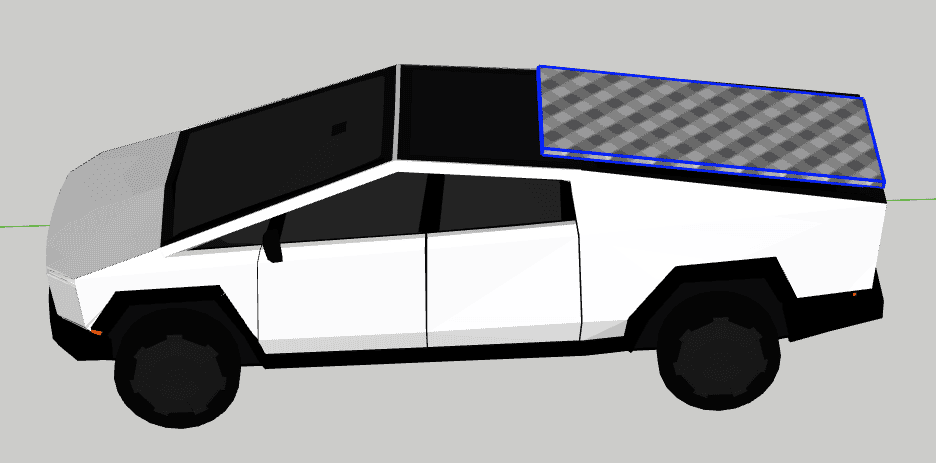
Essentially, you feed the solar energy into the battery generator. Since battery generators can charge while you are drawing 120V current from the inverter you simply charge the car while the sun is shining. This is mostly to prevent the steady and predictable vampire drain that will eventually leave your battery flat (but with good solar conditions, and a good setup, you will be able to steadily add a bit a range to the battery every day). You can also run things off it, lights, charge devices, even a cooler if you have a reasonable solar array. That's in addition to adding a bit of range each day.
I would love it if Tesla offered DC charging inputs! And I'm sure they will some day, but probably not for a couple of years or more.
 By my estimation, DC solar inputs and a built-in MPPT charge controller would increase the output of your solar array by around 20-25% by bypassing the battery generator.
Sponsored