Sponsored
OP
OP
cvalue13

cvalue13

Well-known member
Joined
Aug 17, 2022
Threads
74
Messages
7,153
Reaction score
13,769
Location
Austin, TX
Vehicles
F150L
Occupation
Fun-employed
Country flag
With that understanding in hand, accepting the internal structure as the CT's primary structure becomes a lot more palatable.
Appreciate all the thought you’ve put into this.

If I may, from the layman’s chair, push back on a few things:

We should get out of the way that as you know I don’t believe the sail storage exists. This most recent frame/casting photo only further confirms that for me. The bulk of the sails, in my view, are inhabited by the rear casting and makes far too nominal any remaining void.

If you’ll agree on that momentarily only purposes of argument’s sake on topic at hand:


That means it is only the front fender, and possibly the rear sail fender, if it doesn't open, that can actually be attached to the CT in a mechanical way that allows for loads to be passed through them. As such the amount that the SS skin can contribute to the structural rigidity of the frame is limited to those areas only, and given that the casts are attached to the drive assembly and suspension, and the suspension risers are supported by the cabin frame and casts, there is little to no load that will go through the outside skins themselves, without being forced to make a detour there intentionally.
consider the reasons that historically unibody and monocoque designs have been insufficient for significant payload, towing, or offroad capabilities. The reasons for this you’ve described in parts of your post. but in real terms, with a significant payload or towing, the bodies would flex so badly the doors wouldn’t open until the load was released. The reason for this was basically that the rear wheels created a fulcrum, the front of the vehicle a counter-weight, and so a significant load on the hitch or rearward portion of the bed and the body-frame would begin bending “around” the wheels/fulcrum, causing the vehicle to distort longitudinally and incur damage at any weak point forward of the rear wheels. Similar issues occurred off-roading with any material torsional forces applied.

Now, if we believe the unveil payload/towing/off-roading claims, the CT as you’ve describe it would seem destined to meet the same fate. If it’s only material structural support were a rear aluminum casting attached to a central aluminum cab frame, then it would only be as strong as that joint at the cab/casting junction - for any of payload/towing force or torsional rotation.

For brevity and at only at this cartoon level of depth, the resulting conclusions would seem to be either:

(1) the CT as you describe it will not meet its on-screen payload/towing/offroad specs, or

(2) something else offers the CT more longitudinal (and torsional) rigidity

at the rear, I believe that ‘something else’ could be fairly assumed the SS panels, as follows:

That means it is only the front fender, and possibly the rear sail fender, if it doesn't open, that can actually be attached to the CT in a mechanical way that allows for loads to be passed through them.
if the rear SS quarter panels is attached not only to the rear casting but also continues on to attach to the cab frame, those SS panels become effectively giant mending brackets. Those brackets would not just reinforce the cab-casting joint, but possibly become the primary means of adhering them.

Also, it would possibly provide another explanation for the sail pillar design of the CT generally: those ‘triangles’ are designed in part to allow the rear quarter panels to transfer load at the hitch/rear of the bed up to the location of max sheer force in the casting/cab joint.

Similarly, as for torsional forces, the C-shape of the rear quarter panels likewise becomes a structural design choice - for reasons I find hard to put in text, but the “C-shape” mention likely clues you in on the intent.

all this talk an oversimplification for brevity (ha!), but in fine:

I’m torn by both understanding and partially agreeing with your post (especially concerning the portions of the vehicle forward of the ~rear door handle), while at the same time believing that fully adopting that view would mean the CT will not meet its stated payload/towing/offroad specs - I cannot believe the joint between the rear casting and can frame, in aluminum, would suffice.

To avoid that conclusion, it lends me to believe the rear quarter panels in particular are attached to the cab, essentially creating mending brackets that distribute the loads.

And to further believe, on that view, yet another reason the sail storage isn’t real ;)
Sponsored


ED_SFO

Well-known member
First Name
Ed
Joined
Apr 16, 2021
Threads
7
Messages
466
Reaction score
856
Location
Sfo
Vehicles
M3
Country flag
im just curious how they will be attaching these very heavy ss panels to the truck...we do see mount points on the under body frame...but how does it bolt to the ss skin panels.
 
OP
OP
cvalue13

cvalue13

Well-known member
Joined
Aug 17, 2022
Threads
74
Messages
7,153
Reaction score
13,769
Location
Austin, TX
Vehicles
F150L
Occupation
Fun-employed
Country flag
im just curious how they will be attaching these very heavy ss panels to the truck...we do see mount points on the under body frame...but how does it bolt to the ss skin panels.
Strange thing is, there’s surprisingly little to “attach” once you step through it, and discount the obvious bits:

• windshield and roof are glass
• hood attaches by hinge
• tailgate attaches by hinge
• 4 doors attach by hinges

that leaves the only SS attaching to the body as:

• small trim strip above passenger windows
• two front quarter panels
• two rear quarter panels

Notice that of these pieces actually attaching to the body, the only ones of much size/weight are the two rear quarter panels

And most of these pieces attachments are seemingly straightforward

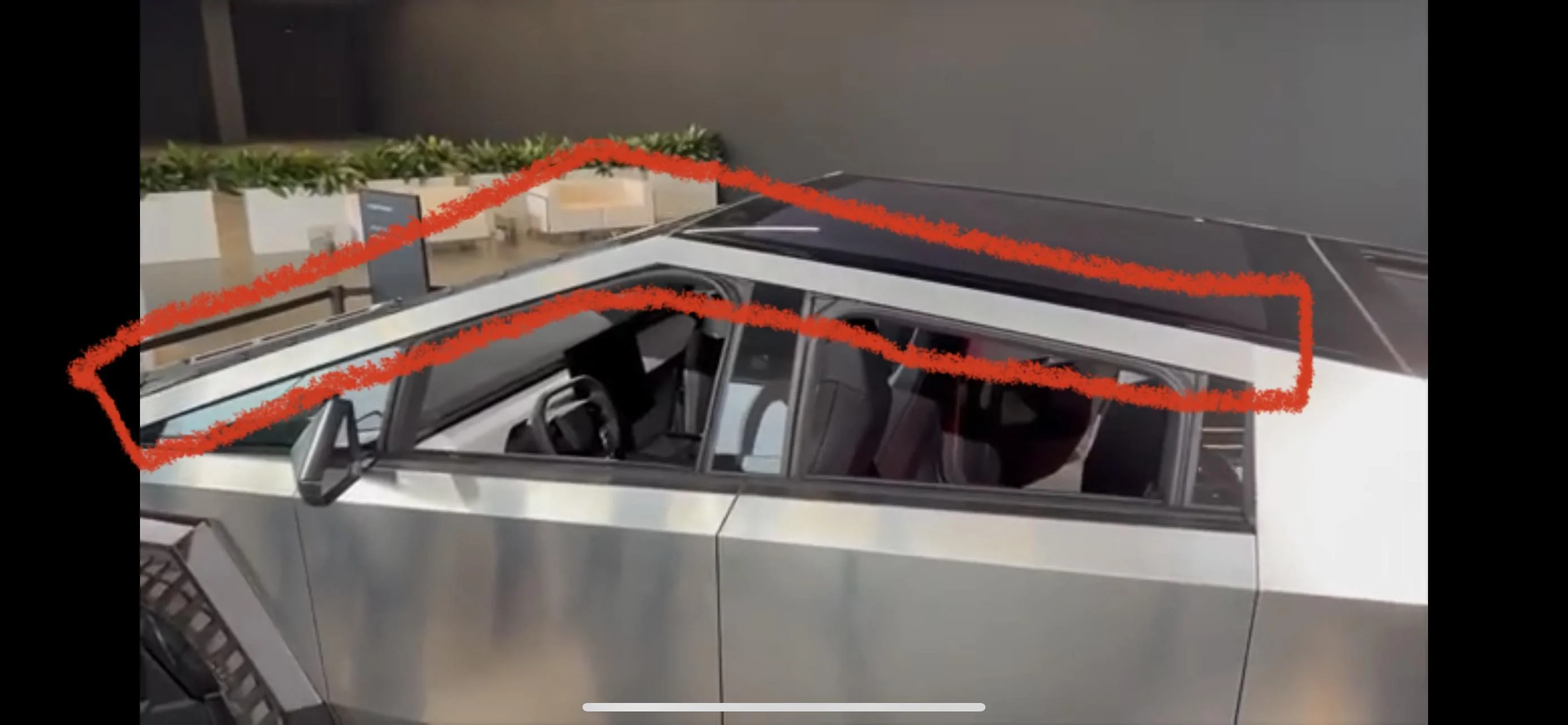
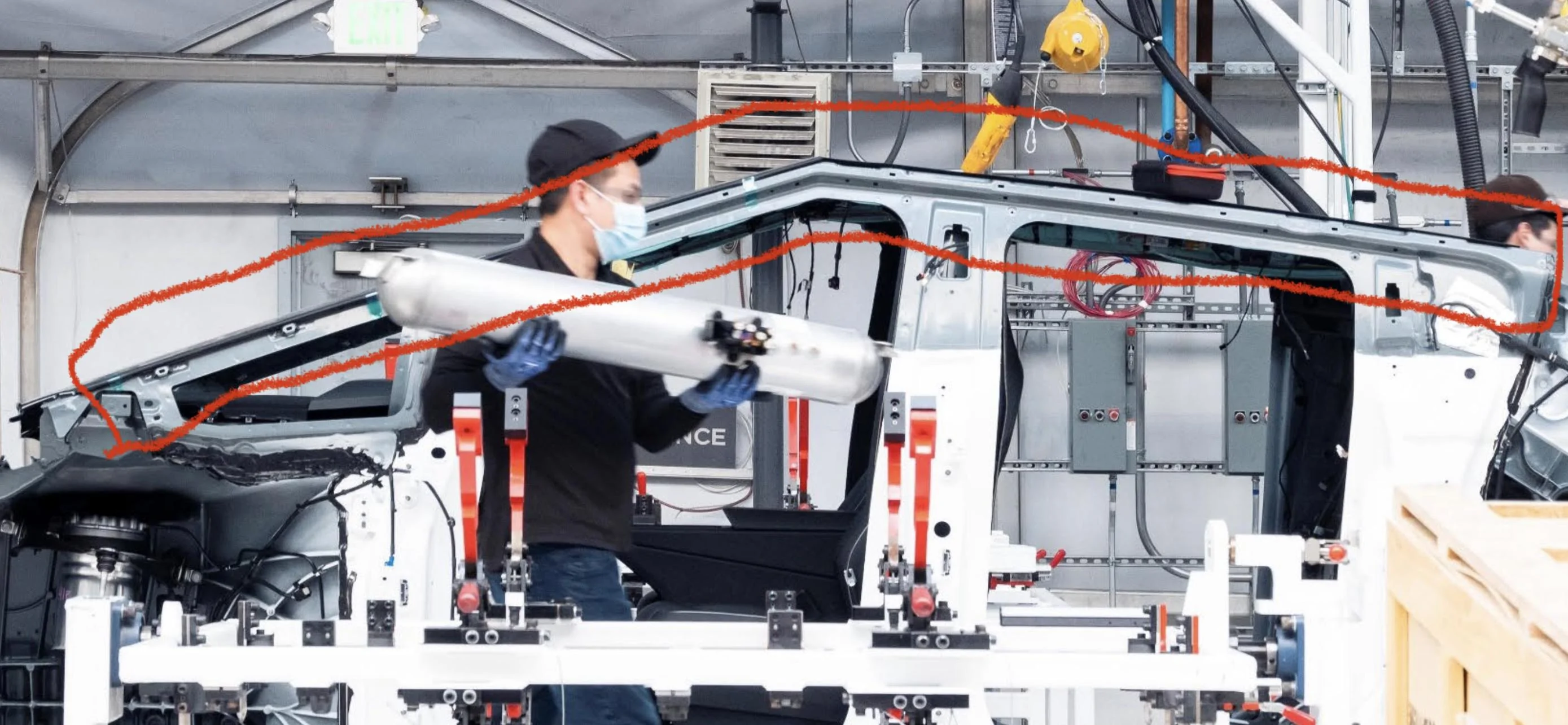
• the small trim pieces above passenger windows are attaching using clips:

Tesla Cybertruck Cybertruck Front Casting Analysis (and Frunk Implications) - 3 vs 2 Chickens EBE7CB51-C3EC-477A-953A-B9530E1356D7
Tesla Cybertruck Cybertruck Front Casting Analysis (and Frunk Implications) - 3 vs 2 Chickens A41DD015-9881-4241-8AE4-4DA0A360F10B


• the front quarter panels are pretty small, and attaching at three points: (A) to the cab just forward of the doors, and (B) to the cab just forward of the small triangle window, and (C) to the forward most bracket located under the hood (described in my OPs)

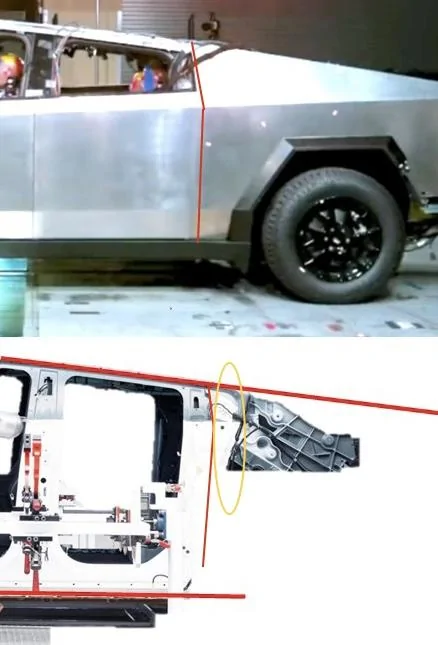
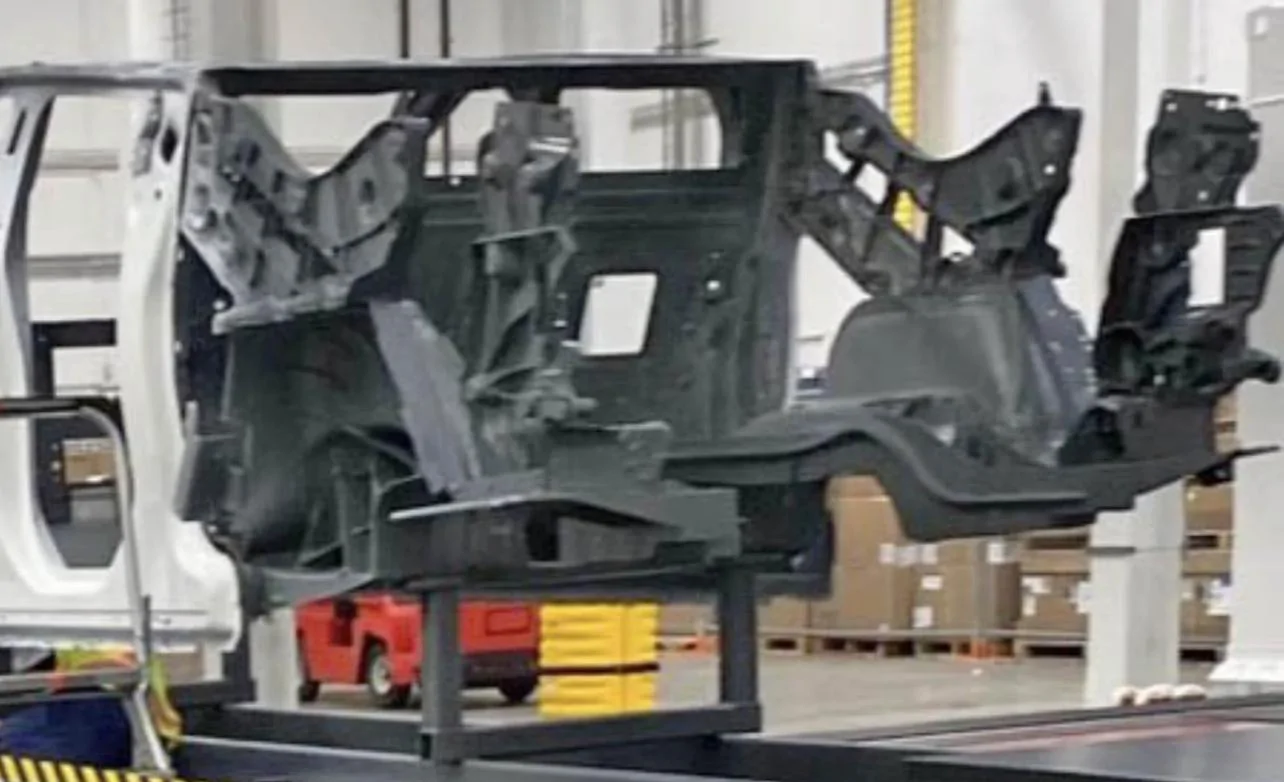
• the rear quarter panels are huge, but have a lot of obvious support points from the rear casting to “hang” upon, as well as extending beyond the rear casting to overlapping points on the cab structure:

Tesla Cybertruck Cybertruck Front Casting Analysis (and Frunk Implications) - 3 vs 2 Chickens 32E93981-0E29-439E-B0B7-C07FEDCAE9E6


Tesla Cybertruck Cybertruck Front Casting Analysis (and Frunk Implications) - 3 vs 2 Chickens 9D1A66F7-86FD-47CA-B59A-DC45B58A63B8


Once you step through each of the SS panel’s relationship to the underbody, this is why @JBee is doubtful of the “exoskeleton” providing much functional structure to the CT

In effect, only the two front quarterpanels, and two rear quarterpanels, are attached (mechanically speaking) to the underlying frame structures. Everything else are attached via hinge points, or are tiny trim pieces attaching with clips


CyberGus

Well-known member
First Name
Gus
Joined
May 22, 2021
Threads
91
Messages
10,240
Reaction score
33,895
Location
Austin, TX
Vehicles
1981 DeLorean, 2024 Cybertruck
Occupation
IT Specialist
Country flag
Strange thing is, there’s surprisingly little to “attach” once you step through it, and discount the obvious bits:

• windshield and roof are glass
• hood attaches by hinge
• tailgate attaches by hinge
• 4 doors attach by hinges

that leaves the only SS attaching to the body as:

• small trim strip above passenger windows
• two front quarter panels
• two rear quarter panels

Notice that of these pieces actually attaching to the body, the only ones of much size/weight are the two rear quarter panels

And most of these pieces attachments are seemingly straightforward

• the small trim pieces above passenger windows are attaching using clips:

EBE7CB51-C3EC-477A-953A-B9530E1356D7.jpeg
A41DD015-9881-4241-8AE4-4DA0A360F10B.jpeg


• the front quarter panels are pretty small, and attaching at three points: (A) to the cab just forward of the doors, and (B) to the cab just forward of the small triangle window, and (C) to the forward most bracket located under the hood (described in my OPs)

• the rear quarter panels are huge, but have a lot of obvious support points from the rear casting to “hang” upon, as well as extending beyond the rear casting to overlapping points on the cab structure:

32E93981-0E29-439E-B0B7-C07FEDCAE9E6.jpeg


9D1A66F7-86FD-47CA-B59A-DC45B58A63B8.jpeg


Once you step through each of the SS panel’s relationship to the underbody, this is why @JBee is doubtful of the “exoskeleton” providing much functional structure to the CT

In effect, only the two front quarterpanels, and two rear quarterpanels, are attached (mechanically speaking) to the underlying frame structures. Everything else are attached via hinge points, or are tiny trim pieces attaching with clips
I'm sure no one considered the hinged, movable pieces to be part of the frame-o-skeleton, but the sealed glass definitely provides rigidity.
 

AlDente

Well-known member
First Name
Roberto
Joined
Dec 28, 2022
Threads
9
Messages
561
Reaction score
999
Location
CA
Vehicles
Tesla 2026 "Premium" Cybertruck DM
Occupation
Retired (of a fashion)
Country flag
They'll fit.
I dunno, my Driver & 3 Wood are 1.5" and the irons are 1" over length so it might be tight. The barely fit diagonally in the Model Y rear hatch space.
 

AlDente

Well-known member
First Name
Roberto
Joined
Dec 28, 2022
Threads
9
Messages
561
Reaction score
999
Location
CA
Vehicles
Tesla 2026 "Premium" Cybertruck DM
Occupation
Retired (of a fashion)
Country flag
This is all interesting and even a bit amusing but I have to say, wouldn't it be great if all this initiative and effort went toward more productive purposes? Perhaps a re-design of the Boca Chica launch site?


CostcoSamples

Well-known member
First Name
Trevor
Joined
Feb 24, 2020
Threads
2
Messages
245
Reaction score
555
Location
Alberta, Canada
Vehicles
Mazda 6, Odyssey
Occupation
Engineer
Country flag
With all these castings and frame components, how is the CT an 'exo-skeleton' design? Seems closer to a unibody to me.
 
OP
OP
cvalue13

cvalue13

Well-known member
Joined
Aug 17, 2022
Threads
74
Messages
7,153
Reaction score
13,769
Location
Austin, TX
Vehicles
F150L
Occupation
Fun-employed
Country flag

charliemagpie

Well-known member
First Name
Charlie
Joined
Jul 6, 2021
Threads
48
Messages
2,982
Reaction score
5,369
Location
Australia
Vehicles
CybrBEAST
Occupation
retired
Country flag
exoskeleton or no exoskeleton makes no difference to me.

If no one ever told me, I wouldn't even ask.
 

TyPope

Well-known member
First Name
Ty
Joined
Mar 31, 2020
Threads
33
Messages
3,218
Reaction score
4,933
Location
Chesapeake Beach, MD
Vehicles
'23 MYLR, FS Cyberbeast 280xx
Occupation
Current Operations for... an organization
Country flag
Great thread! I mean, it means diddly squat to most of us in the long run but it's been a fun read. Do I care if I can put my golf clubs in the Frunk? A little, I suppose. Though, they go in the back of my F-150 just fine and should fit in the CT as well.

The best thread, I'll bet we all can agree will start with something like:

"I just picked up my Cybertruck and it is even better in person than I could ever have imagined. And kudos to Tesla for honoring the original pricing even though it has 4 motors now. The 0-60 is way quicker than I need to merge into traffic. I mean, 2.65 seconds to 60 mph is redonkulous."
Sponsored


Top