Sponsored

mongo

Well-known member
Joined
May 27, 2024
Threads
6
Messages
4,654
Reaction score
5,653
Location
SE Michigan
Vehicles
Cyberbeast
Country flag
I'm not an expert, but that's assuming the exact same vehicles hitting each other at the exact same angles, etc. (In a vacuum haha). Dead center on the car would respond different than near the corner. Point being, it's not exact, but there point is it's not like 120, it's closer to 60. And you would think that the heavier vehicle (Cybertruck) more likely goes through the lighter vehicle more. Ex: If a car hit's a bike, the bike takes it much harder. Just spit balling here...
Yeah, then you're dealing with conservation of momentum versus removing all the kinetic energy during impact.
Sponsored


petercyber

Well-known member
Joined
May 17, 2024
Threads
23
Messages
366
Reaction score
385
Location
U.S.A
Vehicles
Cyberbeast
Country flag
Simply incredible. Gotta be one of the biggest reasons to be in a CT (or at least any Tesla). The safety bubble to protect yourself (and loved ones) from what you can’t control.

🙏
I still think that seeing many front CT crashed I have my doubts about how safe it is in a frontal collition. It seem to me that the front of the CT it is a big empty enclosure, what stops the impact is the cabin where you are. CT definately is not a tank as portraited.
 

mongo

Well-known member
Joined
May 27, 2024
Threads
6
Messages
4,654
Reaction score
5,653
Location
SE Michigan
Vehicles
Cyberbeast
Country flag
I still think that seeing many front CT crashed I have my doubts about how safe it is in a frontal collition. It seem to me that the front of the CT it is a big empty enclosure, what stops the impact is the cabin where you are. CT definately is not a tank as portraited.
 

CyberGus

Well-known member
First Name
Gus
Joined
May 22, 2021
Threads
91
Messages
10,313
Reaction score
34,184
Location
Austin, TX
Vehicles
1981 DeLorean, 2024 Cybertruck
Occupation
IT Specialist
Country flag
I still think that seeing many front CT crashed I have my doubts about how safe it is in a frontal collition. It seem to me that the front of the CT it is a big empty enclosure, what stops the impact is the cabin where you are. CT definately is not a tank as portraited.
 

ABILISK

Well-known member
Joined
Nov 6, 2024
Threads
22
Messages
2,133
Reaction score
3,866
Location
DFW
Website
ts.la
Vehicles
‘24 Beast
Country flag
I still think that seeing many front CT crashed I have my doubts about how safe it is in a frontal collition. It seem to me that the front of the CT it is a big empty enclosure, what stops the impact is the cabin where you are. CT definately is not a tank as portraited.
NHTSA doesn’t hand out 5-star ratings to just anyone. The ugly fact is that no matter how safe you make a vehicle there’s still this possibility. Yes, people have even died in tank crashes in training. The fact that the CT driver held out as long as he did speaks volumes about its safety.

I’ve worked plenty of wrong way driver wrecks on freeways. I’ve seen bodies in pieces, brain matter thrown 100 yards away, you name it. They’re brutal. This guy almost made it out. That’s incredible.


Tallgeese179

Well-known member
First Name
Nikola
Joined
Sep 11, 2025
Threads
3
Messages
175
Reaction score
358
Location
Pittsburgh, PA
Vehicles
2025 CT AWD, 21 BMW X7, 15 370Z Nismo
Country flag
This story reminded me of this IIHS video I watched a while back. Smaller car, but that the velocity is much more influential in E=1/2(m)(v)^2. Similar nightmare scenario broken down by a guy that's been in the business for a long time.


WILLK

Well-known member
Joined
Oct 22, 2021
Threads
5
Messages
100
Reaction score
104
Location
Reno
Vehicles
Hyundai Tucson
Country flag
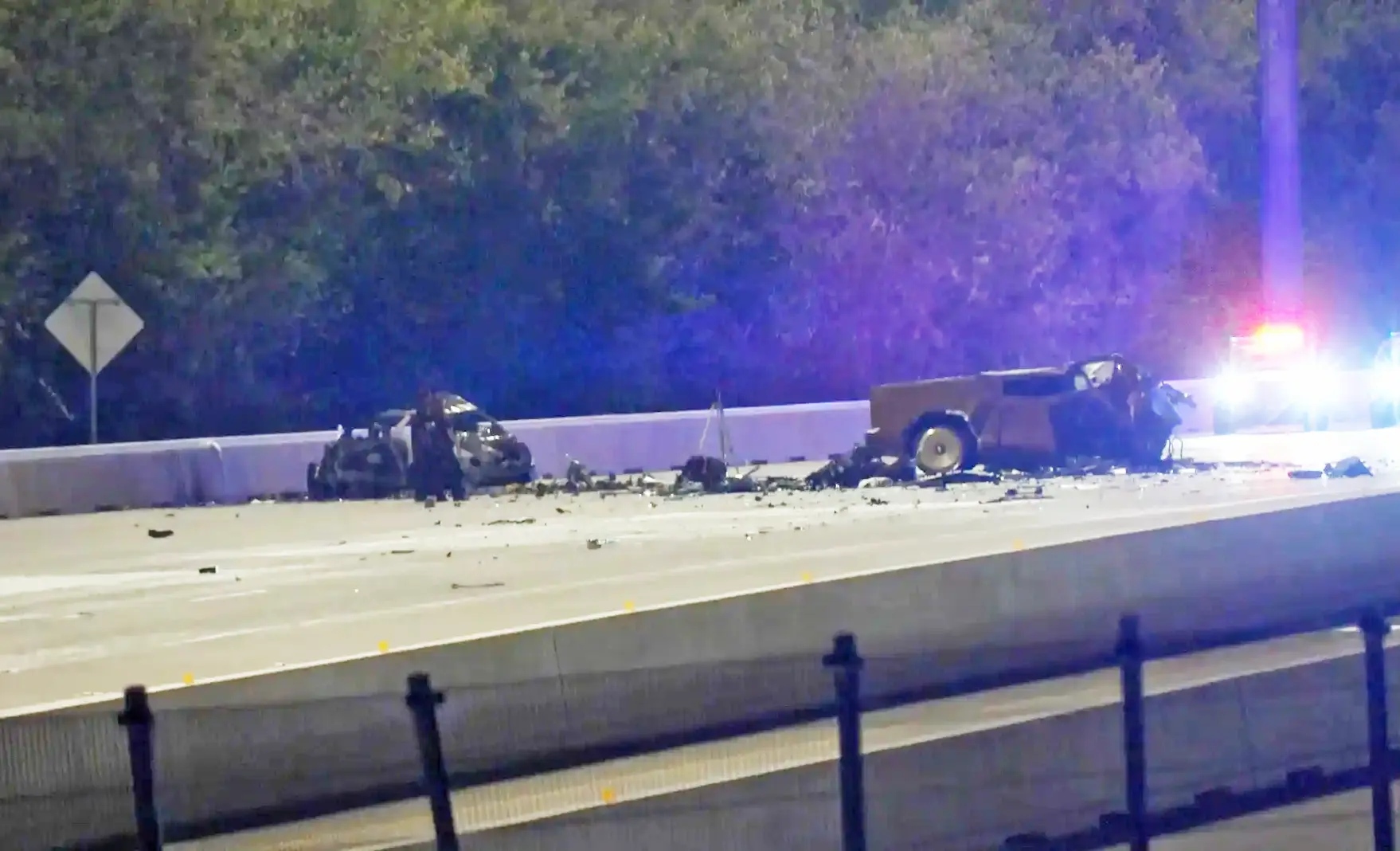
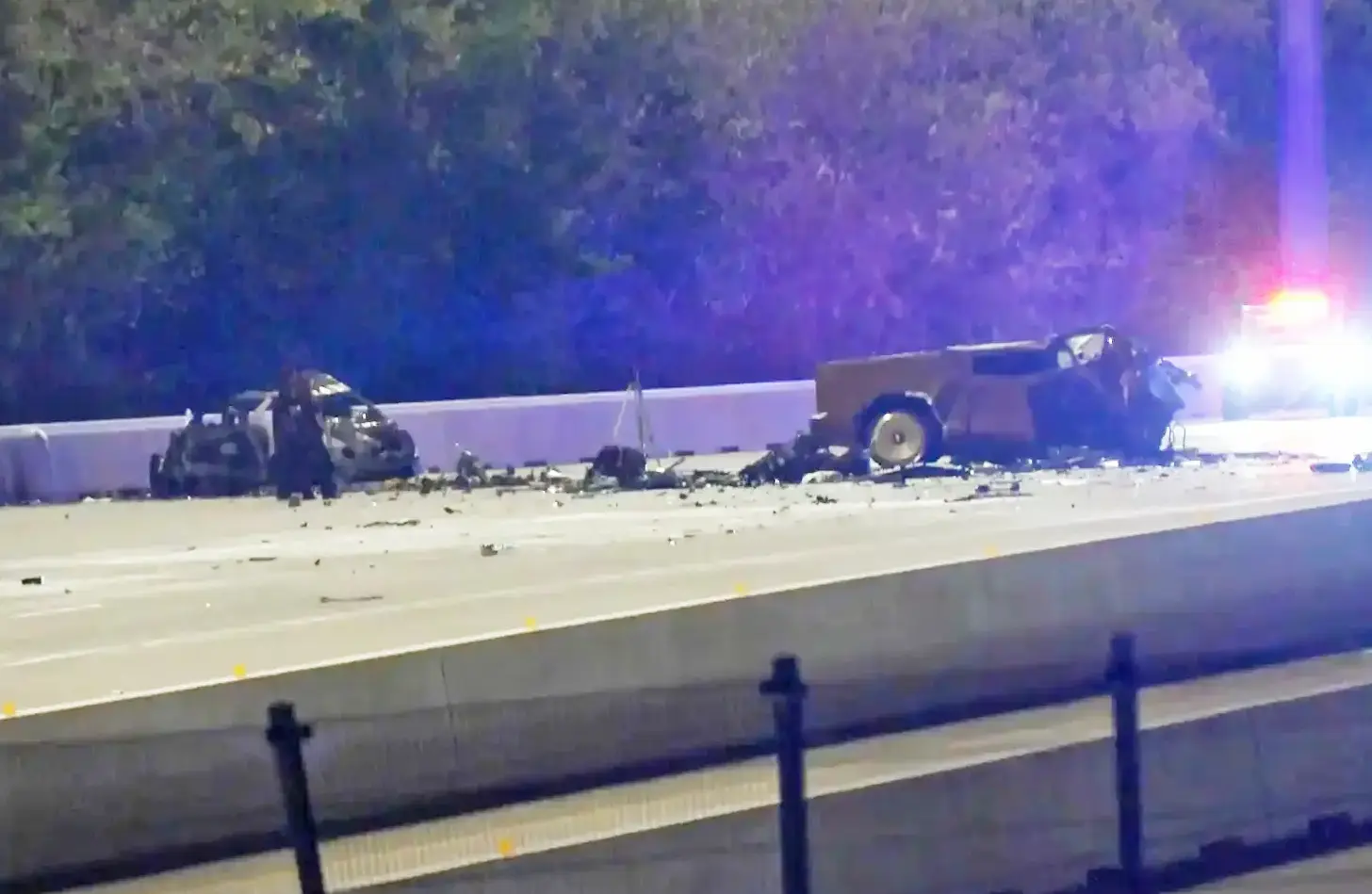
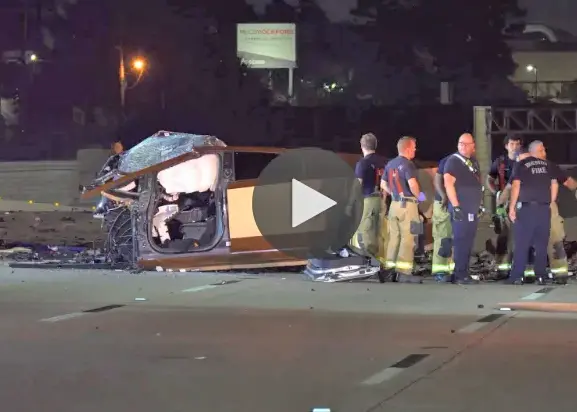
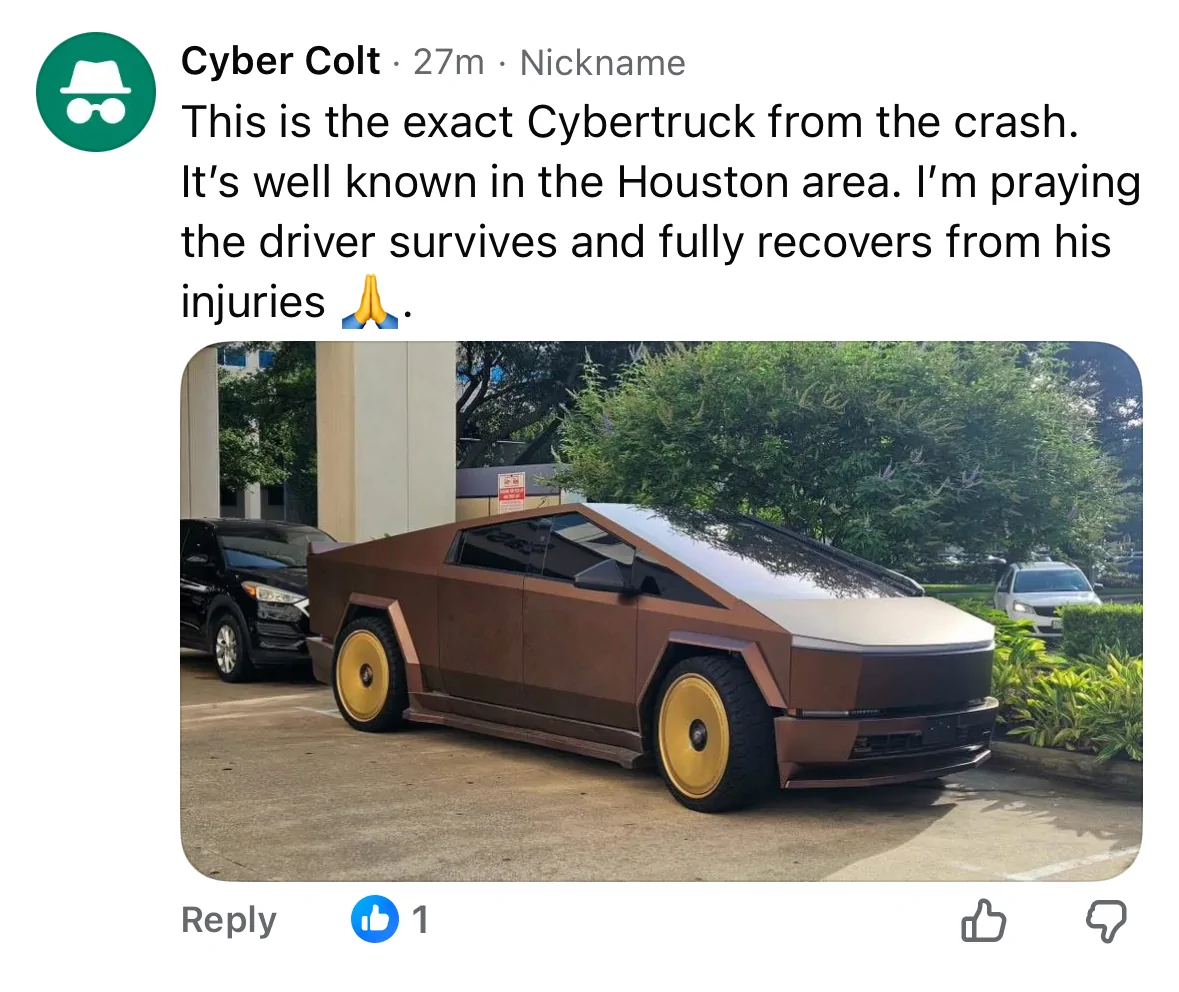
Looks like a Cybertruck was hit head on by a wrong way BMW on I-10. The crash scene looks horrendous and unsurvivable. The CT was NOT the vehicle on fire either! The driver of the CT is listed as in critical condition and at the hospital.

Looking at the photo, if one has to be in a crash, the CT would be my choice.

I know we have a lot of posters from the Houston area, praying for the driver's recovery.

107423-e5789b20048df54659aaada56f78d6f5.webp


107423-e5789b20048df54659aaada56f78d6f5.webp


107425-d027a0c1ed62740b28f3a466837393e1.webp


Full news article below:

Fiery I-10 crash leaves one dead after wrong-way collision near downtown Houston
I heard that at night that you should not spend time in the fast lane . Wrong way drunk drivers like to stay in the slow lane. Driving the wrong way, they will be in the fast lane thinking it is the slow lane. They will also likely not have their headlights turned on.
 

BrockN

Well-known member
First Name
Brock
Joined
Jan 1, 2025
Threads
7
Messages
413
Reaction score
621
Location
Kamloops BC Canada
Vehicles
'24 FS Cybertruck, '23 MY, '15 MS
Occupation
Engineer
Country flag
I'm not fond of posting AI results, but this is an accurate summary of the articles referenced:


Survival in a head-on collision depends heavily on speed; at lower speeds, survival rates are high, but at higher speeds, the risk of fatal or disabling injury increases dramatically. For example, at 50 mph, the survival rate drops to about 31%, and at 70 mph or higher, the chances of survival are extremely low.

Other factors include the angle of impact, whether drivers brake, and vehicle safety features.

Speed is the most critical factor

The kinetic energy carried by your body must be absorbed by something... the seatbelt, airbag, etc. That energy is mass multiplied by the square of velocity (there's a 0.5 in there too, but irrelevant to the final outcome). So double the speed, and you quadruple the energy that your ribs try to transfer to the seatbelt, your neck muscles and spine feel as your head tries to keep going forward. In short, it's that velocity squared term that effs you up, based on the rate of deceleration.

As far as those threshold speeds are concerned, I'm going to guess that they're based on the typical crumple zones in modern vehicles. They reduce the deceleration you experience but can only do so much. Therefore there must be a typical speed where the human body can't survive the deceleration (how quickly the kinetic energy is reduced to zero), even if the body doesn't impact the steering wheel, windshield etc.

In the case of the accident being discussed, it would be interesting to know how the impacts occurred. Assuming the airbags blew at impact with the BMW, they would have been of little use a few moments later when the semi hit the Cybertruck.
 

Tallgeese179

Well-known member
First Name
Nikola
Joined
Sep 11, 2025
Threads
3
Messages
175
Reaction score
358
Location
Pittsburgh, PA
Vehicles
2025 CT AWD, 21 BMW X7, 15 370Z Nismo
Country flag
A lot of us, myself included, want to analyze this with physics, correlating kinetic energy to survivability. This analysis approach works well for braking systems, since they primarily dissipate kinetic energy into heat (along with a little light and sound). A good example of the extreme forces that a body can withstand was demonstrated by John Stapp. He endured 46.2G on his maximum run, enough to have the whites of his eyes turn red from the capillaries bursting. Like a brake system, the degrees of freedom here are restricted and the forces primarily act in one direction.


On the other hand, a crash is anything but linear. Take examples of deaths in racing: Dale Earnhardt's death lead to the widespread use of the HANS device. The HANS restricts the movement of the head and provides an auxiliary load path so your neck isn't subject to violent bending/torsional forces resulting from your head's momentum.

Jules Bianchi died after a freak accident where his F1 car slid off the course and under a recovery vehicle that was on course. Similar stuff occurs with tractor trailers and their still ineffective underride barriers, where rear ending one at speed is a death sentence by decapitation.

The list is long, sometimes you just get unlucky. There's no certain way to predict these things, but it's a fact that in an accident speed is not your friend. Also the more you can elongate the timer interval for initial speed to 0, the better. Other than that, IMO there are too many variables to really take much away from a post crash picture and a rough description. We can try, but it's just going to be a mess of assumptions, guessing, and ignorance.
 

pricedm

Well-known member
First Name
Adam
Joined
Feb 17, 2022
Threads
2
Messages
940
Reaction score
1,861
Location
Denver, Colorado, USA
Vehicles
2026 Tesla Model Y LR. 2025 Cybertruck AWD. 2023 MY and 2018 M3: retired
Occupation
IT
Country flag
I still think that seeing many front CT crashed I have my doubts about how safe it is in a frontal collition. It seem to me that the front of the CT it is a big empty enclosure, what stops the impact is the cabin where you are. CT definately is not a tank as portraited.
Here you go, direct from the Cybertruck engineering team:


Crissa

Well-known member
First Name
Crissa
Joined
Jul 8, 2020
Threads
138
Messages
19,571
Reaction score
31,477
Location
Santa Cruz
Vehicles
2014 Zero S, 2013 Mazda 3
Country flag
I still think that seeing many front CT crashed I have my doubts about how safe it is in a frontal collition. It seem to me that the front of the CT it is a big empty enclosure, what stops the impact is the cabin where you are. CT definately is not a tank as portraited.
That's better, not worse. That 'big empty' is absorbing the impact.

-Crissa
 

757 Beast

Member
First Name
Ron
Joined
Oct 6, 2024
Threads
0
Messages
5
Reaction score
2
Location
Hampton VA
Vehicles
2024 Foundation Series Beast
Country flag
I’m wondering if the first impact (head-on) was survivable, without the second (tractor trailer) impact.
I was thinking the same thing. All of the air bags likely deployed to protect the occupant in the initial crash, but the impact with the semi likely didn't have the same protection.
 

cyberjeff25

Well-known member
First Name
jeffrey
Joined
Sep 3, 2024
Threads
5
Messages
195
Reaction score
308
Location
temecula california
Vehicles
cyberbeast
Occupation
registerd investment advisor
Country flag
If the CT was running FSD at the time of the collision- wonder if the system would have tried to swerve to avoid the oncoming car and then tried to evade the large truck as well.

The FSD should be able to react evasively faster than a human being that might not see all the possibilities to avoid the accident or visualize the threat from the other vehicles.

Someone needs to put obstacles out on a track an then run CT with FSD toward the obstacles or parked car and let’s see how the CT reacts to avoid the collision.


Top