Sponsored

Explain battery drain and Snowflake

mongo

Well-known member
Joined
May 27, 2024
Threads
5
Messages
4,520
Reaction score
5,495
Location
SE Michigan
Vehicles
Cyberbeast
Country flag
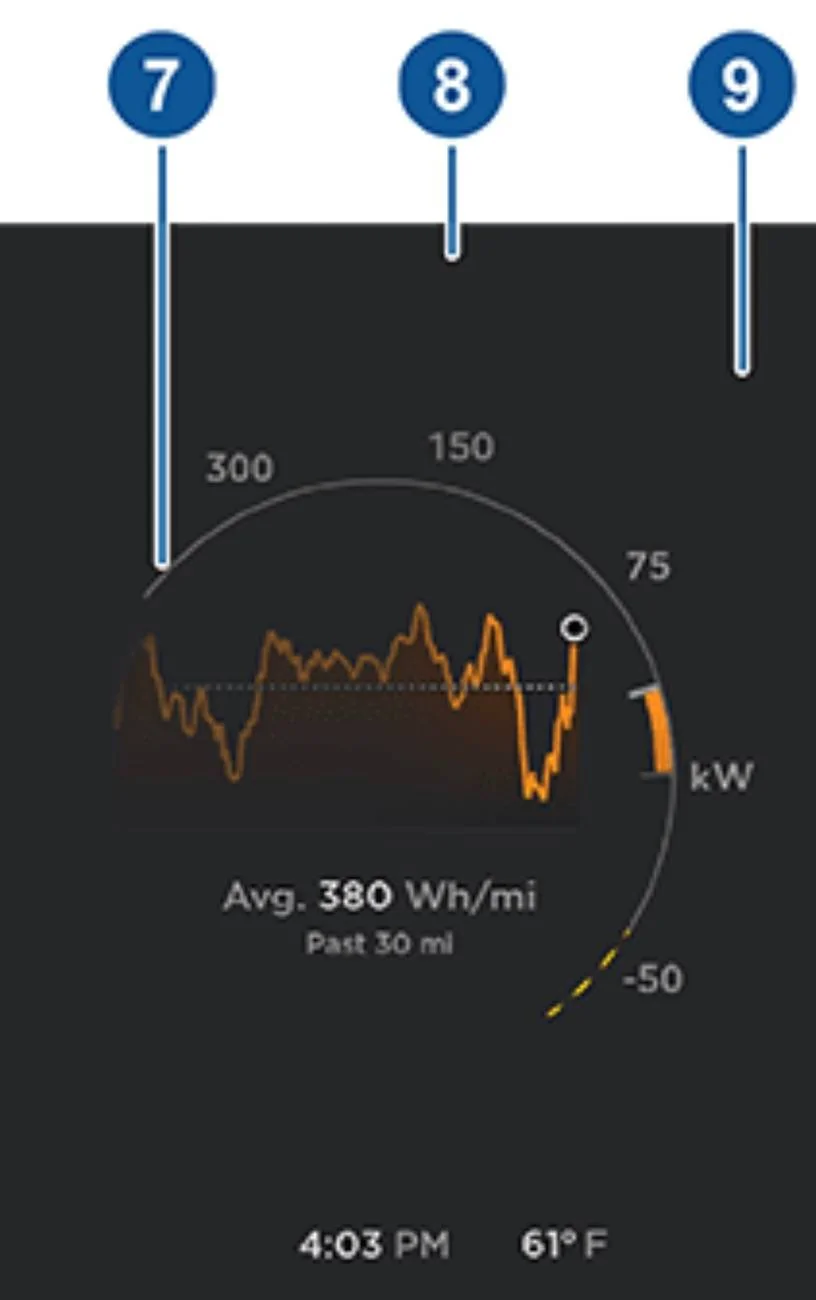
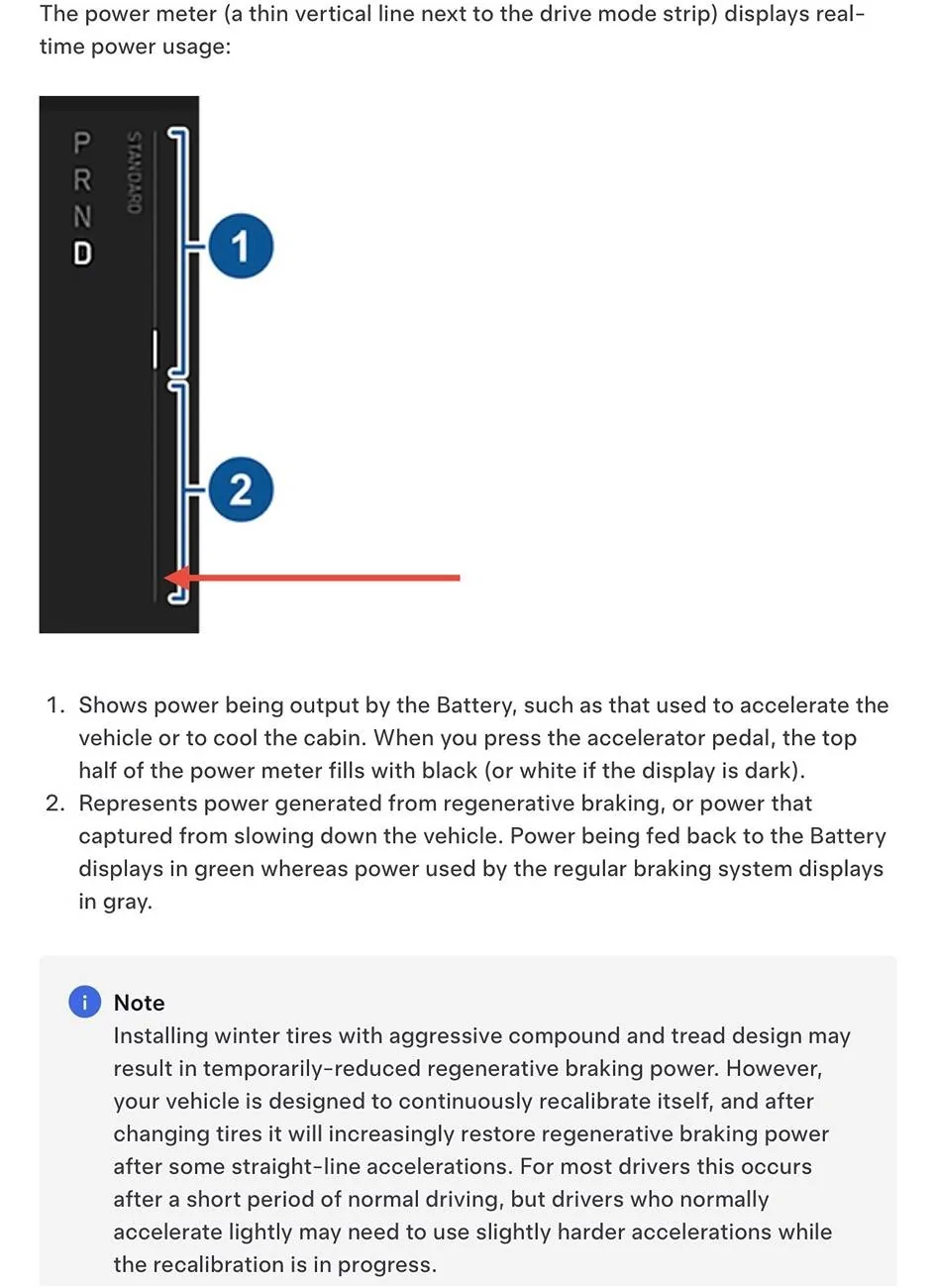
I think this icon is a carryover from the power display on some of the first models. For example our X the way it displays regen or power being delivered is with an energy graph that is round. When regen is limited it is represented with dashes in the bottom of the regen graph. It is a little difficult to see but the power meter on the Cybertruck (other models that have the meter as well) will also so dashed lines when regen is limited (would be at the red arrow in the below pic) I assume they added the green icon to make it more apparent so people are more careful. Once you get use to the distance needed to stop with only regen as soon as that is reduced it can surprise you that physical brakes are needed for the same stop you have made hundreds of times with only regen.

Model X energy graph:
IMG_0405.jpeg

Cybertruck power meter:
IMG_0406.jpeg
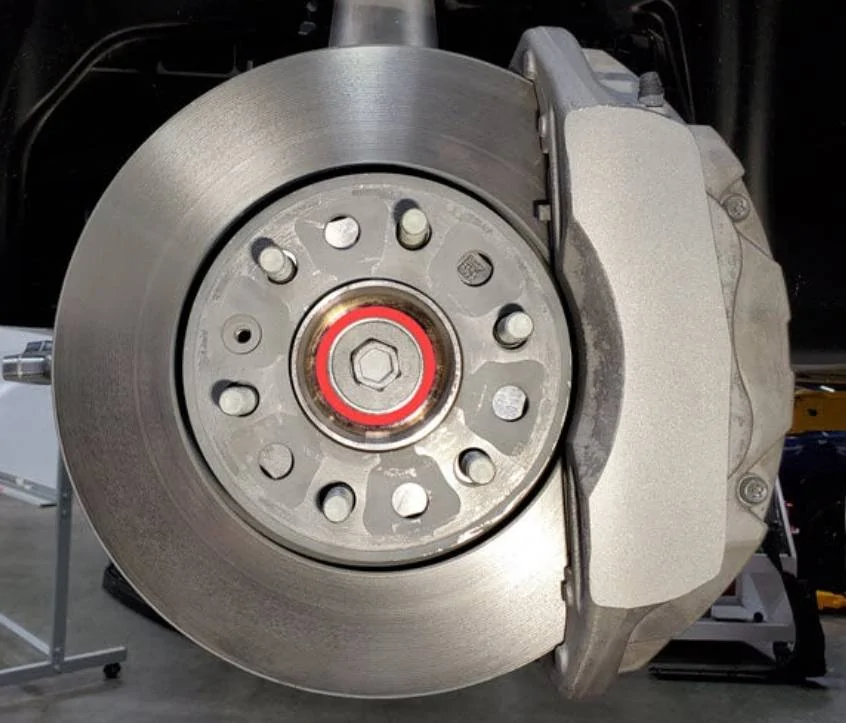
Interesting, I was thinking the dotted part was the dust shield, but that isn't visible from the outside of the assembly. So it could be showing a limited regen power graph with a disk brake shape. (Standard icons use drum brake looking things ?)


Tesla Cybertruck Explain battery drain and Snowflake SmartSelect_20241206_081000_Firefox
Sponsored


AlmostHuman

Well-known member
Joined
May 1, 2024
Threads
7
Messages
985
Reaction score
1,349
Location
Earth
Vehicles
Model X, Cybertruck
Occupation
Human
Country flag
Interesting, I was thinking the dotted part was the dust shield, but that isn't visible from the outside of the assembly. So it could be showing a limited regen power graph with a disk brake shape. (Standard icons use drum brake looking things ?)


SmartSelect_20241206_081000_Firefox.jpg
Yeah it totally could be! I don’t known for sure, just what I always thought it was. ??‍♂
 

mongo

Well-known member
Joined
May 27, 2024
Threads
5
Messages
4,520
Reaction score
5,495
Location
SE Michigan
Vehicles
Cyberbeast
Country flag
Yeah it totally could be! I don’t known for sure, just what I always thought it was. ??‍♂
I think it's both (and being a graph explains why it's green). Like this image, you can see either though it may depend on if Cybertruck is your first Tesla...
Tesla Cybertruck Explain battery drain and Snowflake Face_or_vase_ata_01.svg
 

PhilEsq

Well-known member
First Name
Philip
Joined
Aug 14, 2021
Threads
3
Messages
266
Reaction score
185
Location
Roslyn, NY
Vehicles
Cybertruck ordered and two MB GLC
Occupation
Attorney
Country flag
Ok but his CT is in a heated garage, unlike mine and his battery is not warm enough? Math is not mathing here..
The garage may be heated but Tesla knows that it's cold outside so once the truck driving outside in the cold weather the range will be reduced and Tesla is showing how much of a reduction you will get. I suspect the 4680 cells do not do as well in the cold as the other batteries.
 
First Name
Matt
Joined
Dec 12, 2023
Threads
0
Messages
20
Reaction score
35
Location
OC
Vehicles
Model 3, Toyota Highlander
Country flag
There are temperature sensors in the battery. A cold soaked battery that has been outside will stay cold for a LONG time after it is in a heated garage. I'm sure there are differences in software and sensors between the Y and CT but also the CT battery is much larger than a Y so it will stay colder for longer. Also, what temperature are you heating your garage to? I would imagine it isn't as warm as the house so the truck will take a long time to warm up.

Also, you will notice a big drop day 1 sitting outside in the cold but the charge loss stops after that because the battery is fully cold soaked.

Cold weather tip, always charge right after driving the CT and not after it has cold soaked, it will be much more efficient.

I drive to the mountains often and supercharging my 3 after a weekend in the cold takes MUCH MUCH longer than supercharging right when I arrive with a warm battery.


Crissa

Well-known member
First Name
Crissa
Joined
Jul 8, 2020
Threads
138
Messages
19,571
Reaction score
31,475
Location
Santa Cruz
Vehicles
2014 Zero S, 2013 Mazda 3
Country flag
Thanks a lot for your quick reply. Do you know if there’s a specific way to warm up the battery before the drive?
You would need to warm the entire mass of the pack to like 80F to get full range. It's not just LFP, or whatever - If it's cold enough outside, that's just not going to happen.

My Zero has no thermal management. On a hot day I can literally get three times the range than below freezing.

It's not vampire drain, it's the battery just taking more chemical time to store and discharge energy. If you leave a charged, cold-soaked lithium battery without trying to draw from it until it's warmed back up from the outside temperature - you'd get nearly all of that energy back.

Think if it like how cold muscles are stiffer, and take more effort to move.

-Crissa
 
Last edited:

yamadirt

Well-known member
First Name
Richard
Joined
Oct 23, 2024
Threads
2
Messages
48
Reaction score
27
Location
NJ
Vehicles
Cybertruck
Country flag
You would need to warm the entire mass of the pack to like 80F to get dull range. It's not just LFP, or whatever - If it's cold enough outside, that's just not going to happen.

My Zero has no thermal management. On a hot day I can literally get three times the range than below freezing.

It's not vampire drain, it's the battery just taking more chemical time to store and discharge energy. If you leave a charged, cold-soaked lithium battery without trying to draw from it until it's warmed back up from the outside temperature - you'd get nearly all of that energy back.

Think if it like how cold muscles are stiffer, and take more effort to move.

-Crissa
Thanks for the explanation. That’s very helpful.
 

Crissa

Well-known member
First Name
Crissa
Joined
Jul 8, 2020
Threads
138
Messages
19,571
Reaction score
31,475
Location
Santa Cruz
Vehicles
2014 Zero S, 2013 Mazda 3
Country flag
Thanks for the explanation. That’s very helpful.
Every little bit of outside power or heat can help, of course. So someone with a heated garage will get more than someone who stores outside... and someone can leave plugged in will do better than one who can't. But all will feel that cold once they're on the drive.

And a Tesla will only as a last resort stop drawing from a cold battery pack. They programmed it to expect you to come back - but it will do better if you tell it when you're coming back, and it's plugged in, so it can do everything it can to ready itself for you. Any shore power you use is range you get to keep in the pack.

-Crissa
 

dalton108

Well-known member
First Name
Dalton
Joined
Oct 17, 2020
Threads
130
Messages
3,947
Reaction score
7,869
Location
USA
Vehicles
‘24 FS/CB; ‘24 MX; ‘23 MS PLAID (Prior: ‘20-MY; ‘21-M3P) (Also: ‘14-FJ; ‘21-C8)
Occupation
Lawyer
Country flag
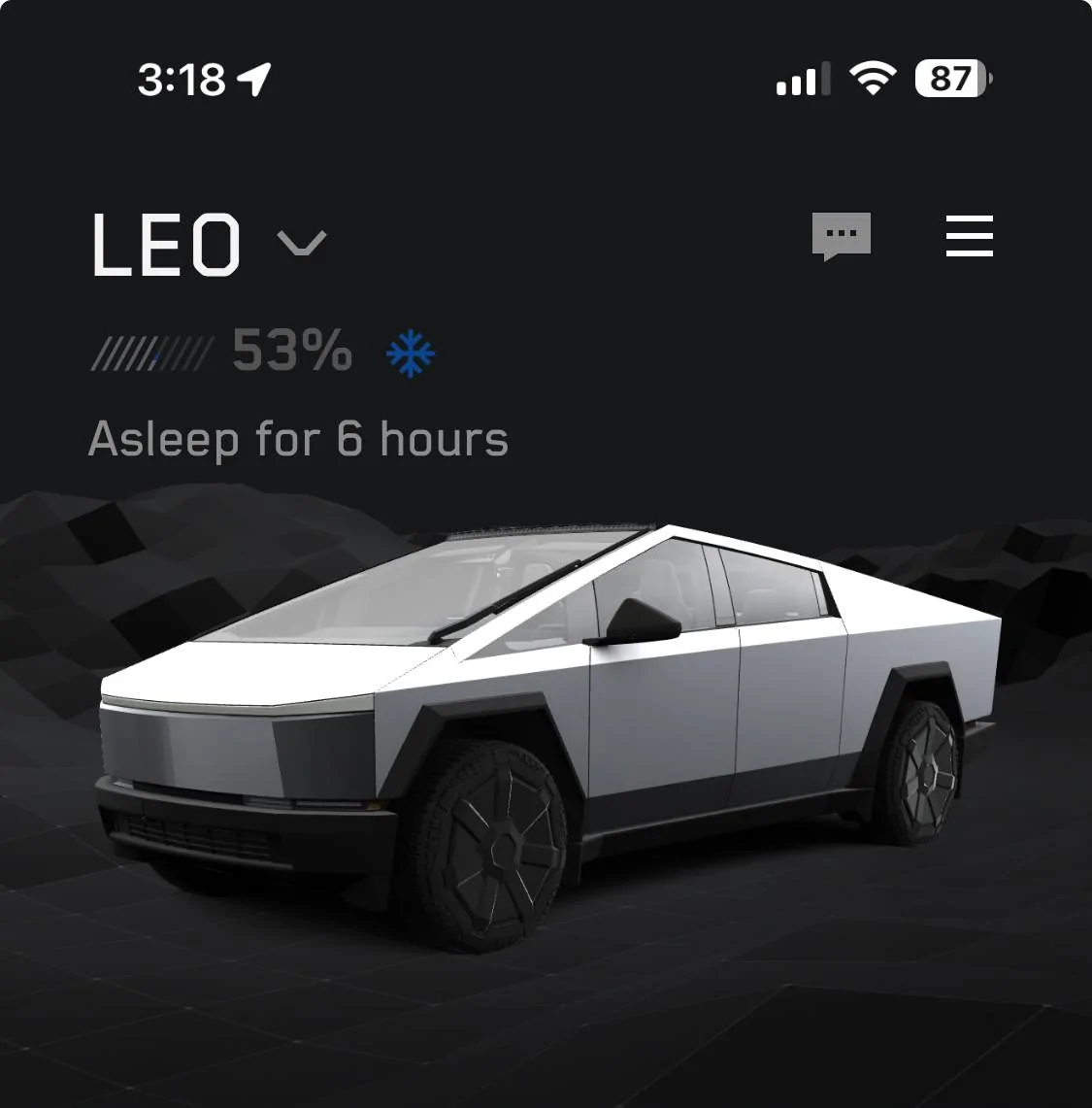
It’s 60° outside today and sunny and the only car in the fleet that thinks it’s “cold” is my CyberBeast.

I saw the comments about battery chemistry etc. above, just adding this as a data point.

Anybody seeing this at warmer than 60°?

Tesla Cybertruck Explain battery drain and Snowflake IMG_2416
 

eswimm

Well-known member
Joined
Jun 6, 2024
Threads
3
Messages
555
Reaction score
994
Location
Charlotte, NC
Vehicles
Model Y, Cybertruck
Country flag
There are temperature sensors in the battery. A cold soaked battery that has been outside will stay cold for a LONG time after it is in a heated garage. I'm sure there are differences in software and sensors between the Y and CT but also the CT battery is much larger than a Y so it will stay colder for longer. Also, what temperature are you heating your garage to? I would imagine it isn't as warm as the house so the truck will take a long time to warm up.

Also, you will notice a big drop day 1 sitting outside in the cold but the charge loss stops after that because the battery is fully cold soaked.

Cold weather tip, always charge right after driving the CT and not after it has cold soaked, it will be much more efficient.

I drive to the mountains often and supercharging my 3 after a weekend in the cold takes MUCH MUCH longer than supercharging right when I arrive with a warm battery.
It's not only more efficient to charge before stopping for the night, but stopping below 10% SOC and waiting for morning to charge may actually leave you stranded as the battery cools beyond the point it can access the lower end of the battery charge.


Jager

Well-known member
First Name
Jeff
Joined
May 25, 2020
Threads
24
Messages
337
Reaction score
1,089
Location
Virginia
Vehicles
2024 Cybertruck AWD, 2022 Model 3 LR AWD
Country flag
It’s 60° outside today and sunny and the only car in the fleet that thinks it’s “cold” is my CyberBeast.

I saw the comments about battery chemistry etc. above, just adding this as a data point.

Anybody seeing this at warmer than 60°?

IMG_2416.jpeg
The Cybertruck currently exhibits very different thermal behaviors than do the S3XY vehicles. Most prominent for owners, now that we're into colder weather, is the persistent snowflake... even when a S3XY model is parked right alongside the CT, sans snowflake. And even after a long drive in the CT.

There are likely a couple of good reasons for those differences. One being the larger cell / larger pack dimensions of the 4680 pack architecture which is inherently less efficient at thermal change (either going up or coming down) than either the 18650 or 2170 architectures. The other being that, I suspect, Tesla is being extremely conservative with the 4680 CT pack architecture until they have more data... and the implications behind that data for longterm pack health.

As an example, one facet I find very interesting in the CT pack is a remarkably wide variance in module temp - there are four modules in the CT's 4680 pack - compared to the cell-to-cell temp variance one typically sees in the S3XY models. There is no upside to such a variance, but potentially some downsides.

I expect Tesla is just being very cautious.
 

mongo

Well-known member
Joined
May 27, 2024
Threads
5
Messages
4,520
Reaction score
5,495
Location
SE Michigan
Vehicles
Cyberbeast
Country flag
As an example, one facet I find very interesting in the CT pack is a remarkably wide variance in module temp - there are four modules in the CT's 4680 pack - compared to the cell-to-cell temp variance one typically sees in the S3XY models. There is no upside to such a variance, but potentially some downsides.
The other vehicles are modular also, not one monolithic block of cells.
What does the temperature distribution look like?
Outer modules would theoretically be more impacted by ambient temps than the middle two. Same with ends vs center in a module.
 

Jager

Well-known member
First Name
Jeff
Joined
May 25, 2020
Threads
24
Messages
337
Reaction score
1,089
Location
Virginia
Vehicles
2024 Cybertruck AWD, 2022 Model 3 LR AWD
Country flag
The other vehicles are modular also, not one monolithic block of cells.
What does the temperature distribution look like?
Outer modules would theoretically be more impacted by ambient temps than the middle two. Same with ends vs center in a module.

Aye, I'm aware that S3XY models have their packs arranged in modules, too. But I've only ever monitored temps on a per-cell basis. In my 2022 Model 3, cell-to-cell variance has always been very small (a couple degrees, F) regardless of condition, ranging from cold-soaked pack (below freezing) to more or less normal driving temps (up to a bit above 100 degrees, F), to a pre-conditioned-for-Supercharger pack (~120F), to a Supercharger session itself (~155F).

I don't have a way to monitor the 1,344 individual cell temps in the CT. That would be preferable. But at least I can see the four modules comprising the pack. And it's not uncommon to see a variance of as much as 15F from coldest to hottest. That's quite a lot.

Based on the very little cell-to-cell temp variance seen in my Model 3, I have long assumed that module architecture was largely irrelevant. It should be pretty straightforward to design the internal cooling lines such that all cells receive more or less equal cooling/heating effect, after all, regardless of how the modules themselves are divided up.

That was my starting assumption with the CT, as well. And kinda still is. But the module temp variance is something I didn't expect, and so I'm prepared to be proven wrong about that.
 

mongo

Well-known member
Joined
May 27, 2024
Threads
5
Messages
4,520
Reaction score
5,495
Location
SE Michigan
Vehicles
Cyberbeast
Country flag
Aye, I'm aware that S3XY models have their packs arranged in modules, too. But I've only ever monitored temps on a per-cell basis. In my 2022 Model 3, cell-to-cell variance has always been very small (a couple degrees, F) regardless of condition, ranging from cold-soaked pack (below freezing) to more or less normal driving temps (up to a bit above 100 degrees, F), to a pre-conditioned-for-Supercharger pack (~120F), to a Supercharger session itself (~155F).

I don't have a way to monitor the 1,344 individual cell temps in the CT. That would be preferable. But at least I can see the four modules comprising the pack. And it's not uncommon to see a variance of as much as 15F from coldest to hottest. That's quite a lot.

Based on the very little cell-to-cell temp variance seen in my Model 3, I have long assumed that module architecture was largely irrelevant. It should be pretty straightforward to design the internal cooling lines such that all cells receive more or less equal cooling/heating effect, after all, regardless of how the modules themselves are divided up.

That was my starting assumption with the CT, as well. And kinda still is. But the module temp variance is something I didn't expect, and so I'm prepared to be proven wrong about that.
Is this via service menu or some other tool (I'm curious to look at mine)?
 

Outdoors

Well-known member
First Name
Outdoors
Joined
Nov 19, 2019
Threads
17
Messages
1,870
Reaction score
3,449
Location
North West Montana
Vehicles
S,3,Y,CT,CT(holding pattern) Slate is back on
If you just keep driving and supercharge every 75 to 100 miles. -25F is where one starts to not be able to keep up with keeping the regen. Of course clear roads are needed to go fast. Keep Wh/mi high.

In really cold filling up the pack really high at a supercharger it can actually cool off as charge rate lowers. -35F is my lowest supercharging temp.

Why this is all a discussion about it all I don't know. Someone I guess doesn't like to look at a snowflake. There must be something wrong there is a light on and I don't know why. A warmed up pack is not needed to drive the truck. Warmed up pack is needed to charge efficiently. Not needed to charge.
Sponsored


Top