Sponsored

cvalue13

Well-known member
Joined
Aug 17, 2022
Threads
74
Messages
7,153
Reaction score
13,769
Location
Austin, TX
Vehicles
F150L
Occupation
Fun-employed
Country flag
EDIT TO ADD:

The CT crash prototype is nearly identical to the unveil on-screen specs.

  • wheelbase is ~142"
  • max width flare-to-flare ~82"
  • length nose-to-tail ~230"
the above within +/- 1-2" margin of error I'd guess

Thought the interior dimensions appear a bit tight, but hard to say.

If you want the actual, correct, guestimated measurements from the CT crash video, jump to this post later in this thread.

----------------------------------------------------------------------------------------


Since it's a bit of a deep dive, and I tomorrow have some other observations to come back for, I thought this was worth a separate thread.

Usual caveats apply RE the limitations of on-screen measurements. That said, these crash test videos are an unusual case, because such facilities generally use cameras placed in locations (and using lenses) that minimize the distorting effects - other than the distorting effects of perspective (i.e., things nearer appear larger, further away smaller, etc.) which can't really be remedied.

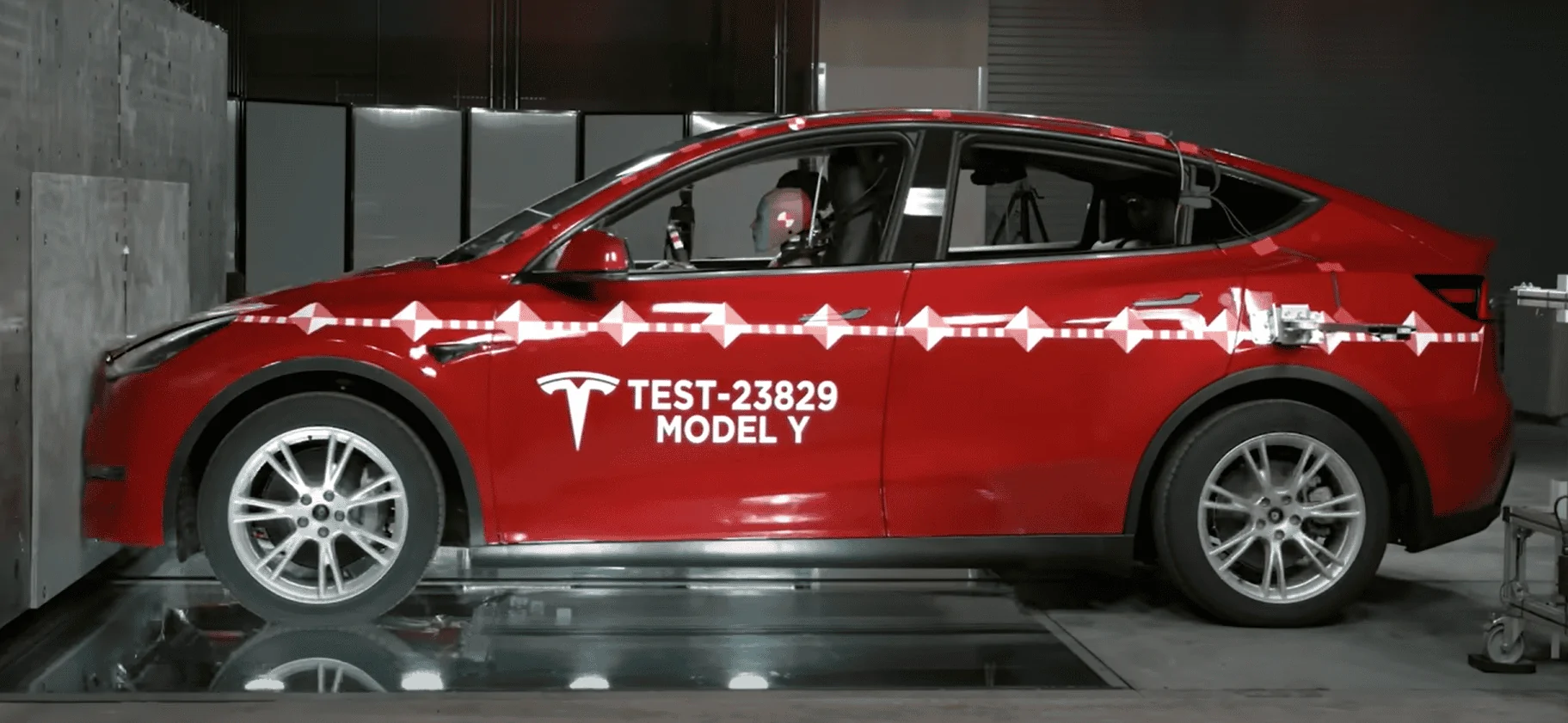
Which point about measurement by cameras actually raises something worth noting about this recent Tesla crash test video: they've made some modifications to typical crash test set-ups, probably to avoid giving away some particular data. In particular, usual practice in these tests is to use 1" checkered tape and other size-confirming indices along the planes of vehicles, in order that the video can be analyzed with a known dimension. Here's an example of the 1" checker tape that crash tests, including at Tesla, are typically employing:
Tesla Cybertruck Crash Test Video Measurements For Cybertruck Dimensions Screenshot (38)


In digging for this post, I found a few old videos from Tesla, here and here. And now with this CT crash test, those older videos are worth rewatching. They, like the CT crash test, are filmed in same Tesla Engineering's Safety Lab where the CT is filmed.

Anywho, if you watch the older videos you'll notice a few modifications made to the CT video in order to not give away certain details (e.g., no 1" checker tape), or heighten cinematography (e.g., they've darkened the run-up ramp so the CT emerges from the shadows). (Though, do remember the 1" checker tape, as it comes up later...)

Point being, though, so long as one observes the limits of perspective, and measures items only at roughly the same plane as the reference, the cameras used in these videos tend to minimize other types of distortions. And, this video has fairly good resolution for finding points from which to measure (the CT's angularity helps, too).

Accordingly, various shots from the CT crash videw allow one to find a known reference point in one photo, then in another photo use that known reference point to find a further reference point, etc. With some care, one can get a good sense of scale at worst, or even better a directional size (e.g., if something measures 40" you can be pretty sure it's not 60"), and at best a representative measurement to within ~1-2".

In what follows, I built a chain of reference points roughly as follows (a bit more went into it, and confirming measurements, but for simplicity).

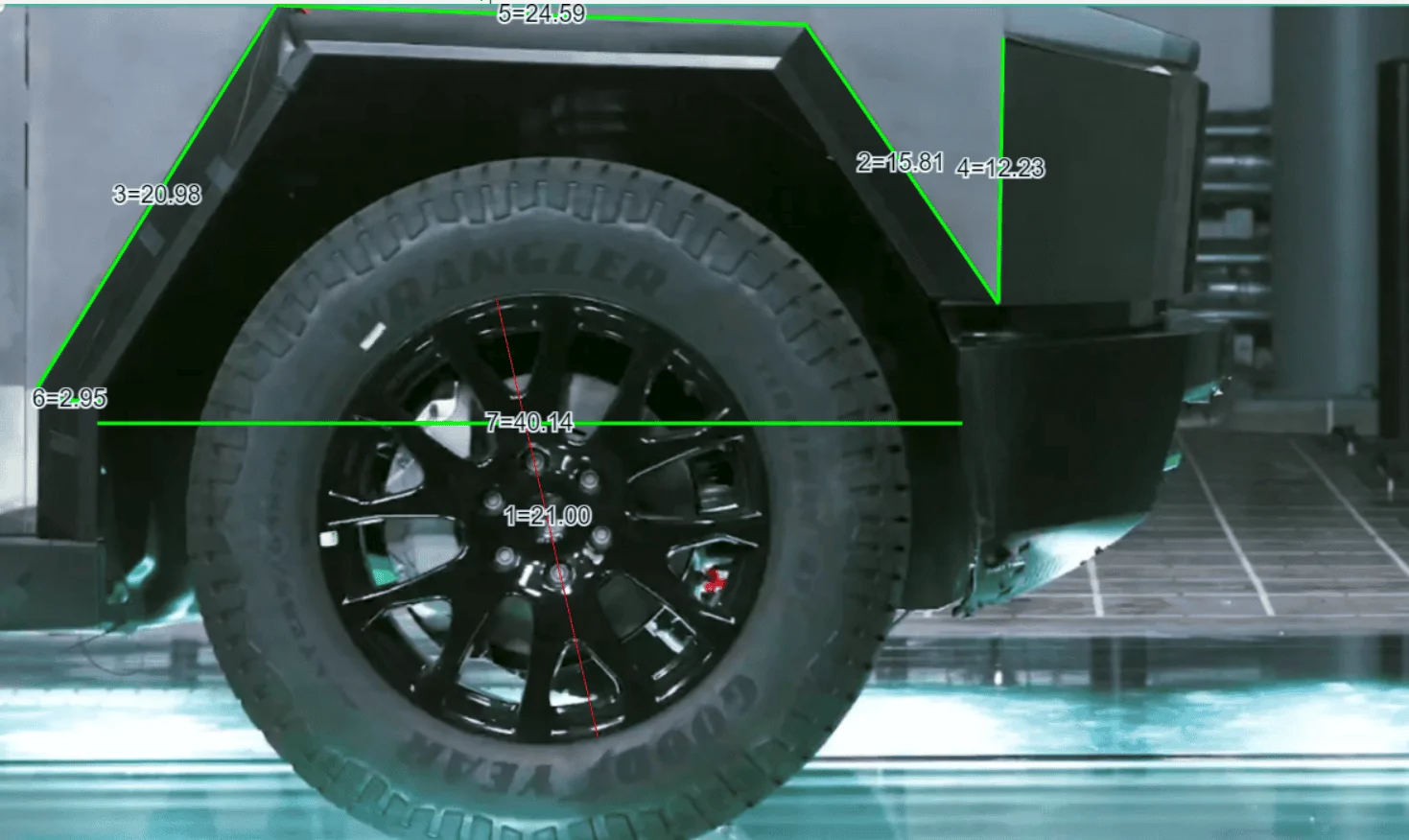
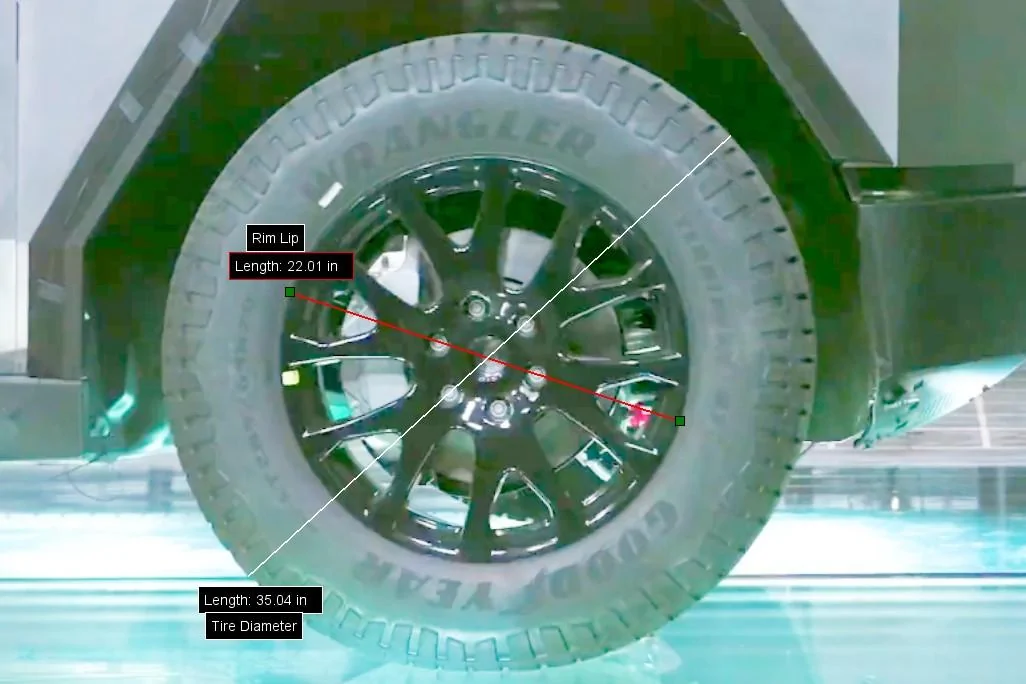
Photo A: the CT's tire sidewall shows it's on a 20" rim as reference. I wasn't certain that a 20" rim is exactly 20" at the outer lip, and through some research sure enough learned the visible outermost lip of a rim is a bit wider than the designated width of the wheel, typically by ~0.5 inches all around (the extra lip width is there for seating the tire bead, with the actual rim beginning a bit 'lower' into the rim). Accordingly, I measured the rim reference as 21" (in red):
Tesla Cybertruck Crash Test Video Measurements For Cybertruck Dimensions Passenger Wheel Measure (1)


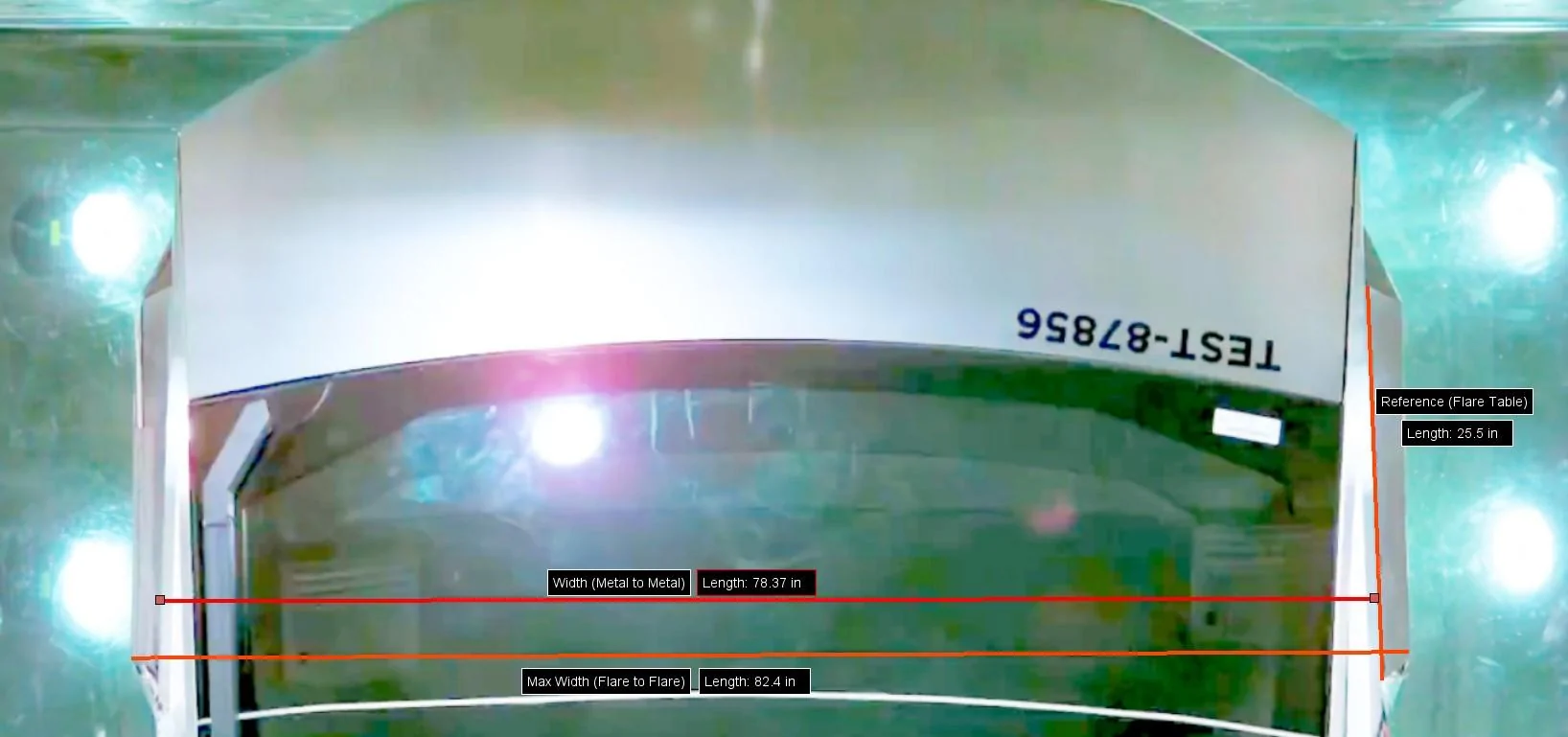
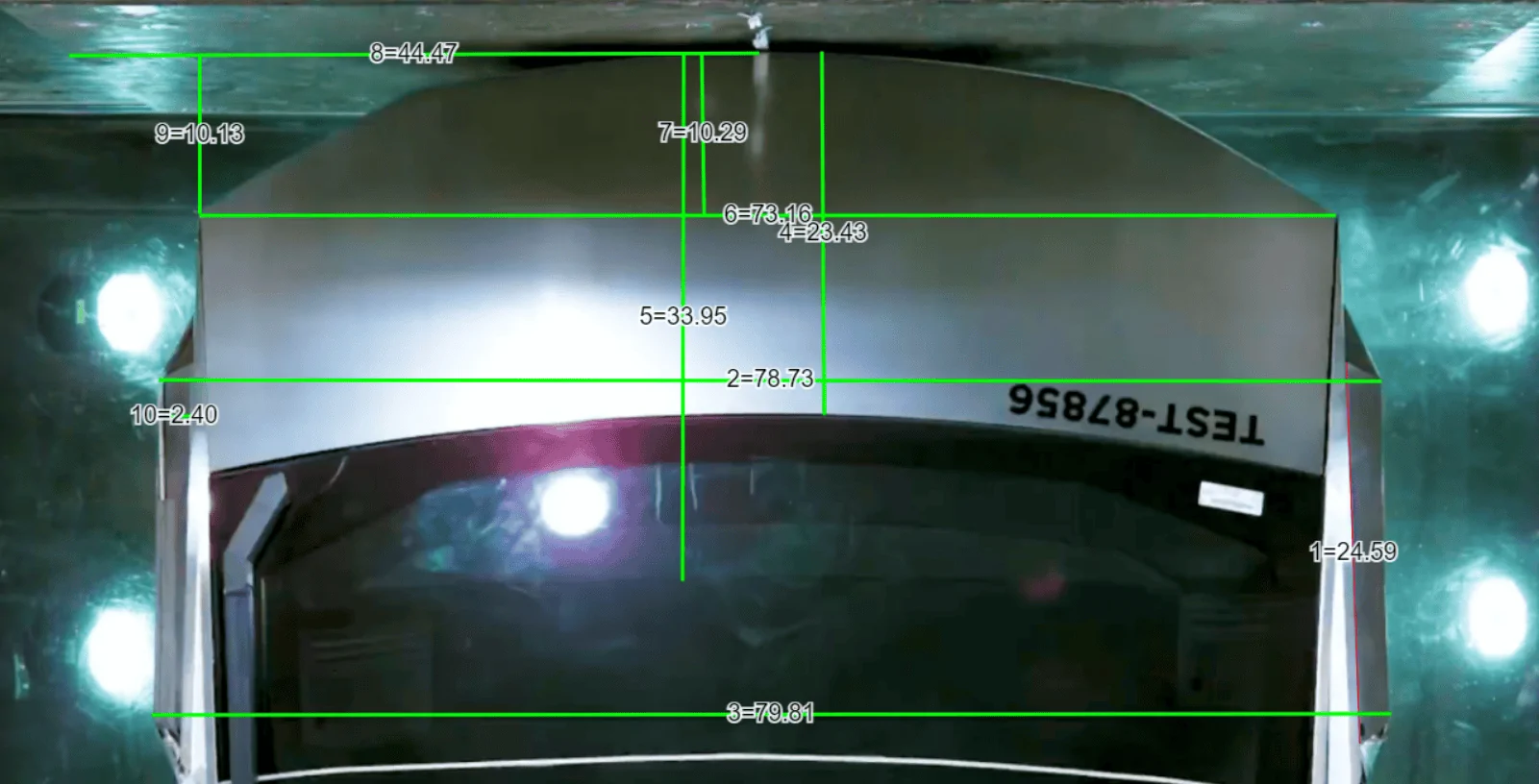
Photo B: from Photo A reference measurement 5, I used the now known upper shelf of the fender flare as a reference in the next photo (in red below) - encouragingly, it resulted in the max width point of the CT registering as 79.8", which squares both with the standard width of full-sized trucks (absent amber lights) as well as reports that the unveil prototype had "shrunk" down ~5% (from ~84" wide to ~80" wide).

While I was at the hood, I took several other measurements that would generally relate to the maximum width/depth of a frunk (not that the numbers report frunk size, but give a directional sense of the outer bounds of possibilities):
Tesla Cybertruck Crash Test Video Measurements For Cybertruck Dimensions Fender MEasure (3)


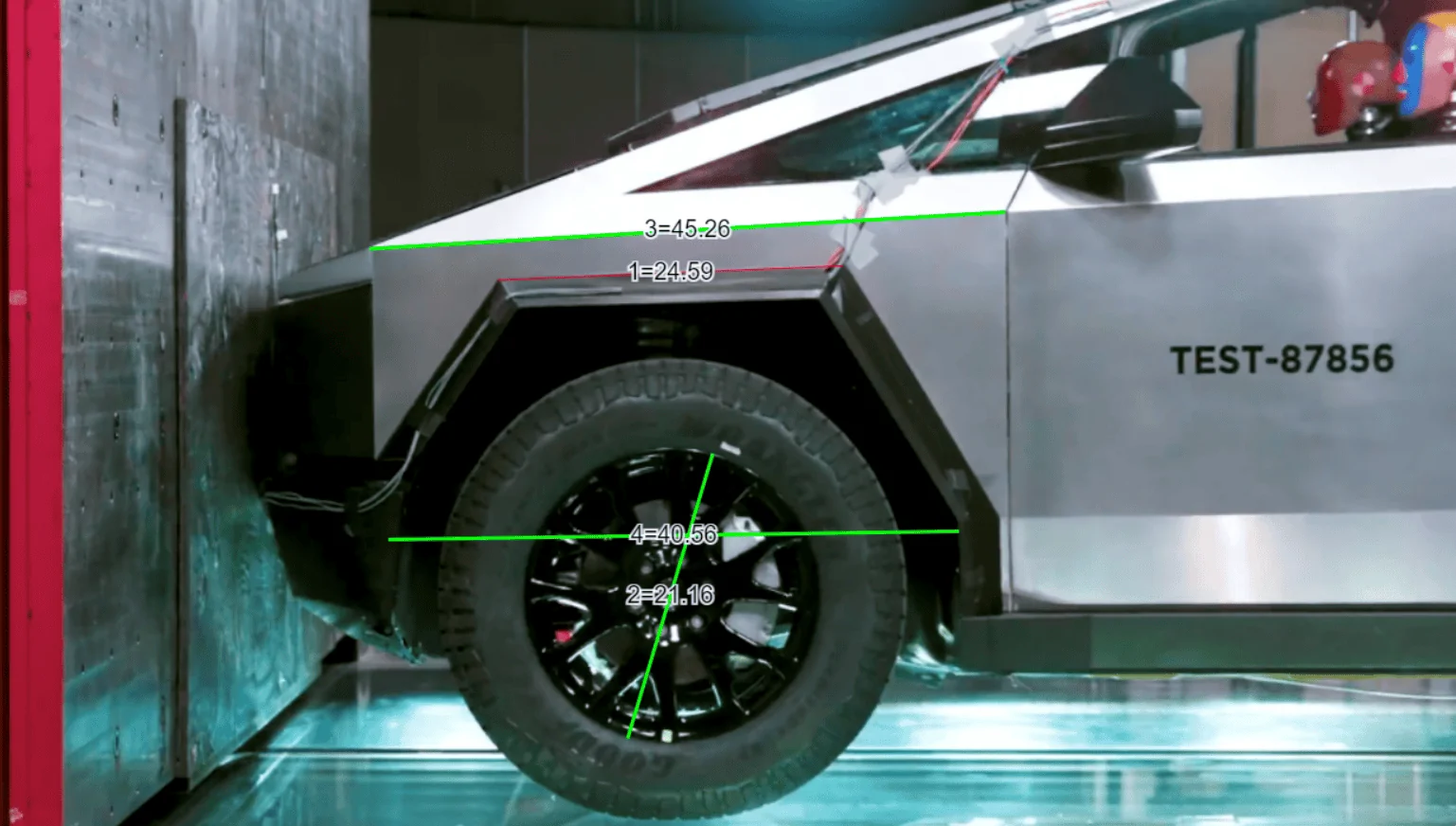
Photo C: also from Photo A reference measurement 5, I next determined the length of the waistline from the front tip of the quarter panel the door seam (measurement 3 below). I also took a few confirmatory measurements of the rim and wheel well opening (which square with Photo A's results of the same measurements):
Tesla Cybertruck Crash Test Video Measurements For Cybertruck Dimensions Driver Quarter Panel Measure (2)


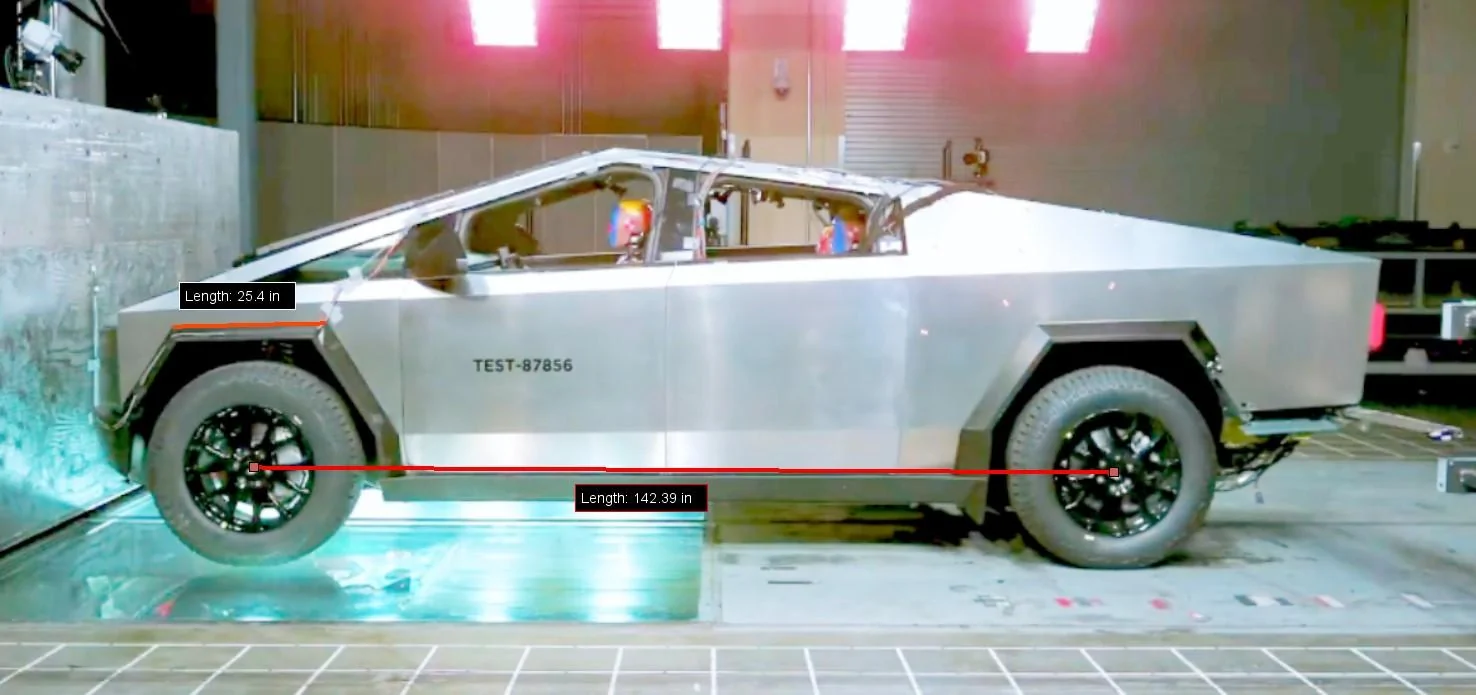
Photo D: using Photo C's reference measurement 3, I next found a rough measurement of the CT wheelbase (and a few more confirmatory measurements of the rim size). To some surprise, the wheelbase results are smaller than what was purported at unveil (149.9"); but the unveil's purported wheelbase was unusually long, besting even an F150, which would result in less-than-ideal turning radius - as F150 drivers know. Perhaps the 5% 'shrink' involves not only a 'shrink' from the unveil prototype's width, but even a ~5" shrink of the unveil purported wheelbase stats, all in the name of creating a superior performance in turning radius?

In any event, several folks have attempted to measure the length of the CT using these crash test videos, and while numbers vary not one have approached the unveil purported length of 232" - if the CT has become shorter than even the unveil stats (see Photo E below), then it would stand to reason the wheelbase as shrunk somewhat proportionally along with it.
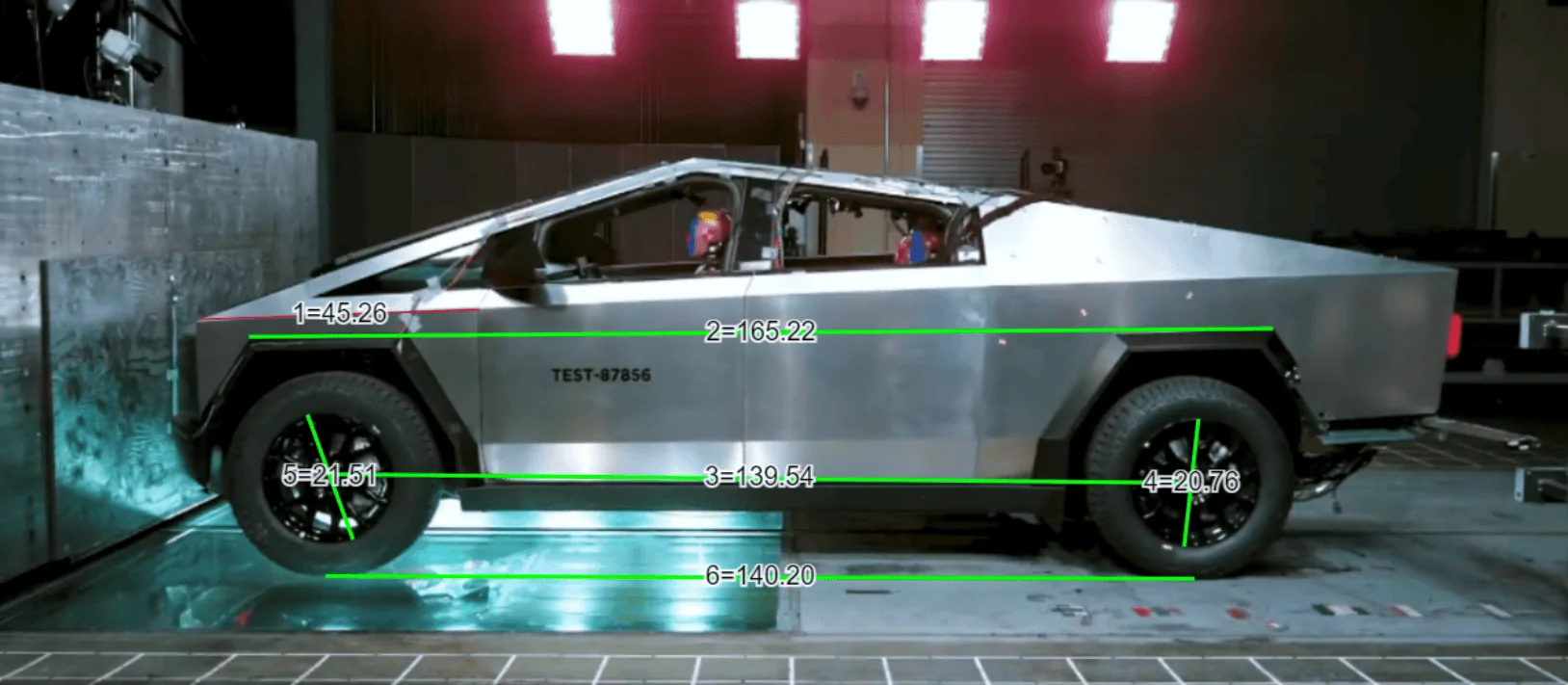
Tesla Cybertruck Crash Test Video Measurements For Cybertruck Dimensions Wheelbase Measure (4)


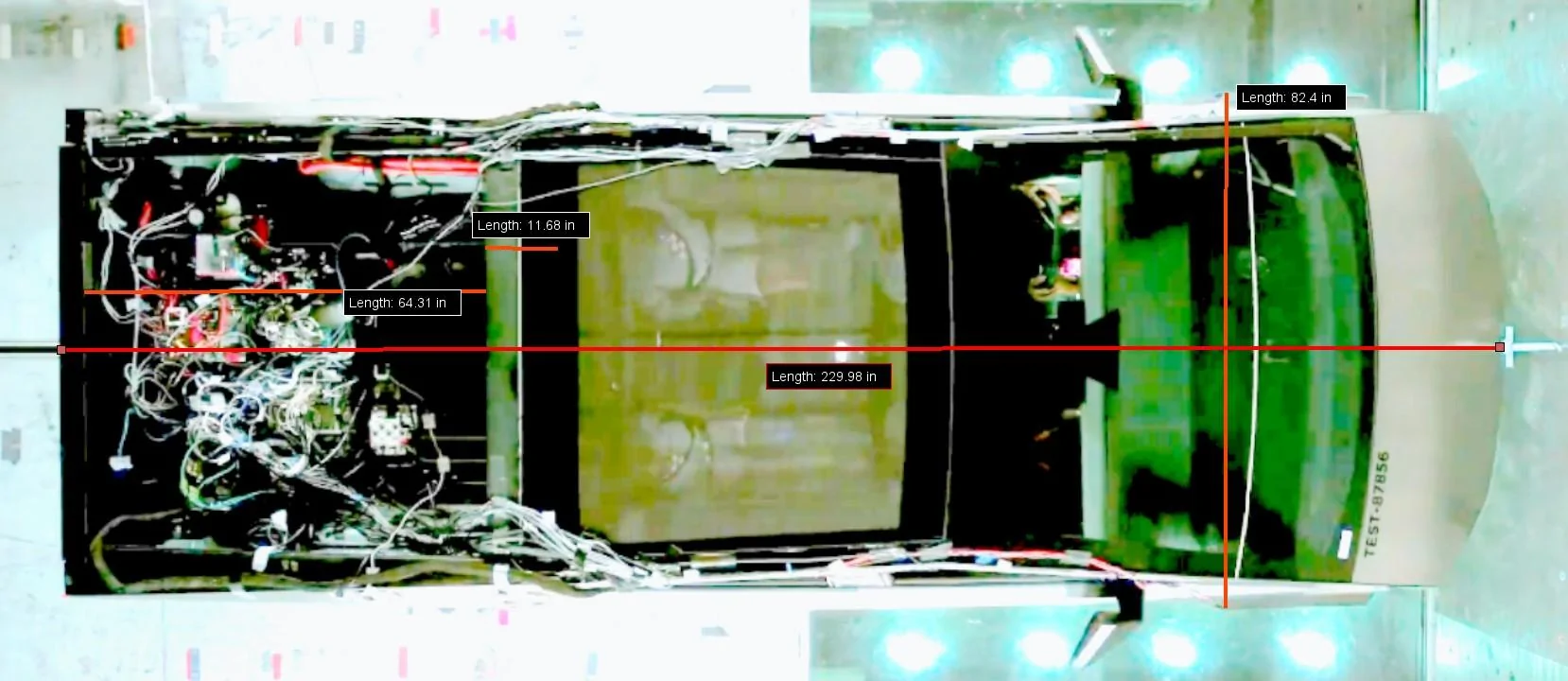
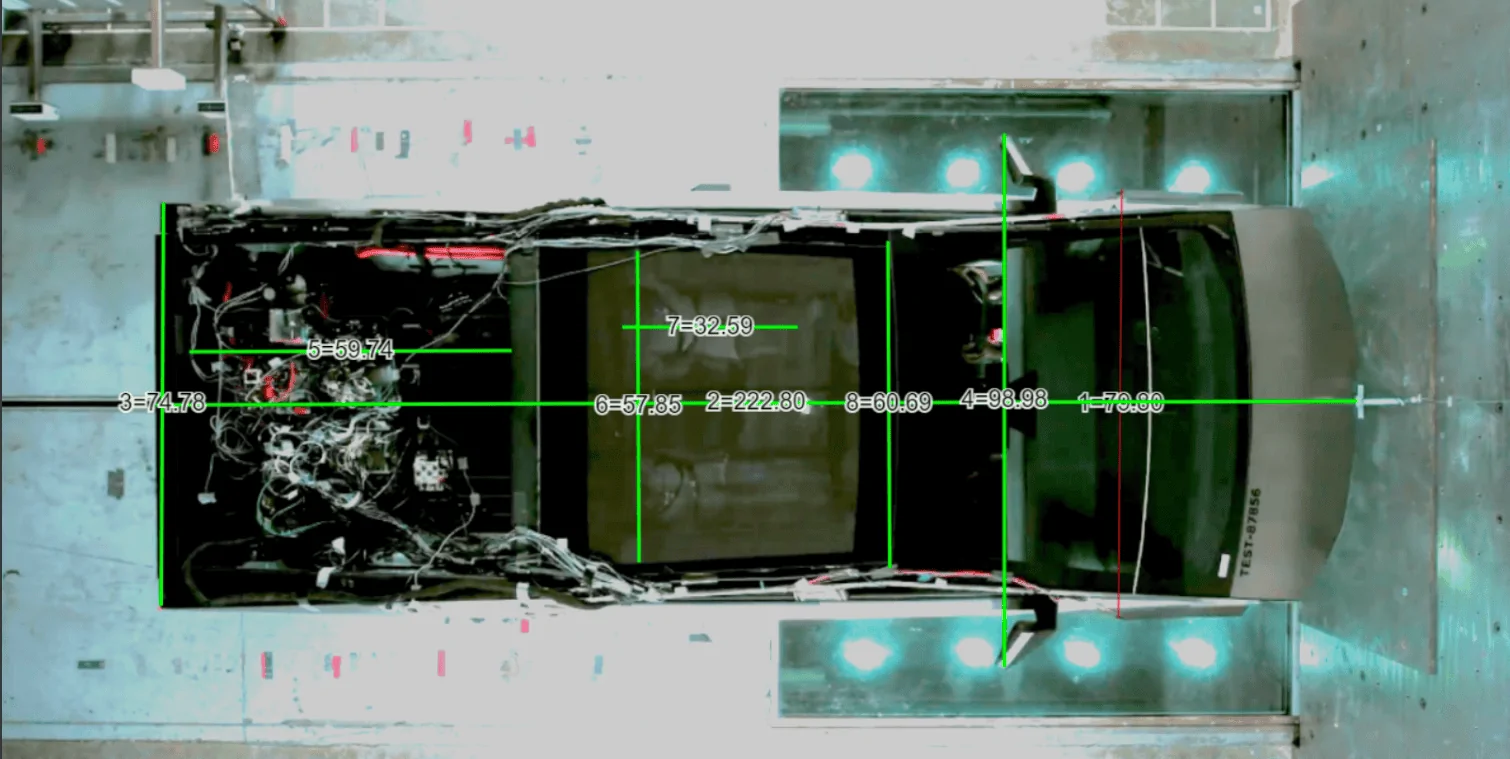
Photo E: using the Photo B (hood) reference measurement 3 for width, I next turned to the shot of the CT overhead. There's lots to see here, so after the photo I'll briefly note the measurement relevance by its number in the photo:
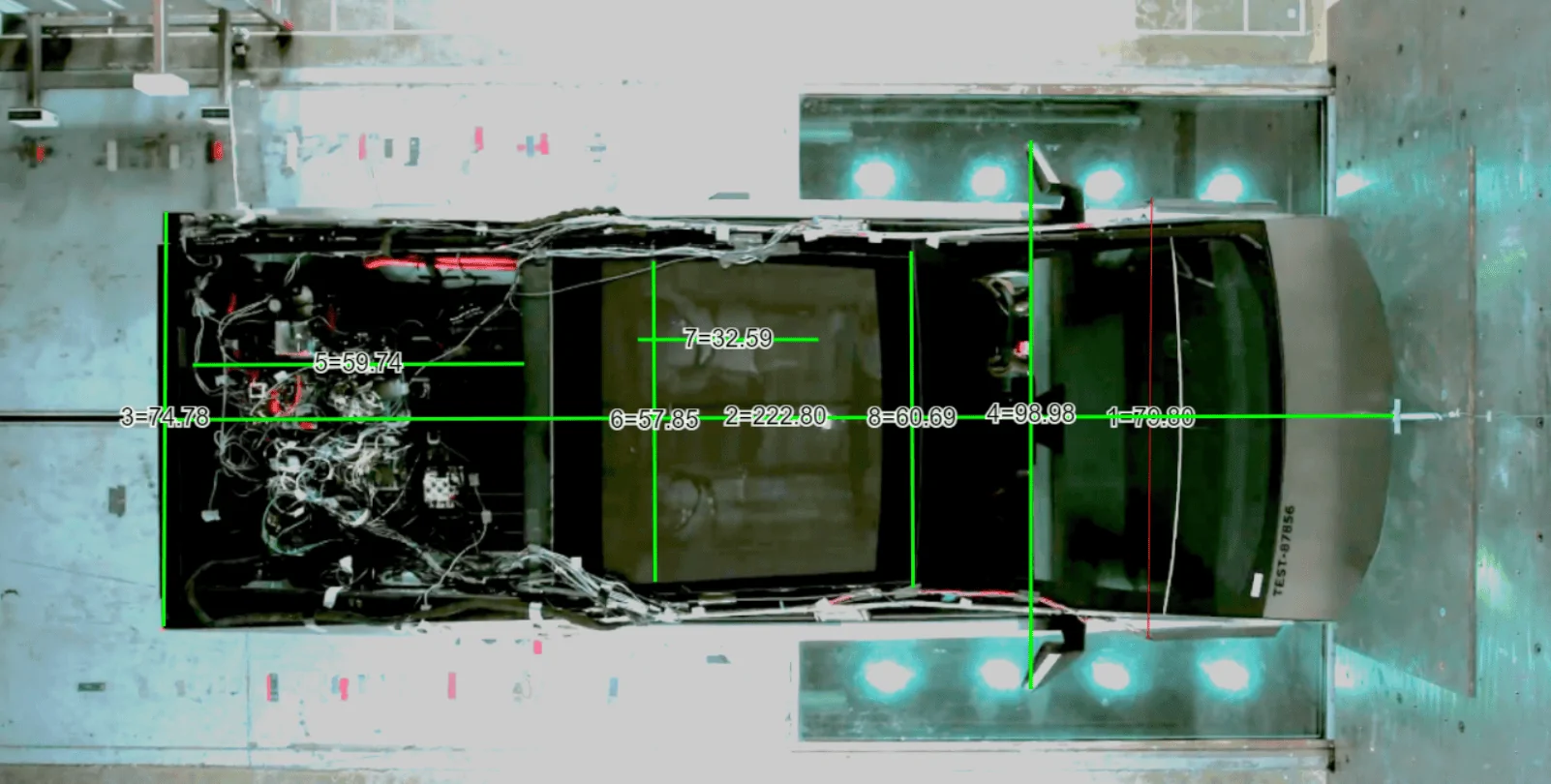
Tesla Cybertruck Crash Test Video Measurements For Cybertruck Dimensions Length Measure (5)


Photo E measurements by number above:

(1) the reference width

(2) total vehicle length of 223" (+/-1.5") (btw, for folks using the squares on the floor, perspective kills you bc the floor is a good 3-4' further away from the waistline of the CT); notably, this reduced length from unveil stats (231.7") both (A) is notionally consistent with a narrowing of the wheelbase, for proportion's sake, and (B) would make the CT that much more competitive against the size issues presented by other full-sized trucks. Specifically, at this reduced length it would fit more easily in several garages, and provide a more city-appropriate turning radius/maneuverability.

(3) width at tailgate of 75" (consistent with prior thread's estimates, and dead-on to @JBee 's contribution to that thread)

(4) width at mirrors of 99" (an F150 is 96" - and the CT's do seem a bit more... pointy)

(5) depth of bed aperture at 60" (distinct from bed floor depth, and directionally consistent with the bed floor being ~6', then closing back towards the tailgate with first the bulkhead lean, then the encroaching sill overhanging the back window)

(6) shoulder room at rear passenger of 58"

(7) leg room at rear passenger of 33"

(8) shoulder width at driver of 61"


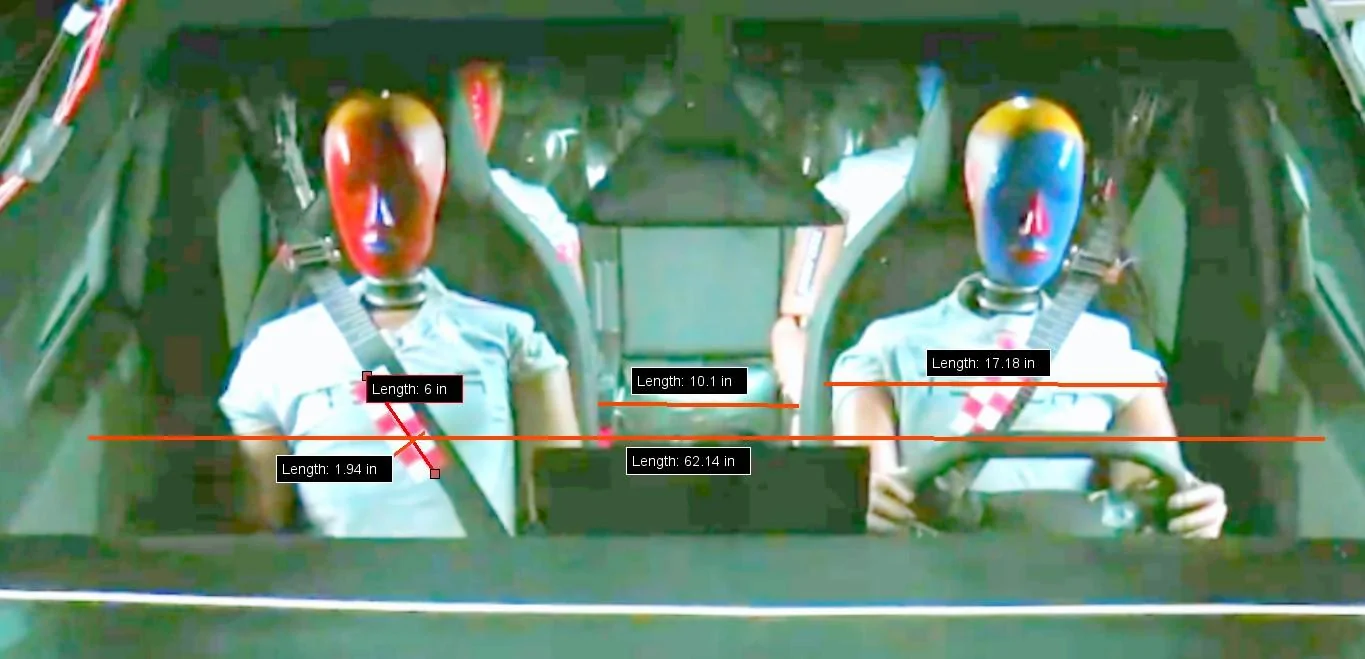
Photo F: last but not least, here's where to measure the 1" checker tape - there's one place Tesla left some on, which provided a 6" reference of size interior to the cabin (red line on passenger seat belt checker tape). I confirmed a measure with the width of the 1" checker tape on driver.

In the interior, depth/perspective play foul. That said, the width of the driver dummy (on the same plane as the checker tape) gives some relative size of the seats, and distance between seats. The shoulder room measure is particularly prone to perspective error - not to mention one cannot see to confirm the innermost narrowest portion of the door, from where the measure would generally be made; however, from the investor day video (photo further below) one can see that the crash test interior does not show the lower and further intruding arm rests. Still, the measure (3) below is directionally reasonable for the known references, and otherwise consistent also with the Photoe E(8) overhead measurement of 61."
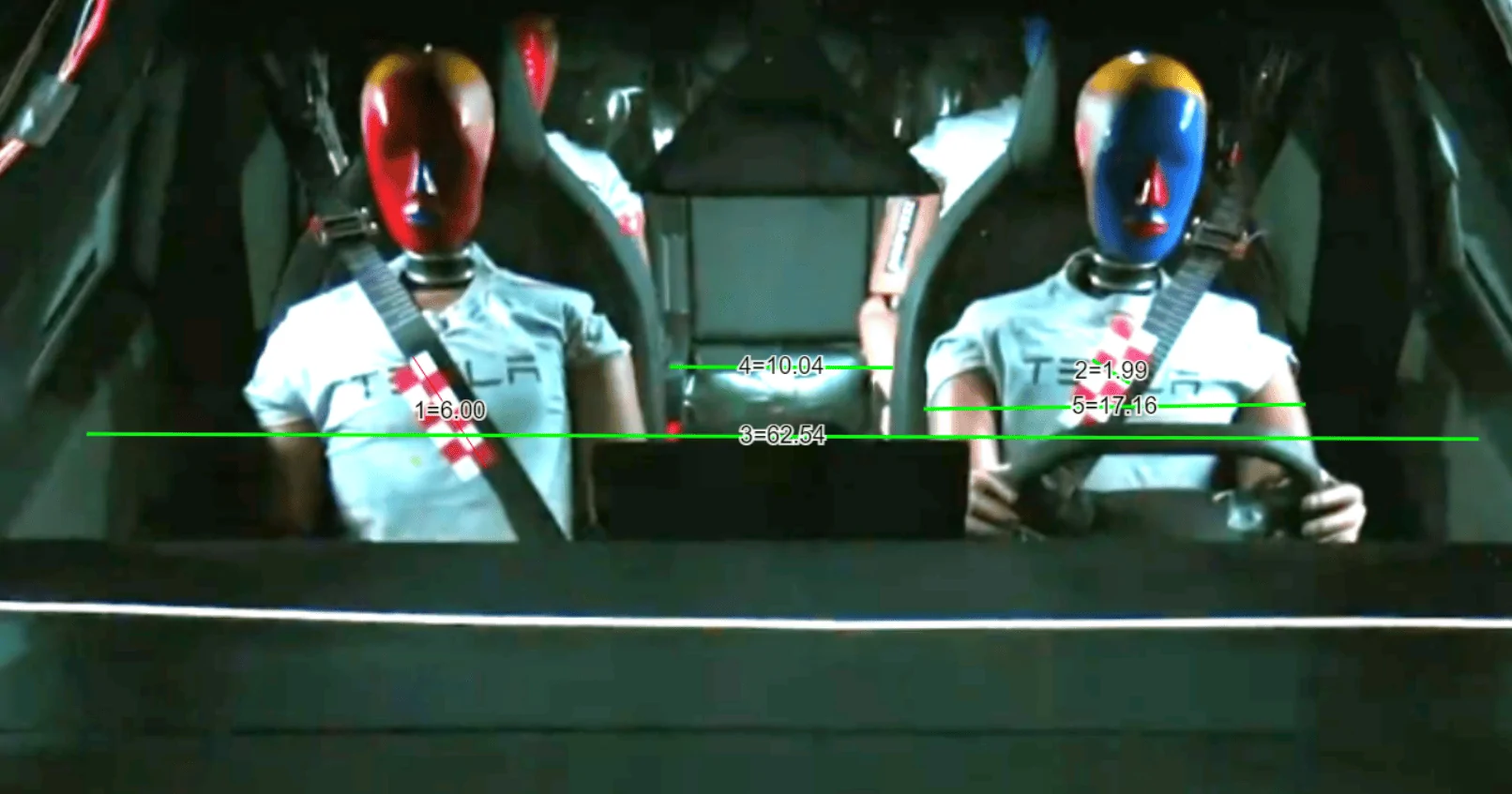
Tesla Cybertruck Crash Test Video Measurements For Cybertruck Dimensions Interior Measure (6)


Hard to believe, I know, but the info above is an only brief version accounting of the measurements and confirmatory measurements I took to do my best to ensure the attempts were about as accurate as one can manage via this method of indirect measurement.

And, if nothing else, several of these measurements put inner or outer bounds on what is reasonable to make conjectures about regarding the scale of certain depths or lengths. For example, while the passenger shoulder room measurement of 57" and rear legroom measurement of 33" are obviously prone to material inaccuracy, one might still from those measures be at least loosely skeptical that the rear shoulder room would be as wide as an F150's 66" and rear legroom of 44". Finding 10" more in each direction seems a stretch, though perhaps 5" of measurement error isn't a stretch.

Let the critiquing begin... some more thoughts tomorrow.

EDIT TO ADD SAID ‘THOUGHTS’:


Collectively, y'all two win the prize.

The CT crash prototype is nearly identical to the unveil on-screen specs.
  • wheelbase is ~142"
  • max width flare-to-flare ~82"
  • max width metal-to-metal ~78.5"
  • length nose-to-tail ~230"
the above within +/- 1-2" margin of error I'd guess

And it proves a point about the sort of conduct on this forum.

Funny thing is, the ACTUAL possible source of material error in my measurements was my stated assumption about the rim's lip height. My stated assumption of 21," if off by only 1," would distort all subsequent measurements by 4.5%. That 4.5% is the difference between an F150 and (nearly) a Tacoma.

Stepping right over that all-critical assumption, the most Kool-Aid drunk amongst us instead doggedly fought about 'lens distortions,' perspective, and even how rulers measure. (!?) They continued to do so even in the face of researched, accurate, proofed-up refutations of those myriads of armchair chirps. (I'll return later to again prove up my positions on those topics.)

Yet the actual critical and flawed stated assumption was right there in the OP:


Some 10 minutes of research could have solved it. One could have just looked at the sidewall, seen it was a 285/65/r20 (I referenced its availability just above), and so a 35" tire. Then, with 2 minutes of an online measurement tool (which I used in my OP as a breadcrumb, despite having access to measurement software), just plugged in a 35" tire reference measurement and found the rim is 22" not 21":

CT wheel close adjusted.webp


Alternatively, for those feeling short on time or uninterested in research, the flaw in the methodology could have been most quickly and effortlessly determined by any version of a single question that was both skeptical and generous to the efforts and possible expertise of others:

"I'm surprised by these results - what would you say is the biggest possible point of error in your assumptions?"

Whether being handed the answer because you asked nicely, or because you cared to spend fraction of your time actually contributing, you might have in either event gotten what your inner child was demanding: pretty damn good proof the CT exterior is near dead-on of the unveil on-screen specs.

But instead only: "you're wrong, and I can prove it by saying 'perspective'... a lot."
This is a fairly typical dynamic here. Maybe I bring it out in people. But I see others subjected to it as well. (Though they're smarter than me, and relent/stop participating sooner.) I'm also probably guilty of it at times (glances at Mr. "parasitic profiteer"). But there are some deep, repeat, offenders.

There was a silver lining to all this subterfuge: it was kind of fun. I've never had good occasion to pepper a thread with Easter Eggs. But I got to lay several such eggs while the wild goose-chases about camera technology got frothy. I once even mentioned them:


Hell, after @ÆCIII came in and nearly gave it on a silver platter (in the kindest of ways), I thought it was all over. But never underestimate the obstinance of the horde!

Which brings me to the final point: in all of those goose-chases around lens distortions, perspective, measurements, etc., my responses were all pretty dead-on accurate. None of those unexamined, uninformed, critiques explained the measurement issue in OP.

As a final proof of this, here are the actual CT exterior photo measurements which come out to nearly identical (within and still subject to margin of error) of CT unveil stats (although wheelbase appears to have been improved).

Something tells me there won't be such vehement objection to these outcomes, despite all the previously asserted (and re-asserted) assertions about perspective errors being unavoidable in photos. (And if someone still feels tempted, they should know that such perspective distortions in these photos would tend to cause the CT to be in-world larger than these measurements.)


Wheelbase Measure.webp
Hood Measure.webp
Overhead.webp


I will say, however, that for the interior photo (you might remember) I didn't use the rim as reference, but instead the checkerboard reference tape on the dummy's seat belt. The CT interior measurements still seem a bit dodgy RE potential interior space being a bit tight. Though (as admitted in OP) perspective is messy in the cabin area (given the nearness of camera and varying depths of objects of interest), so the measurements in this interior pic are more error-prone.

If there's ultimately any truth to the 5% shrinkage rumors, I'm left wondering if it could be largely related to interior dimensions?

Interior.webp
Sponsored

 
Last edited:

JBee

Well-known member
First Name
JB
Joined
Nov 22, 2019
Threads
18
Messages
4,913
Reaction score
6,362
Location
Australia
Vehicles
Cybertruck
Occupation
. Professional Hobbyist
Country flag
Since it's a bit of a deep dive, and I tomorrow have some other observations to come back for, I thought this was worth a separate thread.

Usual caveats apply RE the limitations of on-screen measurements. That said, these crash test videos are an unusual case, because such facilities generally use cameras placed in locations (and using lenses) that minimize the distorting effects - other than the distorting effects of perspective (i.e., things nearer appear larger, further away smaller, etc.) which can't really be remedied.

Which point about measurement by cameras actually raises something worth noting about this recent Tesla crash test video: they've made some modifications to typical crash test set-ups, probably to avoid giving away some particular data. In particular, usual practice in these tests is to use 1" checkered tape and other size-confirming indices along the planes of vehicles, in order that the video can be analyzed with a known dimension. Here's an example of the 1" checker tape that crash tests, including at Tesla, are typically employing:

Screenshot (38).webp


In digging for this post, I found a few old videos from Tesla, here and here. And now with this CT crash test, those older videos are worth rewatching. They, like the CT crash test, are filmed in same Tesla Engineering's Safety Lab where the CT is filmed.

Anywho, if you watch the older videos you'll notice a few modifications made to the CT video in order to not give away certain details (e.g., no 1" checker tape), or heighten cinematography (e.g., they've darkened the run-up ramp so the CT emerges from the shadows). (Though, do remember the 1" checker tape, as it comes up later...)

Point being, though, so long as one observes the limits of perspective, and measures items only at roughly the same plane as the reference, the cameras used in these videos tend to minimize other types of distortions. And, this video has fairly good resolution for finding points from which to measure (the CT's angularity helps, too).

Accordingly, various shots from the CT crash videw allow one to find a known reference point in one photo, then in another photo use that known reference point to find a further reference point, etc. With some care, one can get a good sense of scale at worst, or even better a directional size (e.g., if something measures 40" you can be pretty sure it's not 60"), and at best a representative measurement to within ~1-2".

In what follows, I built a chain of reference points roughly as follows (a bit more went into it, and confirming measurements, but for simplicity).

Photo A: the CT's tire sidewall shows it's on a 20" rim as reference. I wasn't certain that a 20" rim is exactly 20" at the outer lip, and through some research sure enough learned the visible outermost lip of a rim is a bit wider than the designated width of the wheel, typically by ~0.5 inches all around (the extra lip width is there for seating the tire bead, with the actual rim beginning a bit 'lower' into the rim). Accordingly, I measured the rim reference as 21" (in red):

Passenger Wheel Measure (1).webp


Photo B: from Photo A reference measurement 5, I used the now known upper shelf of the fender flare as a reference in the next photo (in red below) - encouragingly, it resulted in the max width point of the CT registering as 79.8", which squares both with the standard width of full-sized trucks (absent amber lights) as well as reports that the unveil prototype had "shrunk" down ~5% (from ~84" wide to ~80" wide).

While I was at the hood, I took several other measurements that would generally relate to the maximum width/depth of a frunk (not that the numbers report frunk size, but give a directional sense of the outer bounds of possibilities):

Fender MEasure (3).webp


Photo C: also from Photo A reference measurement 5, I next determined the length of the waistline from the front tip of the quarter panel the door seam (measurement 3 below). I also took a few confirmatory measurements of the rim and wheel well opening (which square with Photo A's results of the same measurements):

Driver Quarter Panel Measure (2).webp


Photo D: using Photo C's reference measurement 3, I next found a rough measurement of the CT wheelbase (and a few more confirmatory measurements of the rim size). To some surprise, the wheelbase results are smaller than what was purported at unveil (149.9"); but the unveil's purported wheelbase was unusually long, besting even an F150, which would result in less-than-ideal turning radius - as F150 drivers know. Perhaps the 5% 'shrink' involves not only a 'shrink' from the unveil prototype's width, but even a ~5" shrink of the unveil purported wheelbase stats, all in the name of creating a superior performance in turning radius?

In any event, several folks have attempted to measure the length of the CT using these crash test videos, and while numbers vary not one have approached the unveil purported length of 232" - if the CT has become shorter than even the unveil stats (see Photo E below), then it would stand to reason the wheelbase as shrunk somewhat proportionally along with it.

Wheelbase Measure (4).webp


Photo E: using the Photo B (hood) reference measurement 3 for width, I next turned to the shot of the CT overhead. There's lots to see here, so after the photo I'll briefly note the measurement relevance by its number in the photo:

Length Measure (5).webp


Photo E measurements by number above:

(1) the reference width

(2) total vehicle length of 223" (+/-1.5") (btw, for folks using the squares on the floor, perspective kills you bc the floor is a good 3-4' further away from the waistline of the CT); notably, this reduced length from unveil stats (231.7") both (A) is notionally consistent with a narrowing of the wheelbase, for proportion's sake, and (B) would make the CT that much more competitive against the size issues presented by other full-sized trucks. Specifically, at this reduced length it would fit more easily in several garages, and provide a more city-appropriate turning radius/maneuverability.

(3) width at tailgate of 75" (consistent with prior thread's estimates, and dead-on to @JBee 's contribution to that thread)

(4) width at mirrors of 99" (an F150 is 96" - and the CT's do seem a bit more... pointy)

(5) depth of bed aperture at 60" (distinct from bed floor depth, and directionally consistent with the bed floor being ~6', then closing back towards the tailgate with first the bulkhead lean, then the encroaching sill overhanging the back window)

(6) shoulder room at rear passenger of 58"

(7) leg room at rear passenger of 33"

(8) shoulder width at driver of 61"


Photo F: last but not least, here's where to measure the 1" checker tape - there's one place Tesla left some on, which provided a 6" reference of size interior to the cabin (red line on passenger seat belt checker tape). I confirmed a measure with the width of the 1" checker tape on driver.

In the interior, depth/perspective play foul. That said, the width of the driver dummy (on the same plane as the checker tape) gives some relative size of the seats, and distance between seats. The shoulder room measure is particularly prone to perspective error - not to mention one cannot see to confirm the innermost narrowest portion of the door, from where the measure would generally be made; however, from the investor day video (photo further below) one can see that the crash test interior does not show the lower and further intruding arm rests. Still, the measure (3) below is directionally reasonable for the known references, and otherwise consistent also with the Photoe E(8) overhead measurement of 61."

Interior Measure (6).webp


Hard to believe, I know, but the info above is an only brief version accounting of the measurements and confirmatory measurements I took to do my best to ensure the attempts were about as accurate as one can manage via this method of indirect measurement.

And, if nothing else, several of these measurements put inner or outer bounds on what is reasonable to make conjectures about regarding the scale of certain depths or lengths. For example, while the passenger shoulder room measurement of 57" and rear legroom measurement of 33" are obviously prone to material inaccuracy, one might still from those measures be at least loosely skeptical that the rear shoulder room would be as wide as an F150's 66" and rear legroom of 44". Finding 10" more in each direction seems a stretch, though perhaps 5" of measurement error isn't a stretch.

Let the critiquing begin... some more thoughts tomorrow.
If your green lines are the length mentioned, then I think your measurements of the front and rear seat shoulder width are not quite long enough. This is because the shoulder width is lower down on the CT body than the roof line where it was measured. If you have 62" wide in the front seat from the inside photo, then I would expect the rear seat width to be very similar, as there is only a small curvature in the outside length of the CT in the overhead shot, with the CT being thickest in the area of the rear doors. Although it seems the rear passengers are sitting more inwards, we can't really tell where the doors start. Overall the dummies look very slender, there isn't a full size man, with some shoulders, in there :)

Otherwise though, I think the overall dimensions are within 3-5" of what it is. I was always curious on just how much they could shorten the the overall length, whilst keeping the bed floor length and cabin interior viable.
 
OP
OP
cvalue13

cvalue13

Well-known member
Joined
Aug 17, 2022
Threads
74
Messages
7,153
Reaction score
13,769
Location
Austin, TX
Vehicles
F150L
Occupation
Fun-employed
Country flag
If your green lines are the length mentioned, then I think your measurements of the front and rear seat shoulder width are not quite long enough. This is because the shoulder width is lower down on the CT body than the roof line where it was measured. If you have 62" wide in the front seat from the inside photo, then I would expect the rear seat width to be very similar, as there is only a small curvature in the outside length of the CT in the overhead shot, with the CT being thickest in the area of the rear doors. Although it seems the rear passengers are sitting more inwards, we can't really tell where the doors start. Overall the dummies look very slender, there isn't a full size man, with some shoulders, in there :)
If the CT manages to have equidistant front and rear shoulder room, it will the first of its kind in the class far as I’m aware. I don’t understand anything about the CT’s design that distinct from other vehicles in this regard.

I believe the widths are more accurate than 5” error, lest you’re suggesting the CT width is somewhere between 85” and 75” wide? Or are you suggesting it’s between 82.5” and 77.5”?

but you’re correct they’ve appeared to use only the female (and one child) versions of the (I’m pretty sure) “Hybrid III” model of crash test dummy. If so, those dummies are 4’11” tall. rather narrow or width, as well. Perhaps another alteration for purposes of filming a test they knew may be released
 

JBee

Well-known member
First Name
JB
Joined
Nov 22, 2019
Threads
18
Messages
4,913
Reaction score
6,362
Location
Australia
Vehicles
Cybertruck
Occupation
. Professional Hobbyist
Country flag
If the CT manages to have equidistant front and rear shoulder room, it will the first of its kind in the class far as I’m aware. I don’t understand anything about the CT’s design that distinct from other vehicles in this regard.

I believe the widths are more accurate than 5” error, lest you’re suggesting the CT width is somewhere between 85” and 75” wide? Or are you suggesting it’s between 82.5” and 77.5”?

but you’re correct they’ve appeared to use only the female (and one child) versions of the (I’m pretty sure) “Hybrid III” model of crash test dummy. If so, those dummies are 4’11” tall. rather narrow or width, as well. Perhaps another alteration for purposes of filming a test they knew may be released
I was thinking cm not inches. So 1-2" either way. All in all close enough to get an idea of dimensions in any case.


TheLastStarfighter

Well-known member
Joined
Jul 6, 2020
Threads
9
Messages
1,660
Reaction score
4,307
Location
Canada
Vehicles
Dodge Challenger, Tesla Model 3
Occupation
Industrial Engineer
Country flag
Because of depth, I think your estimates are off a bit. It's a little bigger than you are calculating.
 
OP
OP
cvalue13

cvalue13

Well-known member
Joined
Aug 17, 2022
Threads
74
Messages
7,153
Reaction score
13,769
Location
Austin, TX
Vehicles
F150L
Occupation
Fun-employed
Country flag
Because of depth, I think your estimates are off a bit. It's a little bigger than you are calculating.
what problematic depth problem, exactly, are you referencing?

I was very careful to utilize objects that were maximum within a few inches of each other in terms of depth of field, e.g.:

• the 20” wheel height is ~identical in from camera as the top shelf of the fender flare (Photo A)

• the the top shelf of the left fender flare is ~identical in depth from camera as the left fender flare (Photo B)

• the top shelf of the fender flare is ~identical in depth from camera as the quarterpanel’s waistline (Photo C)

• the quarterpanel’s waistline is ~identical in depth from camera as the outermost edge of the wheels (Photo D)

• for Photo E, the the topmost width height of the front fender flare is ~identical to the depth from camera as the front quarterpanel’s waistline; as for how the waistline (and so top of tailgate) rises toward the camera compared to the frontmost waistline, this may cause some minor distortion - but by being closer to the camera (and angled outward from the bumper), which if anything would make the on-screen measurement longer than physical

the other distances measured in Photo E are all similarly taken as from the relative height it the upper shelf of the fender flares, or nearer the camera, again if anything disorienting in favor of the measurements erroring larger than reality

none of this explanation is to say the measurements don’t have some inherent margin of error as I laid out before; nor is it to state with 100% certainty I haven’t made some material mistake I’m not appreciating.

But when you say I haven’t somehow accounted for depth from camera, I’m not following where you might be meaning.

Conversely, those others who have for example attempted to use the square pattern on the floor from overhead are most definitely erroring in depth in favor of miss-measuring the CT to be too large, as the floor is at least 3.5-4.5” further from camera than the upper visible edges of the CT. (Not to mention there’s merely a sort of educated guess that the squares are any standard size - reasonable, but a bit shaky.)
 
OP
OP
cvalue13

cvalue13

Well-known member
Joined
Aug 17, 2022
Threads
74
Messages
7,153
Reaction score
13,769
Location
Austin, TX
Vehicles
F150L
Occupation
Fun-employed
Country flag
I was thinking cm not inches. So 1-2" either way. All in all close enough to get an idea of dimensions in any case.
ah ok - since I’d stated 1-2” error, when you said 5 I thought it was a correction rather than agreement
 

TheLastStarfighter

Well-known member
Joined
Jul 6, 2020
Threads
9
Messages
1,660
Reaction score
4,307
Location
Canada
Vehicles
Dodge Challenger, Tesla Model 3
Occupation
Industrial Engineer
Country flag
what problematic depth problem, exactly, are you referencing?

I was very careful to utilize objects that were maximum within a few inches of each other in terms of depth of field, e.g.:

• the 20” wheel height is ~identical in from camera as the top shelf of the fender flare (Photo A)

• the the top shelf of the left fender flare is ~identical in depth from camera as the left fender flare (Photo B)

• the top shelf of the fender flare is ~identical in depth from camera as the quarterpanel’s waistline (Photo C)

• the quarterpanel’s waistline is ~identical in depth from camera as the outermost edge of the wheels (Photo D)

• for Photo E, the the topmost width height of the front fender flare is ~identical to the depth from camera as the front quarterpanel’s waistline; as for how the waistline (and so top of tailgate) rises toward the camera compared to the frontmost waistline, this may cause some minor distortion - but by being closer to the camera (and angled outward from the bumper), which if anything would make the on-screen measurement longer than physical

the other distances measured in Photo E are all similarly taken as from the relative height it the upper shelf of the fender flares, or nearer the camera, again if anything disorienting in favor of the measurements erroring larger than reality

none of this explanation is to say the measurements don’t have some inherent margin of error as I laid out before; nor is it to state with 100% certainty I haven’t made some material mistake I’m not appreciating.

But when you say I haven’t somehow accounted for depth from camera, I’m not following where you might be meaning.

Conversely, those others who have for example attempted to use the square pattern on the floor from overhead are most definitely erroring in depth in favor of miss-measuring the CT to be too large, as the floor is at least 3.5-4.5” further from camera than the upper visible edges of the CT. (Not to mention there’s merely a sort of educated guess that the squares are any standard size - reasonable, but a bit shaky.)
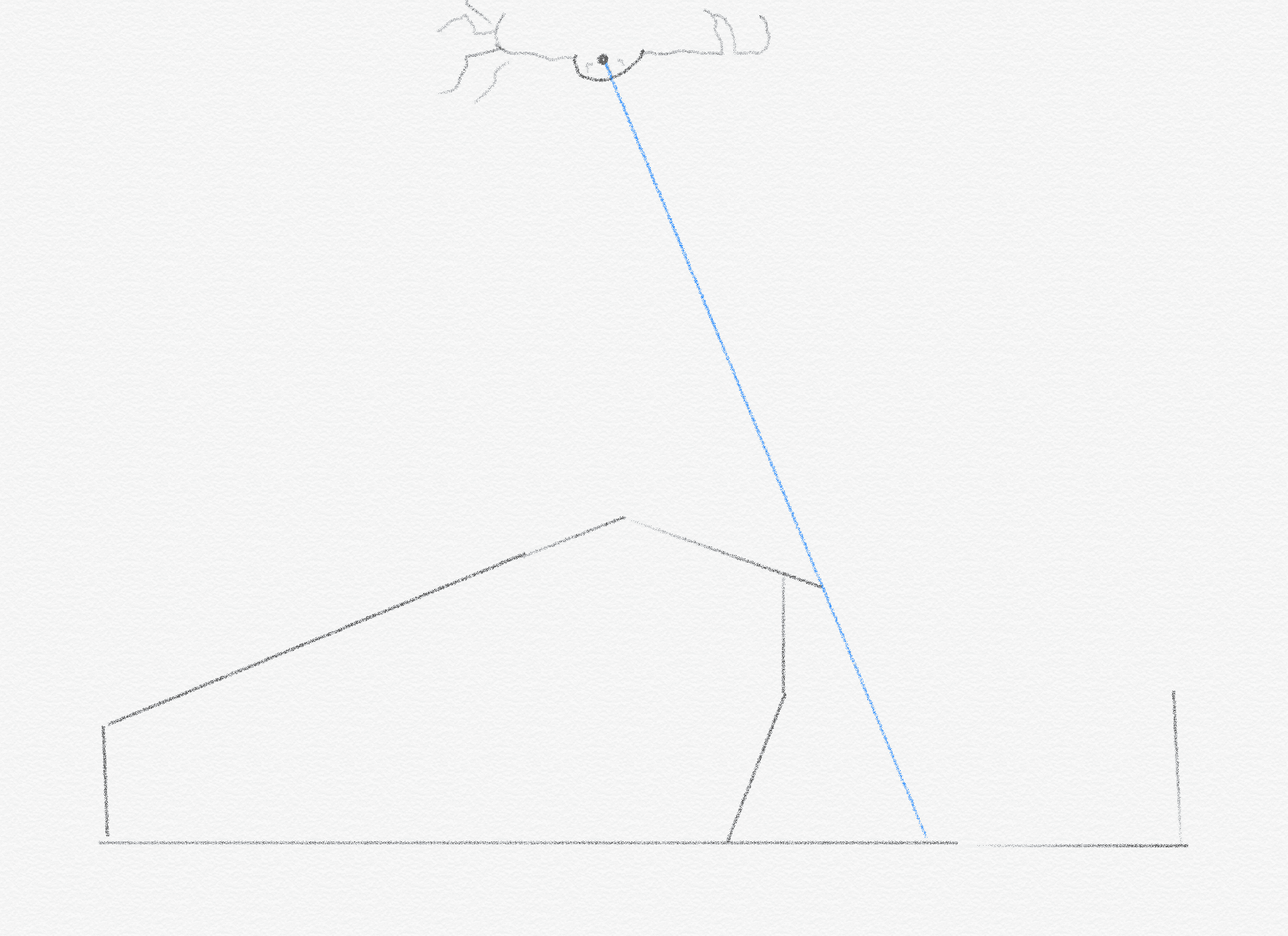
What you've done there is 5 is close to 6. And 6 is close to 7. Which is close to 8 and then 9. So 5=10. Each step adds error. We don't know where the camera is centered, and we DO know somethings are closer to the camera than others. The most extreme example being the peak of the roof, which would be several feet closer to the camera than the wheel arches in photo E. If you look at it from the front, the peak looks tiny in width compared to the widest point. If this picture was from the wheel level, the effect would be even more dramatic.

Tesla Cybertruck Crash Test Video Measurements For Cybertruck Dimensions CTFront
 
OP
OP
cvalue13

cvalue13

Well-known member
Joined
Aug 17, 2022
Threads
74
Messages
7,153
Reaction score
13,769
Location
Austin, TX
Vehicles
F150L
Occupation
Fun-employed
Country flag
The most extreme example being the peak of the roof, which would be several feet closer to the camera than the wheel arches in photo E.
which is why I never measured the peak.

I can only think you’re referencing the measurements that overlap the top of the truck in the overhead photo. But those measurements are not relevant to the top of the truck. I measured items that happened to overlap the peak, but was measuring relative to about shoulder height within the cabin - i.e., the midline


What you've done there is 5 is close to 6. And 6 is close to 7. Which is close to 8 and then 9. So 5=10. Each step adds error.
This is a misunderstanding of the methodology, I think. At bottom, the only relevant reference is the wheel diameter. If that reference is wrong, then all subsequent measures are wrong.

In subsequent photos, whatever the Photo-relevant reference may have been, I also performed confirmatory measurements that relate back to the base wheel diameter reference. For example. Check for example Photo C. The photo-relevant reference is the upper fender flare, as determined in Photo A. But having made that photo-relevant reference, I separately made confirmatory measurements of eg the wheel well again - which measured to within 0.16” of the original reference photo of the wheel.

I made multiple other, similar, confirmatory cross-reference measurements for each such photo - but I did not include them all in the photos I provided above - for clarity in the post.

Which I attempted to signal clearly in the OP when stating things such as:
the info above is an only brief version accounting of the measurements and confirmatory measurements I took to do my best to ensure the attempts were about as accurate as one can manage via this method of indirect measurement.
I suppose it’s worth also reiterating that the OP post is similarly littered with descriptions of both (a) the likely margins of direct errors per measurement, and (b) the fact that if nothing else the measures in even the far worst of unexpected error cases will still nonetheless accurately describe relative sizes and reasonable bounds. As an esteemed example of this directionality, for cartoon-like simplicity:

Absent even an accurate in-photo reference measurement, the following observations are nonetheless true:

• if we want to make some assumptions around the 5% shrinkage information from Elon and others, and for exploration’s sake assume the max width is 80,” then the on-screen measuring tool provides a near perfect ability to determine relative size. Specifically, the overhead measurement photo above if taken to merely assume an overhead width of ~80, then the length measurement is accurate but for margin of error from either (A) depth of field deltas, or (B) improper selection of endpoints. (But I’m this example as I’ve explained, depth of field would cause errors only if making the CT appear larger than it really is, not smaller)

• second and less impressively perhaps, regardless of depth of field or point selection errors, the measurements provide bounds of reasonable inference. For example, and again making extreme/cartoon simplicity, if the on-screen measurements report 223” long, we can be pretty damn sure it’s not 260” long nor 100” long. The actual bounds of reason allow for some far narrower directional inference than that wild example.

All in all, we’ll just happily and easily disagree that methodology was so flawed as to create compounding, game of telephone, errors between Photos A -F (if only because that’s also not how I built the references, nor did I leave the errors unchecked from cross-confirmation).

Even with that agreement to disagree, the above relative scaling inferences, and the directional bounds of reason inferences, still both stand on their own.


We don't know where the camera is centered
On this I’ll reiterate that I covered this in the lead-in: the camera’s being used and the angles being utilized I assume (quite reasonably and with lots of confidence) are the cameras Tesla uses for the crash tests: accordingly, that’s why at the moment impact the cameras are optimized for scales and distortions other than perspective, vehicle centered. This reduces the possibility for margins of photo distortion errors to very little - and amounts to the roughly 1-2” margin of error I built in (after taking 3X measures per key measure to average out the possibility of point-selection errors).

I thought about this a lot. Which of course doesn’t delete the possibility of being errored, but does justify perhaps some generous dialogue in the form of questions that explore a particular line of skepticism, rather preemptively conclusive assertions of error absent any inquiry.


Deleted member 17810

Guest
What you've done there is 5 is close to 6. And 6 is close to 7. Which is close to 8 and then 9. So 5=10. Each step adds error. We don't know where the camera is centered, and we DO know somethings are closer to the camera than others. The most extreme example being the peak of the roof, which would be several feet closer to the camera than the wheel arches in photo E. If you look at it from the front, the peak looks tiny in width compared to the widest point. If this picture was from the wheel level, the effect would be even more dramatic.

CTFront.jpg
Everything OP measures is in-plane.

What you're measuring is not.

perspective, how does it?
 

Ogre

Well-known member
First Name
Dennis
Joined
Jul 3, 2021
Threads
166
Messages
10,735
Reaction score
27,050
Location
Ogregon
Vehicles
Model Y
Country flag
Tesla Cybertruck Crash Test Video Measurements For Cybertruck Dimensions 1680467871992


The side view picture this is less a problem, but this top down view is not going to get accurate numbers. Most of these numbers are likely wrong due to the angles involved. This freakish monstrosity illustrates why.

Your measurements work fine on a flat surface, but as soon as you are looking at 3d objects with different layers, they get off-kilter rather quickly. Particularly with the Cybertruck’s weird angles.

Tesla Cybertruck Crash Test Video Measurements For Cybertruck Dimensions 1680468244212
 

ÆCIII

Well-known member
Joined
Apr 27, 2020
Threads
10
Messages
1,251
Reaction score
3,023
Location
USA
Vehicles
Model 3
Country flag
You did a lot of awesome work.

I wish we knew the exact dimensions of the six-lug pattern (a lot of them are a 139.7mm or 5.5 inch circle), because we could then use that to help collaborate your rim outer lip diameter measurement to be more certain.

Your rim diameter of 21" is likely accurate or pretty close, but if we could know the lug pattern was indeed 5.5", this might suggest a 21.5" rim or maybe a larger lip for the tire bead, maybe 5/8" or even 3/4". But you might already have more information on that, as I was thinking for such a larger size tire the lip for the tire bead might be slightly more than a half inch.

Of course a very slight size increase of the rim would indeed make the whole CT bigger with the scaled measurements, and I'm Ok with that. Again, awesome work.

- ÆCIII


Top