Sponsored
OP
OP
cvalue13

cvalue13

Well-known member
Joined
Aug 17, 2022
Threads
74
Messages
7,153
Reaction score
13,769
Location
Austin, TX
Vehicles
F150L
Occupation
Fun-employed
Country flag
It's not "in-plane" though. Close, but the estimate will be a bit off.
Describe your issue.

Take Photo A for example. Maximum the near the plane of the wheel rim is within an 1” or 2” from the where the fender flare is measured junction with the quarterpanel:
Tesla Cybertruck Crash Test Video Measurements For Cybertruck Dimensions D9760569-CFAD-4434-AD36-37E701DD9AF3


Meanwhile, the distortions of depth on perspective are relative by the distance the camera is from the objects being captured. The further the camera from the subject (relative to the distance between two objects in the photo being compared, the less discernible any distortion of depth).

The camera rigs for these tests are place well out out of way of debris - at least 20’ back
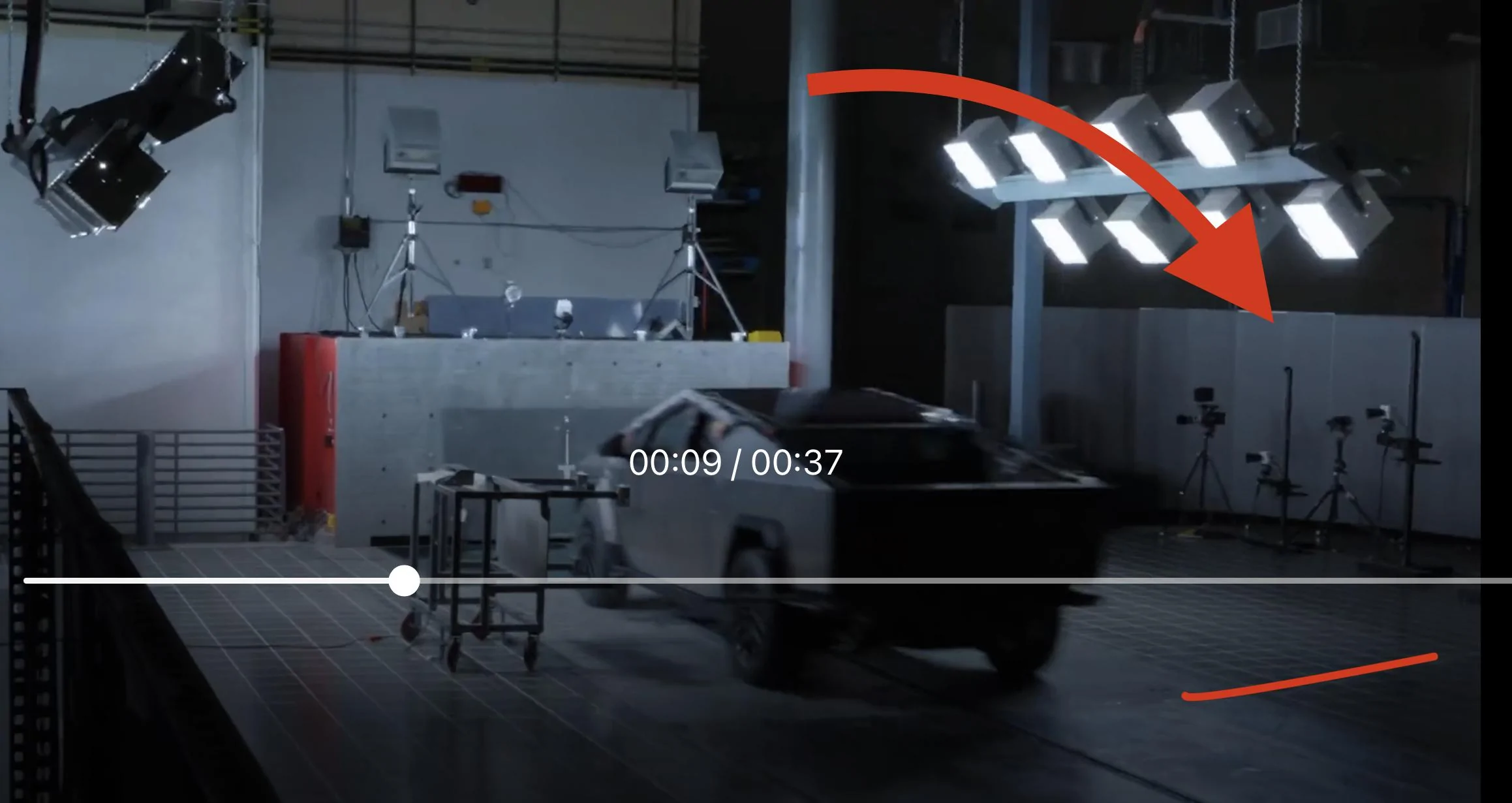
Tesla Cybertruck Crash Test Video Measurements For Cybertruck Dimensions 6A1CBD1C-B73A-47B0-94F4-909A080462EF


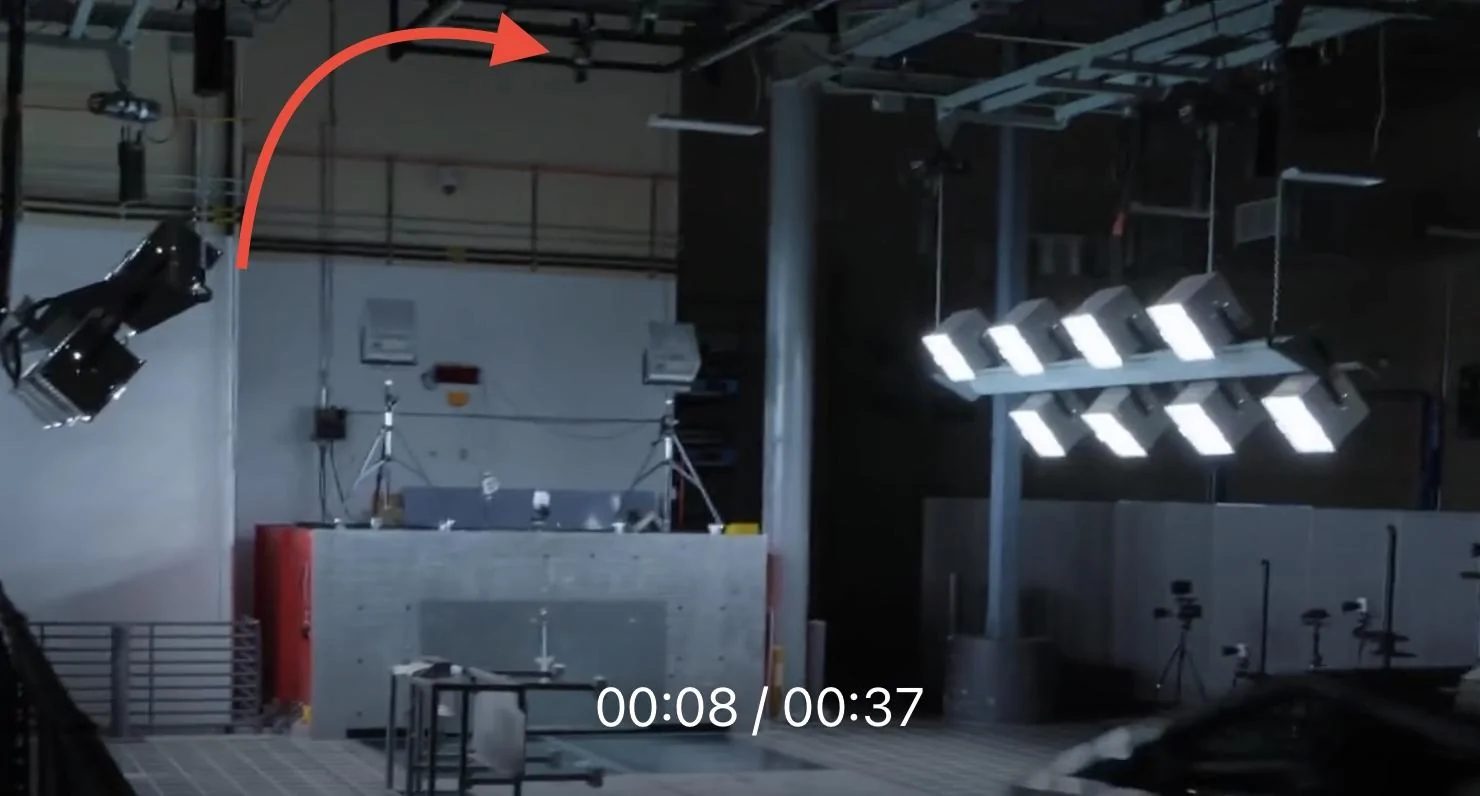
At 20” distance from lens, the ~2”-ish inch delta of depth between rim lip and and quarterpanel’s junction with flare is… nearly zero (pixel resolution is likely a greater hindrance than DOF)

Notice the camera rigs above and to the driver side are all also of at least equal distance from the vehicle. .

These cameras set-ups are designed to allow accurate measurements from distances - it’s basically the point of taking the videos.

But read on …

Your measurements work fine on a flat surface, but as soon as you are looking at 3d objects with different layers, they get off-kilter rather quickly. Particularly with the Cybertruck’s weird angles.
Respectfully, your drawing only tells me that you’re misunderstanding the measurements, cameras, and camera distances at play here - and the cumulative low levels of distortions at play as a result.

Tesla Cybertruck Crash Test Video Measurements For Cybertruck Dimensions DD508B37-4B33-459F-A98B-97BCBD0CDCE2


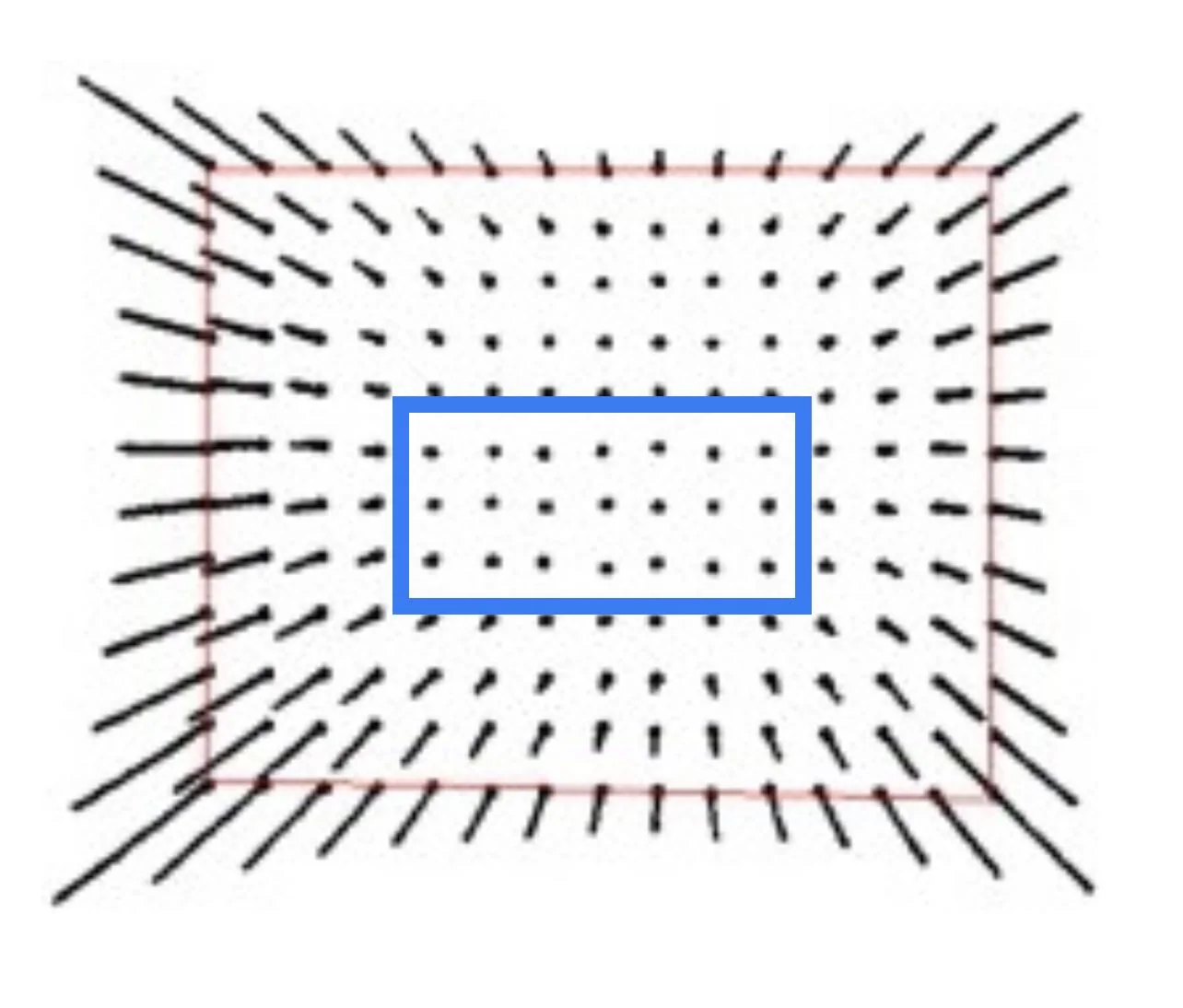
These cameras are not Walmart point-and-shoots. They use large lenses, that greatly minimize radial distortion of the sort you seem to be referencing in your drawing. In effect the lens choice first minimizes radial distortion into this relatively minimal field of distortion:
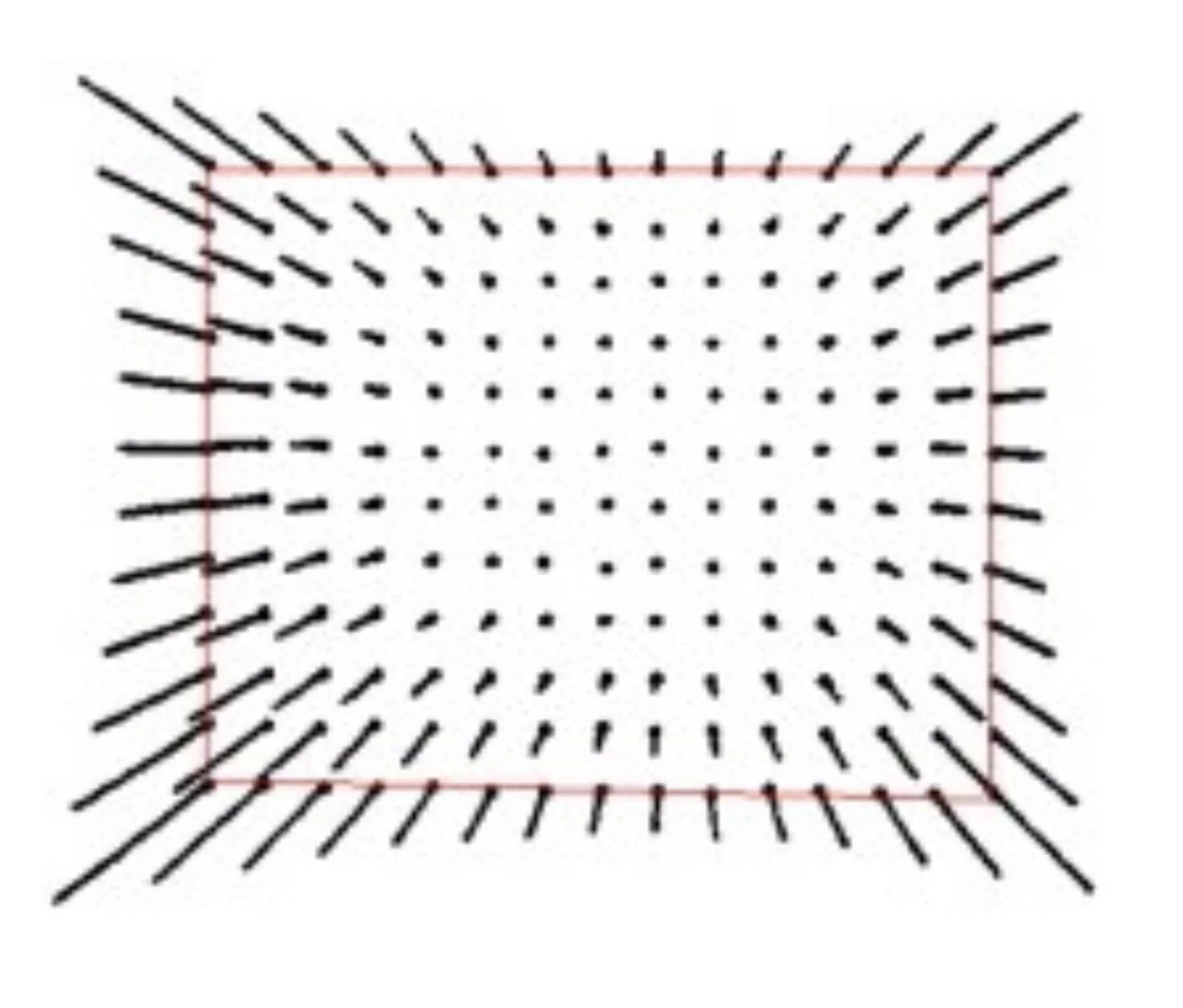
Tesla Cybertruck Crash Test Video Measurements For Cybertruck Dimensions 3C9353C6-1472-4F3F-AEC3-5E183F990CB6


The cameras are then placed at prescribed distance from object coordinates, with prescribed focal lengths, to standardize data collection and further minimize radial distortion. In effect, in the world view diagram above, they place the vehicle like this:
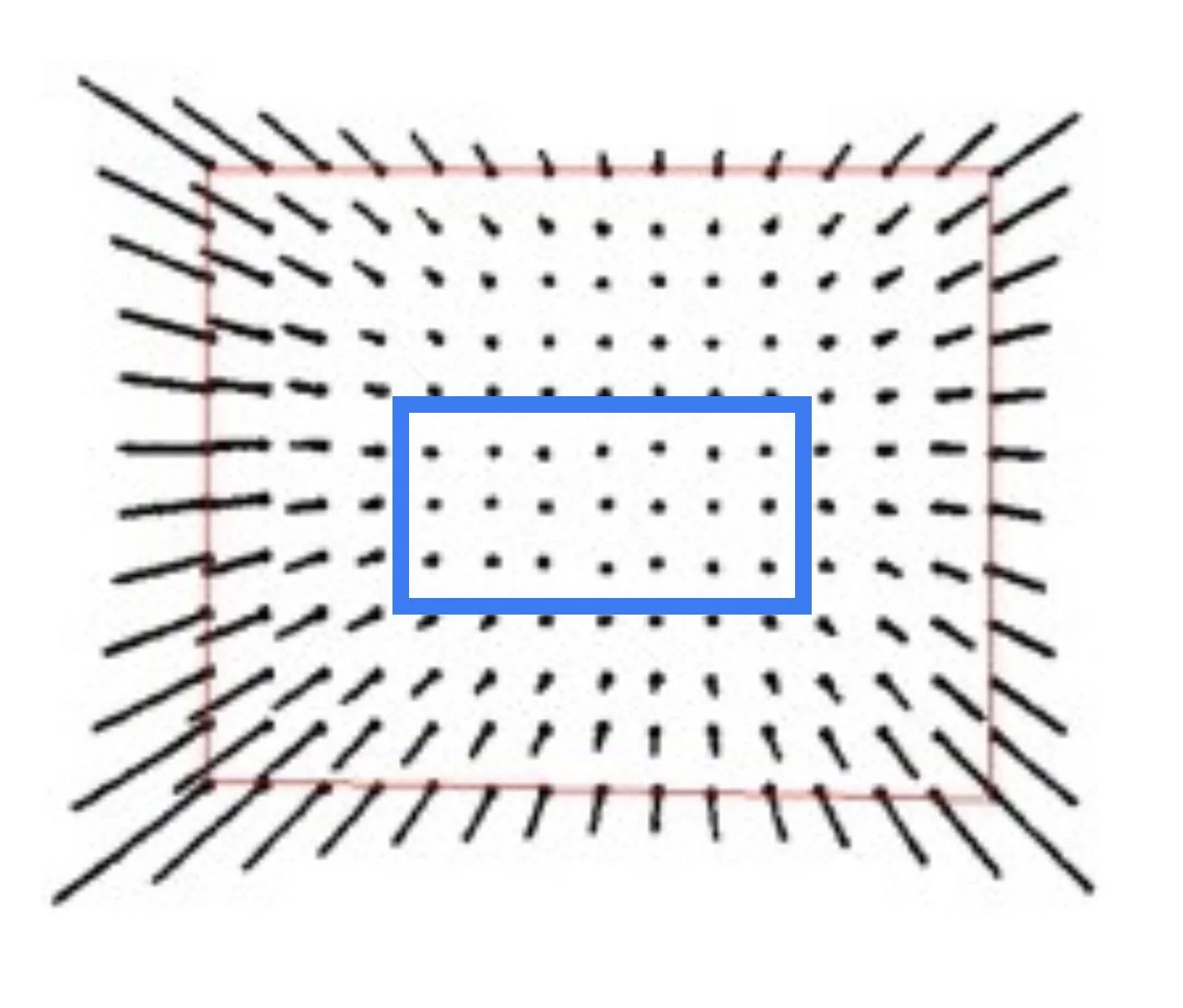
Tesla Cybertruck Crash Test Video Measurements For Cybertruck Dimensions 7493188B-202E-454A-B52D-15791ECA3737


[ As an aside, the video is then subjected to various forms of geometric camera calibration, also known as camera resectioning. These calibrations are used to correct for remaining lens distortion, and measure the size of an object in world units. These tasks are used in applications such as machine vision to detect and measure objects at distance. Put differently, without this type of lens calibration technology, FSD couldn’t work.

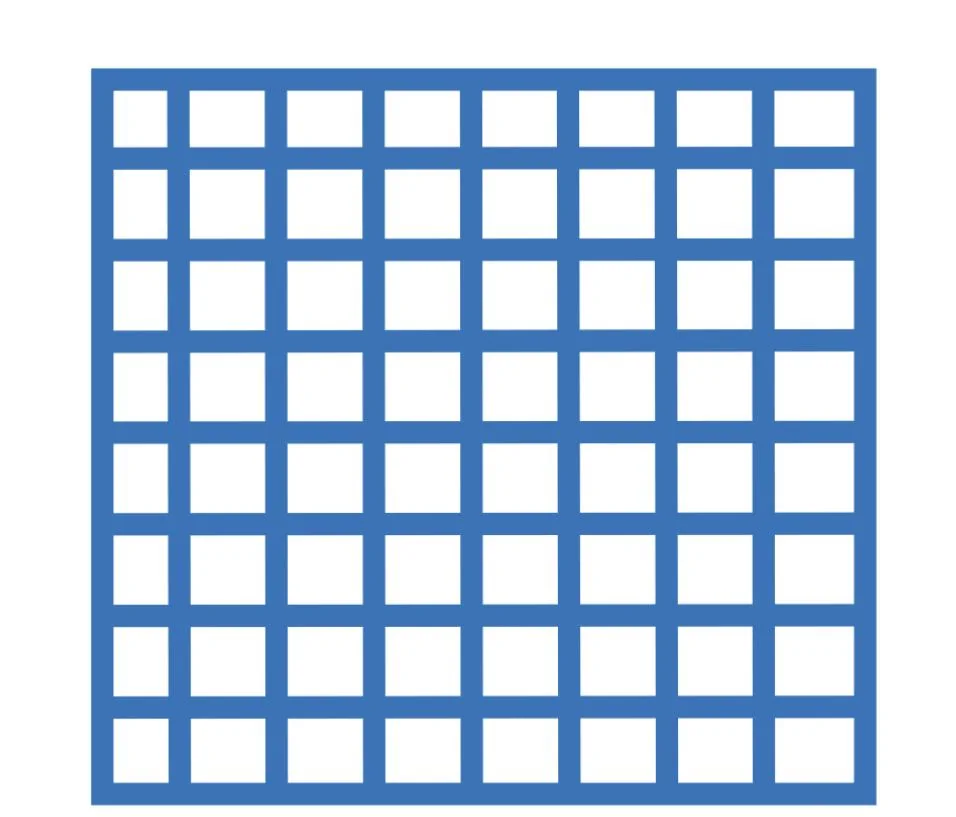
After lens calibration, the relevant portion of the frame to be studie appears like this:
Tesla Cybertruck Crash Test Video Measurements For Cybertruck Dimensions BD1911A0-C2FF-4FD2-AFCC-025A0E2DFE0F


The checkerboard tape typically seen in Tesla tear videos is used for this final data processing, allowing them to ultimately do things like turn the video into accurate 3D models that can account for remaining distortions of perspective in frame, or if vehicle lifts or rotated out of the ideal depth of field. Results like this:
Tesla Cybertruck Crash Test Video Measurements For Cybertruck Dimensions EC2C07C6-CE50-4381-B13B-84C568786B9B


The data processing is a final layer we don’t have access to. But prior to that, the lens choice, distance from camera, focal length, and vehicle envelope placement within frame collectively act to minimize the sorts of radial distortions your drawing seemed to be driving at. So minimized, that the the greater source of any error is likely measurement point selection.

In all, the point of this whole thread was that the Easter Egg within the Tesla crash test video was great ability to make on-screen measurements with even crude tools.

Which is all a medium-depth way of saying:

such facilities generally use cameras placed in locations (and using lenses) that minimize the distorting effects
Sponsored

 
Last edited:

CyberGus

Well-known member
First Name
Gus
Joined
May 22, 2021
Threads
91
Messages
10,245
Reaction score
33,914
Location
Austin, TX
Vehicles
1981 DeLorean, 2024 Cybertruck
Occupation
IT Specialist
Country flag
OP
OP
cvalue13

cvalue13

Well-known member
Joined
Aug 17, 2022
Threads
74
Messages
7,153
Reaction score
13,769
Location
Austin, TX
Vehicles
F150L
Occupation
Fun-employed
Country flag
Maybe worth qualifying my last post.

I’m maybe more agile with this stuff than the average bear, enough to be able to do some supporting research prior to my post.

But I’m not an engineer with such deep knowledge that I’m not prone to misspeaking or erroring at the deep (medium?) level.

I am, though, an executive at an Intel-backed edge-AI computing company whose main line of revenue are camera-based AI systems for applications that are basically cousins of FSD-like tech.

Which is to say only that I’m certainly prone to the errors of a non-expert non-engineer (plus some) - but I’m not totally prone to complete novice errors, either.

(Famous last words…)


Ogre

Well-known member
First Name
Dennis
Joined
Jul 3, 2021
Threads
166
Messages
10,735
Reaction score
27,050
Location
Ogregon
Vehicles
Model Y
Country flag
Describe your issue.

Take Photo A for example. Maximum the near the plane of the wheel rim is within an 1” or 2” from the where the fender flare is measured junction with the quarterpanel:

D9760569-CFAD-4434-AD36-37E701DD9AF3.webp


Meanwhile, the distortions of depth on perspective are relative by the distance the camera is from the objects being captured. The further the camera from the subject (relative to the distance between two objects in the photo being compared, the less discernible any distortion of depth).

The camera rigs for these tests are place well out out of way of debris - at least 20’ back

6A1CBD1C-B73A-47B0-94F4-909A080462EF.webp


At 20” distance from lens, the ~2”-ish inch delta of depth between rim lip and and quarterpanel’s junction with flare is… nearly zero (pixel resolution is likely a greater hindrance than DOF)

Notice the camera rigs above and to the driver side are all also of at least equal distance from the vehicle. .

These cameras set-ups are designed to allow accurate measurements from distances - it’s basically the point of taking the videos.

But read on …


Respectfully, your drawing only tells me that you’re misunderstanding the measurements, cameras, and camera distances at play here - and the cumulative low levels of distortions at play as a result.

DD508B37-4B33-459F-A98B-97BCBD0CDCE2.webp


These cameras are not Walmart point-and-shoots. They use large lenses, that greatly minimize radial distortion of the sort you seem to be referencing in your drawing. In effect the lens choice first minimizes radial distortion into this relatively minimal field of distortion:

3C9353C6-1472-4F3F-AEC3-5E183F990CB6.webp


The cameras are then placed at prescribed distance from object coordinates, with prescribed focal lengths, to standardize data collection and further minimize radial distortion. In effect, in the world view diagram above, they place the vehicle like this:

7493188B-202E-454A-B52D-15791ECA3737.webp


[ As an aside, the video is then subjected to various forms of geometric camera calibration, also known as camera resectioning. These calibrations are used to correct for remaining lens distortion, and measure the size of an object in world units. These tasks are used in applications such as machine vision to detect and measure objects at distance. Put differently, without this type of lens calibration technology, FSD couldn’t work.

After lens calibration, the relevant portion of the frame to be studie appears like this:

BD1911A0-C2FF-4FD2-AFCC-025A0E2DFE0F.webp


The checkerboard tape typically seen in Tesla tear videos is used for this final data processing, allowing them to ultimately do things like turn the video into accurate 3D models that can account for remaining distortions of perspective in frame, or if vehicle lifts or rotated out of the ideal depth of field. Results like this:

EC2C07C6-CE50-4381-B13B-84C568786B9B.webp


The data processing is a final layer we don’t have access to. But prior to that, the lens choice, distance from camera, focal length, and vehicle envelope placement within frame collectively act to minimize the sorts of radial distortions your drawing seemed to be driving at. So minimized, that the the greater source of any error is likely measurement point selection.

In all, the point of this whole thread was that the Easter Egg within the Tesla crash test video was great ability to make on-screen measurements with even crude tools.

Which is all a medium-depth way of saying:
It doesn’t matter how good of quality your camera is, it can only be in one location and that location affects relative locations of objects. Fundamentally, the camera wasn’t placed there to measure what you are trying to measure. It is coincidentally useful for other things, but not for measuring the opening here.

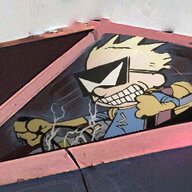
As my monster clearly points out, no lens distortion needed, mark-1 eyeball only sees things relative to where it is located.

Stuff that’s on the same plane can be measured correctly, you are measuring an opening where the top and bottom are diagonal to the perspective of the viewer. That doesn’t work.
 
OP
OP
cvalue13

cvalue13

Well-known member
Joined
Aug 17, 2022
Threads
74
Messages
7,153
Reaction score
13,769
Location
Austin, TX
Vehicles
F150L
Occupation
Fun-employed
Country flag
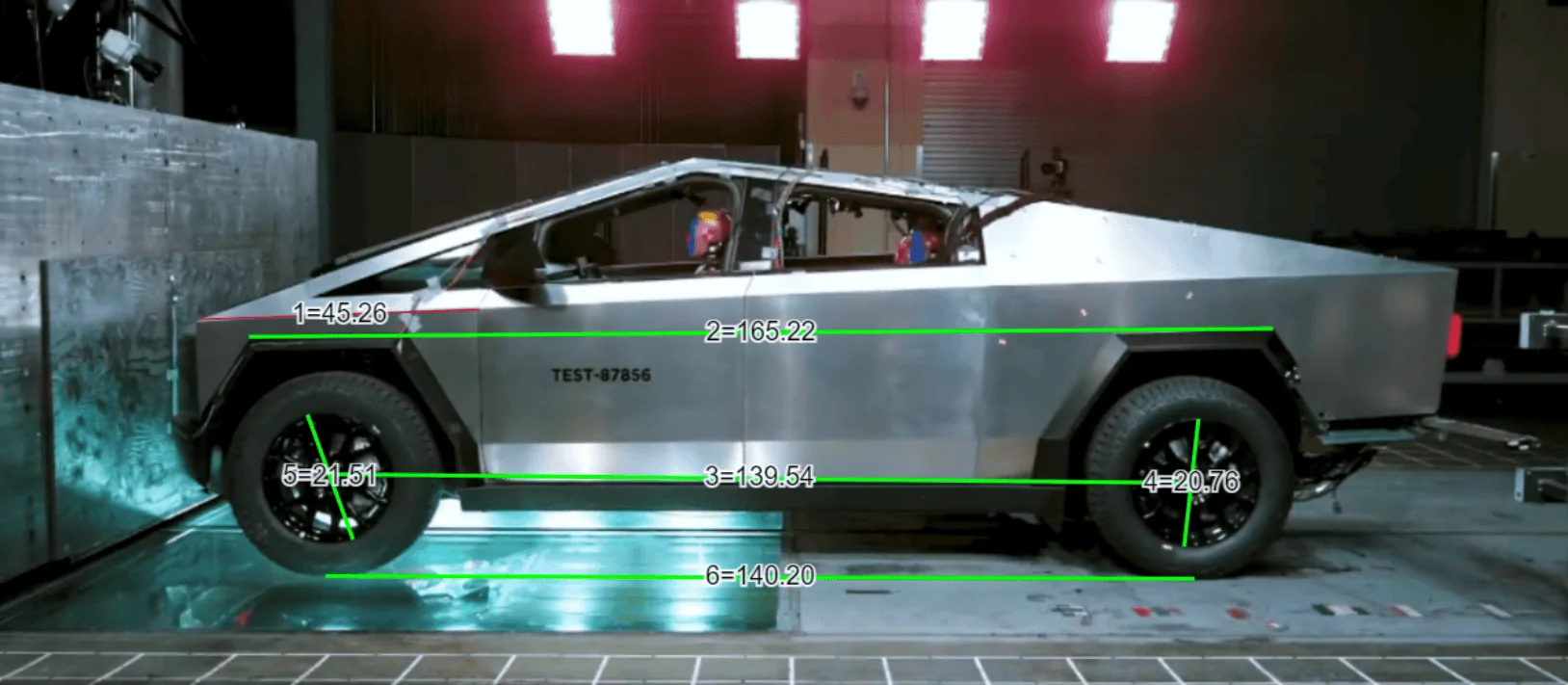
Why is the back rim smaller than the front?
Largely just measurement point selection error, owing to the inability to clearly see and “grab” where the black rim meets the black tire - I didn’t overthink those essentially side-show distortion measures, so long as they were within ~0.5” of expected - as I took that to be at least just pixel selection error.

It’s the front rim, not the back, that’s further off from expected measure of 21.00” (+2.3% front vs -1.1% rear).

But since you asked:

this is a good example of how I roughly cross-checked rates of error on more critical measurements. Take for example the length measurement of the truck from front flare tip to rear flare tip in the same photo, 165.22” - a +2.3% error would give +\- 3” (167.22) while a -1.1% error would give +\-1.65” (163.6”) - on average roughly within that 1”-2” average error of measure, even for a long measurement

I wasn’t fretting as much about the measures in this photo anyway, as I’m not terribly interested in wheelbase except to extent it’s reduced wheelbase length relevant to reduced overall vehicle length seem roughly proportional (a measure would be questionable if wheel base didn’t shrink from unveil stated states in some proportion to length shrinkage from unveil stats)
 
OP
OP
cvalue13

cvalue13

Well-known member
Joined
Aug 17, 2022
Threads
74
Messages
7,153
Reaction score
13,769
Location
Austin, TX
Vehicles
F150L
Occupation
Fun-employed
Country flag
Stuff that’s on the same plane can be measured correctly, you are measuring an opening where the top and bottom are diagonal to the perspective of the viewer. That doesn’t work.
sure, pal :ROFLMAO:
 
Last edited:
OP
OP
cvalue13

cvalue13

Well-known member
Joined
Aug 17, 2022
Threads
74
Messages
7,153
Reaction score
13,769
Location
Austin, TX
Vehicles
F150L
Occupation
Fun-employed
Country flag
It’s ok, you’re not alone. lots of people don’t believe in physics.

:rolleyes: ?

Edit: Probably more like geometry than physics… one relies on the other though.
read prior post

study cartoon:

Tesla Cybertruck Crash Test Video Measurements For Cybertruck Dimensions 5CB8EF00-2ABD-40ED-B5F3-470495938EA0


Absorb the OP qualifications regarding admitted error range of measurements.

Thing is, I have this burning suspicion that if certain measurements were nearer to what you want/assume them to be, you’d be cheering on the results.

Meanwhile, I’m posting these under complete awareness that the truck will be released and the in-world measurements will be known, and could be too materially different than my estimates. I’ll be wrong.

I’m fine with that. It’s just for fun. And it’s optional to read.


Ogre

Well-known member
First Name
Dennis
Joined
Jul 3, 2021
Threads
166
Messages
10,735
Reaction score
27,050
Location
Ogregon
Vehicles
Model Y
Country flag
In order to get accurate images for measuring obscured objects across multiple heights you’d need a series of cameras taking images in sync, then your need to computationally combine those images.

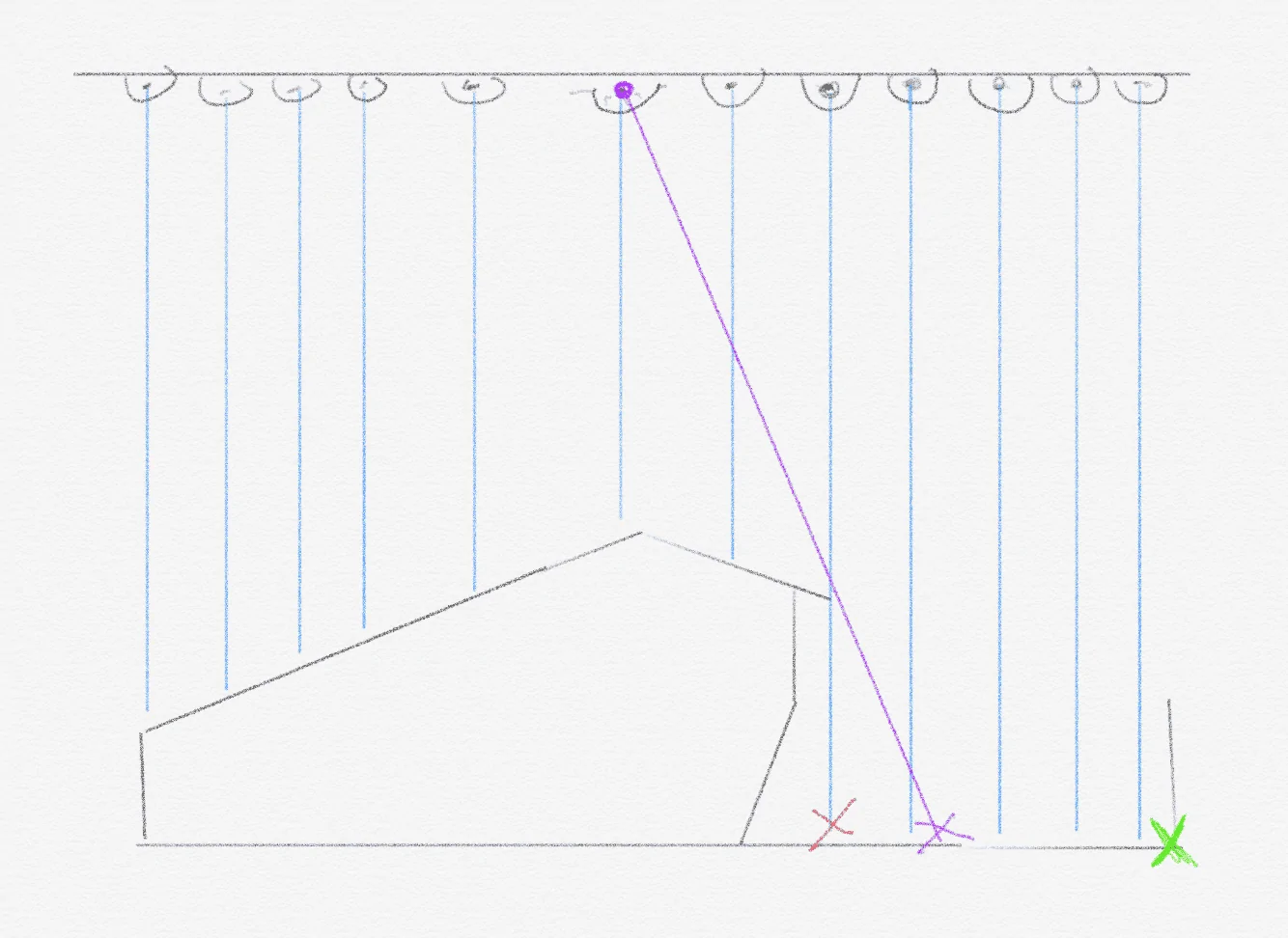
The camera over the center of the cab literally cannot see the red X. There is no “bend light” lens that would allow this. You may have a very accurate measurement from the purple X to the green X. The purple camera literally cannot see the red X which is the actual endpoint we care about.

Tesla Cybertruck Crash Test Video Measurements For Cybertruck Dimensions 1680478590355
 

TheLastStarfighter

Well-known member
Joined
Jul 6, 2020
Threads
9
Messages
1,660
Reaction score
4,307
Location
Canada
Vehicles
Dodge Challenger, Tesla Model 3
Occupation
Industrial Engineer
Country flag
Largely just measurement point selection error, owing to the inability to clearly see and “grab” where the black rim meets the black tire - I didn’t overthink those essentially side-show distortion measures, so long as they were within ~0.5” of expected - as I took that to be at least just pixel selection error.

It’s the front rim, not the back, that’s further off from expected measure of 21.00” (+2.3% front vs -1.1% rear).

But since you asked:

this is a good example of how I roughly cross-checked rates of error on more critical measurements. Take for example the length measurement of the truck from front flare tip to rear flare tip in the same photo, 165.22” - a +2.3% error would give +\- 3” (167.22) while a -1.1% error would give +\-1.65” (163.6”) - on average roughly within that 1”-2” average error of measure, even for a long measurement

I wasn’t fretting as much about the measures in this photo anyway, as I’m not terribly interested in wheelbase except to extent it’s reduced wheelbase length relevant to reduced overall vehicle length seem roughly proportional (a measure would be questionable if wheel base didn’t shrink from unveil stated states in some proportion to length shrinkage from unveil stats)
The difference in size is likely due to the camera angle. 21.5/20.7 is a difference of about 4%. This is relevant because you're basing all other measurements from that first tire. You extend lines as if in a plane, but they are not. Not exactly. That 4% difference in rims applies to the rest of the vehicle along the line. Well it applies on a scale, less so to the left, moreso for the far right beyond the tire. This is why I'm saying your measurements are close, but probably a bit small. On the length I'd add 2-4%, or 4-8". Adding those inches would get you up to previous estimates including that guy on Twitter.


Top