
Sponsored

Jhodgesatmb

Well-known member
First Name
Jack
Joined
Dec 1, 2019
Threads
89
Messages
6,487
Reaction score
9,025
Location
San Francisco Bay area
Website
www.arbor-studios.com
Vehicles
Tesla Cybertruck FS AWD, Tesla Model Y LR
Occupation
Retired AI researcher
Country flag
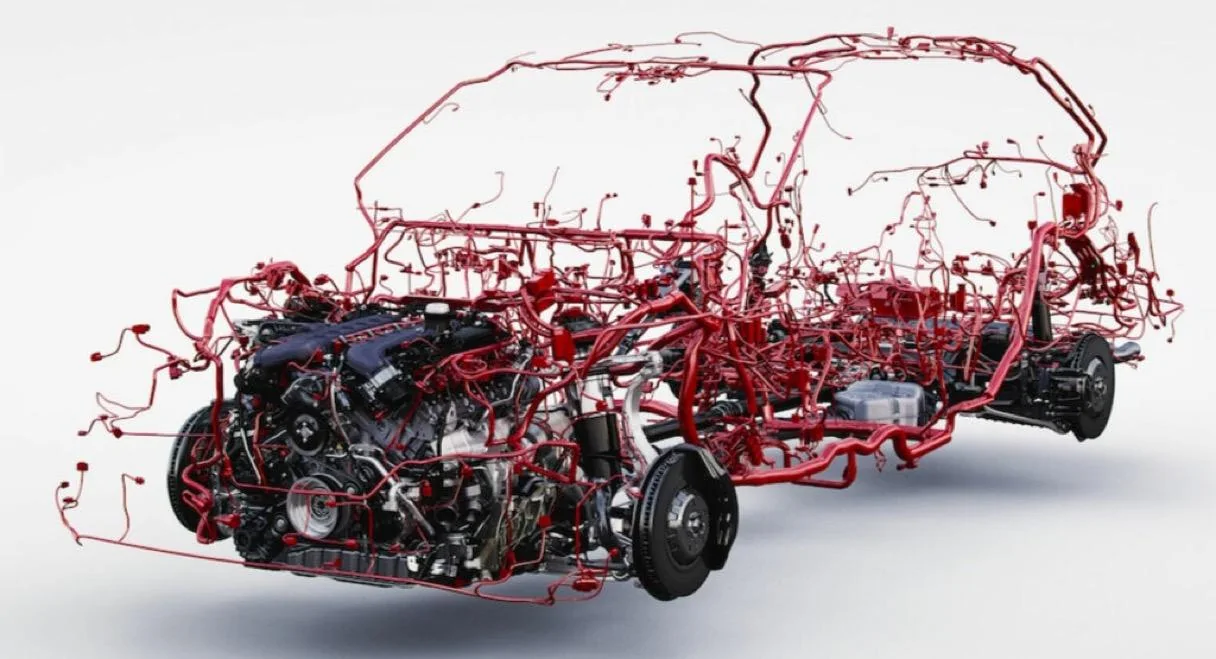
You know how cars have huge wiring harnesses?

That's because each component needs its own set of wires, connected to the central ECUs, in order to function.

Every speaker, every switch, every sensor, every actuator, every button.

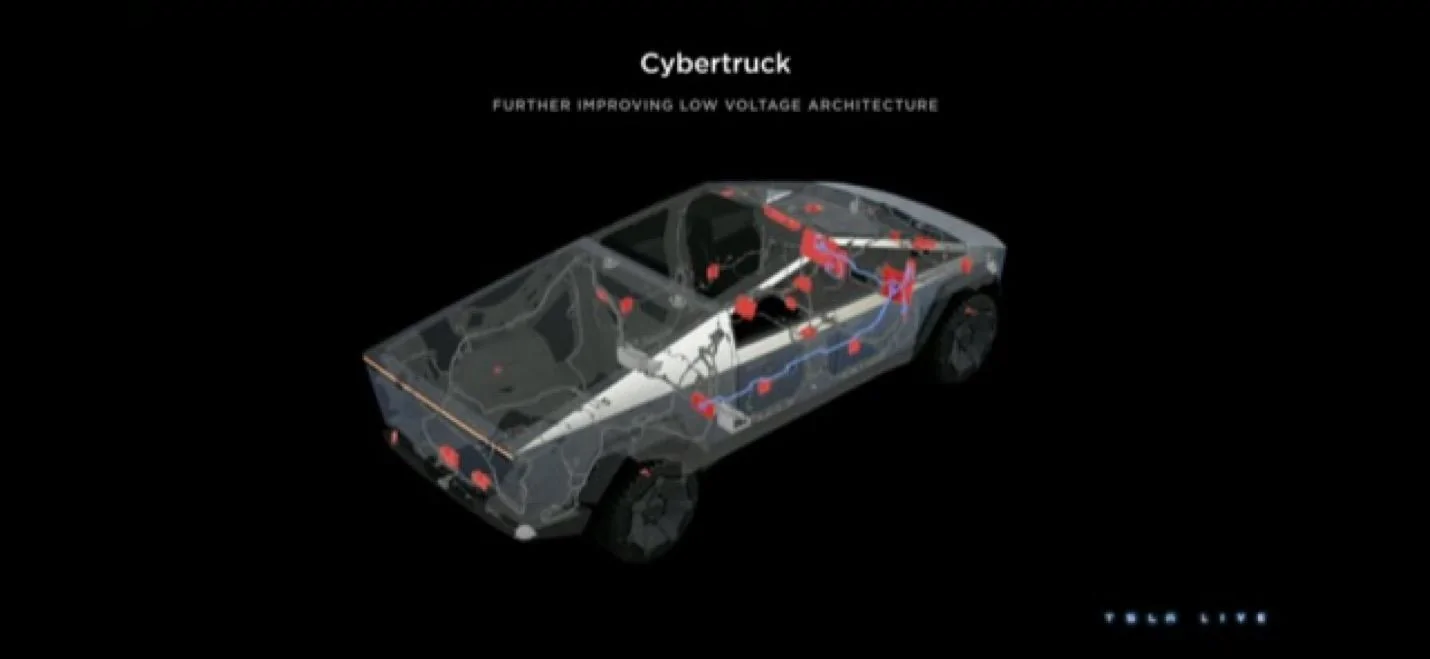
Tesla threw out that entire system for Cybertruck.

Instead, they're running gigabit ethernet cabling with a 48v power + data CAN bus to every component— all on the same cable.

Instead of running one wiring harness to the driver door speaker, and another to the driver's door window motor, they can daisy-chain them together on the same self-contained cable interface. Your computer could connect to your door handle using the *same* wire that's already been through your speaker, window, ambient lights, and steering wheel.

Each of those devices/components listen to the continuous stream of data for a command relevant to its operation.

By doing this,Tesla was able to reduce the total wiring in the Cybertruck by 77%, using 1/2 the copper.

IMG_5194.jpeg


IMG_5195.jpeg

cybertruckguy
I guess Wi-Fi was not possible (safe, secure, performant) yet. Hell, I still prefer hardwiring my home appliances over using WiFi. Faster and more reliable. That said, I would not be surprised to see much of the wiring go away in the future.
Sponsored


Jhodgesatmb

Well-known member
First Name
Jack
Joined
Dec 1, 2019
Threads
89
Messages
6,487
Reaction score
9,025
Location
San Francisco Bay area
Website
www.arbor-studios.com
Vehicles
Tesla Cybertruck FS AWD, Tesla Model Y LR
Occupation
Retired AI researcher
Country flag
I believe that is called power over internet. There is limited power available. I believe the current is 1 amp unless Tesla changed wire size And connectors.
My limited experience with PoE has been with a dedicated wire. A waste of potential bandwidth. In fact I am not sure how the ‘same’ cable could be used for multiple devices. The same data stream could be.
 

Jhodgesatmb

Well-known member
First Name
Jack
Joined
Dec 1, 2019
Threads
89
Messages
6,487
Reaction score
9,025
Location
San Francisco Bay area
Website
www.arbor-studios.com
Vehicles
Tesla Cybertruck FS AWD, Tesla Model Y LR
Occupation
Retired AI researcher
Country flag
It actually makes repair easier. You just fix the one cable or unit, instead of a whole harness. The cables are common instead of specific to each peripheral.


...that's how my house is wired. There's a switch in the bedroom, one in the media cabinet, and then the few off the router.

If I want more than one device in the room, it gets a switch. Bedroom has some weird echoes, so it gets a switch. Office doesn't, but I ran two data wires to it anyway. One goes up the arm that holds the monitor. The media cabinet is an old brick fireplace so it gets a switch.

Means I only had to run one data line to each room.

-Crissa
My house is the same. Data into the house through the router, split to several gigabit Ethernet switches in different rooms using cat6, and a network diagram so I can manage the peripherals occasionally.
 

CyberGus

Well-known member
First Name
Gus
Joined
May 22, 2021
Threads
91
Messages
10,238
Reaction score
33,893
Location
Austin, TX
Vehicles
1981 DeLorean, 2024 Cybertruck
Occupation
IT Specialist
Country flag
Imagine a complete circle, and that is a cable connected to itself as a loop. Then add nodes to that same cable (like lights) all the way around.
Maybe they're using Token-Ring networking ?‍♂
 

Jhodgesatmb

Well-known member
First Name
Jack
Joined
Dec 1, 2019
Threads
89
Messages
6,487
Reaction score
9,025
Location
San Francisco Bay area
Website
www.arbor-studios.com
Vehicles
Tesla Cybertruck FS AWD, Tesla Model Y LR
Occupation
Retired AI researcher
Country flag
Crissa, do you have any of your switches wired like this:?: Router->Switch->Switch->Device (where both switches could have one or more end devices connected.) The daisy chain aspect is that the second switch is not connected directly to the router.

I'm just trying to visualize your wiring better. My mesh WiFi system was a little pricey and I'm wondering it I could have done it with a few more E-net cables and cheap switches.
Mine is router -> switch -> switch -> peripheral.


Petertsai

Well-known member
First Name
Peter
Joined
Oct 16, 2022
Threads
0
Messages
112
Reaction score
90
Location
44 Indian Clover Drive, 77381
Vehicles
Tesla S, cybertruck reservation
Occupation
Engineer
Country flag
My limited experience with PoE has been with a dedicated wire. A waste of potential bandwidth. In fact I am not sure how the ‘same’ cable could be used for multiple devices. The same data stream could be.
My mistake, it is power over Ethernet. Used most often in places like airports for covering wide areas for WiFi. Being Ethernet, it would be a star wiring configuration so maybe it is more like modbus where it is a bus configuration, allowing for devices to tap into bus power. Probably a combination because it is difficult to a large bus to each controllable device, ie heat pump to turn light with different power needs.
 

wtibbit

Well-known member
First Name
Wayne
Joined
Aug 27, 2020
Threads
12
Messages
819
Reaction score
1,617
Location
DFW
Vehicles
Cybertruck AWD FS, Mercedes sedan, Corvette coupe, 1968 Cougar XR-7
Occupation
Retired Engineering Program Director
Country flag

JBee

Well-known member
First Name
JB
Joined
Nov 22, 2019
Threads
18
Messages
4,913
Reaction score
6,362
Location
Australia
Vehicles
Cybertruck
Occupation
. Professional Hobbyist
Country flag
Maybe they're using Token-Ring networking ?‍♂
I think the difference is the node doesn't interface either side with its on PHY, rather it only piggy backs on the same cable without intercepting it, so it doesn't need two PHYs? That way a node failure doesn't also cause a disconnect.
 

Tiberius

Well-known member
Joined
Sep 2, 2023
Threads
0
Messages
198
Reaction score
422
Location
Texas
Vehicles
Model 3
Occupation
Chief cook and bottlewasher
Country flag
First major thing to realize - Can Bus does not equal ethernet, so using home network analogies doesn't apply.
The new part in Cybertruck isn't can bus, distributed architecture or any of that, its just 1G instead of being low speed.
Second major thing to realize - wiring savings compared to previous Teslas (especially 3 &Y) has nothing to do with Can Bus and more to do with being able to use smaller gauge wires thanks to 48V instead of 12v
CanBus reference https://en.wikipedia.org/wiki/CAN_bus#Architecture
 

baumer81

Member
First Name
Kurt
Joined
Dec 1, 2023
Threads
0
Messages
8
Reaction score
20
Location
South Carolina
Vehicles
Tesla Model S 90D
Country flag
Yep.

.....

There's still 12V on the vehicle, all the CPU/GPU, displays etc will need it, plus the USB-C PD outlets etc.
Hopefully they will use the max voltage of USB-C, which is 20V. 12V is a negotiated lower voltage available in USB-C.


Dazureus

Well-known member
Joined
Sep 1, 2023
Threads
7
Messages
264
Reaction score
589
Location
US
Vehicles
'21 Model Y, '24 Cyberbeast
Occupation
Software Engineer - Steering Systems
Country flag
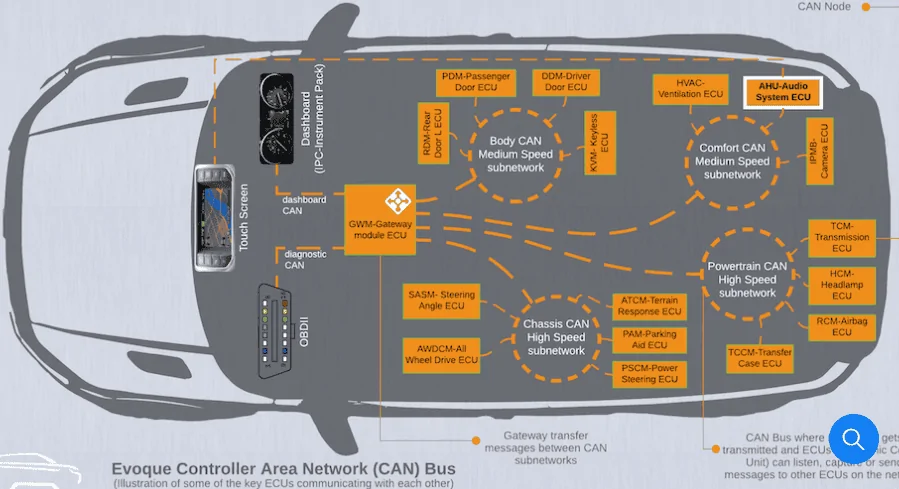
I think it's a little more than increasing the bus speeds to 1Gb. CAN communications are limited to 500kbps and CAN-FD is limited to (up to) 5Mbps. Moving to 1Gbps ethernet is also implying a redesign of the vehicle network architecture, that I don't think has really been broached yet. As stated before, and restated here for emphasis, current automotive networks consist of a primary Gateway device, which is connected to a few segregated CAN networks. You might have low speed CAN bus for infotainment/comfort systems, one CAN-FD for ADAS (advanced driver assistance system), another CAN-FD for BCM (body control modules), yet another bus for Powertrain modules, etc. Each of these buses are connected to multiple ECUs and can communicate to other CAN busses via the gateway module. However, the ECUs on a bus aren’t based on the physical location in the vehicle; it’s based on it's function and who else it needs to communicate with.
Tesla Cybertruck Wiring genius: 48v power + data CAN bus 1701809929115

In the example graphic shown above, the PSCM (power steering control module) is positioned near the driver and is connected to the Chassis CAN, but communicates with the Parking Aid ECU, which could be located in the rear bumper. The wiring harnesses for these CAN buses physically connect the ECUs together, then all run to the Gateway, so physically, you have multiple bundles of wires running all over the car for each bus, to connect physically remote ECUs.

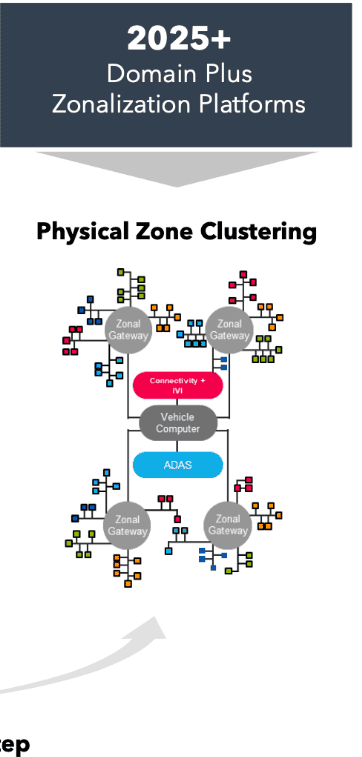
Besides speeding up communications of the bus, so you don't need to segregate the various ECUs onto their own buses to prevent collision and throughput issues, I think what Tesla is implementing here is the Zonal Architecture, where one Computer Control Module (CCM) is connected via gigabit ethernet to zonal switches distributed around the vehicle. Those switches are then wired locally to the ECMs close to it, dividing the vehicle into zones (hence the term Zonal).
Tesla Cybertruck Wiring genius: 48v power + data CAN bus 1701810281154

Note that this graphic states 2025+, so when people state that Tesla is 5 years ahead of other OEMs, this is why. OEMS are just starting to talk about zonal architecture implementation, but you won't hear that name. You'll hear Software Defined Vehicles closely tied to subscription based features.

By clustering the ECU powers in the CCM (I've personally seen inklings of this in Ford and GM), all other features (steering, powered seats, speakers, abs, etc) are reduced to smart actuators, which no longer process their own features, but receive everything from the CCM. OEMS love this because it pulls all the Intellectual property into their in-house CCM unit, and makes OTA updates easier since they don't have to push to each individual ECU scattered across their vehicle networks. As you've heard, it gets rid of tons of wires and copper, and makes it easier to implement subscription based services, because it's no longer about writing config settings CAN on the ECU that controls seat heating, it's just setting a config on the CCM that they have direct control and communication over.

This is of particular interest to me because I'm in a steering software engineer. I work on projects that combine various code features for steering into one package that we write to our PSCM ECU's that go on steering racks we manufacture. I think within 5 years, my job will be very different. There won't be a PSCM ECU communicating out on the CAN bus. Our steering smart actuator will just receive messages from our zonal controller that comes from the CCM and all those steering features won't have to be integrated into our software binary. My company is starting to use Software as a Service buzzwords because that's what we'll be doing; selling our software steering component features to OEMS so they can integrate it into their CCM software.

So TLDR: When you hear Subscription based services in cars, this is part in parcel of a shift to zonal architecture. I'm not positive this is what's going on in the Cybertruck, but combined with statements like "wiring harness reduction" and "gigabit ethernet" I can't see them half-assing the implementation into something other than Zonal architecture.
 

Mini2nut

Well-known member
Joined
Apr 2, 2020
Threads
138
Messages
4,073
Reaction score
7,389
Location
Planet Earth
Vehicles
*Tesla MYP *SAWD Cybertruck ordered 2/20/26
Country flag
My outdoor security camera system use POE. It even powers the small LED lights on the cameras that come on when it senses motion.
 

Dman_CT

Active member
Joined
Nov 8, 2023
Threads
0
Messages
27
Reaction score
39
Location
California
Vehicles
Tacoma, Transit
Country flag
Several comments state that there is still 12V. Is this true? I realize a few components may require 12V but I assume that’s all converted at point of load from 48V. A few days ago I myself was grumbling about lack of 12V cigarette lighter sockets for add-ons but after learning about USB C PD being able to provide 12V I realize I need to enter the 21st century.

FYI, our Transit van camper conversion has zero 12V outlets beyond the factory sockets in the dash. All accessory outlets we use are USB; we have USB charged battery powered air filter, cooling fan and vacuum cleaner. Of course we do have some hardwired 12V stuff like fridge, roof vent and water pump but 48V would be even better.
 

TruckElectric

Well-known member
First Name
Bryan
Joined
Jun 16, 2020
Threads
772
Messages
2,488
Reaction score
3,280
Location
Texas
Vehicles
Dodge Ram diesel
Occupation
Retired
Country flag
They are calling it 48V POE but it has nothing to do with the household/office/industrial Ethernet 802.3 POE standard. Standard POE can only do up to 100W max, which isn't enough to do much at all in a vehicle, except run sensors or window winder motors etc.

It could never handle the 5hp required for the SbW for example, or the AC compressor, cooling system etc.

First up it's 4 core round cable based and not 8 core, and it uses a "connectorless" connection system that just terminates a precisely cut cable end directly into a node without a plug. The cable is also considerably thicker than CAT5/6 LAN cable, so it can run higher power devices.

Elon did mention ethernet comms.....do you think that Tesla has custom/purpose-built cabling?

Any fiber optic for data?
 

JBee

Well-known member
First Name
JB
Joined
Nov 22, 2019
Threads
18
Messages
4,913
Reaction score
6,362
Location
Australia
Vehicles
Cybertruck
Occupation
. Professional Hobbyist
Country flag
Elon did mention ethernet comms.....do you think that Tesla has custom/purpose-built cabling?

Any fiber optic for data?
Yes there's pictures of what I described in their patent docs.
Sponsored


Top