Sponsored

Supercharger Times from 20% - 80%?

TurboCJ

Member
First Name
Eric
Joined
Jan 29, 2024
Threads
1
Messages
13
Reaction score
9
Location
Richmond, VA
Vehicles
Rivian R1S, BMW i3, Model Y
Country flag
What's the current status of charging from 20%-80% at superchargers? I know at release it was 45+ minutes. What the experience today after all the software updates?
Sponsored


 

cardad

Well-known member
First Name
Kelvin
Joined
Feb 14, 2024
Threads
3
Messages
219
Reaction score
207
Location
Moab
Vehicles
R1S, R1T, Bronco Raptor
Country flag
It’s faster. I went 11% to 77% in 32 min today. That’s 80.4 kwh or about 151 kw avg rate. You’ll want to start below 20 to optimize the charge rate as you can sustain around 250 from sub 10% to almost 30% and then it starts to taper down.
 

Woodrick

Well-known member
First Name
Ed
Joined
Dec 30, 2023
Threads
6
Messages
4,786
Reaction score
4,762
Location
Gainesville Ga
Vehicles
Model 3, Model Y, Cybertruck AWD
Occupation
Consultant
Country flag
What's the current status of charging from 20%-80% at superchargers? I know at release it was 45+ minutes. What the experience today after all the software updates?
Not sure the answer, but if you want to travel faster, lower the numbers.
 

RickJ19Zeta8

Well-known member
Joined
Mar 25, 2024
Threads
0
Messages
130
Reaction score
361
Location
Wisconsin
Vehicles
Tri-Motor Cybertruck (soon_TM), Model 3
Country flag
What does that mean? To travel faster lower the numbers. Please explain.
For long distance, multiple charging stop trips. You'll want to arrive at 10% or lower at the supercharger, and charge to 65%-ish. As soon as the charge rate drops under 100 kW, leave for the next charger assuming the arrival estimate is around 10% or more.

Once you get comfortable and understand the route planner / range estimation, you'll start leaving with an arrival estimate of 5-10% which is often enough buffer even in the cold and wind. And then charge to 60%. Thats the range that charges the fastest and is a balance between more stops being an overall faster trip.

Now, if you're trailering and need to drop the trailer to charge. Then that extra time for every stop is better spent sitting at the charger for a bit longer, even at the lower charge rate. And you can charge to 80%.

ABetterRoutePlanner.com is a really good resource for trip planning. They have a selector for more stops / best speed / less stops that you can see how that impacts your trip time. I know on long trips, I like to stop every 2.5 hrs or so anyways. So I plan my charging stops accordingly.


MI2Y4U

Well-known member
First Name
Richard
Joined
Sep 21, 2024
Threads
2
Messages
123
Reaction score
86
Location
Houston, N Ft Myers, Barnagat, NJ.
Vehicles
Cybertruck
Occupation
Retired
Country flag
For long distance, multiple charging stop trips. You'll want to arrive at 10% or lower at the supercharger, and charge to 65%-ish. As soon as the charge rate drops under 100 kW, leave for the next charger assuming the arrival estimate is around 10% or more.

Once you get comfortable and understand the route planner / range estimation, you'll start leaving with an arrival estimate of 5-10% which is often enough buffer even in the cold and wind. And then charge to 60%. Thats the range that charges the fastest and is a balance between more stops being an overall faster trip.

Now, if you're trailering and need to drop the trailer to charge. Then that extra time for every stop is better spent sitting at the charger for a bit longer, even at the lower charge rate. And you can charge to 80%.

ABetterRoutePlanner.com is a really good resource for trip planning. They have a selector for more stops / best speed / less stops that you can see how that impacts your trip time. I know on long trips, I like to stop every 2.5 hrs or so anyways. So I plan my charging stops accordingly.
 

MI2Y4U

Well-known member
First Name
Richard
Joined
Sep 21, 2024
Threads
2
Messages
123
Reaction score
86
Location
Houston, N Ft Myers, Barnagat, NJ.
Vehicles
Cybertruck
Occupation
Retired
Country flag
Great explaination. TY!
I’m sure it will all make sense when I try it on our upcoming roadtrip from Texas to Florida, then Florida to NJ, returning to Texas. Any issues with the CT being transported on the Autotrain from Florida to Virginia should we decide to try that?
 

Gaximus

Well-known member
Joined
Jun 22, 2024
Threads
23
Messages
1,462
Reaction score
2,287
Location
Mead, CO
Vehicles
CyberBeast, Model 3, Jeep Wrangler, Yamaha R6
Occupation
Software Developer
Country flag
I'm not sure if I would leave with only 5-10% estimated at next arrival. I did that once and the range anxiety was pretty bad, It was when I first got my Model S, but still, I usually leave with estimate 12% arrival. One of my trips I hit an unexpected rain downpour. And it crushed our range. The extra resistance of the rain and the wheels pushing the water on the highway (I think the water on the road was the biggest factor), lost 15% in 30 minutes. Gained about 7% back once the rain stopped, but would have been SOL if the rain had lasted longer.
 

HaulingAss

Well-known member
Joined
Oct 3, 2020
Threads
28
Messages
10,319
Reaction score
20,736
Location
Western Washington, USA
Vehicles
Cybertruck DM, 2010 F-150, 2018 Performance Model 3, 2024 Performance Model 3
Country flag
I'm not sure if I would leave with only 5-10% estimated at next arrival. I did that once and the range anxiety was pretty bad, It was when I first got my Model S, but still, I usually leave with estimate 12% arrival. One of my trips I hit an unexpected rain downpour. And it crushed our range. The extra resistance of the rain and the wheels pushing the water on the highway (I think the water on the road was the biggest factor), lost 15% in 30 minutes. Gained about 7% back once the rain stopped, but would have been SOL if the rain had lasted longer.
Everyone is different.

I used to travel around the backroads of the American West on a sport-touring motorcycle with 180-300 miles of range (depending upon how you rode it) and I would get a real thrill by passing up my "last" chance for gas, as long as I saw I could make it to the next gas station. I used a GPS to give me accurate distances to the next town. If the town was small, I would check the GPS to make sure they had a gas station.

I rode hundreds of miles "on fumes" and it wasn't uncommon to arrive with only the fuel left in my fuel filter and fuel lines (no visible gas in the bottom of the tank). I never ran out doing this and it gave me a real charge of excitement to push the limit as close as I thought I could without actually running out.

It's a little different in an EV, but many of the same principles apply. Know your vehicle, know your route, and always be ready to slow down at the first sign that you might be arriving with too small of a buffer for your own comfort. Everyone will have a different comfort level. With experience, yours will expand. If you don't like playing games on road trips, this might not be for you. Personally, I love it, it makes the trip more fun! And I would do it for that reason alone, even if it didn't shorten my charge times.

Sometimes I even drive at high speeds, when I see I will arrive at a charger with too much SOC (while not having enough to make it to the next closest charger on my route). The high speed driving lowers my SOC upon arrival and speeds charging.
 
Last edited:

RickJ19Zeta8

Well-known member
Joined
Mar 25, 2024
Threads
0
Messages
130
Reaction score
361
Location
Wisconsin
Vehicles
Tri-Motor Cybertruck (soon_TM), Model 3
Country flag
Cybertruck coefficient of drag / frontal area is a blessing and a curse. It uses much more energy to go 80mph, but the flip side is if the arrival estimate starts moving towards 0%, slowing down 5mph can make a huuuuge difference.

And if your arrival % starts climbing to 10-15%.... well, ratchet up another 5mph.


Pablito3

Active member
First Name
Paul
Joined
Feb 3, 2024
Threads
0
Messages
34
Reaction score
56
Location
Sarasota / Miami Beach Florida
Vehicles
Escalade ESV, Cyberbeast
Occupation
Real Estate: Investment/Development/Construction
Country flag
I just did this recharge about a week ago. I think I was at 19% and charged to about 81%, it took exactly 1 hour to add 76.6kw to the truck.

This was at an older supercharger in a retail center. My guess is the newer faster super charger could accomplish this in 45mins or less.

The reality is that range isn’t really what any ev manufacturer should be focused on, they just really need to focus on recharge time. If they are ever able to get an ev to recharge from 20% to 80% in 5 mins it would be game over for gas.
 

CyberGus

Well-known member
First Name
Gus
Joined
May 22, 2021
Threads
91
Messages
10,244
Reaction score
33,906
Location
Austin, TX
Vehicles
1981 DeLorean, 2024 Cybertruck
Occupation
IT Specialist
Country flag
Any issues with the CT being transported on the Autotrain from Florida to Virginia should we decide to try that?
There's a thread somewhere here on that subject. I believe the CT fits on the train, but is charged double due to the length.
 

JimBuck333

Well-known member
First Name
Jim
Joined
Jul 18, 2024
Threads
0
Messages
74
Reaction score
102
Location
New York
Vehicles
Model Y, Cybertruck being processed
Occupation
Engineer
Country flag
For long distance, multiple charging stop trips. You'll want to arrive at 10% or lower at the supercharger, and charge to 65%-ish. As soon as the charge rate drops under 100 kW, leave for the next charger assuming the arrival estimate is around 10% or more.

Once you get comfortable and understand the route planner / range estimation, you'll start leaving with an arrival estimate of 5-10% which is often enough buffer even in the cold and wind. And then charge to 60%. Thats the range that charges the fastest and is a balance between more stops being an overall faster trip.

Now, if you're trailering and need to drop the trailer to charge. Then that extra time for every stop is better spent sitting at the charger for a bit longer, even at the lower charge rate. And you can charge to 80%.

ABetterRoutePlanner.com is a really good resource for trip planning. They have a selector for more stops / best speed / less stops that you can see how that impacts your trip time. I know on long trips, I like to stop every 2.5 hrs or so anyways. So I plan my charging stops accordingly.
What interests me also is the tradeoff between speed of travel balanced against speed of charging to minimize overall trip time. For instance, if you go fast enough, you'll lose most or all of the time saved in going that fast in having to charge more often and/or charge longer. Perhaps there is even a point of going so fast (and thereby use energy so fast) that you experience "negative returns" in terms of getting to where you're going as soon as possible?
 

RickJ19Zeta8

Well-known member
Joined
Mar 25, 2024
Threads
0
Messages
130
Reaction score
361
Location
Wisconsin
Vehicles
Tri-Motor Cybertruck (soon_TM), Model 3
Country flag
What interests me also is the tradeoff between speed of travel balanced against speed of charging to minimize overall trip time. For instance, if you go fast enough, you'll lose most or all of the time saved in going that fast in having to charge more often and/or charge longer. Perhaps there is even a point of going so fast (and thereby use energy so fast) that you experience "negative returns" in terms of getting to where you're going as soon as possible?
There is a theoretical point where going so fast, you will loose time due to the extra charging. Especially if you have to add charging stops. A Better route planner can do this math for you, by adjusting the “speed” tab to over 100% of road speed. It also has a toggle to tell you to slow down to make a charging stop.

For my upcoming trip of 895 miles, it takes 15hrs 23 minutes with 1hrs 57 minutes of charging over 4 stops. Going the speed limit.

If I speed by going 20% over. (84mph in a 70 which is pushing it for Police). The trip estimate changes to 14hrs 16 minutes for 905 miles and 3hrs 0minutes of charging over 5 stops.

40% over, or 98 in a 70. The trip estimate is 13hrs 52minutes with 4hrs 0minutes of charging over 6 stops.

And 50% is the same time as 40% speeding. But with 8 stops and 4hrs 16 minutes of charging. Shorter stops, staying in the sweet spot of high charging at the bottom of the pack.

So, 105mph is the break even point. If you drive faster, you’ll start loosing time due to charging stops. Now this assumes staying on Tesla network. And assumes no congestion at chargers, each charging session goes good. No traffic getting off the expressway. And no cops.
 

mstatkus

Well-known member
First Name
Mark
Joined
Jun 28, 2024
Threads
0
Messages
203
Reaction score
184
Location
WA
Vehicles
Cybertruck, Model Y, Model 3
Occupation
DevOps
Country flag
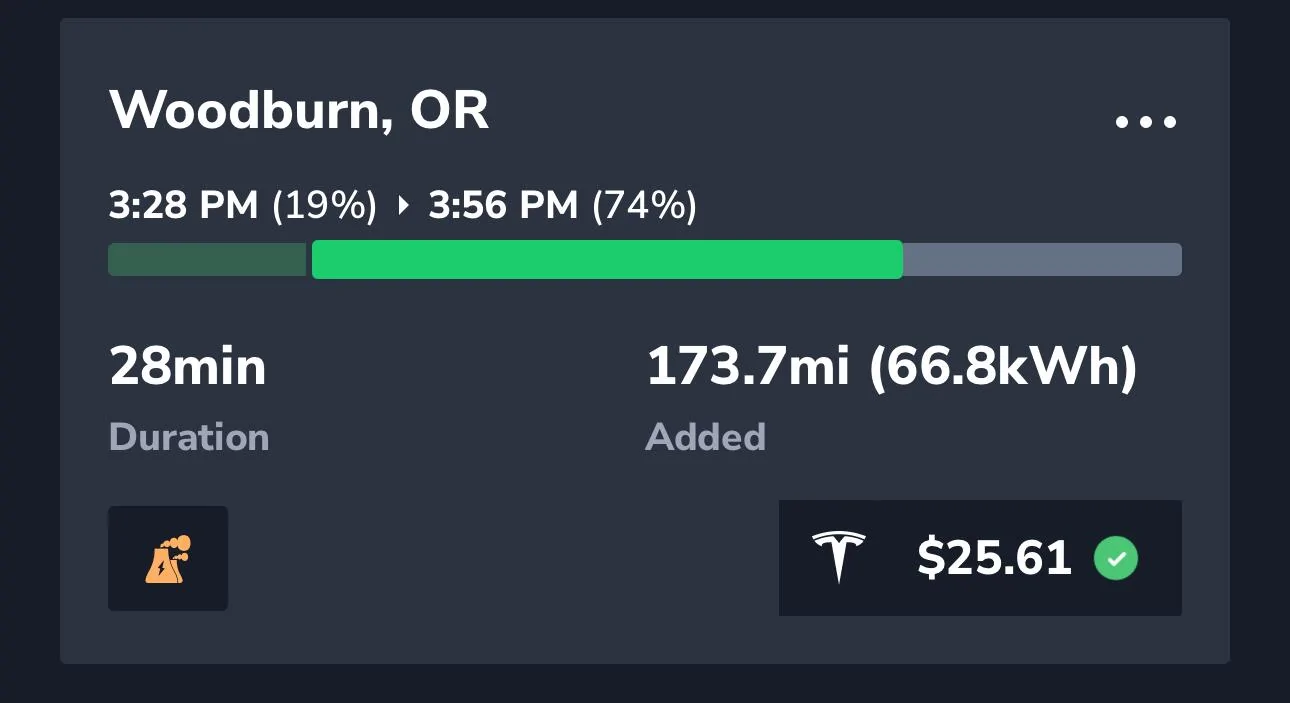
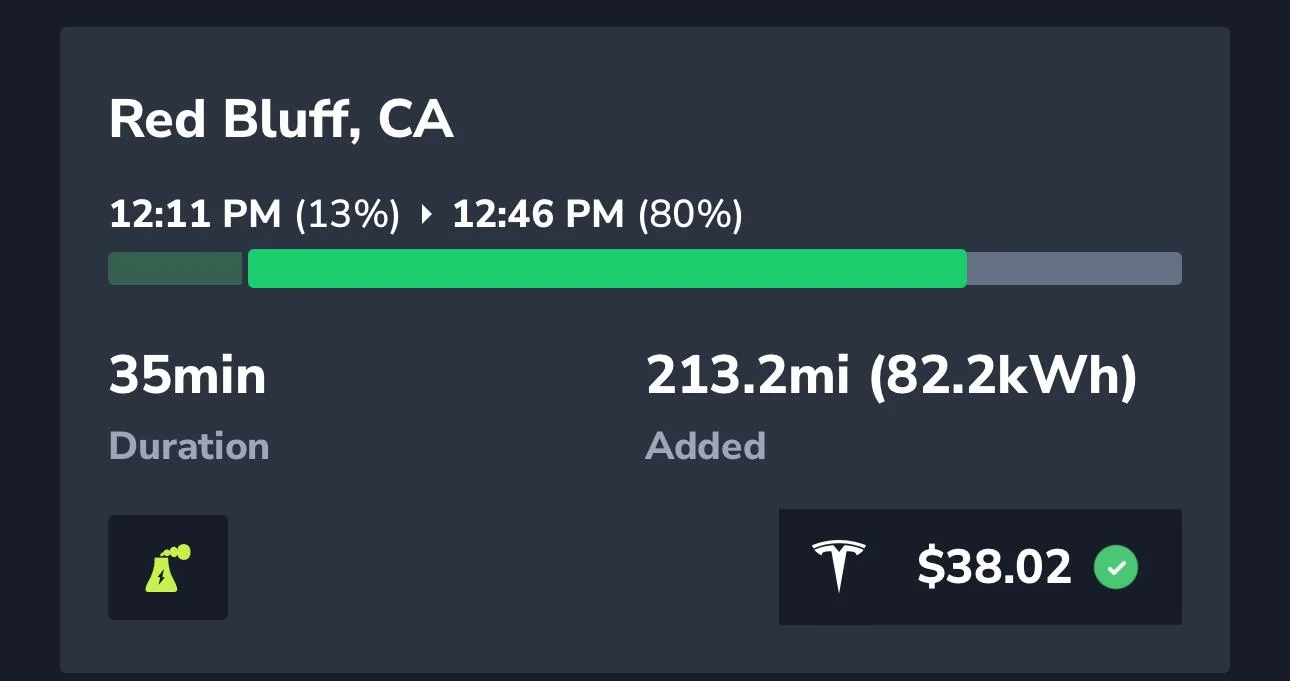
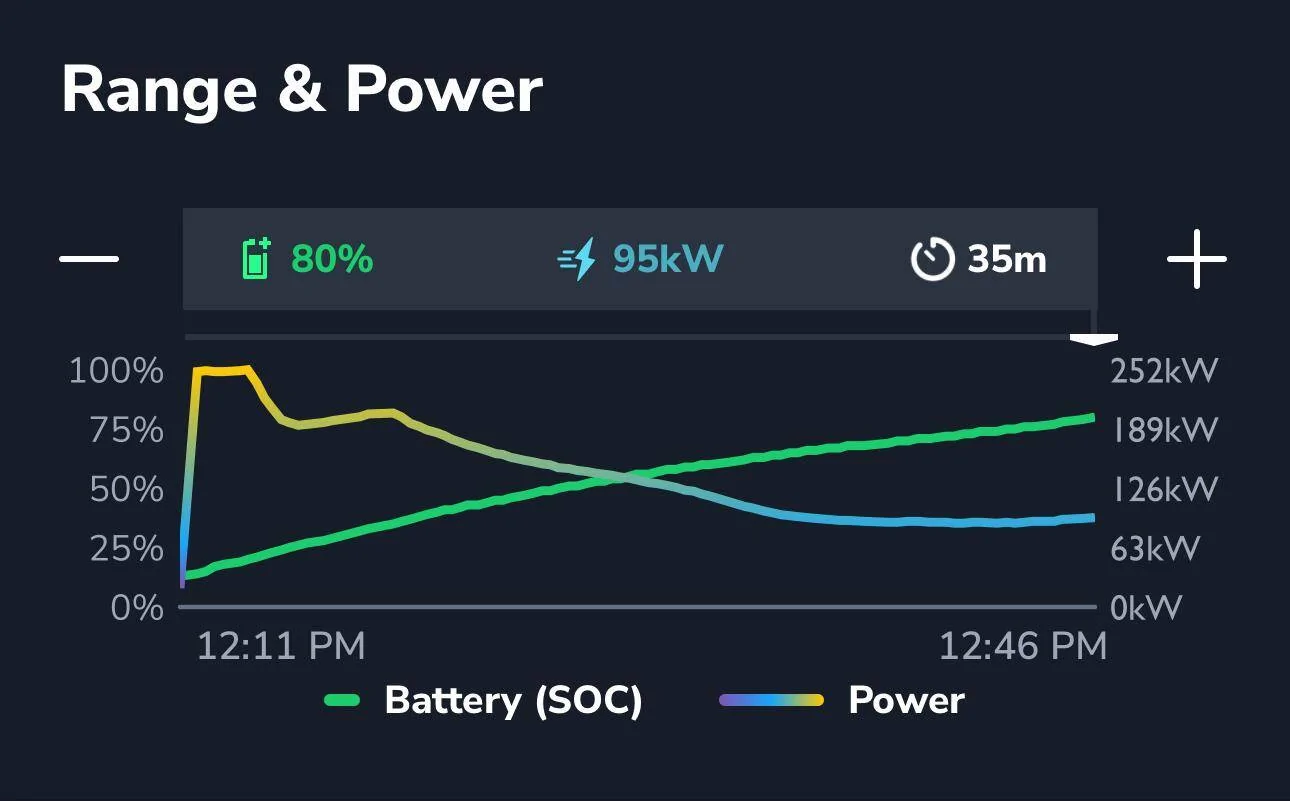
Close as I got in my last road trip. Commonly I only go past 65% if it’s lunch of dinner. Truck still pulling 91kW at 80% which in contrast the Model Y LR was around 45kW
So it’s packing in the power within minutes of each other.
Tesla Cybertruck Supercharger Times from 20% - 80%? 1727533842379-24

Tesla Cybertruck Supercharger Times from 20% - 80%? 1727534070222-0f

Tesla Cybertruck Supercharger Times from 20% - 80%? 1727534167875-jf
Sponsored

 
Last edited:


Top