Sponsored

Cybertruck Range Prediction + Cell Calculation + More [Sources]

OP
OP
samroy92

samroy92

Well-known member
First Name
Sam
Joined
Apr 20, 2021
Threads
14
Messages
186
Reaction score
581
Location
San Diego
Website
samroy.io
Vehicles
2018 Model 3, CT Tri/Quad FSD
Occupation
Head of Technology (SW, DevOps, IT, Security)
Country flag
It's hard to say because there is a lot of factors in cost of battery manufacturing but between $100-$150 per kWh at the pack level. Cost of raw materials has fluctuated a lot in the last few years but at least we can make a range of cost.

Cost of a 150kWh CT pack may cost between $15,000-$22,500 to build
And the big promise of Tesla DBE (purchased from Maxwell acquisition) dry-battery-electrode process is that the cost to manufacture a cell will be substantially cheaper than a wet battery electrode process (lots of extra chemicals, machinery, and processes).
Sponsored

 
OP
OP
samroy92

samroy92

Well-known member
First Name
Sam
Joined
Apr 20, 2021
Threads
14
Messages
186
Reaction score
581
Location
San Diego
Website
samroy.io
Vehicles
2018 Model 3, CT Tri/Quad FSD
Occupation
Head of Technology (SW, DevOps, IT, Security)
Country flag
Bingo!

There is a lot of battery wastage as Tesla develops the manufacturing equipment for 4680 cells. Logically, Tesla would use the least expensive chemistry until the machines have the mechanics of rolling out cells down pat.
I think we are all assuming yields will improve over time, the current cells yield about 81Wh usable capacity per cell. I am already assuming they will be >10% better yields and >5% more increase from chemistry alone. That may put our CT cells at a comfortable 93Wh per cell by late 2023.
 

charliemagpie

Well-known member
First Name
Charlie
Joined
Jul 6, 2021
Threads
48
Messages
2,982
Reaction score
5,369
Location
Australia
Vehicles
CybrBEAST
Occupation
retired
Country flag
It's hard to say because there is a lot of factors in cost of battery manufacturing but between $100-$150 per kWh at the pack level. Cost of raw materials has fluctuated a lot in the last few years but at least we can make a range of cost.

Cost of a 150kWh CT pack may cost between $15,000-$22,500 to build
those figures sound about perfect. But it's Tesla. lol

I think we should start to calculate pack level a little differently. We plonk the seats and integrate whatever other into it before assembly. And its structural.

Sort of share the cost of manufacture with the other integrated components.

Squeezing out the benefits of vertical integration and doing it at enormous scale, I am even thinking far less than $65 pe Kw at pack level.

I guess I am trying to find reason for keeping the prices close to the announced prices lol
 
OP
OP
samroy92

samroy92

Well-known member
First Name
Sam
Joined
Apr 20, 2021
Threads
14
Messages
186
Reaction score
581
Location
San Diego
Website
samroy.io
Vehicles
2018 Model 3, CT Tri/Quad FSD
Occupation
Head of Technology (SW, DevOps, IT, Security)
Country flag
I guess I am trying to find reason for keeping the prices close to the announced prices lol
Agree with you. I also think they could release CT at original prices and post positive on automotive gross margin... kinda nuts.

But w/ supply and demand Tesla isn't going to leave money on the table. Elon is going to try to sweeten the deal for us though: more features that we thought we didn't need :p.
 

charliemagpie

Well-known member
First Name
Charlie
Joined
Jul 6, 2021
Threads
48
Messages
2,982
Reaction score
5,369
Location
Australia
Vehicles
CybrBEAST
Occupation
retired
Country flag
And there will be people who will say

'I didn't need this widget. make the greatest truck on Earth $2.50 cheaper' :LOL:


HaulingAss

Well-known member
Joined
Oct 3, 2020
Threads
28
Messages
10,305
Reaction score
20,716
Location
Western Washington, USA
Vehicles
Cybertruck DM, 2010 F-150, 2018 Performance Model 3, 2024 Performance Model 3
Country flag
I think we are all assuming yields will improve over time, the current cells yield about 81Wh usable capacity per cell. I am already assuming they will be >10% better yields and >5% more increase from chemistry alone. That may put our CT cells at a comfortable 93Wh per cell by late 2023.
Yeilds refers to the percentage of cells that pass quality control. For the cells to have industry leading cost efficiencies, they need to get well over 99% yields. I believe at that time they might start using a more expensive chemistry that has higher energy density.
 
OP
OP
samroy92

samroy92

Well-known member
First Name
Sam
Joined
Apr 20, 2021
Threads
14
Messages
186
Reaction score
581
Location
San Diego
Website
samroy.io
Vehicles
2018 Model 3, CT Tri/Quad FSD
Occupation
Head of Technology (SW, DevOps, IT, Security)
Country flag
Yeilds refers to the percentage of cells that pass quality control. For the cells to have industry leading cost efficiencies, they need to get well over 99% yields. I believe at that time they might start using a more expensive chemistry that has higher energy density.
Thanks for this correction, now I feel like an idiot! I did know that yield was % of good vs bad but I also thought cell yields referred to things like Grade A vs Grade B cells and so on: https://evreporter.com/lithium-ion-cells-a-grade-vs-b-grade/

Those Grade B cells don't have the "full" normal capacity due to molecular level degradation or other errors in the process. Either way, good correction, I need to start thinking better way to describe improvements in battery capacity over time through improved processes and cell chemistry.
 

ldjessee

Well-known member
First Name
Lloyd
Joined
Apr 22, 2020
Threads
14
Messages
1,148
Reaction score
1,361
Location
Indiana, USA
Vehicles
Nissan Leaf, MYLR, Kaw 1700 Vaquero
Occupation
Business Intelligence Manager & Analyst
Country flag
It would be interesting to see where they make the cut off of keeping a cell and using it for stationary storage vs scraping and recycling it (for those less than good enough to put in a vehicle).

Once they have their recycling up to speed and efficiency, that cut-off might climb, as there is a chance with recycling, getting a Grade A vs keeping it as a Grade B and using it for stationary storage...

And, if they really do get their production up for 4680, they could sell Grade B cells to competitors who are so desperate for cells, they would pay even for Tesla's Grade B cells. Maybe.
 

Ogre

Well-known member
First Name
Dennis
Joined
Jul 3, 2021
Threads
166
Messages
10,735
Reaction score
27,050
Location
Ogregon
Vehicles
Model Y
Country flag
It would be interesting to see where they make the cut off of keeping a cell and using it for stationary storage vs scraping and recycling it (for those less than good enough to put in a vehicle).

Once they have their recycling up to speed and efficiency, that cut-off might climb, as there is a chance with recycling, getting a Grade A vs keeping it as a Grade B and using it for stationary storage...

And, if they really do get their production up for 4680, they could sell Grade B cells to competitors who are so desperate for cells, they would pay even for Tesla's Grade B cells. Maybe.
I suspect Tesla makes use of every cell they make


ldjessee

Well-known member
First Name
Lloyd
Joined
Apr 22, 2020
Threads
14
Messages
1,148
Reaction score
1,361
Location
Indiana, USA
Vehicles
Nissan Leaf, MYLR, Kaw 1700 Vaquero
Occupation
Business Intelligence Manager & Analyst
Country flag
So, if a cell is half the capacity of most other cells, you think they keep that? How would they balance a string or pack with that kind of variance?

Maybe they do have a use, but I think at some point, they will just recycle the cell, it is not worth trying to work it in with other cells.

The energy density would just be too low I would think...
 

Ogre

Well-known member
First Name
Dennis
Joined
Jul 3, 2021
Threads
166
Messages
10,735
Reaction score
27,050
Location
Ogregon
Vehicles
Model Y
Country flag
So, if a cell is half the capacity of most other cells, you think they keep that? How would they balance a string or pack with that kind of variance?

Maybe they do have a use, but I think at some point, they will just recycle the cell, it is not worth trying to work it in with other cells.

The energy density would just be too low I would think...
Cells must be extremely close to each other in capacity. If a cell is 50% capacity at manufacture, there is something seriously wrong with it and it’ll get recycled.

I think the difference in “A cells” and B cells is more like half a percent or perhaps less.
 
OP
OP
samroy92

samroy92

Well-known member
First Name
Sam
Joined
Apr 20, 2021
Threads
14
Messages
186
Reaction score
581
Location
San Diego
Website
samroy.io
Vehicles
2018 Model 3, CT Tri/Quad FSD
Occupation
Head of Technology (SW, DevOps, IT, Security)
Country flag
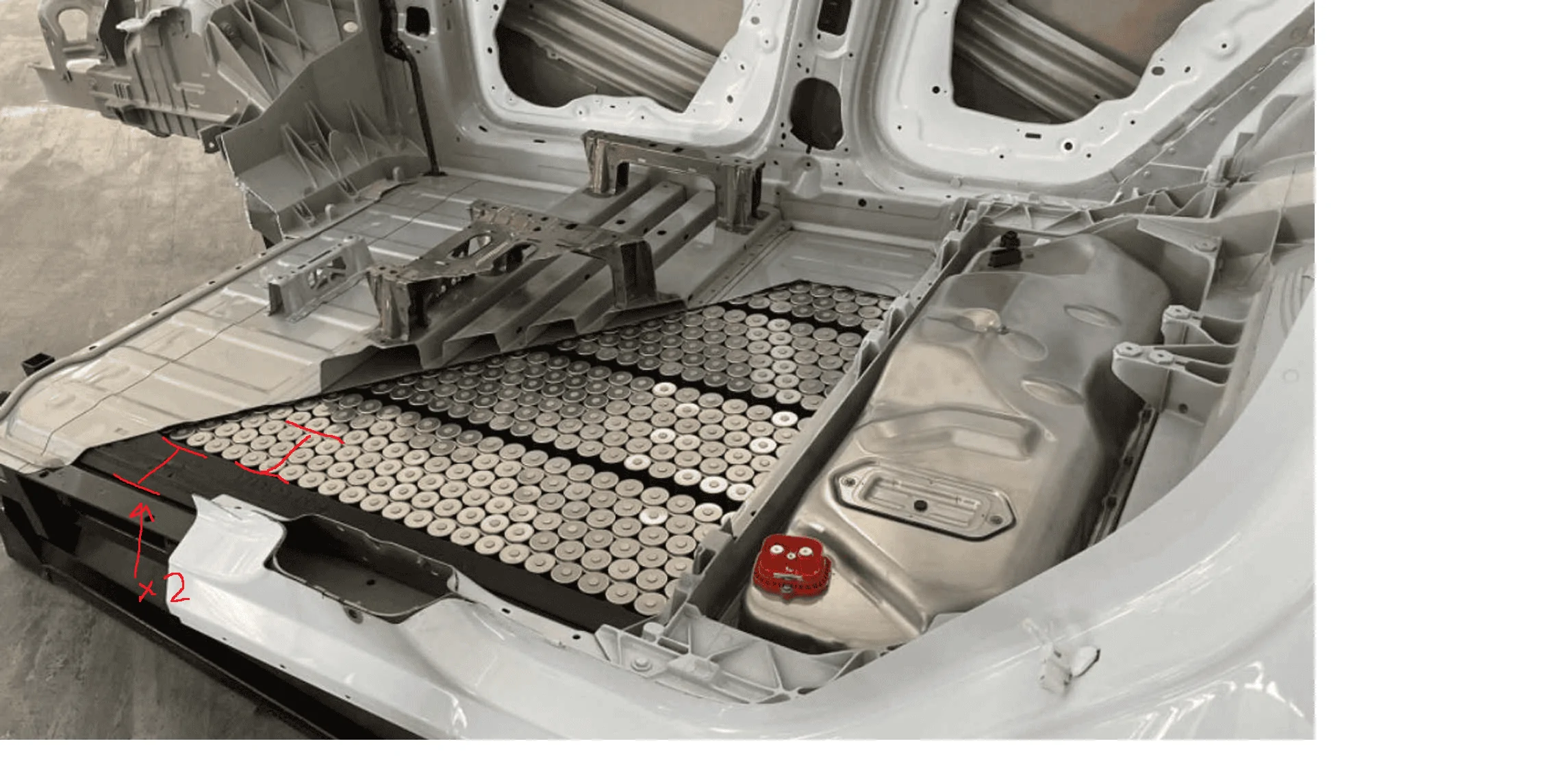
We don't really have enough information to calculate the width, I made a rough estimation. Take a look at the picture below of a 4680 structural model y. They put a spacer in the side of the pack here, it just happens to be roughly exactly the width of half a group of cells. There's two of those spacers. This leads me to speculate the model y can support 5 groups of cells for a long range model (I went into that above).

Given that the Cybertruck is wider than the model Y, 5 groups of cells was a safe assumption (so I think).

1658687819544.webp
@Crissa
@ldjessee

Great to get some validation from The Limiting Factor on this prediction here (at 6:40):
 

Jhodgesatmb

Well-known member
First Name
Jack
Joined
Dec 1, 2019
Threads
89
Messages
6,487
Reaction score
9,025
Location
San Francisco Bay area
Website
www.arbor-studios.com
Vehicles
Tesla Cybertruck FS AWD, Tesla Model Y LR
Occupation
Retired AI researcher
Country flag
Fair - what I am trying to accomplish is pulling in all known facts and data related to 4680 yields+production as well as structural packs to show whether or not its even -possible- for Cybertruck to have 500mi of range out of the gate. I am the biggest TSLA bull in the world but I just don't see it being 500mi in 2023. The goal of this thread is to back up my claims. Would absolutely LOVE to be wrong here.

From a practical business perspective it also doesn't make sense for Tesla to burn through extra cells on the range of CT to achieve 500mi. It only made sense if the density improvements were made, and unfortunately, we aren't there yet.

I have no doubt we will see a 500 range CT at some point in the future just not anytime soon.
It is really all about the efficiency of the truck. When Tesla showed that it could drive a Class A semi, fully loaded, from Fremont to San Diego, on a single charge, that became the new baseline for me.

We know that it has an efficiency of ~1.7 KwH/mile and weighed 81,000 lbs. We know that the Model X has an efficiency of .32 KwH/mile. If the CT has a tow rating of 14,000 lbs and weighs around 6,000 ls then it will be 1/4 (i.e., ~20,000 lbs) the tow weight of the Semi. A quarter of the efficiency of the Semi would be about .425 KwH/mile. The Semi has about an 850 KwH battery pack. If the CT has an efficiency between .32 and .425, and 1/4 of the Semi battery size (i.e., ~212 KwH), would it be reasonable to then expect a similar range of 500 miles?

I have no idea how to perform these kinds of calculations. Can someone that knows how to do this please correct me? I am assuming that there is a linear relationship and that they can actually be scaled across vehicles. If in fact the CT efficiency is closer to the Model X, then the size of the battery pack could be reduced to 160 KwH and achieve the same range. But the big thing here is that these calculations, if at all valid, are based on a 20,000 lb total weight.
 

Jhodgesatmb

Well-known member
First Name
Jack
Joined
Dec 1, 2019
Threads
89
Messages
6,487
Reaction score
9,025
Location
San Francisco Bay area
Website
www.arbor-studios.com
Vehicles
Tesla Cybertruck FS AWD, Tesla Model Y LR
Occupation
Retired AI researcher
Country flag
It is quite weird that the Rivian isn’t significantly more efficient than the F150 considering the F150 is so much bigger.

Cybertruck is also bigger than the Rivian, but it might have a lower wind cross-section. It’s definitely wider, just thinking perhaps it’s thinner, sort of a pancake truck. I “measured” the Cybertruck against the F150 and seem to recall it was 4-6 inches less thick. They end up the same height, but the F150 has far less ground clearance.
The CT 'can' have a ground clearance of 8", which is less than my old Lexus RX. It would then be more like a wedge pushing through the air than a block like the F150 Lightning. I recently drove a rental Model X and played a bit with the suspension. Tesla had it set to 'low' but it also had a 'very low' setting. The difference was less than an inch, but the total range was only a couple of inches. Taking the CT through its entire suspension range could be quite the ride :)
Sponsored


Top