
Sponsored

Instant Compact F150 (Structure matters!)

Diehard

Well-known member
First Name
D
Joined
Dec 5, 2020
Threads
23
Messages
2,127
Reaction score
4,257
Location
U.S.A.
Vehicles
Olds Aurora V8, Saturn Sky redline, Lightning, CT2
Country flag
...And in every other accident, the one in the giant vehicle has more momentum to arrest, which means they're more likely to lose control and more likely to roll over.

And that mass will crush itself against whatever it hits, which probably won't be a softer car.

-Crissa
I am not sure how statistically accurate it is, but my hats off to the creative response. I can see how the extra mass can become your enemy at times. It makes me feel better about the low center of gravity of Lightning and CT.
Sponsored


Crissa

Well-known member
First Name
Crissa
Joined
Jul 8, 2020
Threads
138
Messages
19,571
Reaction score
31,475
Location
Santa Cruz
Vehicles
2014 Zero S, 2013 Mazda 3
Country flag
I am not sure how statistically accurate it is, but my hats off to the creative response. I can see how the extra mass can become your enemy at times. It makes me feel better about the low center of gravity of Lightning and CT.
It's hard to assess statistically, but yes, that extra weight works against you in an emergency. An object in motion stays in motion, resisting attempts to change direction or stop. You're also more likely to sink into turf, mud, snow, which is not always good.

-Crissa
 
OP
OP
Ogre

Ogre

Well-known member
First Name
Dennis
Joined
Jul 3, 2021
Threads
166
Messages
10,735
Reaction score
27,050
Location
Ogregon
Vehicles
Model Y
Country flag
There is this peculiar myth that bulkier/ heavier cars are safer. They are not. Stopping distances are worse, rollover risk is worse, moose turn type turning is much worse.

Heavier cars are more likely to be in collisions so you are more likely to be injured and injure others.

Smaller cars are safer because they are far less likely to be in a collision. This is trebly true for people not inside the vehicle in question who take the brunt of the damage when you have the overweight vehicle.

The smart car takes more damage in a frontal collision than a heavier car at a given speed, it is far likelier to be going slower when it is involved in a collision because it stops faster. The only case where a (significantly) heavier car is safer is if somehow you are in a frontal collision you are unaware of until the absolute last instant.
 

Crissa

Well-known member
First Name
Crissa
Joined
Jul 8, 2020
Threads
138
Messages
19,571
Reaction score
31,475
Location
Santa Cruz
Vehicles
2014 Zero S, 2013 Mazda 3
Country flag
The smart car takes more damage in a frontal collision than a heavier car at a given speed, it is far likelier to be going slower when it is involved in a collision because it stops faster. The only case where a (significantly) heavier car is safer is if somehow you are in a frontal collision you are unaware of until the absolute last instant.
Even then, it's a toss-up: because of that weight, the crumple zones have to crumple more, and the vehicle itself continues moving. More likely to have more secondary collisions, more likely for a small-offset collision to penetrate the cabin.

-Crissa


OP
OP
Ogre

Ogre

Well-known member
First Name
Dennis
Joined
Jul 3, 2021
Threads
166
Messages
10,735
Reaction score
27,050
Location
Ogregon
Vehicles
Model Y
Country flag
I think many of these do relate to size.

All of these types of accidents are less likely when you have a smaller, more controllable vehicle. Rollovers in particular are much more likely in a truck and are quite lethal.
  • 58 percent of police-reported fatal car accidents involved only one vehicle.
  • 40 percent of all fatal car accidents started by a collision with a fixed object (such as trees or street signs) or a noncollision (such as rollovers).
  • Light trucks and trucks experienced the highest rollover rate in fatal car accidents, at 25.6 percent.
  • Rollovers accounted for 17.9 percent of all fatal car accidents in 2016.
 

charliemagpie

Well-known member
First Name
Charlie
Joined
Jul 6, 2021
Threads
48
Messages
2,982
Reaction score
5,369
Location
Australia
Vehicles
CybrBEAST
Occupation
retired
Country flag
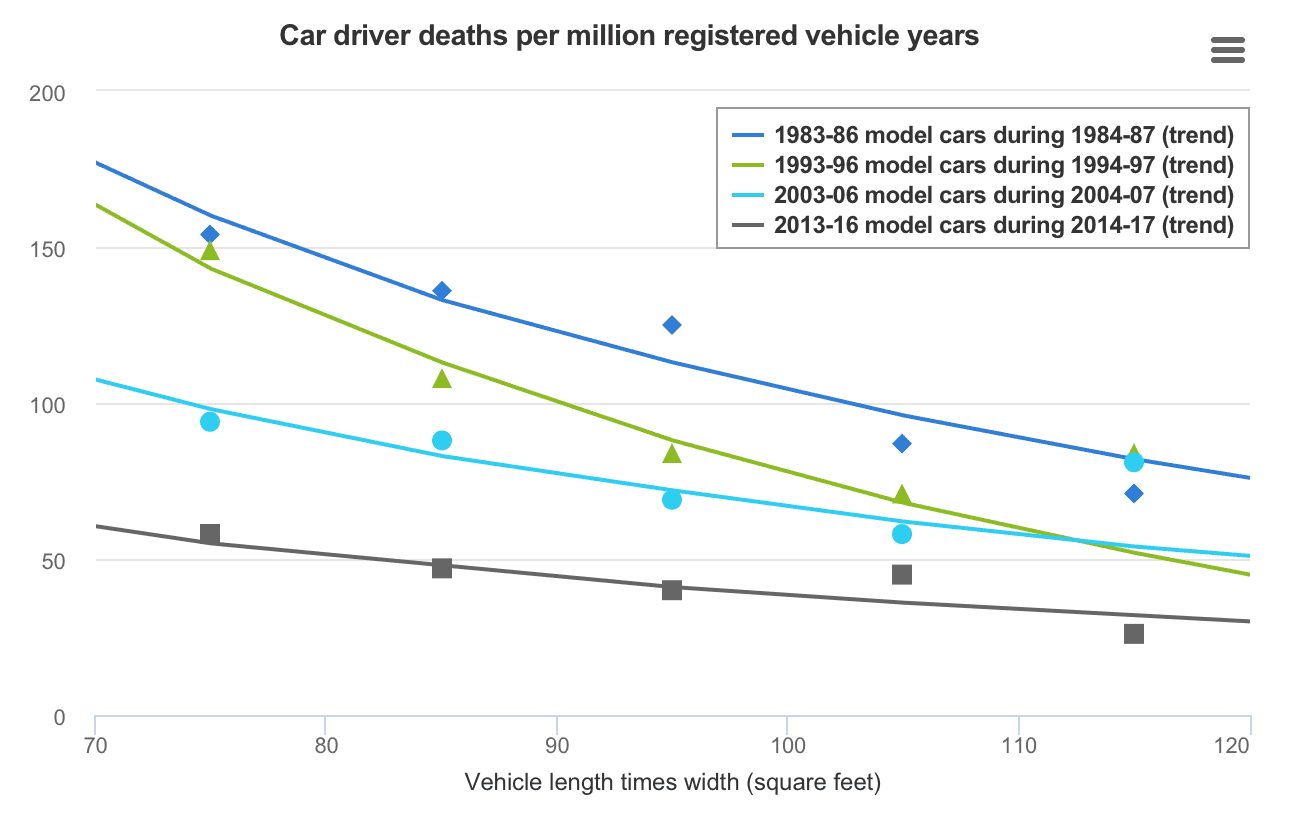
Hopefully one day we will not have enough data to correlate these types of charts.
 

Diehard

Well-known member
First Name
D
Joined
Dec 5, 2020
Threads
23
Messages
2,127
Reaction score
4,257
Location
U.S.A.
Vehicles
Olds Aurora V8, Saturn Sky redline, Lightning, CT2
Country flag
I think many of these do relate to size.

All of these types of accidents are less likely when you have a smaller, more controllable vehicle. Rollovers in particular are much more likely in a truck and are quite lethal.
  • 58 percent of police-reported fatal car accidents involved only one vehicle.
  • 40 percent of all fatal car accidents started by a collision with a fixed object (such as trees or street signs) or a noncollision (such as rollovers).
  • Light trucks and trucks experienced the highest rollover rate in fatal car accidents, at 25.6 percent.
  • Rollovers accounted for 17.9 percent of all fatal car accidents in 2016.
Regardless of how you view these bullet points, I am not saying that weight and size of the vehicle can not be a disadvantage in some circumstance. There have been many times I almost crap my pants with a large truck on ice. I am not even saying a larger vehicle is inherently safer regardless of conditions. If automobiles had weight class like boxers and were confined to the roads restricted to their own weight class, lighter vehicles may very well prove to be safer.

What I am saying is that as data shows, “over all“ occupying the same roads, smaller vehicles are deadlier. Most likely because they share the roads with larger vehicles. I make this assumption because drop in how deadly they are seem to coincide with more recent design improvement of the larger vehicles to protect smaller ones in case of an accident.

I am trying to prevent a misunderstanding here. I am not saying Big cars Good, small Cars bad. I am saying every vehicle has Pros and Cons. There are tons of reasons one may want to drive a smaller vehicle where advantages outweigh the disadvantages. I ride a bicycle, scooter and a motorcycle on public roads knowing the risks. When I get on the road I don’t pretend if I get hit by a Smi, I will be fine because of all the other advantages they have. If staying alive in an accident is the only thing that matters, all other conditions being equal, data says you should pick a larger vehicle. Of course that is never the case. Conditions very and priorities do too. That is why the roads are full of vehicles of different sizes. As Moto Moto would say, I likem chunky ( but I am not anti-petite ).
 

JBee

Well-known member
First Name
JB
Joined
Nov 22, 2019
Threads
18
Messages
4,913
Reaction score
6,362
Location
Australia
Vehicles
Cybertruck
Occupation
. Professional Hobbyist
Country flag
In a head on collision, driver of the Rivian/F150 with four times the momentum will experience much smaller rapid peak deceleration than driver of the smart car no matter how much better those airbags in smart car are. Of course I have never done a test with those cars but I sincerely am having problem picturing how this could not be true.
"Peak" is from a short period of high load, which typically is the result of a part of the vehicle or restraint system not deforming progressively, but abruptly. There are a couple of factors, but if you look at any crash dummy video you can see that the dummy keeps on moving even after first impact, whilst the car is already slowing down.

The best way I find to visualize this is to use a piece of paper with a coin on top being pushed across a table. When you suddenly stop moving the paper the coin keeps moving and then also stops. Now a coin is not restrained to the paper, so it experiences even deceleration due to the friction between the paper and the coin. The amount of friction determines the deceleration, but in a vehicle this is more extreme, in that the velocity difference is greater and the stopping "space" inside the vehicle is quite small in comparison, and that the methods of slowing body movements are more abrupt aka higher peak.

For reference, it takes around 20g to set off an airbag, a collision from 40Mph can be as low as 40g, and the highest survivable impact recorded is around 214g.

There's a general impression that Airbags are "soft cushions" rather very high pressure inflated fiber reinforced bags that actually cause injuries. They are so to prevent more serious injuries, of the fatal kind. Similar to seat belts that have a long history of snapping collar bones. That is also why they have multistage airbags now so they can regulate the forces according to the crash severity to reduce airbag injury, and also why seat belt pretensioners reduce forces by increasing the deceleration prior to the body moving very much.

In regards to vehicle mass and inertia, it's easiest to understand the forces involved by considering that it is only the "change of motion direction" that causes acceleration. That is to say if vehicle is brought to a complete stop all the forces were absorbed by the structure, but if the vehicle is deflected the forces are distributed over different angles and can dissipate with less extreme peaks. Hence my somewhat flamboyant ping pong ball analogy, where a hard ping pong ball hits a hard table tennis surface, slightly compresses, and deflects energy into a different path. (table tennis serves are up to 60mph btw). Now imagine a body suspended by cushions (airbags) and belts in the middle of the structure to reduce body accelerations and peaks. The mass of the table (and supporting floor) is huge in comparison to a table tennis ball.

Another factor to consider regarding energy transfer in the collision, is how long each vehicle is actually decelerating from the impact. In a "full stop head on" (which is unlikely given the deliberate Smart structure, look at how it "bounces" in any crash video) a higher mass vehicle will travel further than the lower mass vehicle after impact. If both at the same velocity that would mean the lighter vehicle will end up travelling backwards, meaning that so long g-forces remain progressive, you can still have survivable peaks. But because of the deflection, those peaks can and are reduced.

Although a lighter vehicle has less inertia to overcome, the real metric for stopping time is the coefficient of friction (tyres, road surface) to the ground and the capability of the brakes, in particular to convert kinetic into heat. That means a higher mass vehicle will have better traction by nature of it's mass, and so long the tyres and brakes are comparable in performance, it will brake just as fast as a lighter vehicle. What it won't want to do though is change direction as fast as a lighter vehicle, meaning that cornering, or steering to avoid, and general handling are less impacted by a lighter design. There is a caveat here in that in production vehicles, the tendency is that lighter vehicles brake faster, mostly because their brakes can be oversized at little to no extra cost, in comparison to a heavy vehicle. Note cars like the MS Plaid are both accelerating and decelerating at the limit of traction of the tyres, and not because their vehicle systems can't achieve more performance. In fact most cars that activate ABS on braking are already approaching the traction limits, although mostly a locking tyre will stop in less distance on a dry bitumen road but not be as controllable.
 

Crissa

Well-known member
First Name
Crissa
Joined
Jul 8, 2020
Threads
138
Messages
19,571
Reaction score
31,475
Location
Santa Cruz
Vehicles
2014 Zero S, 2013 Mazda 3
Country flag
Per registered vehicle means all those fleet vans sitting idle in parking lots. And professionally driven busses and limos.

-Crissa


cvalue13

Well-known member
Joined
Aug 17, 2022
Threads
74
Messages
7,153
Reaction score
13,769
Location
Austin, TX
Vehicles
F150L
Occupation
Fun-employed
Country flag
There is this peculiar myth that bulkier/ heavier cars are safer. They are not. Stopping distances are worse, rollover risk is worse, moose turn type turning is much worse.

Heavier cars are more likely to be in collisions so you are more likely to be injured and injure others.

Smaller cars are safer because they are far less likely to be in a collision. This is trebly true for people not inside the vehicle in question who take the brunt of the damage when you have the overweight vehicle.

The smart car takes more damage in a frontal collision than a heavier car at a given speed, it is far likelier to be going slower when it is involved in a collision because it stops faster. The only case where a (significantly) heavier car is safer is if somehow you are in a frontal collision you are unaware of until the absolute last instant.
Really just feeling devil’s advocate to understand the bounds of all these assertions. I’m instinctively fine with the notion that bigger/heavier cars may be “less safe” on some metric, all else being equal.

But the glitch in my system is the apparent implication that the degree of difference is a preeminent for safety and that it’s a generalized truth that tells us little about individual scenarios.

“Heavier cars are more likely to be in collisions,” based on what? That all else being equal they don’t stop as fast? Isn’t the corollary that all else equal they also don’t accelerate as fast in the first place? And if we’re broadly equating heavier cars with being in collisions, is that not damning of EVs generally? On the other hand, if we’re broadly equating heavier cars with shit centers of gravity, is that not also damming of EVs? Or these examples instead point to the real issues of such population-based generalizations, which is similar to discussing BMI of people’s weight: there is population level relevance if not controlling for relevant variables, but almost zero individual-level relevance once relevant variables are controlled for.

Just as a competitive bodybuilder has a BMI that would at population level suggest she will be dying soon of obesity-related illness, a fully modern SUV/pickup is light years more safe than almost any vehicle of any size built just 10 years ago. And some SUV/trucks built today are all things considered far more safe than many other smaller choices on the market.

Sure, if you take two vehicles identical in all other relative capabilities except one that is heavier and with a higher center of gravity may imply some delta safety, in both directions (plus and minus), with one direction outweighing the other. No solutions, only trade-offs. All else being equal, avoid cars with shit breaks, shit centers of gravity, and shit visibility - which are issues universal to all cars, and requires additional selection effort in the larger vehicle classes.

However probably more relevant from a “safety” perspective in terms of individual choices is if possible to first buy almost any modern car that has the suite of modern safety features.
 
Last edited by a moderator:

firsttruck

Well-known member
Joined
Sep 25, 2020
Threads
205
Messages
2,761
Reaction score
4,441
Location
mx
Vehicles
none
Country flag
Really just feeling devil’s advocate to understand the bounds of all these assertions. I’m instinctively fine with the notion that bigger/heavier cars may be “less safe” on some metric, all else being equal.

But the glitch in my system is the apparent implication that the degree of difference is a preeminent for safety and that it’s a generalized truth that tells us little about individual scenarios.

“Heavier cars are more likely to be in collisions,” based on what? That all else being equal they don’t stop as fast? Isn’t the corollary that all else equal they also don’t accelerate as fast in the first place? ...
Yes, heavier vehicles are MORE LIKELY ( BUT NOT 100% guaranteed) to be in collisions just based on they don’t stop as fast?

From a safety aspect shorter distance to come to a stop (deccelerate) is usually much more important than unusually quick ability to accelerate.

A huge portion of accidents are either driving into fixed objects (trees, walls, concrete barriers, poles, etc), driving into the back of another vehicle, T-bone another vehicle, or a failed maneuver around (slowing helps) an obstacle/vehicle. In all these situations a shorter stopping distance (or slowing ability) is important factor.

Much fewer accidents occur (other than pedal mis-applications or suicides) are accelerating into a fixed objects or other vehicle .
 

cvalue13

Well-known member
Joined
Aug 17, 2022
Threads
74
Messages
7,153
Reaction score
13,769
Location
Austin, TX
Vehicles
F150L
Occupation
Fun-employed
Country flag
Yes, heavier vehicles are MORE LIKELY ( BUT NOT 100% guaranteed) to be in collisions just based on they don’t stop as fast?

From a safety aspect shorter distance to come to a stop (deccelerate) is usually much more important than unusually quick ability to accelerate.
Yes thank you for amplifying. Though I only mentioned that correlate as the first of only a few of many examples of how several variables (e.g. the weight of EVs vs their low center of gravity, etc.) can significantly alter the calculation as to whether a specific vehicle is on an all-things-considered basis more or less safe than a specific comparison.

It seems like to say that “heavy vehicles with a high center of gravity are materially less safe” is missing the important qualifier of: “… compared to an identical vehicle that is materially less heavy and/or with a materially lower center of gravity.” The specificity of that more accurate comparison shows the limits of the point.

To broadly suggest that anyone in any heavy vehicle with a high center of gravity is materially less safe than any other vehicle that is lighter and with a lower center of gravity is patently false in its generalization. One need only compare a modern F150 complete with all of its modern safety accoutrements (and all-around 5-star safety railings) to a 1997 BMW 3-series (which even in its time of relatively unsafe peers still received no higher than a 2-star safety raiting).

That said, despite the limits of these population-level comparisons, I’d be interested to see data proving up that people driving modern large SUV/Trucks have materially higher fatality/injuries than people driving equally modern passenger vehicles. Whether that’s true or not I just don’t know and haven’t seen the data, though I follow and empathize with the inferences and anecdotes being put forward here.
 

JBee

Well-known member
First Name
JB
Joined
Nov 22, 2019
Threads
18
Messages
4,913
Reaction score
6,362
Location
Australia
Vehicles
Cybertruck
Occupation
. Professional Hobbyist
Country flag
Yes, heavier vehicles are MORE LIKELY ( BUT NOT 100% guaranteed) to be in collisions just based on they don’t stop as fast?

From a safety aspect shorter distance to come to a stop (deccelerate) is usually much more important than unusually quick ability to accelerate.

A huge portion of accidents are either driving into fixed objects (trees, walls, concrete barriers, poles, etc), driving into the back of another vehicle, T-bone another vehicle, or a failed maneuver around (slowing helps) an obstacle/vehicle. In all these situations a shorter stopping distance (or slowing ability) is important factor.

Much fewer accidents occur (other than pedal mis-applications or suicides) are accelerating into a fixed objects or other vehicle .
It's simply against the laws of physics to generalise that lighter vehicles brake faster than heavier ones. It's also particularly bogus if you don't specify and compare what types of brakes, tyres and road surface conditions are involved.

As described in my previous post the two main factors for braking distance are 1) brake performance and 2) how much of that can be translated into deceleration by the coefficient of friction of your tyre to ground interface.

Any mass can be braked at the same rate, if both these factors above are the same. Hence the equation ÎĽ = F/N. Remember a heavier vehicle also naturally has more traction than a lighter one running the same tyres. It's fairly trivial and cheap to over dimension brakes, which most are, and even there it depends on cooling (so ambient conditions) and brake wear etc, and if you are coming down a hill hot or just a one off freeway cold stop etc.

Tyres are also not all equal, slicks are better for dry conditions, different treads and compounds make huge differences (like the addition of carbon black) and how water is shed or rubber stays supple in cold conditions etc.

So for any comparison to be made you would need to throw in at least some of those variables to get any type of meaningful trend.

The first thing I would do though is remove the statistics involving driving under the influence, drugs, poor state of repair and all the drivers who got their licence in a Corn Flakes cereal box.

Note this applies directly to the act of braking, in other metrics, like manevouring etc, lighter is often better, but is also is limited to the capability of the contact patch with the road.

As for roll over or crash structure the overall vehicle mass has little to say how good the structure is, as this is determined by size, shape and materials used for the structure, in relation to its total vehicle mass and how it decelerates it progressively.
 
Last edited:
OP
OP
Ogre

Ogre

Well-known member
First Name
Dennis
Joined
Jul 3, 2021
Threads
166
Messages
10,735
Reaction score
27,050
Location
Ogregon
Vehicles
Model Y
Country flag
It's simply against the laws of physics to generalise that lighter vehicles brake faster than heavier ones. It's also particularly bogus if you don't specify and compare what types of brakes, tyres and road surface conditions are involved.
So which pickup truck or large SUV on the market Today has a stopping distance which is remotely close to the stopping distance of a Smart car?

What is “Possible within the laws of physics” and what is actually in fact real and exists are different things.

Maybe Cybertruck will be the exception.
Sponsored


Top