no%X#XMVk65v#cq
Well-known member
- Thread starter
- #1
Disclosure: I am not an electrician or qualified to advise on doing this kind of work. This is just what I did.
Recent extreme weather has prodded me to finally deal with how to get the enormous battery pack already in my garage to power my house. First off, even though I have a Foundation Series with the Powershare credit, Powershare was just never an option for me for a number of reasons:
Interlock pros:
Now what about neutral-bonding? If you ask around the responses for how important this issue is range from you-will-instantly-die to no-biggie. What's even more frustrating is there just is no info about neutral-bonding from Tesla's side. We don't know. Any test you conduct might have false readings based on the logic of the truck's systems. I've searched and come up with no definitive answer as to whether to treat the onboard power on the Cybertruck as a neutral-bonded generator, or a floating-neutral generator. For home powering, you want floating, because the neutral is already bonded at the panel. Having two neutral bonds can cause voltage to ride on the ground. I fretted about this quite a bit. But then I got curious and grabbed a multimeter and just started testing stuff around the property. Turns out that one outbuilding and half of another has some voltage returning on ground, and it has been that way for over a decade without me missing even one night's sleep over it. I tried to correct it... but decided to just scratch my head and walk away after everything I tried failed. Likewise I am comforted by the knowledge that most generator owners have no clue about this concern at all and just send it right out of the box, and since the only deaths I hear about are from people running them indoors, I just decided not to worry about it.
What we do know from other forum members who have already tried this by back-feeding with an interlock is, neutral-bonded or not, it works. This is not the case with the F150 Lightning onboard plugs. To get those to work, you must cheat by leaving a ground off or the truck trips. Cybertruck does not. Why is this? Who knows. Is the Cybertruck plug not GFCI protected? Doubt it. Is it neutral-floating? Doubt that too as it's far more dangerous to run power tools or whatever from a neutral-floating generator than to power a house from a neutral-bonded one. Does Cybertruck have some logic that switches back and forth as needed? Not likely, since they sell the entire Powershare Gateway system for this exact purpose. Is there something special about the grounding of the vehicle or inverter architecture that makes this a non-issue? Perhaps the stainless steel construction makes the flux dispersal... Anyway, I jacked into the house and I have no voltage on ground in branch circuits.
You can also (for added cost and complexity) get a neutral-switching manual transfer switch if you're certain that your generator is neutral-ground bonded. But are we certain of that? We are not.
These are the products I used, all available on Amazon:
A510C Pro/Tran2 50-Amp 10-Circuit 2 Manual Transfer Switch
50 Amp Generator Cord 10FT and Power Inlet Box Waterproof Combo Kit, NEMA 14-50P to SS2-50R Generator Extension Cord with NEMA SS2-50P Generator Inlet, ETL Listed
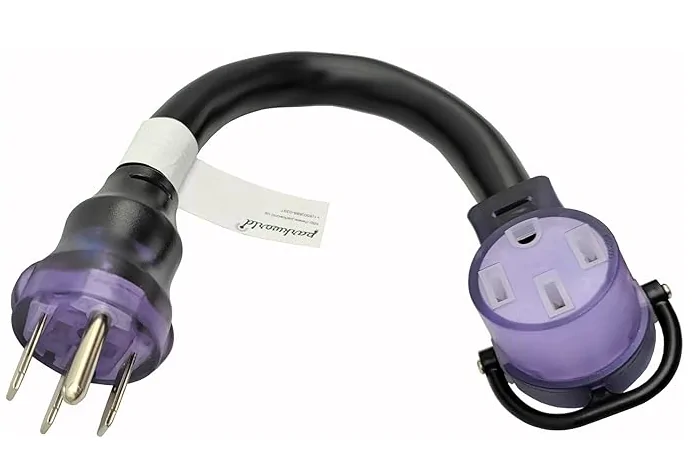
Parkworld RV/EV 50A Extension Cord, NEMA 14-50 Extension Cord, NEMA 14-50P to 14-50R Straight Plug for Generator (1.5FT)
I already had some 6/3 wire on hand to run between the two products. I just installed the inlet in the garage, since our generators create no fumes. The short cord works perfect for me. I like that it came with the extension adapter on the truck end because it is tight getting that thing plugged in with how close to the outlet is to the bottom of the bed. I wish Tesla would have made that easier to access, but the extender makes it just a little more maneuverable. I can't see how you'd plug it in without leaving the tailgate open, but I guess that's ok, just makes it tight in a garage. Also, it's a little concerning how much play there is on that panel that houses the outlets on the truck. It's not heavy-duty at all, kind of the same way the NACS port gives when the plug is stretched.
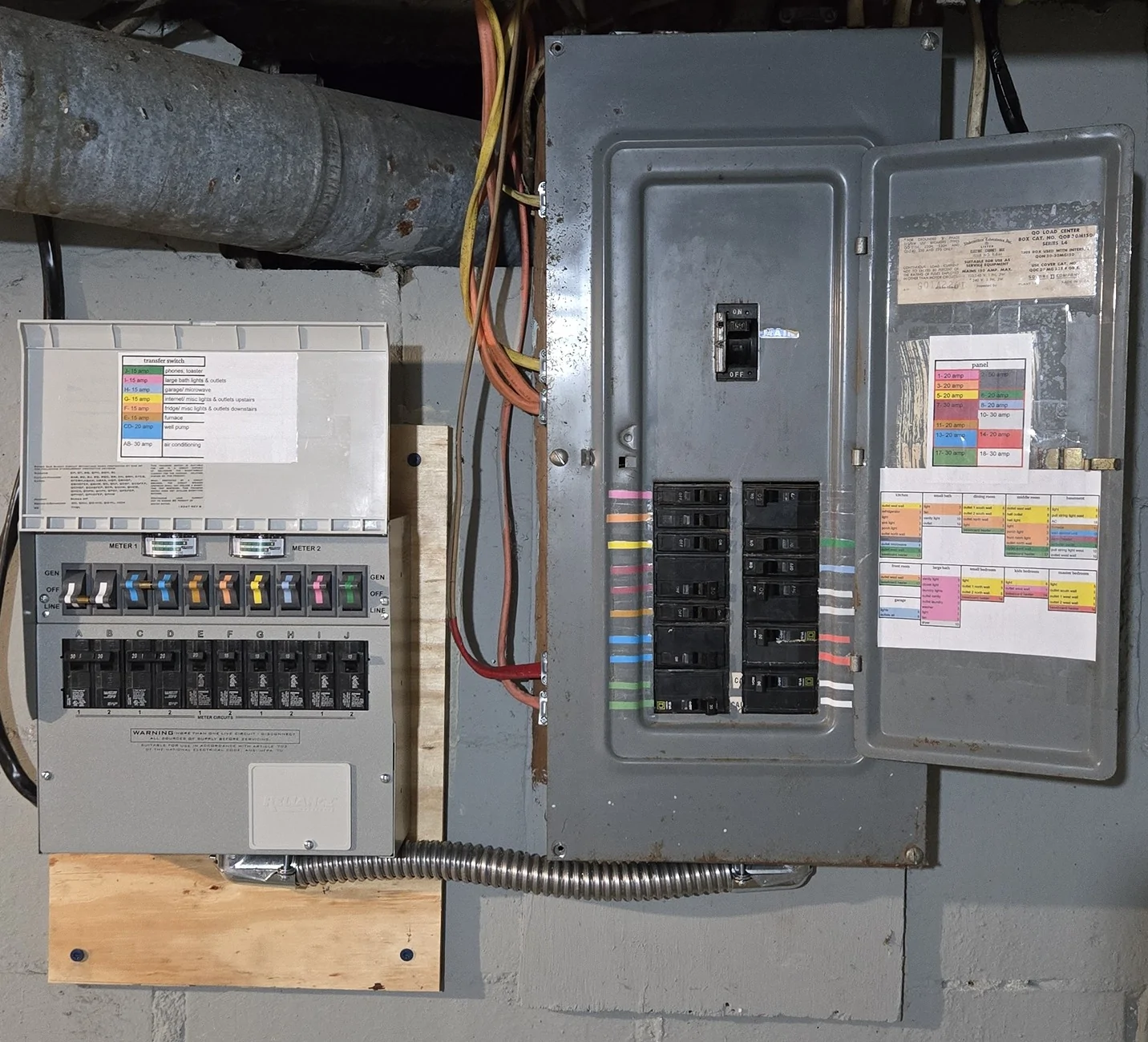
So next I had to choose which circuits to include. I decided the most important were well pump, furnace, fridge, and then the rest. I had to make a choice between water heater and air conditioning, as there was only one 30 amp 2 pole slot available. I chose A/C because water tanks keep water hot for an insane amount of time, but the house will get hot real fast in the summer without A/C. I ended up with room for nearly all the lights and outlets in the house as well. The only things excluded from my setup are: water heater, oven/stove, clothes dryer, and baseboard heaters (not vital to my HVAC system).
I made it a point to leave the truck in it's spot the night before my test day, so it was about 12 degrees and not conditioned when I used the app to power on the outlets. No problem there. I ran everything off the truck yesterday from 9:30 to 5:30. Temps never got out of the teens and my house is old so the furnace was running a ton. I used 5% of the battery. No one believes me. This is a massive battery by home battery backup standards!
Overall I'm very pleased how it turned out, and I believe this is an underrated feature of the truck. Here's a picture of my setup. I maybe went a little overboard with the color-coding, but it was such a guessing game prior to this that I wanted it as organized as humanly possible.

Recent extreme weather has prodded me to finally deal with how to get the enormous battery pack already in my garage to power my house. First off, even though I have a Foundation Series with the Powershare credit, Powershare was just never an option for me for a number of reasons:
- Tesla has no installers in my area. Or at least they didn't when I got my truck, haven't checked since. But I've had a powerwall ordered since before I made my Cybertruck reservation, and the status still just says they will contact me when they have installers in my area.
- Tesla won't sell me the Powershare setup without an installer.
- I wouldn't pay thousands of dollars to have it installed anyway.
- The system seems finicky and clunky... relies on an app and a lot of software to work.
- I don't charge the truck at my house anyway. I charge it at an outbuilding with a separate electrical service, because I'm out of room in my house panel.
Interlock pros:
- Simpler, easier to install, cheaper
- Powers the entire panel
- They seem...janky? A tacked on puzzle of a device that can easily be defeated by simply removing the cover.
- You must throw the main, so it's uncertain when the power returns to the line
- When power returns you must disconnect power, then reconnect to the main, so all devices will power off
- Does not require any space in the main panel
- No need to throw the main, or any breakers, ever
- Circuits powered by generator can be run at the same time as circuits powered by line
- Switching from generator back to line is seamless, devices stay on
- You must choose which circuits you wish to power by generator and those choices are fixed. Maximum 10 poles total is the largest option I found
- Cost
Now what about neutral-bonding? If you ask around the responses for how important this issue is range from you-will-instantly-die to no-biggie. What's even more frustrating is there just is no info about neutral-bonding from Tesla's side. We don't know. Any test you conduct might have false readings based on the logic of the truck's systems. I've searched and come up with no definitive answer as to whether to treat the onboard power on the Cybertruck as a neutral-bonded generator, or a floating-neutral generator. For home powering, you want floating, because the neutral is already bonded at the panel. Having two neutral bonds can cause voltage to ride on the ground. I fretted about this quite a bit. But then I got curious and grabbed a multimeter and just started testing stuff around the property. Turns out that one outbuilding and half of another has some voltage returning on ground, and it has been that way for over a decade without me missing even one night's sleep over it. I tried to correct it... but decided to just scratch my head and walk away after everything I tried failed. Likewise I am comforted by the knowledge that most generator owners have no clue about this concern at all and just send it right out of the box, and since the only deaths I hear about are from people running them indoors, I just decided not to worry about it.
What we do know from other forum members who have already tried this by back-feeding with an interlock is, neutral-bonded or not, it works. This is not the case with the F150 Lightning onboard plugs. To get those to work, you must cheat by leaving a ground off or the truck trips. Cybertruck does not. Why is this? Who knows. Is the Cybertruck plug not GFCI protected? Doubt it. Is it neutral-floating? Doubt that too as it's far more dangerous to run power tools or whatever from a neutral-floating generator than to power a house from a neutral-bonded one. Does Cybertruck have some logic that switches back and forth as needed? Not likely, since they sell the entire Powershare Gateway system for this exact purpose. Is there something special about the grounding of the vehicle or inverter architecture that makes this a non-issue? Perhaps the stainless steel construction makes the flux dispersal... Anyway, I jacked into the house and I have no voltage on ground in branch circuits.
You can also (for added cost and complexity) get a neutral-switching manual transfer switch if you're certain that your generator is neutral-ground bonded. But are we certain of that? We are not.
These are the products I used, all available on Amazon:
A510C Pro/Tran2 50-Amp 10-Circuit 2 Manual Transfer Switch
50 Amp Generator Cord 10FT and Power Inlet Box Waterproof Combo Kit, NEMA 14-50P to SS2-50R Generator Extension Cord with NEMA SS2-50P Generator Inlet, ETL Listed
Parkworld RV/EV 50A Extension Cord, NEMA 14-50 Extension Cord, NEMA 14-50P to 14-50R Straight Plug for Generator (1.5FT)
I already had some 6/3 wire on hand to run between the two products. I just installed the inlet in the garage, since our generators create no fumes. The short cord works perfect for me. I like that it came with the extension adapter on the truck end because it is tight getting that thing plugged in with how close to the outlet is to the bottom of the bed. I wish Tesla would have made that easier to access, but the extender makes it just a little more maneuverable. I can't see how you'd plug it in without leaving the tailgate open, but I guess that's ok, just makes it tight in a garage. Also, it's a little concerning how much play there is on that panel that houses the outlets on the truck. It's not heavy-duty at all, kind of the same way the NACS port gives when the plug is stretched.
So next I had to choose which circuits to include. I decided the most important were well pump, furnace, fridge, and then the rest. I had to make a choice between water heater and air conditioning, as there was only one 30 amp 2 pole slot available. I chose A/C because water tanks keep water hot for an insane amount of time, but the house will get hot real fast in the summer without A/C. I ended up with room for nearly all the lights and outlets in the house as well. The only things excluded from my setup are: water heater, oven/stove, clothes dryer, and baseboard heaters (not vital to my HVAC system).
I made it a point to leave the truck in it's spot the night before my test day, so it was about 12 degrees and not conditioned when I used the app to power on the outlets. No problem there. I ran everything off the truck yesterday from 9:30 to 5:30. Temps never got out of the teens and my house is old so the furnace was running a ton. I used 5% of the battery. No one believes me. This is a massive battery by home battery backup standards!
Overall I'm very pleased how it turned out, and I believe this is an underrated feature of the truck. Here's a picture of my setup. I maybe went a little overboard with the color-coding, but it was such a guessing game prior to this that I wanted it as organized as humanly possible.
Sponsored
Last edited: