Sponsored

Charging from Tesla to Tesla (Vehicle to Vehicle - V2V)

carsly

Well-known member
First Name
Vin
Joined
Dec 13, 2023
Threads
93
Messages
1,529
Reaction score
2,898
Location
Princeton, NJ
Vehicles
LR Defender, CT AWD
Country flag
Did you know the first superchargers just used multiple Model S charger units?
V3 cabinets handle four posts plus deal with incoming three phase AC and include cooling. The high power DC-DC conversion doesn't really take much space/weight.
inside-v3-cabinet_650-1(1).jpg


https://teslatap.com/articles/supercharger-superguide/
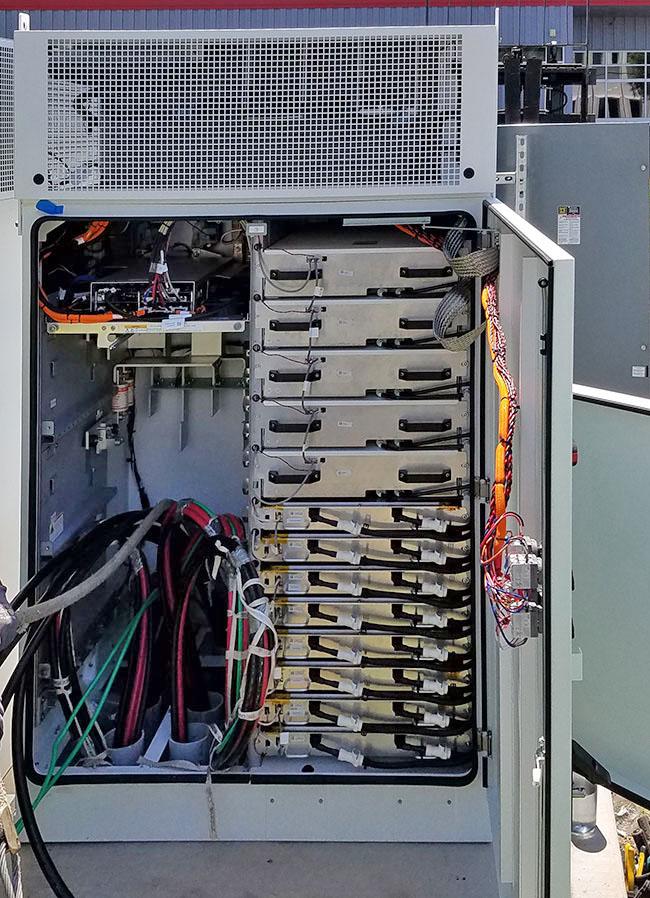
Great info, thanks! Still not lugging that cabinet in the bed to potentially speed up DC to DC charging on the off chance it's needed. Feels like a spare tire might be more helpful.
Sponsored


mongo

Well-known member
Joined
May 27, 2024
Threads
5
Messages
4,520
Reaction score
5,495
Location
SE Michigan
Vehicles
Cyberbeast
Country flag
Great info, thanks! Still not lugging that cabinet in the bed to potentially speed up DC to DC charging on the off chance it's needed. Feels like a spare tire might be more helpful.
Yeah, I'm not thinking there is a lot to be gained, but it only needs one of those silver boxes to do it.
 

QuantumGlen

Well-known member
First Name
Glen
Joined
Mar 22, 2024
Threads
5
Messages
58
Reaction score
78
Location
Los Alamos, NM
Vehicles
Model 3, Model Y
Occupation
Scientist
Country flag
Just saw this post and have some questions:

Cybertruck helps charge a Model Y

I think it's great that a Cybertruck can serve as a mobile charger to rescue vehicles with a dead battery.

Will the Powershare/bidirectional charging ability of a Cybertruck allow a simple cable from charging port to charging port? Thus avoiding the inefficiency of DC-AC-DC conversion.

This is the only helpful article I found which is a bit dated.
Tesla releases Powershare bidirectional charging – on Cybertruck only, so far

Apologies if this has already been discussed here. Thanks.
Works fine. I plugged my mobile cable that came with the truck into the 240 volt outlet (with the right adapter) at the back of the bed, and then charged my wife's Model Y at a 3.8 kW rate.
 
OP
OP

Ed1

Member
First Name
Ed
Joined
Jul 3, 2024
Threads
1
Messages
18
Reaction score
9
Location
NYC
Vehicles
2011 Highlander hybrid
Occupation
Real estate
Country flag
Works fine. I plugged my mobile cable that came with the truck into the 240 volt outlet (with the right adapter) at the back of the bed, and then charged my wife's Model Y at a 3.8 kW rate.
I meant from the charging port directly and not the 240 V outlet. Do a straight DC to DC supercharge. ?
 

Woodrick

Well-known member
First Name
Ed
Joined
Dec 30, 2023
Threads
6
Messages
4,786
Reaction score
4,762
Location
Gainesville Ga
Vehicles
Model 3, Model Y, Cybertruck AWD
Occupation
Consultant
Country flag
Right. my question is whether it’s possible to directly plug from charging port to charging port and get Level 3 supercharger speeds from the Cybertruck to a stranded Tesla. If not, what would it take?

if the CT allows bidirectional charging and can receive supercharging, why not in reverse?
Superchargers are relatively complex animals. They don't put out just 400V. They have multiple modules that adapt to the voltage of the battery when you plug in.
So when you first plug in, it measures the battery voltage and then starts to provide power at varying voltages until the module maxes out, at which time the next module kicks in and does the same, matching the charging voltage of the first, and then a few more modules kick in.
That's why at V2 locations, if no one is plugged into the paired charger, you get all the modules, but if someone plugs in, it takes a module away and then slowly another.

Plugging two 400V batteries together at what WILL be a significant voltage difference will result in basically one thing, a welding machine.

But the bigger thing is how often are you going to need this? I dare says that 99.9% of the Cybertrucks will NEVER charge another EV (except for maybe testing).
Probably 75% will never plug anything into the NEMA 14-50 connector.
And less than 50% will use any of the AC plugs.


mongo

Well-known member
Joined
May 27, 2024
Threads
5
Messages
4,520
Reaction score
5,495
Location
SE Michigan
Vehicles
Cyberbeast
Country flag
Superchargers are relatively complex animals. They don't put out just 400V. They have multiple modules that adapt to the voltage of the battery when you plug in.
So when you first plug in, it measures the battery voltage and then starts to provide power at varying voltages until the module maxes out, at which time the next module kicks in and does the same, matching the charging voltage of the first, and then a few more modules kick in.
That's why at V2 locations, if no one is plugged into the paired charger, you get all the modules, but if someone plugs in, it takes a module away and then slowly another.
The voltage does vary, but the variable being controlled is current (internally power). The cabinet's DC-DC converter output voltage is effectively regulated by the pack with the cabinet likely only providing a maximum voltage control. It's likely not trying to control things by directly setting a voltage. Technically it could, but the resolution on that would be poor due to the low series resistance.

Clarification for others due to phrasing ambiguity:
Modules assigned to a post can run in parallel to reduce individual dissipation or get added when they reach their current/ power limit (or are no longer needed on a shared post), it's not voltage that maxes out. Otherwise, a low SOC battery would not get full charge power.
 

Woodrick

Well-known member
First Name
Ed
Joined
Dec 30, 2023
Threads
6
Messages
4,786
Reaction score
4,762
Location
Gainesville Ga
Vehicles
Model 3, Model Y, Cybertruck AWD
Occupation
Consultant
Country flag
The voltage does vary, but the variable being controlled is current (internally power). The cabinet's DC-DC converter output voltage is effectively regulated by the pack with the cabinet likely only providing a maximum voltage control. It's likely not trying to control things by directly setting a voltage. Technically it could, but the resolution on that would be poor due to the low series resistance.

Clarification for others due to phrasing ambiguity:
Modules assigned to a post can run in parallel to reduce individual dissipation or get added when they reach their current/ power limit (or are no longer needed on a shared post), it's not voltage that maxes out. Otherwise, a low SOC battery would not get full charge power.
If the batteries resistance is relatively constant. Then E=IR means that if you change the current, you have to change the voltage.

It's the voltage that is increased or decreased to cause the current to flow.

When charging batteries, the voltage is continually adjusted to account for the battery voltage increasing.
 

mongo

Well-known member
Joined
May 27, 2024
Threads
5
Messages
4,520
Reaction score
5,495
Location
SE Michigan
Vehicles
Cyberbeast
Country flag
If the batteries resistance is relatively constant. Then E=IR means that if you change the current, you have to change the voltage.

It's the voltage that is increased or decreased to cause the current to flow.

When charging batteries, the voltage is continually adjusted to account for the battery voltage increasing.
As I said:
The voltage does vary, but the variable being controlled is current (internally power).
the resolution on that would be poor due to the low series resistance.
The converter internally deals with power.
More current in it's inductor * more output switch on time -> more power
More power out -> more current out
More current out -> increase in cell voltage and voltage drop across all wires and interconnects.

To say the control loop on cabinet is based on voltage is likely incorrect. Voltage is a lagging parameter to current (worse for control) and the vehicle's charger request (along with recharge limit) is based Amps. There is no value add to adjust coverter duty cycle to match a voltage to match a current when it can just adjust duty cycle to match a current.

You can (mostly) safely charge batteries with a constant current supply (with final voltage cut off). You can't safely charge batteries with a constant voltage supply which is why direct pack to pack connections are a bad idea.


Top