Sponsored

Cybertruck Trailer Hitch/Casting Failure @10,400 lbs *VERTICAL LOAD*

cybercricket

Well-known member
Joined
Oct 31, 2024
Threads
13
Messages
659
Reaction score
798
Location
Oregon
Vehicles
Cybertruck
Country flag
Are we talking anti sway hitches or weight distributing ones?
Weight distribution hitches produce torque opposite of the tongue weight while also decreasing what the receiver would perceive as weight.
Image the trailer was reduced to a point load on the ball and you lifted on the spring arms. That reduces the torque at the pin/receiver and total weight the point source is applying.
How is that ? There are no attachment points to the vehicle utilized other than the receiver, so entire weight is transferred through the receiver whether WD or no WD.
Sponsored


mongo

Well-known member
Joined
May 27, 2024
Threads
6
Messages
4,536
Reaction score
5,524
Location
SE Michigan
Vehicles
Cyberbeast
Country flag
How is that ? There are no attachment points to the vehicle utilized other than the receiver, so entire weight is transferred through the receiver whether WD or no WD.
The two equations which need to balance out are wheel loads equal total weight and wheel loads and weight torques sum to zero. The hitch point dynamics fall out from that.

The force imparted by your feet becomes additional load on the trailer axle. In the extreme case, one could lift the rear axle entirely resulting in an (excessive) upward torque and negative receiver weight.

(Or I could be missthinking, it is dinner time)
 

PungoteagueDave

Well-known member
First Name
David
Joined
Mar 2, 2025
Threads
2
Messages
950
Reaction score
1,039
Location
Boynton Beach
Vehicles
‘25 Tesla Cybertruck, ‘26 Tesla MY Launch, ‘13 Porsche C4S, ‘26 BMW R1300 GSA
Occupation
retired
Country flag
Are we talking anti sway hitches or weight distributing ones?
Weight distribution hitches produce torque opposite of the tongue weight while also decreasing what the receiver would perceive as weight.
Image the trailer was reduced to a point load on the ball and you lifted on the spring arms. That reduces the torque at the pin/receiver and total weight the point source is applying.
I’m well aware of the distinction. Weight distribution hitches also provide anti-sway functionality. They are designed to transfer weight from the rear wheels to the front wheels (actually axles) but they do NOT decrease the weight stress on the rear hitch area. In fact, the more weight being transferred to the front, the more weight pushing down on the trailer hitch fulcrum. Yes, weight is being pulled off the rear axle, but only by locking everything together, with the ball pushing UP against the spring load of the equalizer bars to add the weight to the front axle. Put another way, weight equalizing hitches do NOT increase the load capacity or the acceptable tongue weight EXCEPT they can increase the total towing capacity of a hitch system that has a separate rating for use with weight distribution.

For example, every Ford F-150 made for the past 20 years has a hitch receiver that’s rated for maximum 5,000 pounds total trailer weight and 500 lbs tongue weight, except with weight distribution hitch it’s 14,000 pounds total trailer weight and 1,400 tongue weight (if properly equipped with max tow package, etc.) - every truck is speced differently, but that’s the range and no F-150 can tow over 5,000 pounds within spec unless weight distribution is used.

I stand by the view, supported by the CT owners manual data shown above, that using a weight distribution hitch with a 12” span from hitch pin to ball center will reduce rated tongue weight capacity well below 1,100 pounds, likely to 700-750 lbs. You are still pushing the weight fulcrum back and you are not reducing tongue weight in the process.

Everyone has to make their own call but I’ve had enough tight sphincter moments over hundreds of thousands of towing miles to know that taking chances beyond specifications can be done, and I’ve done it, but only in very controlled situations and for short distances. We never know the conditions we will see on a multi day trip and it’s just not something I am willing to risk.
 

PungoteagueDave

Well-known member
First Name
David
Joined
Mar 2, 2025
Threads
2
Messages
950
Reaction score
1,039
Location
Boynton Beach
Vehicles
‘25 Tesla Cybertruck, ‘26 Tesla MY Launch, ‘13 Porsche C4S, ‘26 BMW R1300 GSA
Occupation
retired
Country flag
How is that ? There are no attachment points to the vehicle utilized other than the receiver, so entire weight is transferred through the receiver whether WD or no WD.
Exactly this. Mongo outed his lack of knowledge on the topic with that claim.
 

PungoteagueDave

Well-known member
First Name
David
Joined
Mar 2, 2025
Threads
2
Messages
950
Reaction score
1,039
Location
Boynton Beach
Vehicles
‘25 Tesla Cybertruck, ‘26 Tesla MY Launch, ‘13 Porsche C4S, ‘26 BMW R1300 GSA
Occupation
retired
Country flag
The two equations which need to balance out are wheel loads equal total weight and wheel loads and weight torques sum to zero. The hitch point dynamics fall out from that.

The force imparted by your feet becomes additional load on the trailer axle. In the extreme case, one could lift the rear axle entirely resulting in an (excessive) upward torque and negative receiver weight.

(Or I could be missthinking, it is dinner time)
Nope, doing so INCREASES upward pressure on the ball to transfer the weight forward, exactly the same as adding weight on top of the ball. The ball is being locked into the system with less up and down motion possible, and this increases stress transfers through the hitch itself.


mongo

Well-known member
Joined
May 27, 2024
Threads
6
Messages
4,536
Reaction score
5,524
Location
SE Michigan
Vehicles
Cyberbeast
Country flag
Nope, doing so INCREASES upward pressure on the ball to transfer the weight forward, exactly the same as adding weight on top of the ball. The ball is being locked into the system with less up and down motion possible, and this increases stress transfers through the hitch itself.
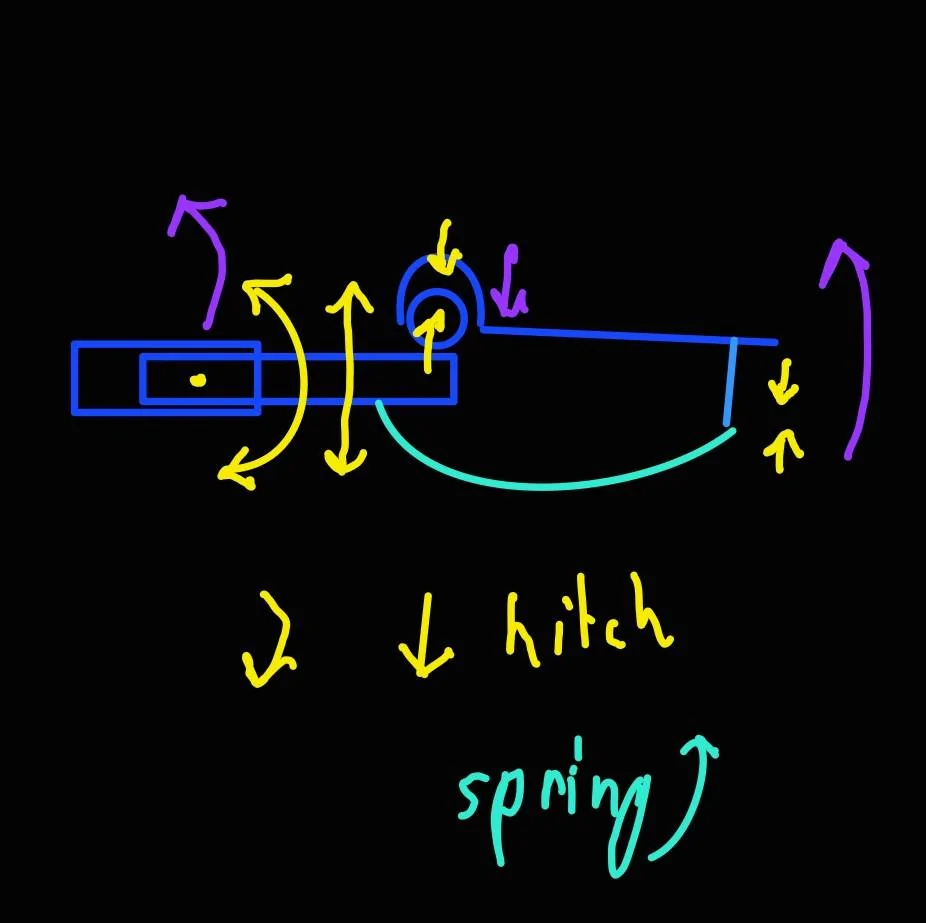
Force on the ball is not the same as force on the receiver.
Tesla Cybertruck Cybertruck Trailer Hitch/Casting Failure @10,400 lbs *VERTICAL LOAD* SmartSelect_20250317_204148_Samsung Notes

Loading the spring arms (green) increases the force on the ball and applies a torque that counters the trailer tongue weight.
Raising the trailer (purple) also increases load on the ball and decreases torque on the receiver (same effect as increasing spring tension).
 

mongo

Well-known member
Joined
May 27, 2024
Threads
6
Messages
4,536
Reaction score
5,524
Location
SE Michigan
Vehicles
Cyberbeast
Country flag
They are designed to transfer weight from the rear wheels to the front wheels (actually axles) but they do NOT decrease the weight stress on the rear hitch area. In fact, the more weight being transferred to the front, the more weight pushing down on the trailer hitch fulcrum.
For example, every Ford F-150 made for the past 20 years has a hitch receiver that’s rated for maximum 5,000 pounds total trailer weight and 500 lbs tongue weight, except with weight distribution hitch it’s 14,000 pounds total trailer weight and 1,400 tongue weight (if properly equipped with max tow package, etc.) - every truck is speced differently, but that’s the range and no F-150 can tow over 5,000 pounds within spec unless weight distribution is used.
You are saying the receiver of the F-150 can only handle the torque of a 500 pound load, but it can take the torque of a 1,400 pound load if the stuff connected to it is called weight-distributing.
Do you see how that must mean the WD mechanism turns the torque of a 1,400 pound tongue into a 500 pound equivilent torque at the receiver?
Put another way, weight equalizing hitches do NOT increase the load capacity or the acceptable tongue weight EXCEPT they can increase the total towing capacity of a hitch system that has a separate rating for use with weight distribution.
They don't make the truck stronger, but they do allow the truck to handle a higher load...
Therfore, they must be modifying the forces the truck sees to acceptable limits.

IOW, the make a higher hitch torque look like a lower torque (like a lighter tongue would).
 

PungoteagueDave

Well-known member
First Name
David
Joined
Mar 2, 2025
Threads
2
Messages
950
Reaction score
1,039
Location
Boynton Beach
Vehicles
‘25 Tesla Cybertruck, ‘26 Tesla MY Launch, ‘13 Porsche C4S, ‘26 BMW R1300 GSA
Occupation
retired
Country flag
Force on the ball is not the same as force on the receiver.
SmartSelect_20250317_204148_Samsung Notes.jpg

Loading the spring arms (green) increases the force on the ball and applies a torque that counters the trailer tongue weight.
Raising the trailer (purple) also increases load on the ball and decreases torque on the receiver (same effect as increasing spring tension).
Hence my statement that tongue weight is not affected by the action of the equalizing hitch (although the hitch itself adds about 140-150 lbs to tongue weight with the two brands I have), but the result of moving the fulcrum out by 5” is correct as seen in the bike carrier example, where rated tongue weight is dramatically reduced with EACH inch outward that the center of the weight is placed. The hitch ball remains the fulcrum either way and is where the weight is centered. Move it out 5”, tongue weight rating drops from 1,100 lbs to 700-750.

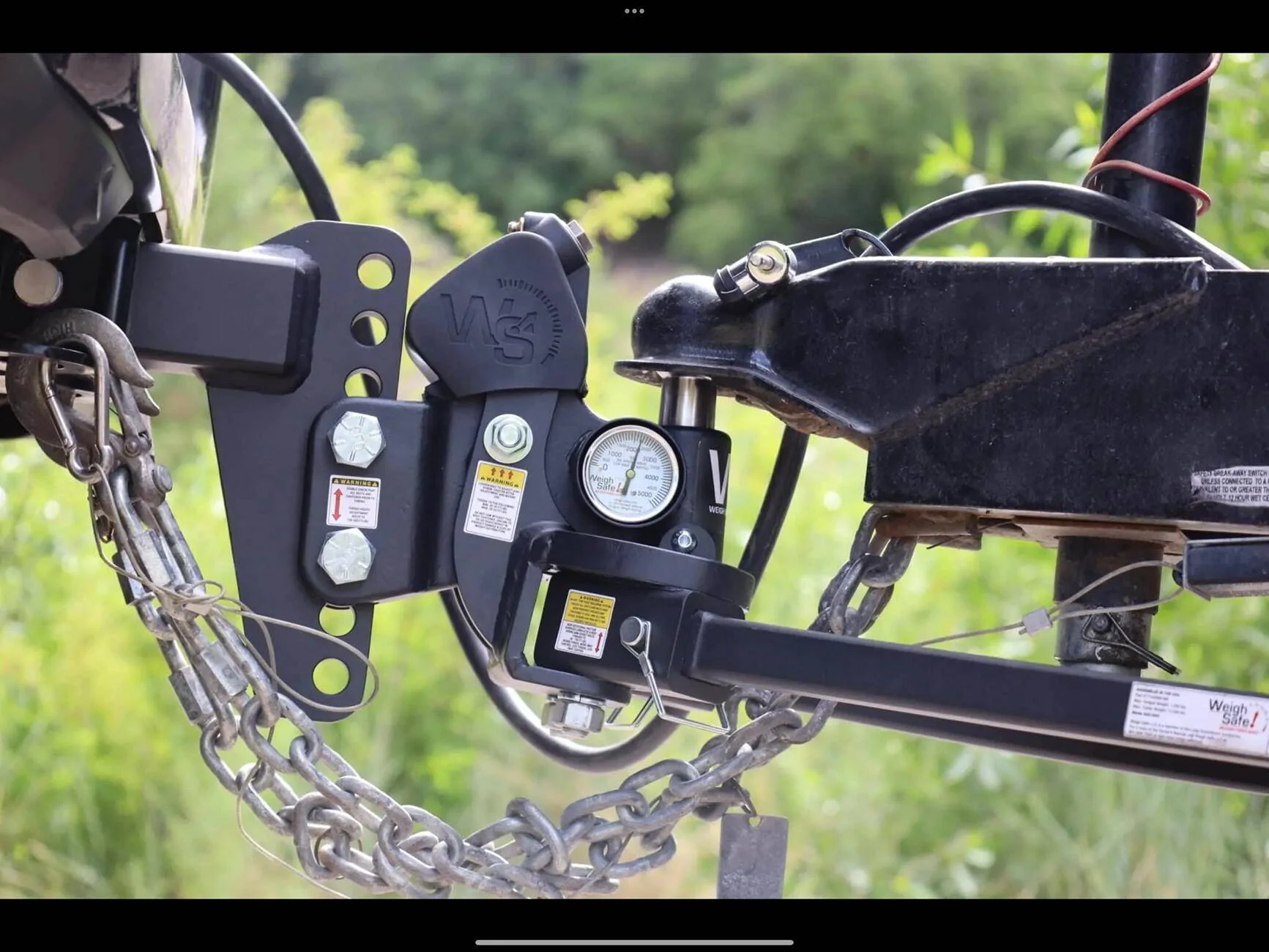
You never explain why this isn’t so or why Tesla’s drawing explaining this is incorrect. For my non equalized loads I use a Weigh-Safe hitch. I just checked and note that THEIR equalizing hitch places the scale exactly at the hitch ball (12” from the hitch pin), so clearly they understand that the point of hitch weight is at the ball. See pic. Therefore, if you use a distribution hitch, you must use the rating applicable for 12” behind the hitch pin, not 7.5” behind the pin, which is the only place you get 1,100 pounds, or the ability to tow 11,000 pounds.

Put another way, when using a weight distribution hitch its pretty clear that you are limited to a trailer weighing 7,000-7,500 pounds. My trailer weighs 9,300 pounds or so depending on the boat’s fuel load, so no way I will trust my normal weight distribution setup with that, but am still within specifications assuming I am careful about how the boat is loaded - hence the non-distributing hitch system with built in scale.

I would genuinely like to have the added safety and security of weight distribution, but believe this would violate the specifications as outlined by Tesla, and place potential liability on me for exceeding the hitch capabilities, should something go wrong, even if unrelated. State police come looking for stuff like this when there’s an incident - they typically will let out of spec private towing alone until there’s a problem, unless a loading issue is obvious to the naked eye. Having air suspension compensate for mis-loading errors can mask issues like this until the point of failure in one or more components.
Tesla Cybertruck Cybertruck Trailer Hitch/Casting Failure @10,400 lbs *VERTICAL LOAD* IMG_0951
 

Cyber Man

Well-known member
Joined
Dec 30, 2023
Threads
11
Messages
1,049
Reaction score
2,259
Location
California
Vehicles
BMW X1, Porsche Cayenne, R1T Perf max, Cyberbeast
Country flag
Hence my statement that tongue weight is not affected by the action of the equalizing hitch (although the hitch itself adds about 140-150 lbs to tongue weight with the two brands I have), but the result of moving the fulcrum out by 5” is correct as seen in the bike carrier example, where rated tongue weight is dramatically reduced with EACH inch outward that the center of the weight is placed. The hitch ball remains the fulcrum either way and is where the weight is centered. Move it out 5”, tongue weight rating drops from 1,100 lbs to 700-750.

You never explain why this isn’t so or why Tesla’s drawing explaining this is incorrect. For my non equalized loads I use a Weigh-Safe hitch. I just checked and note that THEIR equalizing hitch places the scale exactly at the hitch ball (12” from the hitch pin), so clearly they understand that the point of hitch weight is at the ball. See pic. Therefore, if you use a distribution hitch, you must use the rating applicable for 12” behind the hitch pin, not 7.5” behind the pin, which is the only place you get 1,100 pounds, or the ability to tow 11,000 pounds.

Put another way, when using a weight distribution hitch its pretty clear that you are limited to a trailer weighing 7,000-7,500 pounds. My trailer weighs 9,300 pounds or so depending on the boat’s fuel load, so no way I will trust my normal weight distribution setup with that, but am still within specifications assuming I am careful about how the boat is loaded - hence the non-distributing hitch system with built in scale.

I would genuinely like to have the added safety and security of weight distribution, but believe this would violate the specifications as outlined by Tesla, and place potential liability on me for exceeding the hitch capabilities, should something go wrong, even if unrelated. State police come looking for stuff like this when there’s an incident - they typically will let out of spec private towing alone until there’s a problem, unless a loading issue is obvious to the naked eye. Having air suspension compensate for mis-loading errors can mask issues like this until the point of failure in one or more components.
IMG_0951.jpg
Exactly! I agree with everything you said above. This is the reason I sold my Hensley hitch. I don’t plan to use any WD with CT. I haven’t towed yet. I’ll be either towing 10,000 lbs dirt trailer for short distance on regular ball mount or pintle hitch, or 6000 lbs RV trailer long distance. I might use WD eventually with the RV trailer, but I’ll be within specs. No matter what, the concern that this thread talks about is not an issue for me.
 

mongo

Well-known member
Joined
May 27, 2024
Threads
6
Messages
4,536
Reaction score
5,524
Location
SE Michigan
Vehicles
Cyberbeast
Country flag
Hence my statement that tongue weight is not affected by the action of the equalizing hitch (although the hitch itself adds about 140-150 lbs to tongue weight with the two brands I have), but the result of moving the fulcrum out by 5” is correct as seen in the bike carrier example, where rated tongue weight is dramatically reduced with EACH inch outward that the center of the weight is placed. The hitch ball remains the fulcrum either way and is where the weight is centered. Move it out 5”, tongue weight rating drops from 1,100 lbs to 700-750.

You never explain why this isn’t so or why Tesla’s drawing explaining this is incorrect. For my non equalized loads I use a Weigh-Safe hitch. I just checked and note that THEIR equalizing hitch places the scale exactly at the hitch ball (12” from the hitch pin), so clearly they understand that the point of hitch weight is at the ball. See pic. Therefore, if you use a distribution hitch, you must use the rating applicable for 12” behind the hitch pin, not 7.5” behind the pin, which is the only place you get 1,100 pounds, or the ability to tow 11,000 pounds.

Put another way, when using a weight distribution hitch its pretty clear that you are limited to a trailer weighing 7,000-7,500 pounds. My trailer weighs 9,300 pounds or so depending on the boat’s fuel load, so no way I will trust my normal weight distribution setup with that, but am still within specifications assuming I am careful about how the boat is loaded - hence the non-distributing hitch system with built in scale.

I would genuinely like to have the added safety and security of weight distribution, but believe this would violate the specifications as outlined by Tesla, and place potential liability on me for exceeding the hitch capabilities, should something go wrong, even if unrelated. State police come looking for stuff like this when there’s an incident - they typically will let out of spec private towing alone until there’s a problem, unless a loading issue is obvious to the naked eye. Having air suspension compensate for mis-loading errors can mask issues like this until the point of failure in one or more components.
IMG_0951.jpg
The trailer tongue weight which reveals trailer CG vs axle position and therefore stability is measured at the ball. I 100% agree with that.

What I am speaking to are the forces at the truck's receiver which knows only the loads imparted by the piece of 2" square tubing inserted in it.

This tube imparts two forces, a vertical load and a torque.

For the non-WD and cargo carrier cases, the weight is the tongue (plus ball adapter) or carrier weight. The static torque is the horizontal distance from the reference point to either the ball for a trailer or the CoG of load for a cargo carrier.

I think we all agree so far?

A WD setup converts the pivot linkage of a trailer ball and tongue to a semi-rigid structure with a spring rate.
For simplicity, on the static case, we can ignore the spring rate and treat it as a rigid structure.

So basically, WD turns a hinge into a fixed angle. By adjusting this angle, the hitch changes the torque on the receiver. This has the effect of making a higher (tongue weight * ball distance) torque smaller. Thus, from a torque point of view, the tongue load appears less (or the ball appears closer).

Simplest visualization:
Image a truck and trailer where the trailer hitch is just a straight tube into the receiver (even better, imagine the hitch is a 1" tube and can pivot on the locking pin). If everything is perfectly aligned, there is no torque on the receiver beyond the vertical load (small tube centered in large), just like if you put a jack stand under the tongue. The trailer itself has an unbalanced torque, thus the need for the stand, but the truck doesn't need a torque to react it since that receiver to ball level is gone.
In this configuration, the truck reacts the tongue weight, but no induced torque.

It is important to note that this setup relies on the truck being inline after the trailer weight is applied to the receiver. So the rear axle is loaded and the front is unloaded due to the vertical load applied at the receiver which is located aft of the rear axle. If we allow for an adjustable air suspension this is trivial and we can ignore suspension induced effects for the static case.

Are we still in agreement?


PungoteagueDave

Well-known member
First Name
David
Joined
Mar 2, 2025
Threads
2
Messages
950
Reaction score
1,039
Location
Boynton Beach
Vehicles
‘25 Tesla Cybertruck, ‘26 Tesla MY Launch, ‘13 Porsche C4S, ‘26 BMW R1300 GSA
Occupation
retired
Country flag
The trailer tongue weight which reveals trailer CG vs axle position and therefore stability is measured at the ball. I 100% agree with that.

What I am speaking to are the forces at the truck's receiver which knows only the loads imparted by the piece of 2" square tubing inserted in it.

This tube imparts two forces, a vertical load and a torque.

For the non-WD and cargo carrier cases, the weight is the tongue (plus ball adapter) or carrier weight. The static torque is the horizontal distance from the reference point to either the ball for a trailer or the CoG of load for a cargo carrier.

I think we all agree so far?

A WD setup converts the pivot linkage of a trailer ball and tongue to a semi-rigid structure with a spring rate.
For simplicity, on the static case, we can ignore the spring rate and treat it as a rigid structure.

So basically, WD turns a hinge into a fixed angle. By adjusting this angle, the hitch changes the torque on the receiver. This has the effect of making a higher (tongue weight * ball distance) torque smaller. Thus, from a torque point of view, the tongue load appears less (or the ball appears closer).

Simplest visualization:
Image a truck and trailer where the trailer hitch is just a straight tube into the receiver (even better, imagine the hitch is a 1" tube and can pivot on the locking pin). If everything is perfectly aligned, there is no torque on the receiver beyond the vertical load (small tube centered in large), just like if you put a jack stand under the tongue. The trailer itself has an unbalanced torque, thus the need for the stand, but the truck doesn't need a torque to react it since that receiver to ball level is gone.
In this configuration, the truck reacts the tongue weight, but no induced torque.

It is important to note that this setup relies on the truck being inline after the trailer weight is applied to the receiver. So the rear axle is loaded and the front is unloaded due to the vertical load applied at the receiver which is located aft of the rear axle. If we allow for an adjustable air suspension this is trivial and we can ignore suspension induced effects for the static case.

Are we still in agreement?
I agree with this but what it ignores is that tongue weight measured at the critical point as defined by a vehicle manufacturer is about shear strength. Using a weight distributing system introduces a more rigid structure to the calculus (we’ll call it full rigid, as you do). The manufacturer understands its physics in ways we cannot, but has determined the critical points of stress and made a judgement. Tesla chooses to not provide a specification for weight distribution, unlike all other truck builders. However, we do know that it uniquely uses aluminum casting structures in important parts of the towing structure. Adding weight distribution pulls the fulcrum rearward,, and because (1) it is essentially rigid, and (2) it restricts movement of the trailer up and down relative to the tow vehicle (based on the hitch’s spring bar rating), this means that when going over bumps, or even a slow roll onto or off of a ramp, adds huge upward OR downward stresses to the fulcrum point, depending on whether the trailer is in break-over or break-under status relative to the tow vehicle.

The addition of rigidity through a weight distributing hitch means that in extremes, nearly the entirety of the trailer’s weight can be “hung” off the back of the tow vehicle (when in break-over stance), or can push upward in an upward twisting motion (in a break-under stance), using all the leverage of the entire trailer length back to its rearmost axle to pull down or push upward on the vehicle’s shear point in a vertical twisting motion - and it’s entirely on the aluminum hitch to counter these forces - there is no other attachment to the vehicle - it uses the hitch as the single point to transfer all of the combined dynamics of the trailer and its movement relative to the tow vehicle, making it the critical point in transferring weight fore and aft to the tow vehicle’s two axles.

In Tesla’s case, we now know that the shear point is a DESIGNED point of breaking for crash safety purposes. Do we really want to make bets on this, absent Tesla sanctioning weight distribution? I’ll stick with non-distribution hitches that are within the stated manufacturer specs. I have all the options on most of my (nine) trailers and have the needed hitch equipment to go either way. We can’t have enough information to do the actual weight calculations involved here, but we have pretty good guidance based on Tesla’s dramatic loss of tongue weight rating when installing a lightweight bicycle carrier - that pushing back the weight fulcrum reduces capacity in known and unknown ways, and that this all relies on a non-bending aluminum casting at its core. Tesla says a 300-pound bike rack is too heavy for this structure. Really wanna bet against that official rating with 10,000 pounds of tow weight?
 

mongo

Well-known member
Joined
May 27, 2024
Threads
6
Messages
4,536
Reaction score
5,524
Location
SE Michigan
Vehicles
Cyberbeast
Country flag
I agree with this but what it ignores is that tongue weight measured at the critical point as defined by a vehicle manufacturer is about shear strength. Using a weight distributing system introduces a more rigid structure to the calculus (we’ll call it full rigid, as you do). The manufacturer understands its physics in ways we cannot, but has determined the critical points of stress and made a judgement. Tesla chooses to not provide a specification for weight distribution, unlike all other truck builders. However, we do know that it uniquely uses aluminum casting structures in important parts of the towing structure. Adding weight distribution pulls the fulcrum rearward,, and because (1) it is essentially rigid, and (2) it restricts movement of the trailer up and down relative to the tow vehicle (based on the hitch’s spring bar rating), this means that when going over bumps, or even a slow roll onto or off of a ramp, adds huge upward OR downward stresses to the fulcrum point, depending on whether the trailer is in break-over or break-under status relative to the tow vehicle.

The addition of rigidity through a weight distributing hitch means that in extremes, nearly the entirety of the trailer’s weight can be “hung” off the back of the tow vehicle (when in break-over stance), or can push upward in an upward twisting motion (in a break-under stance), using all the leverage of the entire trailer length back to its rearmost axle to pull down or push upward on the vehicle’s shear point in a vertical twisting motion - and it’s entirely on the aluminum hitch to counter these forces - there is no other attachment to the vehicle - it uses the hitch as the single point to transfer all of the combined dynamics of the trailer and its movement relative to the tow vehicle, making it the critical point in transferring weight fore and aft to the tow vehicle’s two axles.

In Tesla’s case, we now know that the shear point is a DESIGNED point of breaking for crash safety purposes. Do we really want to make bets on this, absent Tesla sanctioning weight distribution? I’ll stick with non-distribution hitches that are within the stated manufacturer specs. I have all the options on most of my (nine) trailers and have the needed hitch equipment to go either way. We can’t have enough information to do the actual weight calculations involved here, but we have pretty good guidance based on Tesla’s dramatic loss of tongue weight rating when installing a lightweight bicycle carrier - that pushing back the weight fulcrum reduces capacity in known and unknown ways, and that this all relies on a non-bending aluminum casting at its core. Tesla says a 300-pound bike rack is too heavy for this structure. Really wanna bet against that official rating with 10,000 pounds of tow weight?
Let's table the cargo carrier side of things for the moment because it's a whole different set of dynamics and we agree on the leverage principle.

Agree the WD dynamics are different due to the stiff structure. So let's dig into the details.
We'll use the receiver pin as the reference.
A 11k trailer with 1,100 tongue on a (rounded for simplicity) 8 inch ball to pin distance applies
8*1,100 = 8,800 inch pounds of torque at the pin
1,100 pounds downforce
Given 49 inch rear wheel to ball
49*1,100 = 54k in-lbs rear axle torque
With 143 inch wheelbase, tire loading is
-377 pounds front
+1,477 pound rear.

12 inch non WD limit= 8,800/12=733 pounds
Switching to WD with 12 inch pin to ball:
12*1,100 = 13,200 in-lbs at receiver pin
(49+4)*1,100 = 58k in-lbs at rear axle
-408 front
+1,508 rear

To get 50% return on the front, we need 204 shifted back, that's 204*143=29k in-pounds of torque at rear axle. 29k/53=550 pounds up torque at ball
That leaves 1,100 - 550 = 550 pounds net torque
550*12 = 6,600 in-lbs at receiver pin
This is 2,200 in-lbs less than the non-WD case.
(Note: rear axle unloads more than 204 pounds due to the torque acting on the trailer axle also)

At least in the static case.
As you rightly call out, the dynamics also change.
That behavior depends on spring rate. In this situation, the springs produce 550 pounds, and we have 733-550 = 183 of margin. So removal of 183/550 = 33% of the preload travel would put the system at the normal maximum. So if you allow 10 degrees tow to trailer angle (break over), you would want 30 degrees of initial bend.
Though that is limiting the system to the original static limit, not the dynamic limits it is designed for.
 

PungoteagueDave

Well-known member
First Name
David
Joined
Mar 2, 2025
Threads
2
Messages
950
Reaction score
1,039
Location
Boynton Beach
Vehicles
‘25 Tesla Cybertruck, ‘26 Tesla MY Launch, ‘13 Porsche C4S, ‘26 BMW R1300 GSA
Occupation
retired
Country flag
Okay, we agree and I see your point. Still not comfortable putting all of this in a dynamic environment with an aluminum breakaway hitch structure in the mix, considering the method isn’t specified or sanctioned in the manufacturer’s weight ratings, unlike with every other brand. It’s not just about warranty, but that’s part of it, along with basic safety concerns.
 

mongo

Well-known member
Joined
May 27, 2024
Threads
6
Messages
4,536
Reaction score
5,524
Location
SE Michigan
Vehicles
Cyberbeast
Country flag
Okay, we agree and I see your point. Still not comfortable putting all of this in a dynamic environment with an aluminum breakaway hitch structure in the mix, considering the method isn’t specified or sanctioned in the manufacturer’s weight ratings, unlike with every other brand. It’s not just about warranty, but that’s part of it, along with basic safety concerns.
I would LOVE for Tesla to provide WD guidance, especially since they used it in on-road testing.
I'm less worried about the structure as regards crash design since they have two energy absorbers between the casting and bumper.

Now, do we want to get into how their cargo carrier guidance doesn't really work? (Especially on a Beast)
 

Thunderstrike44

Well-known member
First Name
Brian
Joined
Aug 17, 2022
Threads
9
Messages
184
Reaction score
180
Location
North Liberty, IN
Vehicles
2024 CyberTruck Dual Mtr., 2007 Jeep Rubicon, Ram 1500 Diesel
Occupation
Control Engineering Programming Manager
Country flag
I agree with the Structural engineer's line on this "We rated it for 1100 lbs but it held to 10400 Lbs Wow!" Being a engineer (electrical not structure but know some of the theories) You generally figure 3X Over rated load in most cases for a good safety margin. So this just proves to me that the cast/Forged modeled Casts Rock! compared to standard Welded steel. As most said here, just write this guy off as the typical click baiter.
Sponsored


Top