Sponsored

HaulingAss

Well-known member
Joined
Oct 3, 2020
Threads
28
Messages
10,449
Reaction score
20,983
Location
Western Washington, USA
Vehicles
Cybertruck DM, 2010 F-150, 2018 Performance Model 3, 2024 Performance Model 3
Country flag
I don't understand that. The only thing I know is that solar panels create DC current and the microinverters convert it to AC. I would add more panels and each panel has its own microinverter. I believe I currently produce a little more power than I need so I would install heat pumps first and see how many more panels I would need. After running them for a little while. Also I want to install cold climate heat pumps because the regular heat pumps use an electric element to directly heat the air, which requires a humidifier.
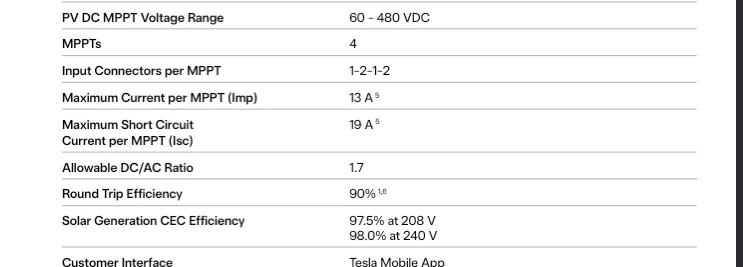
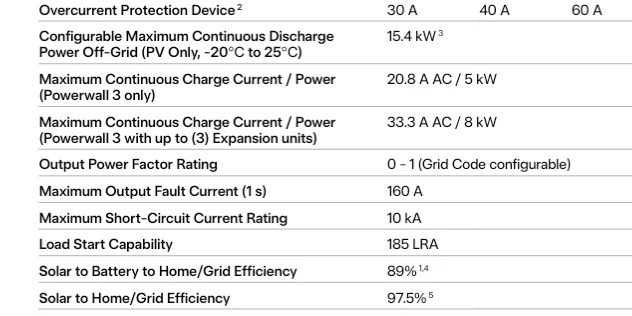
The Powerwall 3 allows a DC coupled system which wastes less solar energy (97.5% solar to home/grid efficiency). Each Powerwall can connect directly to 20 kW of solar panels with it's 6 independent MPPT's and inverter built into the unit. Without external inverters the system design/install is a bit simpler. Here in the PNW I wanted to maximize winter production for self-reliance and the DC coupled system does that.
Sponsored


mongo

Well-known member
Joined
May 27, 2024
Threads
6
Messages
4,678
Reaction score
5,686
Location
SE Michigan
Vehicles
Cyberbeast
Country flag
The Powerwall 3 allows a DC coupled system which wastes less solar energy (97.5% solar to home/grid efficiency). Each Powerwall can connect directly to 20 kW of solar panels with it's 6 independent MPPT's and inverter built into the unit. Without external inverters the system design/install is a bit simpler. Here in the PNW I wanted to maximize winter production for self-reliance and the DC coupled system does that.
Solar to home is just PV->AC though. Enphase micro inverters have equivalent 97.5% conversion efficency when powering a house.

The gain is in PV time shifting. PW3 has 89% efficency PV->battery->home.
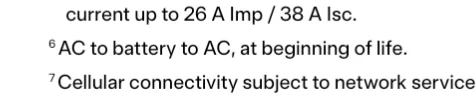
Powerwall + (AC coupled) had 90% for AC->battery->home, but when adding in PV, PW Plus doing PV->(AC)->batt->home would be only 87%.
PW3 also has an extra 5kW PV to battery path for max sunlight utilization.

PW+
Tesla Cybertruck Keeping Solar Panels online with Powershare during power outage AISelect_20260708_073813_Firefox

Tesla Cybertruck Keeping Solar Panels online with Powershare during power outage AISelect_20260708_075829_Firefox

PW3
Tesla Cybertruck Keeping Solar Panels online with Powershare during power outage AISelect_20260707_143928_Firefox
 

Patriot

Well-known member
Joined
May 3, 2025
Threads
1
Messages
52
Reaction score
82
Location
Denver, CO
Vehicles
2020 M3, 2024 Jeep 392, 2024 FS CB
Country flag
The gain is in PV time shifting
Can you please explain what you mean by this? Are you saying that you lose efficiency by adding batteries (PW) to the energy path, but doing so is what allows you to use stored energy during peak rate periods and recharge during lower rate periods, hopefully, offsetting the cost of energy losses due to the lower efficiency?
It makes sense that you lose efficiency by putting battery storage in between generation and usage. My utility company does net metering, so the grid is my "battery", but I have no idea how efficient that whole process is. Of course, if the grid goes down, my panels are useless and I also can't time shift my generated energy to cover my peak energy periods. I would love to add Powershare, but I don't think they will let me since my solar is a prepaid lease. I inquired about Powerwall a couple of years ago, and they said "no".
 

HaulingAss

Well-known member
Joined
Oct 3, 2020
Threads
28
Messages
10,449
Reaction score
20,983
Location
Western Washington, USA
Vehicles
Cybertruck DM, 2010 F-150, 2018 Performance Model 3, 2024 Performance Model 3
Country flag
Solar to home is just PV->AC though. Enphase micro inverters have equivalent 97.5% conversion efficency when powering a house.

The gain is in PV time shifting. PW3 has 89% efficency PV->battery->home.
Powerwall + (AC coupled) had 90% for AC->battery->home, but when adding in PV, PW Plus doing PV->(AC)->batt->home would be only 87%.
PW3 also has an extra 5kW PV to battery path for max sunlight utilization.

PW+
AISelect_20260708_073813_Firefox.webp

AISelect_20260708_075829_Firefox.webp

PW3
AISelect_20260707_143928_Firefox.webp
Good points.

But my understanding is it's not the efficiency gain at max production (when going to battery) that is the most important to my use case, but during dark, cloudy/rainy periods when trying to eek out enough production to keep your battery charged enough to service essential loads (like in the winter). In low-light conditions where the power from an AC-coupled system can struggle to produce any useable power at all, or it can alternate between producing a small amount of power and nothing, a Powerwall can feed a constant (and very efficient) charge voltage to the batteries (or your home). This can help keep the batteries charged when AC coupled systems would struggle.

I don't have solar to save money, that's just what pays for the system over time, I have solar so our dwelling remains habitable, even if we have an extended power outage as would be the case after a major West Coast earthquake, a freak regional ice storm, unusual high wind event, or other cataclysmic event. Solar is an investment in our future in more ways than one.
 
Last edited:

mongo

Well-known member
Joined
May 27, 2024
Threads
6
Messages
4,678
Reaction score
5,686
Location
SE Michigan
Vehicles
Cyberbeast
Country flag
Can you please explain what you mean by this? Are you saying that you lose efficiency by adding batteries (PW) to the energy path, but doing so is what allows you to use stored energy during peak rate periods and recharge during lower rate periods, hopefully, offsetting the cost of energy losses due to the lower efficiency?
It makes sense that you lose efficiency by putting battery storage in between generation and usage. My utility company does net metering, so the grid is my "battery", but I have no idea how efficient that whole process is. Of course, if the grid goes down, my panels are useless and I also can't time shift my generated energy to cover my peak energy periods. I would love to add Powershare, but I don't think they will let me since my solar is a prepaid lease. I inquired about Powerwall a couple of years ago, and they said "no".
Right, going from power to storage to power incurs loss. PW3 has a more efficient PV to battery to AC conversion chain than PV to AC to battery to AC.
 

mongo

Well-known member
Joined
May 27, 2024
Threads
6
Messages
4,678
Reaction score
5,686
Location
SE Michigan
Vehicles
Cyberbeast
Country flag
Good points.

But my understanding is it's not the efficiency gain at max production (when going to battery) that is the most important to my use case, but during dark, cloudy/rainy periods when trying to eek out enough production to keep your battery charged enough to service essential loads (like in the winter). In low-light conditions where the power from an AC-coupled system can struggle to produce any useable power at all, or it can alternate between producing a small amount of power and nothing, a Powerwall can feed a constant (and very efficient) charge voltage to the batteries (or your home). This can help keep the batteries charged when AC coupled systems would struggle.

I don't have solar to save money, that's just what pays for the system over time, I have solar so our dwelling remains habitable, even if we have an extended power outage as would be the case after a major West Coast earthquake, a freak regional ice storm, unusual high wind event, or other cataclysmic event. Solar is an investment in our future in more ways than one.
Interesting, I hadn't thought of the minimal power situation. The PV direct to battery system would be better at handling that.
Sponsored


Top