
Sponsored

Poor Level 1 charging efficiency

Jedi2155

Well-known member
Joined
Apr 13, 2020
Threads
3
Messages
157
Reaction score
157
Location
Southern California
Vehicles
2024 Model Y AWD | FS Cybertruck AWD + FUSC
Occupation
Engineer
Country flag
That's not quite true, re older Volt, Leaf, RAV4.

They had the older, 80% efficient, cheap chargers so they're always stuck there. It's not the overhead that makes it inefficient, it's just older (cheaper) methods of rectifying AC to the appropriate voltage for charging.

It's just like you can choose a more or less efficient power supply for a PC or your USB powered devices. And when I mean just like, it's basically the same electronics! Power supplies have to adjust for the load they're powering: Chargers, on the other hand, adjust the voltage for the charge level so the load remains as consistent as possible. It's the same thing, just a different control.

So for instance, the chargers for the Gen 2 Zero I have is always that 80% efficient - even if you have the Level 2 6kW one.

-Crissa
I believe the switching power supplies vehicles like the Volt was fairly efficient, as it was around that time there was a lot of new research in designing new efficient power supplies (especially in the solar world with 95%+ DC-DC conversion efficiences). A lot of the aspects of efficiency for a power supply comes from cost trade offs, and power electronic costs was a significant concern in the 1st generation Volt (I had a chance to question one of the Volt engineers on this specific topic). My own measurements was 13.5 kWh/charge @ 120v and 12.6 kWh @ 240. With those numbers I was able to determine the base load of the vehicle was around 200watts (with the computers/pumps running), and the net charging efficiency (AC-DC) was slightly highly on 120v (89.6%) vs 240 at (88%) assuming the battery was 10.5 kWh DC per charge implying they probably optimized for 120v charging. BTW the AC meters were calibrated with NIST traceable equipment.
Sponsored


GuyV

Well-known member
First Name
Guy
Joined
Aug 17, 2023
Threads
1
Messages
814
Reaction score
1,073
Location
St. Louis, MO
Vehicles
Tesla Model S, FS Cybertruck AWD
Occupation
Retired
Country flag
Conversion efficiency is lower when the voltage differential is higher. You get 120VAC input and you need to produce over 800VDC. Then the truck probably spends a bunch of juice running the computer, contactors, etc.
My strong hope is that they can learn to manage these things better.

It doesn't have to get to 800V BTW, it splits the pack into 2 sub-400V parts. I don't think anyone has seen CT charging at 800V yet.

Computers seldom have to run at their peak performance levels and power consumption, particularly if you avoid high-level graphics activity which ought to be completely unnecessary for unattended charging, can easily spend most of the time under 5%. I am guessing that monitoring, especially in service mode, defeats that.

I want to believe that Tesla's hardware is fundamentally very energy efficient when they manage it optimally. I would like to see numbers on unattended L1 charging when it has a chance to do its best. In the example we've seen, in almost ideal circumstances, where almost a full 1500W was delivered, probably from a good 20A circuit, it did not do well at all, but then it wasn't left alone to do so. I still wish to entertain hope that it is something they can continue to work on, like vampire drain which has gotten much better over the years even as functionality has been added.
 

scottf200

Well-known member
Joined
Jul 31, 2021
Threads
53
Messages
2,221
Reaction score
3,241
Location
Western NC
Vehicles
X; immed family 3 & Y
Country flag
It doesn't have to get to 800V BTW, it splits the pack into 2 sub-400V parts. I don't think anyone has seen CT charging at 800V yet.
The DPDT (Double-Pole Double-Throw) was in "Series" in her picture ... so 800V.
400V is for Supercharging on V1-V3.5; 800V on V4

800V on some non-Tesla DCFC chargers already
NxuOne™
 

GuyV

Well-known member
First Name
Guy
Joined
Aug 17, 2023
Threads
1
Messages
814
Reaction score
1,073
Location
St. Louis, MO
Vehicles
Tesla Model S, FS Cybertruck AWD
Occupation
Retired
Country flag
The DPDT (Double-Pole Double-Throw) was in "Series" in her picture ... so 800V.
So, if you say that getting to 800V is a power waste that may be something they can address, right?
 

cybercricket

Well-known member
Joined
Oct 31, 2024
Threads
13
Messages
655
Reaction score
797
Location
Oregon
Vehicles
Cybertruck
Country flag
My strong hope is that they can learn to manage these things better.

It doesn't have to get to 800V BTW, it splits the pack into 2 sub-400V parts. I don't think anyone has seen CT charging at 800V yet.

Computers seldom have to run at their peak performance levels and power consumption, particularly if you avoid high-level graphics activity which ought to be completely unnecessary for unattended charging, can easily spend most of the time under 5%. I am guessing that monitoring, especially in service mode, defeats that.

I want to believe that Tesla's hardware is fundamentally very energy efficient when they manage it optimally. I would like to see numbers on unattended L1 charging when it has a chance to do its best. In the example we've seen, in almost ideal circumstances, where almost a full 1500W was delivered, probably from a good 20A circuit, it did not do well at all, but then it wasn't left alone to do so. I still wish to entertain hope that it is something they can continue to work on, like vampire drain which has gotten much better over the years even as functionality has been added.
I understand it can split the pack for DC charging, does it do that when AC charging ? Does it do that when doing powershare ?

There are fundamental limitations with the power electronics which can't be overcome just because it's Tesla.

P.S. a 120V@20A circuit will provide 16A continuously, so about 2000W. 1500W is what you can expect from a 15A circuit (12A continuous max).
 
Last edited:


chaosmarine92

Well-known member
First Name
David
Joined
Feb 27, 2024
Threads
10
Messages
209
Reaction score
313
Location
Knoxville, TN
Vehicles
cybertruck
Country flag
I want to believe that Tesla's hardware is fundamentally very energy efficient when they manage it optimally. I would like to see numbers on unattended L1 charging when it has a chance to do its best. In the example we've seen, in almost ideal circumstances, where almost a full 1500W was delivered, probably from a good 20A circuit, it did not do well at all, but then it wasn't left alone to do so.
I can tell you shortly after I got my truck last year I visited some friends that only had 120v outlets available. Leaving the truck in their garage to charge overnight at 12amps I would get about 1% per hour with ambient temps at 65f.
Clearly not practical to use a 120v source as a range extender.
 

scottf200

Well-known member
Joined
Jul 31, 2021
Threads
53
Messages
2,221
Reaction score
3,241
Location
Western NC
Vehicles
X; immed family 3 & Y
Country flag

GuyV

Well-known member
First Name
Guy
Joined
Aug 17, 2023
Threads
1
Messages
814
Reaction score
1,073
Location
St. Louis, MO
Vehicles
Tesla Model S, FS Cybertruck AWD
Occupation
Retired
Country flag
I can tell you shortly after I got my truck last year I visited some friends that only had 120v outlets available. Leaving the truck in their garage to charge overnight at 12amps I would get about 1% per hour with ambient temps at 65f.
Clearly not practical to use a 120v source as a range extender.
Actually, 1% would be about 3mph, comparable to S or X, so not bad from a 15A circuit. You could then be doing better from a 20A, and even double with 30A is available. L1 is quite useful if you are overnight or longer since most people average less than 40 miles per day. They should be trying really hard to give us the best L1 efficiency possible because when you are limited to 120V for whatever reason is when charging efficiency matters most, not so much at a 350kW+ 800V.
 

cybercricket

Well-known member
Joined
Oct 31, 2024
Threads
13
Messages
655
Reaction score
797
Location
Oregon
Vehicles
Cybertruck
Country flag
Her pictures show 118V and 12A so she was getting 1416W
Rounding error. The main point was that the max continuous draw from a 15A cicuit is 12A and from a 20A it is 16A. For example Honda EU2200 will deliver close to 2kW (19xxW) when using mobile adapter with Nema 5-20 plug.
 

scottf200

Well-known member
Joined
Jul 31, 2021
Threads
53
Messages
2,221
Reaction score
3,241
Location
Western NC
Vehicles
X; immed family 3 & Y
Country flag
Actually, 1% would be about 3mph, comparable to S or X, so not bad from a 15A circuit. You could then be doing better from a 20A, and even double with 30A is available. L1 is quite useful if you are overnight or longer since most people average less than 40 miles per day. They should be trying really hard to give us the best L1 efficiency possible because when you are limited to 120V for whatever reason is when charging efficiency matters most, not so much at a 350kW+ 800V.
True. In my past 2 of the 3 EVs were charing on 12a overnight as their commute was relatively short.

Rounding error. The main point was that the max continuous draw from a 15A cicuit is 12A and from a 20A it is 16A. For example Honda EU2200 will deliver close to 2kW (19xxW) when using mobile adapter with Nema 5-20 plug.
Of course. Only 5.6% less. I wasn't being critical just pointing out she was getting less than optimal based on data she provided.
 

mongo

Well-known member
Joined
May 27, 2024
Threads
5
Messages
4,520
Reaction score
5,496
Location
SE Michigan
Vehicles
Cyberbeast
Country flag
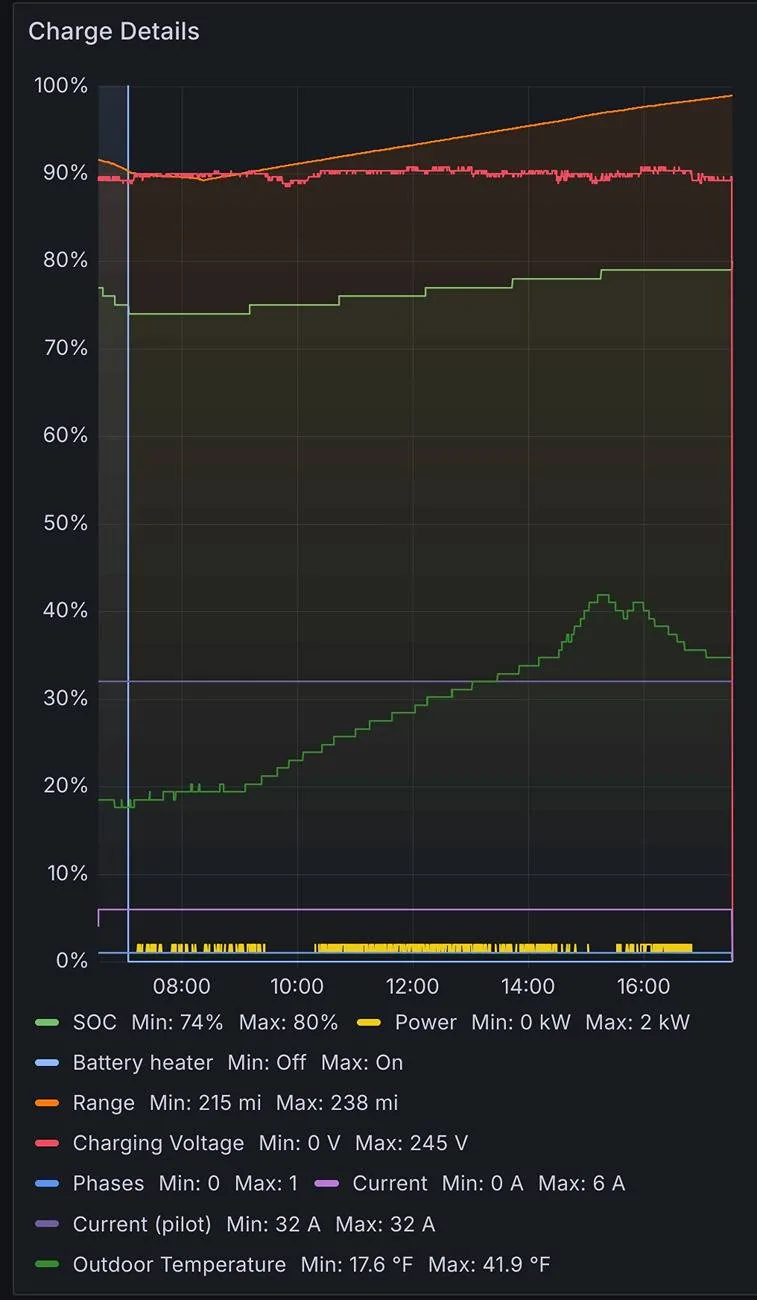
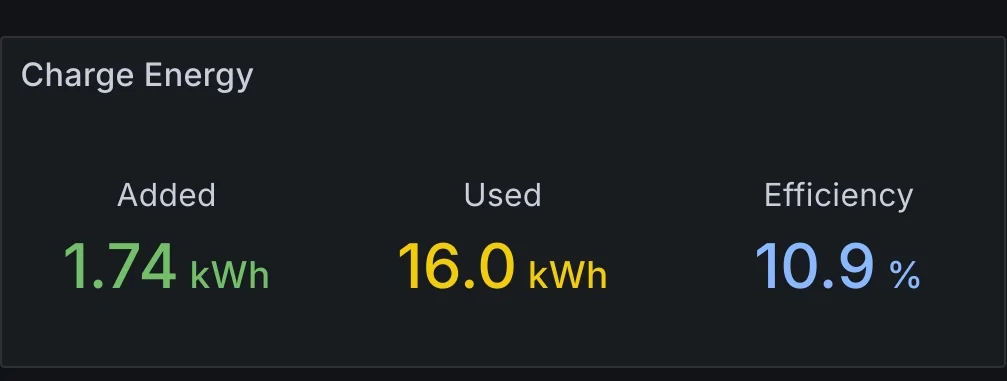
On 240V with 6A current limit.
Started climate control this morning at 6:30am with 75% (73% displayed plus 2% blue)
Truck turned on charging automatically.
Ran climate until 8:22 am, truck was at 74% (72% +2%) inflection point.
Left it charging
At 5:30pm it was at 79% and calculating end of charge so I bumped the limit down to 79 to end the session
Tesla Cybertruck Poor Level 1 charging efficiency SmartSelect_20250211_173225_Firefox

High inefficiency due to climate control:
Tesla Cybertruck Poor Level 1 charging efficiency SmartSelect_20250211_173242_Firefox
Sponsored


Top