
Sponsored

Gigahorse

Well-known member
Joined
Dec 19, 2023
Threads
17
Messages
2,820
Reaction score
3,172
Location
USA
Vehicles
AWD
Back in the plan your own trip days. We would try to get to superchargers as low as possible. 90-100 takes forever to charge. 0-10 doesn't. That's why we throw top out.

But bottom can be bad too if it's cold
Yea was in a Model 3 rental and was set to arrive at a destination charger with 8% left, car was shutting down as I pulled in and if it was not for a long cord on the charger would have been in a tough spot. Cold really makes a difference.
Sponsored


JBee

Well-known member
First Name
JB
Joined
Nov 22, 2019
Threads
18
Messages
4,913
Reaction score
6,362
Location
Australia
Vehicles
Cybertruck
Occupation
. Professional Hobbyist
Country flag
esppecially on ATs
Just as a point of reference, rolling resistance is not speed dependant. So although you will use more energy per until of time when travelling faster you won't use more energy per mile.
 

JBee

Well-known member
First Name
JB
Joined
Nov 22, 2019
Threads
18
Messages
4,913
Reaction score
6,362
Location
Australia
Vehicles
Cybertruck
Occupation
. Professional Hobbyist
Country flag
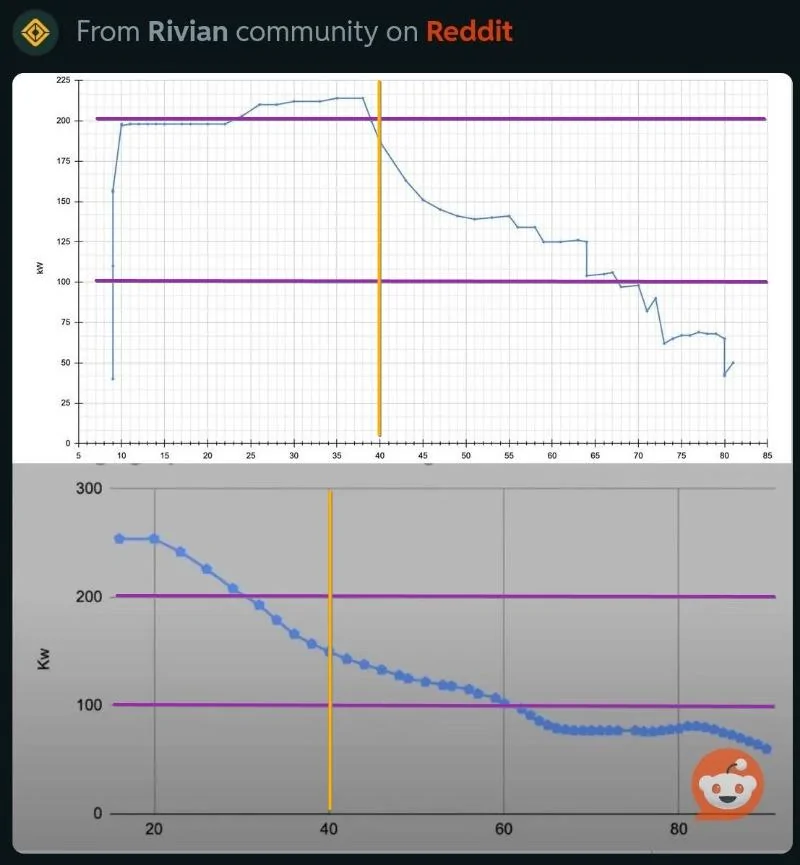
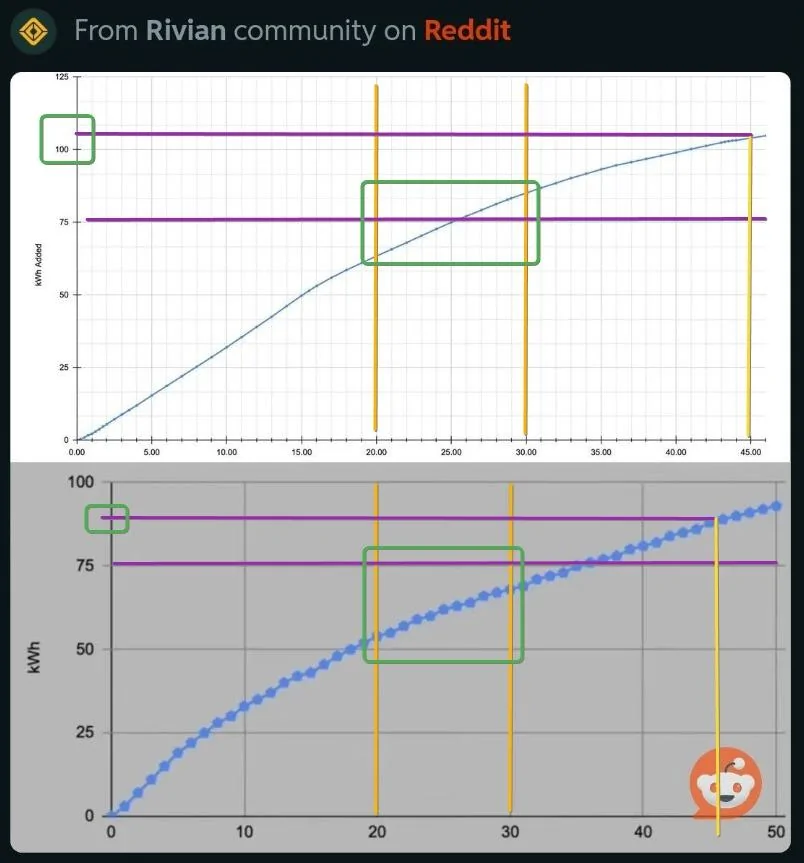
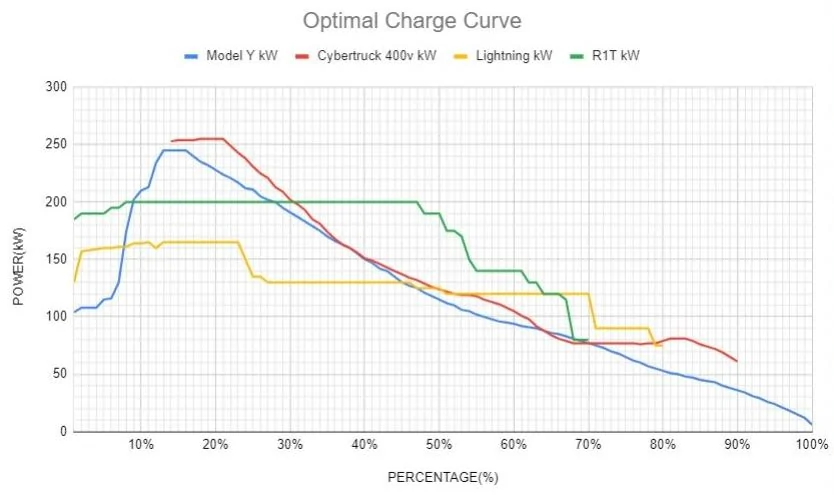
Not really buying that excuse as they have had 4680 in TMYs for a while and certainly have a ton of data on charging them. I would have expected better especially with Tesla knowing how the CT would be compared the existing EV trucks out there (Rivian, F150 lightning)

Rivian comparison:

nYWN1ps.jpg


qUxXzFT.jpg
I'd still be going easy on a new vehicle. There are many other potential failure points that aren't shared with the MY.

Would of expected more as well, but I also think Tesla is playing it overly safe atm with the charge capabilities.

Don't forget they are improving cell performance at the same time as ramping production, so one might add risk if trying to push the envelope early.

I'd rather have a few CTs on the road with people complaining about charging speeds, than a whole bunch of CTs out there sharing fast but breaking down even faster.
 

Klyde

Member
First Name
Klyde
Joined
Dec 10, 2023
Threads
3
Messages
14
Reaction score
41
Location
Toronto
Vehicles
Model S Plaid
Country flag
well reality sets in, no wonder elon isnt very excited about the truck. Great engineering and breakthrough in all aspects, except the 4680 cells, which is really vital part of this vehicle to becoming the dream truck for everyone. These numbers, not even close.
 

scottf200

Well-known member
Joined
Jul 31, 2021
Threads
53
Messages
2,221
Reaction score
3,241
Location
Western NC
Vehicles
X; immed family 3 & Y
Country flag
They will play it safe for quite a while as they build more confidence in charge curves. The 4680s have been in development for a few years, but they need a fleet of data in the real world before feeling comfortable enough to play with the curve.

This has been a thing with all new platforms.
I'd still be going easy on a new vehicle. There are many other potential failure points that aren't shared with the MY.

Would of expected more as well, but I also think Tesla is playing it overly safe atm with the charge capabilities.

Don't forget they are improving cell performance at the same time as ramping production, so one might add risk if trying to push the envelope early.

I'd rather have a few CTs on the road with people complaining about charging speeds, than a whole bunch of CTs out there sharing fast but breaking down even faster.
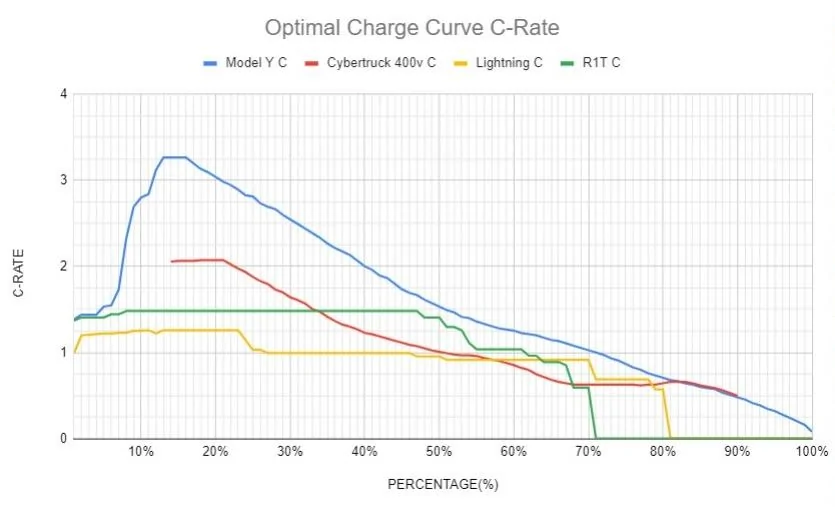
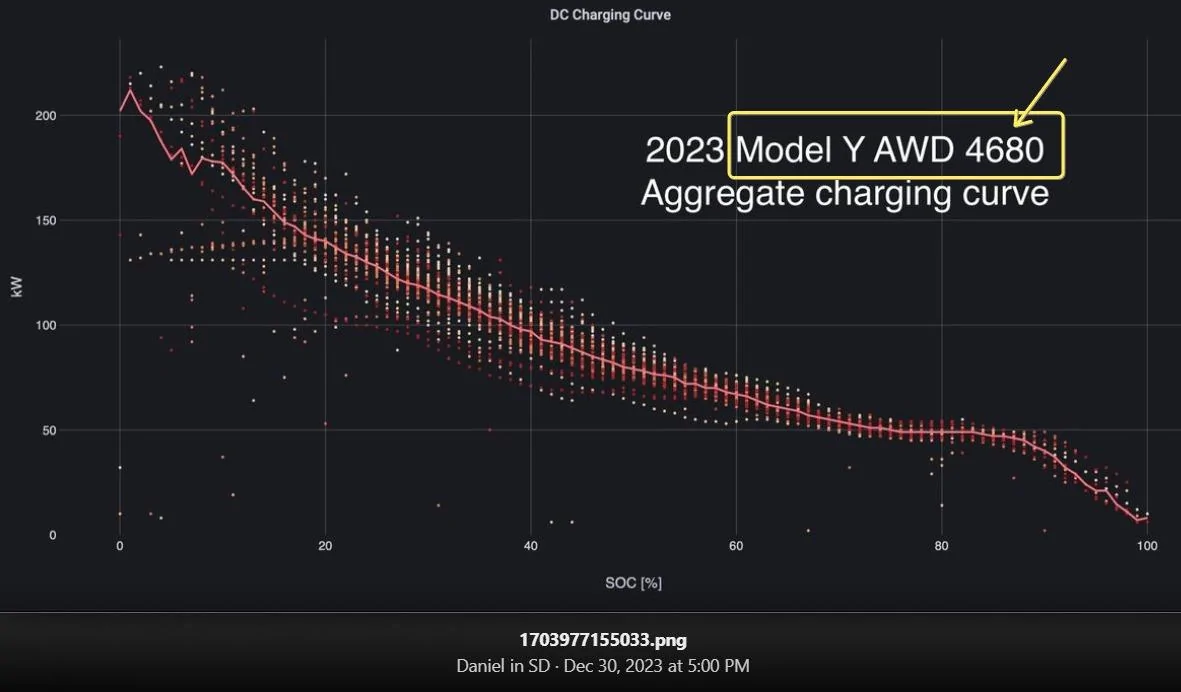
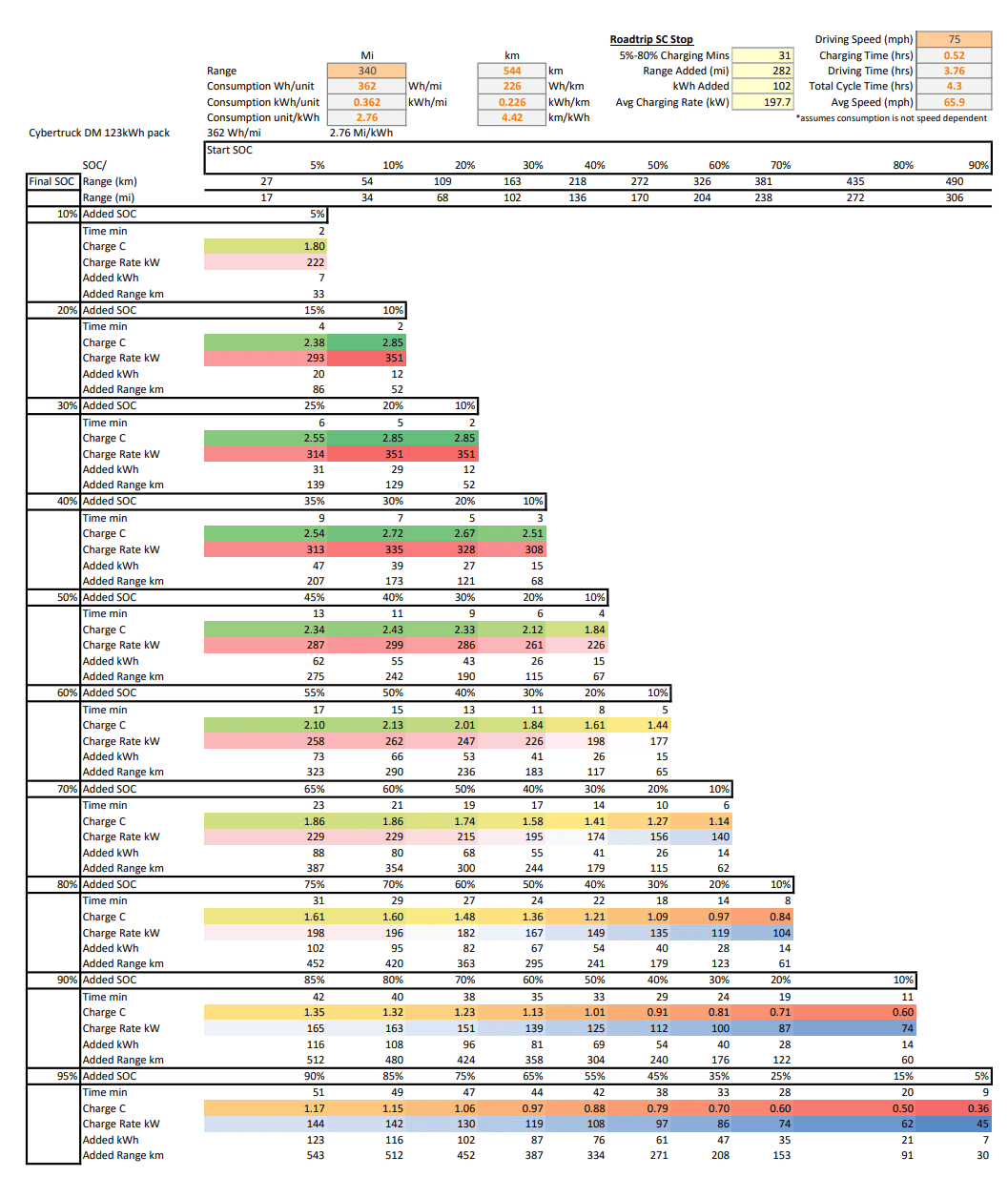
Saw some battery nerd put together this Google sheet with some graphs including C-rate for 4 vehicles. If they are accurate then the CT charging may be being cautious although it is not clear if the Model Y is also 4680s or 2170. Branden Flasch who works in the charger industry has a Model Y 4680 and has been none-to-pleased with the charging.

Model Y 4680 history:
On April 9, 2022, Tesla began building the Standard Range AWD configuration. Manufactured at Gigafactory Texas, it was equipped with the new 4680 battery cells and structural battery pack technology rated at 279 miles (449 km) of EPA range.[73][74] At first, this configuration was only available for employees, invited reservation holders, and customers residing in the Texas area.[75][76] Around April 7, 2023, Tesla made the configuration for sale to the general public.[77][78] On September 14, Tesla stopped taking orders for the Standard Range AWD.[79]
UPDATE: added Tesla Model Y 4680 charging curve
Tesla Cybertruck Cybertruck Charging Curve (Recorded by Owner) Y9Xuk92


Tesla Cybertruck Cybertruck Charging Curve (Recorded by Owner) gHhSL5F


Tesla Cybertruck Cybertruck Charging Curve (Recorded by Owner) zqxYdsP
 
Last edited:


Gurule92

Well-known member
Joined
Sep 2, 2021
Threads
201
Messages
3,825
Reaction score
7,373
Location
Colorado Springs
Vehicles
MYP
Occupation
"Cyber" stuff
Country flag
Except the issue isn't so much the max charge rate as it's the drop-off rate in the charging curve.
It'd basically a whole new battery when in 800v mode. We will have to wait and see.
 

Tiberius

Well-known member
Joined
Sep 2, 2023
Threads
0
Messages
198
Reaction score
422
Location
Texas
Vehicles
Model 3
Occupation
Chief cook and bottlewasher
Country flag
Even funnier is that we are looking at the charge curve for a limited production as if it will remain static for all time and never ever change, while ignoring that Tesla can and will change it based on what is learned from customer charge sessions and all those extra BMS data now being collected.
Exactly the same happened when the first 4680 Y's came out, but don't remember folks still freaking out about Model Y charge curves.
 

Saygmo

Well-known member
First Name
Sas
Joined
Dec 28, 2023
Threads
2
Messages
83
Reaction score
134
Location
Norcql
Vehicles
Model 3 awd
Country flag
It'd basically a whole new battery when in 800v mode. We will have to wait and see.
Not really. Thats not how batteries work. You can take 2 basic 12v car batteries and charge them in series at 24v and 10amps or parallel at 12v and 20amps, it’s still consuming 240 watts each way, and you cannot force the charge in any faster either way, the electrons have to find their way into the cells, you just save a bit on the cable thickness for the 24v series setup.
 

Gurule92

Well-known member
Joined
Sep 2, 2021
Threads
201
Messages
3,825
Reaction score
7,373
Location
Colorado Springs
Vehicles
MYP
Occupation
"Cyber" stuff
Country flag
Not really. Thats not how batteries work. You can take 2 basic 12v car batteries and charge them in series at 24v and 10amps or parallel at 12v and 20amps, it’s still consuming 240 watts each way, and you cannot force the charge in any faster either way, the electrons have to find their way into the cells, you just save a bit on the cable thickness for the 24v series setup.
I'll just let chatgpt explain

Charging two 400V batteries in series versus in parallel leads to different outcomes in terms of voltage, capacity, and current demand. Here's a comparison:

### Charging in Series (to make 800V)
- **Voltage**: When two 400V batteries are connected in series, their voltages add up. So, you get an 800V system.
- **Capacity**: The capacity (measured in Ah or kWh) remains the same as one of the single batteries. It does not increase.
- **Current Demand**: The current demand for charging remains the same as for a single battery. However, the charger and system must be capable of handling the higher voltage (800V).
- **Benefits of 800V System**:
- **Faster Charging**: Higher voltage can support faster charging rates, reducing charge times.
- **Increased Efficiency**: Higher voltage systems can be more efficient, leading to less energy loss in the form of heat.
- **Lighter Wiring**: Higher voltage allows the use of thinner wires for the same power transmission, reducing weight.

### Charging in Parallel
- **Voltage**: The voltage remains at 400V, the same as a single battery.
- **Capacity**: The capacity doubles, offering increased energy storage (e.g., from 100Ah to 200Ah).
- **Current Demand**: The current demand for charging doubles if you want to charge at the same rate as a single battery, as now there is more capacity to fill.
- **Benefits**:
- **Increased Capacity**: More energy storage means longer use between charges.
- **Redundancy**: If one battery fails, the system can potentially still operate on the other.
- **Lower Voltage Handling**: The system and charger don’t need to handle higher voltages, which can simplify design and safety requirements.

### Summary
- **800V System**: Offers fast charging and efficiency, ideal for applications like electric vehicles where these factors are crucial.
- **Parallel System**: Provides more energy storage and redundancy, suitable for applications where extended usage time is more important than charging speed.

Each configuration has its own set of advantages and is chosen based on the specific requirements of the application. In the context of electric vehicles, the trend is moving towards higher voltage systems like 800V for their efficiency and fast charging capabilities.

____________________________________
Notice the part about charging times

Higher voltage charges faster. Because you wouldn't necessarily need to half the amps pushed. Resulting in higher wattage in

You are assuming that they would be adding the same amount of power both ways. But they wouldn't necessarily. I mean, what if they push the same amperage at the two voltages? Obviously the 800v charges faster right?


JBee

Well-known member
First Name
JB
Joined
Nov 22, 2019
Threads
18
Messages
4,913
Reaction score
6,362
Location
Australia
Vehicles
Cybertruck
Occupation
. Professional Hobbyist
Country flag
Saw some battery nerd put together this Google sheet with some graphs including C-rate for 4 vehicles. If they are accurate then the CT charging may be being cautious although it is not clear if the Model Y is also 4680s or 2170. Branden Flasch who works in the charger industry has a Model Y 4680 and has been none-to-pleased with the charging.

Model Y 4680 history:


Y9Xuk92.jpg
As @cybergoose mentioned on the previous page, this all shouldn't come as a big surprise.

The Cybertruck needs a bigger battery because it is a bigger vehicle and uses more energy for the same range. So charging at a standard SC V3 etc, cannot by itself bring ANY battery charging improvement, EXCEPT for slowing down how fast the charge curve ramps down with increasing SOC.

The effective charge rate, is whatever area is covered under the particular graph line.

Meaning that peak is not always better than a consistent flat charge with fast ramps off at the top SOC. The flatter and higher you can get the line the more miles you add in the shortest time.

Provided of course that your vehicle also doesn't use more per mile of range as well...because then the net benefit could be zero, and the increase in consumption means you must have a larger battery AND a larger charger to maintain the SAME travel time performance.

This means that even using a v3 at 250kW with a CT will mean longer travel times with longer charging stops in comparison to a MY. There's no way to get around this, except for reshaping the charge taper after the highest charge rate SOC has been reached.

This has been discussed many times over the years here, and the consensus was that most Teslas charge on average over the whole SOC range at only roughly 1C.

Idealised, using a MY charging profile and a 350kW SC CT charging would look like this:

Tesla Cybertruck Cybertruck Charging Curve (Recorded by Owner) CT Charging at 350kW


That means for a 100% SOC increase the effective charge C rate on the CT on 350kW is 1.14C and on a 250kW charger only 0.84C.

So as mentioned above, the only added charging performance we could expect to occur with v3 SC, is if the 4680 123kW pack can handle high charge rates for longer, essentially flattening the curve to increase the area. The lower resistance 4680 should also help here to maintain a higher charge rate for longer, but the actual resulting performance has yet to be established.

This leaves SC v4 at 350kW, which will increase the top end the where the limiting factor is the v3 250kW rate.
 

happy intruder

Well-known member
First Name
O. K.
Joined
Mar 5, 2020
Threads
8
Messages
1,155
Reaction score
924
Location
Irvine
Vehicles
Model 3 Jun 2019..... Model S Jan 2020
Occupation
Retired
Country flag
It's not normal. The consumption is both higher than expected and higher than the Tesla stated range consumption.
I believe in earlier posts that the consumption would be between 475kWh/mi to 525kWh.....not too far off.....this is just unacceptable.....the guy spent a very long time to charge and the charge rate was very slow......My 2020 MS with 30k is averaging 248kWh/mi....charging take me ~40minutes from 20% to 85%.....longer if I go to 90%
I am just not impressed.....great idea and concept but hard to see the CTs getting only ~320 range with no towing........I still think it a rich mans toy....
 

Saygmo

Well-known member
First Name
Sas
Joined
Dec 28, 2023
Threads
2
Messages
83
Reaction score
134
Location
Norcql
Vehicles
Model 3 awd
Country flag
I'll just let chatgpt explain

Charging two 400V batteries in series versus in parallel leads to different outcomes in terms of voltage, capacity, and current demand. Here's a comparison:

### Charging in Series (to make 800V)
- **Voltage**: When two 400V batteries are connected in series, their voltages add up. So, you get an 800V system.
- **Capacity**: The capacity (measured in Ah or kWh) remains the same as one of the single batteries. It does not increase.
- **Current Demand**: The current demand for charging remains the same as for a single battery. However, the charger and system must be capable of handling the higher voltage (800V).
- **Benefits of 800V System**:
- **Faster Charging**: Higher voltage can support faster charging rates, reducing charge times.
- **Increased Efficiency**: Higher voltage systems can be more efficient, leading to less energy loss in the form of heat.
- **Lighter Wiring**: Higher voltage allows the use of thinner wires for the same power transmission, reducing weight.

### Charging in Parallel
- **Voltage**: The voltage remains at 400V, the same as a single battery.
- **Capacity**: The capacity doubles, offering increased energy storage (e.g., from 100Ah to 200Ah).
- **Current Demand**: The current demand for charging doubles if you want to charge at the same rate as a single battery, as now there is more capacity to fill.
- **Benefits**:
- **Increased Capacity**: More energy storage means longer use between charges.
- **Redundancy**: If one battery fails, the system can potentially still operate on the other.
- **Lower Voltage Handling**: The system and charger don’t need to handle higher voltages, which can simplify design and safety requirements.

### Summary
- **800V System**: Offers fast charging and efficiency, ideal for applications like electric vehicles where these factors are crucial.
- **Parallel System**: Provides more energy storage and redundancy, suitable for applications where extended usage time is more important than charging speed.

Each configuration has its own set of advantages and is chosen based on the specific requirements of the application. In the context of electric vehicles, the trend is moving towards higher voltage systems like 800V for their efficiency and fast charging capabilities.

____________________________________
Notice the part about charging times

Higher voltage charges faster. Because you wouldn't necessarily need to half the amps pushed. Resulting in higher wattage in

You are assuming that they would be adding the same amount of power both ways. But they wouldn't necessarily. I mean, what if they push the same amperage at the two voltages? Obviously the 800v charges faster right?
I can’t tell if you’re trolling or not, but no, higher vs lower voltage doesn’t charge the same battery faster, regardless if you configure the battery in series or parallel, so long as you ramp the amperage to compensate and keep the input watts the same.
 

Saygmo

Well-known member
First Name
Sas
Joined
Dec 28, 2023
Threads
2
Messages
83
Reaction score
134
Location
Norcql
Vehicles
Model 3 awd
Country flag
I'll just let chatgpt explain

Charging two 400V batteries in series versus in parallel leads to different outcomes in terms of voltage, capacity, and current demand. Here's a comparison:

### Charging in Series (to make 800V)
- **Voltage**: When two 400V batteries are connected in series, their voltages add up. So, you get an 800V system.
- **Capacity**: The capacity (measured in Ah or kWh) remains the same as one of the single batteries. It does not increase.
- **Current Demand**: The current demand for charging remains the same as for a single battery. However, the charger and system must be capable of handling the higher voltage (800V).
- **Benefits of 800V System**:
- **Faster Charging**: Higher voltage can support faster charging rates, reducing charge times.
- **Increased Efficiency**: Higher voltage systems can be more efficient, leading to less energy loss in the form of heat.
- **Lighter Wiring**: Higher voltage allows the use of thinner wires for the same power transmission, reducing weight.

### Charging in Parallel
- **Voltage**: The voltage remains at 400V, the same as a single battery.
- **Capacity**: The capacity doubles, offering increased energy storage (e.g., from 100Ah to 200Ah).
- **Current Demand**: The current demand for charging doubles if you want to charge at the same rate as a single battery, as now there is more capacity to fill.
- **Benefits**:
- **Increased Capacity**: More energy storage means longer use between charges.
- **Redundancy**: If one battery fails, the system can potentially still operate on the other.
- **Lower Voltage Handling**: The system and charger don’t need to handle higher voltages, which can simplify design and safety requirements.

### Summary
- **800V System**: Offers fast charging and efficiency, ideal for applications like electric vehicles where these factors are crucial.
- **Parallel System**: Provides more energy storage and redundancy, suitable for applications where extended usage time is more important than charging speed.

Each configuration has its own set of advantages and is chosen based on the specific requirements of the application. In the context of electric vehicles, the trend is moving towards higher voltage systems like 800V for their efficiency and fast charging capabilities.

____________________________________
Notice the part about charging times

Higher voltage charges faster. Because you wouldn't necessarily need to half the amps pushed. Resulting in higher wattage in

You are assuming that they would be adding the same amount of power both ways. But they wouldn't necessarily. I mean, what if they push the same amperage at the two voltages? Obviously the 800v charges faster right?
You do need to cut the amps in half, because every batter cell has a charge rate it can accept, called the c rate. I can get chat gpt4 to say the opposite of yours by asking the same question lol, it’s easily confused on some logical problems.


Charging two 12V batteries, either in parallel or in series, presents different characteristics and may impact the charging time differently:

1. **Parallel Configuration**: When you connect two 12V batteries in parallel (positive to positive, negative to negative), the overall voltage remains at 12V, but the capacity (ampere-hours, Ah) is doubled. This means you can use a 12V charger with sufficient amperage to charge them. The charging time primarily depends on the charger's amperage and the total capacity of the batteries. If the charger can supply enough current to charge the combined capacity effectively, the charging time may not be significantly longer than charging a single battery.

2. **Series Configuration**: Connecting two 12V batteries in series (positive of the first to the negative of the second, and using the free negative of the first and positive of the second for the circuit) results in a total of 24V. To charge them, you'll need a 24V charger. The capacity remains the same as one battery. In this configuration, each battery will be charged with half the current of the charger, which can result in a longer charging time compared to a single 12V battery at the same charging rate.

In summary, charging two batteries in parallel might be faster or comparable to charging them in series, assuming the charger used in the parallel setup can provide sufficient current. The exact time difference depends on the specifications of the batteries and the charger.”

This is also incorrect, since as long as you have a charger that can sustain enough amperage to hit the maximum charge rate of the individual cells, the voltage doesn’t matter, the individual cells charge at the same rate whether in parallel or series.
Sponsored


Top