
ÆCIII
Well-known member

It's amazing how a group in academia who've never innovated or implemented a charging infrastructure at scale themselves ever before, will then somehow conduct a 'study' to tell others they are 'doing it wrong' even as those others are the true pioneers, the first to succeed and participate in it, and are the only ones with real charging experience and vast amounts of charging data.
Agendas will always change how studies are conducted and through what technical, political, and emotional 'lens' that data and observations are included and evaluated. Today's universities unfortunately, are no longer focused in pursuit of pure academic substance and disciplines of arts, science, math, language, and technical skills, but instead are distracted by agendas and political fads embracing activist groups and sometimes actual contradictions to proven science, often having really lost their way.
When pursuing degrees some time ago, I noted there were about six major university accreditation institutions in the United States, and I gave no second thought about the integrity of any one of them and would've been proud of such an accredited degree on my resume. Today, my faith in these same accreditation institutions is near zero, and doing it over I'd be sure to explicitly show qualifications on my resume that would not leverage and reference to these institutions, but instead show my actual academic accomplishments in other ways.
I liked some of Elon's past comments on how he views job applicants with university degrees and how he weighs them in very careful context with a lot of other qualifications, because he knows the true educational substance and innovation skills often have gotten lost and may not always be internalized as abilities and skills in an applicant just because they show up with a 'degree' on their resume. He is so right.
I'm sure there are still solid curricula remaining in a lot of schools, and my views expressed above might not be fairly expressed broadly for all universities.
But, if Stanford really had meaningful expertise in EV charging, they would've been the one's to innovate the NACS standard over the past few years, and they would've been the one's to open it up and then encourage Tesla and others to adopt it from standards they would've refined, tested, and verified for years by now. If they were such experts and this were the case, Tesla would be adopting the NACS standard from them. But this is not the case, and I see those at Stanford as commenting from the sidelines all of a sudden while Tesla has been blazing the real 'trails', doing the real work of innovation, and actuating future development for the way forward. Stanford peers are just writing in the wake of Tesla and others' accomplishments, without vast data and vast experience of their own. It's just my opinion, but I know many other who also share it as well.
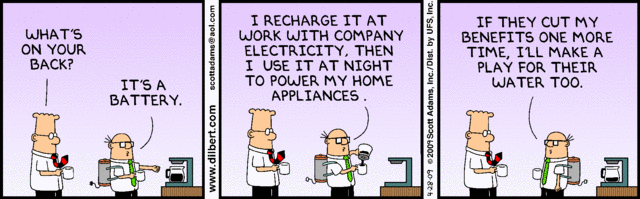
I charge mostly at night, because it saves money and also is less likely to cause excess demand on the electrical grid. It is also a concurrent activity because charging at night is occurring while one sleeps, so therefore it is an efficient use of time and less likely to conflict with activities or sudden transportation needs. These are logical and common sense reasons which no university 'study' will ever be able to refute for my purposes.
- ÆCIII
Agendas will always change how studies are conducted and through what technical, political, and emotional 'lens' that data and observations are included and evaluated. Today's universities unfortunately, are no longer focused in pursuit of pure academic substance and disciplines of arts, science, math, language, and technical skills, but instead are distracted by agendas and political fads embracing activist groups and sometimes actual contradictions to proven science, often having really lost their way.
When pursuing degrees some time ago, I noted there were about six major university accreditation institutions in the United States, and I gave no second thought about the integrity of any one of them and would've been proud of such an accredited degree on my resume. Today, my faith in these same accreditation institutions is near zero, and doing it over I'd be sure to explicitly show qualifications on my resume that would not leverage and reference to these institutions, but instead show my actual academic accomplishments in other ways.
I liked some of Elon's past comments on how he views job applicants with university degrees and how he weighs them in very careful context with a lot of other qualifications, because he knows the true educational substance and innovation skills often have gotten lost and may not always be internalized as abilities and skills in an applicant just because they show up with a 'degree' on their resume. He is so right.
I'm sure there are still solid curricula remaining in a lot of schools, and my views expressed above might not be fairly expressed broadly for all universities.
But, if Stanford really had meaningful expertise in EV charging, they would've been the one's to innovate the NACS standard over the past few years, and they would've been the one's to open it up and then encourage Tesla and others to adopt it from standards they would've refined, tested, and verified for years by now. If they were such experts and this were the case, Tesla would be adopting the NACS standard from them. But this is not the case, and I see those at Stanford as commenting from the sidelines all of a sudden while Tesla has been blazing the real 'trails', doing the real work of innovation, and actuating future development for the way forward. Stanford peers are just writing in the wake of Tesla and others' accomplishments, without vast data and vast experience of their own. It's just my opinion, but I know many other who also share it as well.
I charge mostly at night, because it saves money and also is less likely to cause excess demand on the electrical grid. It is also a concurrent activity because charging at night is occurring while one sleeps, so therefore it is an efficient use of time and less likely to conflict with activities or sudden transportation needs. These are logical and common sense reasons which no university 'study' will ever be able to refute for my purposes.
- ÆCIII
Sponsored
Last edited: