
Sponsored

No Exoskeleton

Crissa

Well-known member
First Name
Crissa
Joined
Jul 8, 2020
Threads
138
Messages
19,571
Reaction score
31,475
Location
Santa Cruz
Vehicles
2014 Zero S, 2013 Mazda 3
Country flag
I never expected the production truck to incorporate a true exoskeleton design.
What is a 'true exoskeleton'? It seems you guys have definitions that exclude most animals with exoskeletons.

The reveal prototype still exists, and will continue to exist for posterity. We'll one day find out who's right. I say it was a structural exoskeleton.
They said the original was made on a ladder frame because it was a prototype. It probably gave up range. It doesn't have a structural batter pack or the 4680 cells. The panels in the front and back triangles are made of thin stainless. Prototypes are basically mockups.

-Crissa
Sponsored

 
Last edited:

JBee

Well-known member
First Name
JB
Joined
Nov 22, 2019
Threads
18
Messages
4,913
Reaction score
6,362
Location
Australia
Vehicles
Cybertruck
Occupation
. Professional Hobbyist
Country flag
What is a 'true exoskeleton'? It seems you guys have definitions that exclude most animals with exoskeletons.

-Crissa
Simply something that is held up structurally primarily from the outside in. For it to be "exo" it needs to be "outside" not inside.
 

Crissa

Well-known member
First Name
Crissa
Joined
Jul 8, 2020
Threads
138
Messages
19,571
Reaction score
31,475
Location
Santa Cruz
Vehicles
2014 Zero S, 2013 Mazda 3
Country flag
Simply something that is held up structurally primarily from the outside in. For it to be "exo" it needs to be "outside" not inside.
Yes, but the body in white is on the outside. And as shown in the images, isn't itself the complete structure.

An exoskeleton isn't excluded from being an exoskeleton if a solid bit of it protrudes through the middle. Most insects and all crab-like creatures have those.

-Crissa
 
Last edited:

JBee

Well-known member
First Name
JB
Joined
Nov 22, 2019
Threads
18
Messages
4,913
Reaction score
6,362
Location
Australia
Vehicles
Cybertruck
Occupation
. Professional Hobbyist
Country flag
Yes, but the body in white *is on the outside*. And as shown in the images, isn't itself the complete structure.

An exoskeleton isn't excluded from being an exoskeleton if a solid bit of it protrudes through the middle. Most insects and all crab-like creatures have those.

-Crissa
Sure, but the internal ribbing is still not the "primary structure" and the ribbing alone, without the outer shell is not sufficient to keep it intact. Conversely, the CT in a body in white is completely structurally sound without it's outer Stainless steel shell. Ergo it is an internal structure not an external one, that keeps the CT together for normal operational loads.

But the skin also has a secondary function in that it is designed to protect the occupants in the event of a impact. That works by compressing the stainless skin into the structure of the cabin and casts that then distribute the load. So like the knight armour, the shell protects the insides from impact, like a sword strike but the insides still have to dissipate the impact forces. But once again the armour shell cannot stand by itself without the structure of the person inside holding it up. Just like the "body in white" knight does in the case of the CT.

-

Sadly, it seems nobody gets my "amour" jokes. :cry:
And no it's not a spelling mistake!
 

Crissa

Well-known member
First Name
Crissa
Joined
Jul 8, 2020
Threads
138
Messages
19,571
Reaction score
31,475
Location
Santa Cruz
Vehicles
2014 Zero S, 2013 Mazda 3
Country flag
Sure, the thing that takes a bunch of pieces to hold it together and really shouldn't have forces applied to it is 'structurally sound'.

Exoskeleton doesn't mean no internal ribbing to the skin. It doesn't mean it doesn't have structures protruding inside. It doesn't mean the outside doesn't pinch inward at joints or orifices.

Your definition of 'structurally sound' joins your definition of 'exoskeleton' in the realm of absolutely unlike how these words are used in reality.

I have shucked many a crab. Crabs don't have exoskeletons according to you. Nor do insects. Eggs maybe?

-Crissa


JBee

Well-known member
First Name
JB
Joined
Nov 22, 2019
Threads
18
Messages
4,913
Reaction score
6,362
Location
Australia
Vehicles
Cybertruck
Occupation
. Professional Hobbyist
Country flag
Sure, the thing that takes a bunch of pieces to hold it together and really shouldn't have forces applied to it is 'structurally sound'.

Exoskeleton doesn't mean no internal ribbing to the skin. It doesn't mean it doesn't have structures protruding inside. It doesn't mean the outside doesn't pinch inward at joints or orifices.

Your definition of 'structurally sound' joins your definition of 'exoskeleton' in the realm of absolutely unlike how these words are used in reality.

I have shucked many a crab. Crabs don't have exoskeletons according to you. Nor do insects. Eggs maybe?

-Crissa
Sorry I can't really help you if you don't want to agree on the definition of words as they are conventionally used. You are changing the definition to fit your argument because you shuck crabs. Crabs might have a exoskeleton, but your perception of what a crab looks like on the inside is not what the exoskeleton is. You need to take in a whole range of various forms phylum arthropod exoskeletons, not just crustaceans, there's also insects etc to which the word applies which exhibit properties unlike a crab. But the two base elements are "external and "structure", and not "internal" and "not-structural".

Look up and understand the morphology of the word "exo-skeleton" and get back to me.

https://www.etymonline.com/word/exoskeleton
 

Crissa

Well-known member
First Name
Crissa
Joined
Jul 8, 2020
Threads
138
Messages
19,571
Reaction score
31,475
Location
Santa Cruz
Vehicles
2014 Zero S, 2013 Mazda 3
Country flag
At this point, I accept that you admit you don't have a clue what you're talking about, JBee. You made a dictionary argument which doesn't support your claims about the Cybertruck.

Here, start with the basics...
https://en.wikipedia.org/wiki/Exoskeleton

And then lead onto how the word actually is used:
https://en.wikipedia.org/wiki/Powered_exoskeleton

Also, I'm sure they have crabs in Australia. Maybe go talk to a docent at an aquarium or something.

-Crissa
 

JBee

Well-known member
First Name
JB
Joined
Nov 22, 2019
Threads
18
Messages
4,913
Reaction score
6,362
Location
Australia
Vehicles
Cybertruck
Occupation
. Professional Hobbyist
Country flag
At this point, I accept that you admit you don't have a clue what you're talking about, JBee. You made a dictionary argument which doesn't support your claims about the Cybertruck.

Here, start with the basics...
https://en.wikipedia.org/wiki/Exoskeleton

And then lead onto how the word actually is used:
https://en.wikipedia.org/wiki/Powered_exoskeleton

Also, I'm sure they have crabs in Australia. Maybe go talk to a docent at an aquarium or something.

-Crissa
I'm sure whatever you say is how it is in your mind.

But for us out here who use language to "communicate ideas and concepts", using something defined as "outside" for something that is "inside" is contrary to convention, and any form meaningful debate.

Good luck with telling that to your crabs though.
 

JBee

Well-known member
First Name
JB
Joined
Nov 22, 2019
Threads
18
Messages
4,913
Reaction score
6,362
Location
Australia
Vehicles
Cybertruck
Occupation
. Professional Hobbyist
Country flag
still serious:

I believe as far as we know, the cab frame is steel (though not 3mm SS), and certain the castings are aluminum. As I understand it, those materials don’t play/weld together well.

These joints occur in the middle thirds of the vehicle, fore / aft of the SS cab.

What’s described above so far, is roughly the same construction as the Model Y.

The Model Y most definitely couldn’t tolerate the sort of payload / towing specs attributed to the CT.

Those loads occur essentially at the rear hitch. In a traditional boxed frame truck, those stresses would cause failure above or just foreward of the rear wheel - the suspension acting essentially as a fulcrum, with the payload/tow weight behind the rear wheel, and on the other side the weight of the front of the truck ahead of the rear wheel.

With the Model Y, where would that point of failure be? Would the suspension itself give first? And if not, where would the Model Y casting/cab separation occur? I assume at/near the joint between cab and rear casting.

Now if the subframe of the Model Y can’t tolerate that sort of CT-level spec of payload/towing, what is it about the CT frame (cab + castings) that allows it to?
This all depends on the specific load paths and how forces are being applied to it.

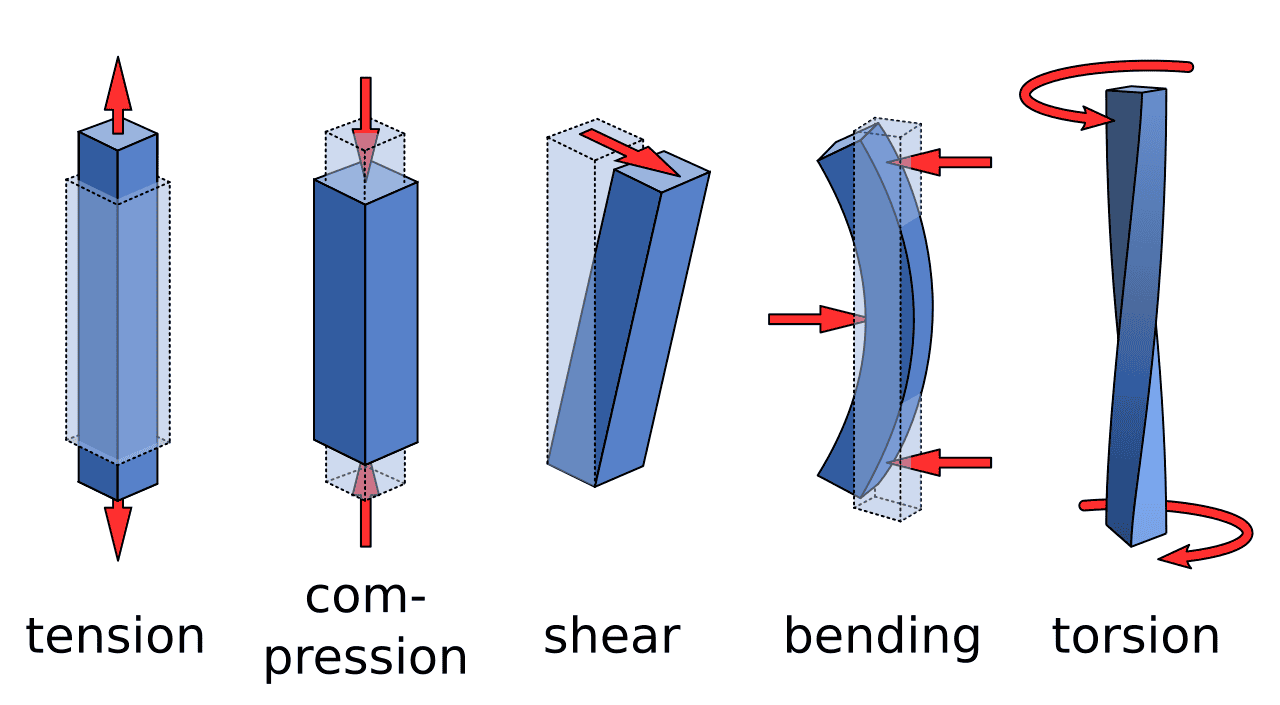
Tesla Cybertruck No Exoskeleton 1280px-Different-types-of-mechanical-stress_EN.sv


To measure force we use Newtons which is expressed as 1 kgms2 or the force required to accelerate 1kg 1 meter per second per second. Now pressure is the amount of force (N) applied perpendicular to a surface over a unit of area. Now if you halve the area you double the force and vice versa.

For example; although they use dissimilar materials like aluminium for the cast and steel for the cabin frame, compression loads are fairly easily transferred through to the next element simply ensuring that wherever they touch there is enough material and surface area at the interface point to transfer the force without it failing. Just like you standing on pavement, the force of gravity is being transferred through the soles of your shoes. Think of your shoes as the contact patch of your car tyres.

Now for tension loads you essentially have to create a structure that stops the separation of the two different surfaces at the interface point. The same rule for surface area and force applies. If you use a fastener like a nut and bolt the inside ends of the nut and the bolt effectively work as opposing surfaces to the primary mating surfaces explained above. Washer's increase the surface area of the force over a greater area leading to better distribution of the forces.

There are other forces that can be applied to the interface point as well, like shear forces, that like a "shear" try to slide the surfaces of the interface point over each other, by applying a force parallel to the interface surface. This is like trying to slide your shoe on the ground whilst supporting your mass. Here the tension of a nut and bolt creates skin friction on the interface point area, and as such can distribute more shear load than the bolt itself, for example when it is not tightened properly. Just like you putting all your weight on one foot will make that shoe harder to slide on the pavement.

There is also torsional forces that can be applied to a interface point, but on a larger frame structure like the CT these frame sized torsional forces become more like shear force on each of the different interface points that connect the cast to the cabin frame. For example a single tow hook does not experience a torsional force until it reaches the end of it's pivot range and contacts the side of the tow ball. Likewise a torsional force on the rear cast will express itself as a shear force at the attachment points to the cabin frame. Imagine the direction of the force on each of the individual corners of the torsional element in the diagram above.

Bending force is another element, but not really that relevant to the connection interface between cabin and casts, although depending on how many points you have and how distributed the forces are, they could create bending forces over the plane of interfaces.

With that out of the way, the next considerations that need to be made is what are the material properties being used. Simply, all materials have something called "elasticity" that define how they respond to external forces. For example on a piece of rubber you can exert a tension force to elongate it, your can also compress it, twist it and bend it with relative ease, like in the diagram.
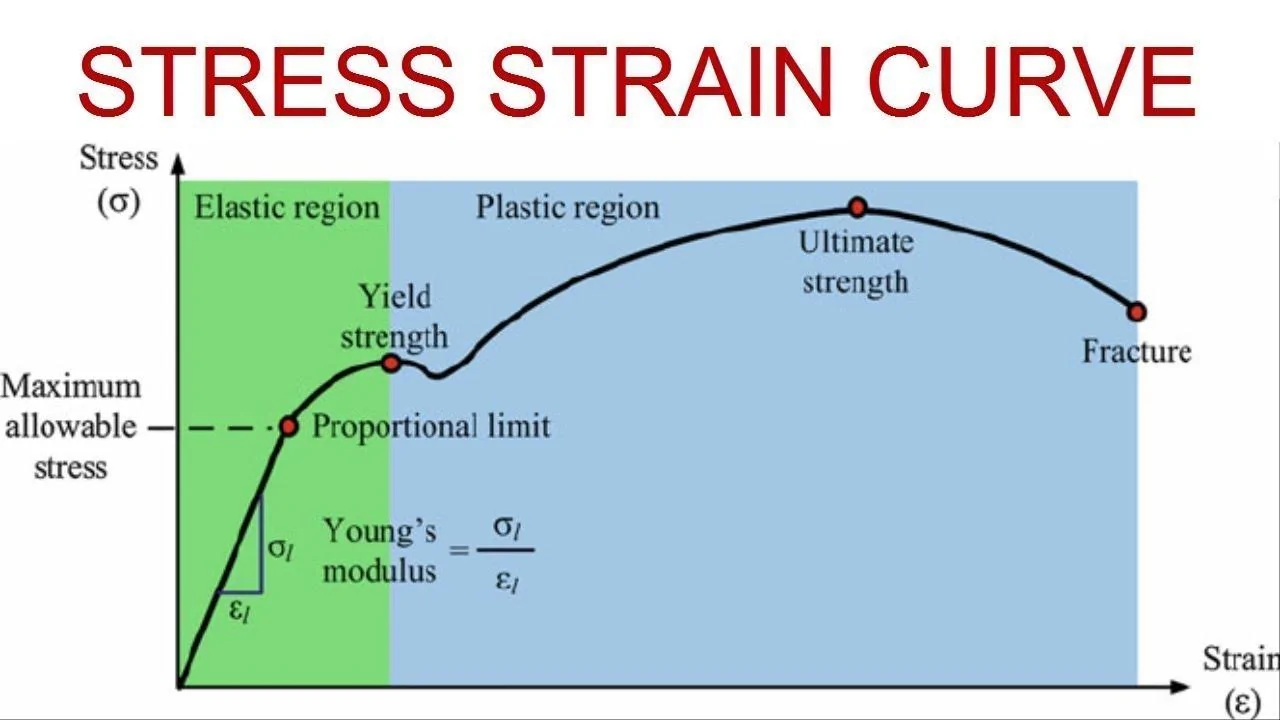
If the rubber returns to it's normal original state after experiencing these forces then you can consider it operating within it's "elastic deformation" range. If you however use even more force and it shows a change in it's shape or properties, like extending a rubber band to far and it discolours and does not bounce back to it's original shape, you call this "plastic deformation". This continues up until the fracture point where it breaks and becomes two parts, and along the way you will have the yield strength and ultimate strength points which form important material parameters for your design.

Tesla Cybertruck No Exoskeleton maxresdefault


In nearly all instances you want to keep your forces within the elastic range for normal operation, but for crash impact forces, you actually want to get the structure to the plastic region and even fracture points in order to "absorb" as much of the impact force and decelerate the vehicle in the smoothest most uniform way possible. A piece of foam for example, or air cushion type deceleration is ideal, as it dissipates force over an area and through time by compressing over a distance, resulting in less peak forces that are the most deadly and damaging.

In the case of the dissimilar materials used in the CT, there various incompatible properties, for example thermal expansion coefficients or dielectric properties that make them corrode. Most can be combated by introducing a layer of material between the interface of the two points to allow for what ever differences there are. Typically, in modern vehicle manufacturing the use of adhesives results not only in a partially flexible connection, but it also can be used as a buffer for peak forces, and can connect dissimilar materials without many material problems. The prerequisite for this is normally larger surface areas as contact points and that there is adequate adhesion to the structural substrate. So sticking stuff to a painted surface, means it's only as good as the paint adheres to the metal.

We can apply the same mechanical principles to the way the load in the CT is distributed down to the contact patches, where the suspension airbag springs are use similar to the structural adhesive. Here we must distinguish between "static" and "dynamic" loads, where a static load is constant and doesn't vary over time, and a dynamic load that does change over time.

In a stationary CT the vehicles own mass can be considered a static load. A payload could be considered a dynamic load. But just be aware that if you move a CT down the road even without a payload, the forces it needs to handle will also become dynamic.

There are three main payload areas on the CT, and when "stationary" they are the funk that predominately loads front axle, the cabin that shares the load between both axles, and the rear bed that predominately loads the rear axle. However whilst driving the dynamic loads act like a pendulum, and the direction of the force vectors change according to the acceleration of the vehicle. Forwards will create more force to the rear, stopping more force to the front, side to the other side, up to down and so on.

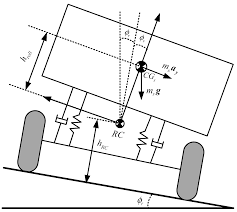
To visualise this imagine that gravity is the only force in the system, and the vehicle is tilted on one side or the other on an angle. Roughly, without including any aero effects or other external force, the maximum amount of force that can be applied sideways to the vehicle is limited by the coefficient of friction of the tyre contact patch, which peaks when the center of gravity is at 45degrees to the tyre contact patch. This also applies to a forwards or backwards tilt on the vehicle, which is where you will find that most off road vehicles, unless they are fairly long, can't climb a slope greater than 45degrees or 100%. A low centre of gravity, like an EV or CT helps here.

Tesla Cybertruck No Exoskeleton 1682751854154


So given the above fundamentals, whilst not experiencing any lateral acceleration forces, and the vehicle being essentially in a steady state, be that parked in your driveway or travelling alons a smooth surface at highway cruising speeds, the CT will primarily exert a downwards force through the suspension to the tyre contact patch directly from the load above it. With most of the frunk load going through the front axle, the cabin payload fairly balanced between both axles, and most of the bed load, given the axles is in the centre of the bed, through the rear axle.

With lateral acceleration forces in normal operation those force magnitudes will be redistributed across the tyres as described further above, in the opposite direction of the acceleration force, and are limited to the forces the tyre contact patch can create. On a crash impact the forces experienced by the cabin are intentionally reduces by the external component that attach to the cabin.

The triangular shape of the CT or the arch shape of the MY cabin are essentially the same, both are good shapes for structural purposes to deflect forces and loads, however the MY's curved roof line would be simpler to optimise for aerodynamics than the CT's triangle, depending on the vehicle length.

Overall the design method would be such that vehicle structural failure would cascade in the following sequence: Tyres, suspension spring, suspension arms, underbody, front and rear bed casts, then lastly cabin frame. Each external component to the cabin is there to support operational loads, but is sacrificial to crash impact loads.
 
Last edited:


Gurule92

Well-known member
Joined
Sep 2, 2021
Threads
201
Messages
3,825
Reaction score
7,373
Location
Colorado Springs
Vehicles
MYP
Occupation
"Cyber" stuff
Country flag
Wait wait wait.

My Obama giving himself a medal pic gets deleted but people out here (on the forum) scrapping with word knives is cool?

Weird
 

Deleted member 17810

Guest
...Conversely, the CT in a body in white is completely structurally sound without it's outer Stainless steel shell. Ergo it is an internal structure not an external one, that keeps the CT together for normal operational loads.
...
How can you know this?
 

JBee

Well-known member
First Name
JB
Joined
Nov 22, 2019
Threads
18
Messages
4,913
Reaction score
6,362
Location
Australia
Vehicles
Cybertruck
Occupation
. Professional Hobbyist
Country flag
How can you know this?
Have you read all my posts about this?

I don't mind if you want to discuss how something or all I said was wrong, but if you want to do so at least make the effort of pointing out what you think it is so we can work our way to the truth.

Just questioning everything doesn't prove much.

I’ve written this so many times before, but show me a load path that is better off going through the skin, then I might be able to believe it too.
 

CyberGus

Well-known member
First Name
Gus
Joined
May 22, 2021
Threads
91
Messages
10,236
Reaction score
33,888
Location
Austin, TX
Vehicles
1981 DeLorean, 2024 Cybertruck
Occupation
IT Specialist
Country flag
My Obama giving himself a medal pic gets deleted but people out here (on the forum) scrapping with word knives is cool?
Stabbing isn't political

usually
 

Gurule92

Well-known member
Joined
Sep 2, 2021
Threads
201
Messages
3,825
Reaction score
7,373
Location
Colorado Springs
Vehicles
MYP
Occupation
"Cyber" stuff
Country flag
Stabbing isn't political

usually
Wait. It was because the person in the picture had a political affiliation you think?

That's silly. The joke itself wasn't political. It could've been Optimus prime giving himself a medal but that wasn't readily available for me to snag lol
Sponsored


Top