
Sponsored

Poor Level 1 charging efficiency

Cybergirl

Well-known member
Joined
Jul 3, 2020
Threads
40
Messages
872
Reaction score
2,933
Location
Illinois and Arizona
Vehicles
Tesla Model Y LR, Model Y SR, Cybertruck AWD FS
Country flag
Off-road adventure in an all electric vehicle can be risky. Having a portable fossil fuel generator or solar generator can ease the anxiety of running out of battery miles from the nearest charging station. Understanding what constitutes a viable range extending power source is important, and the question of charging efficiency feeds into that understanding.

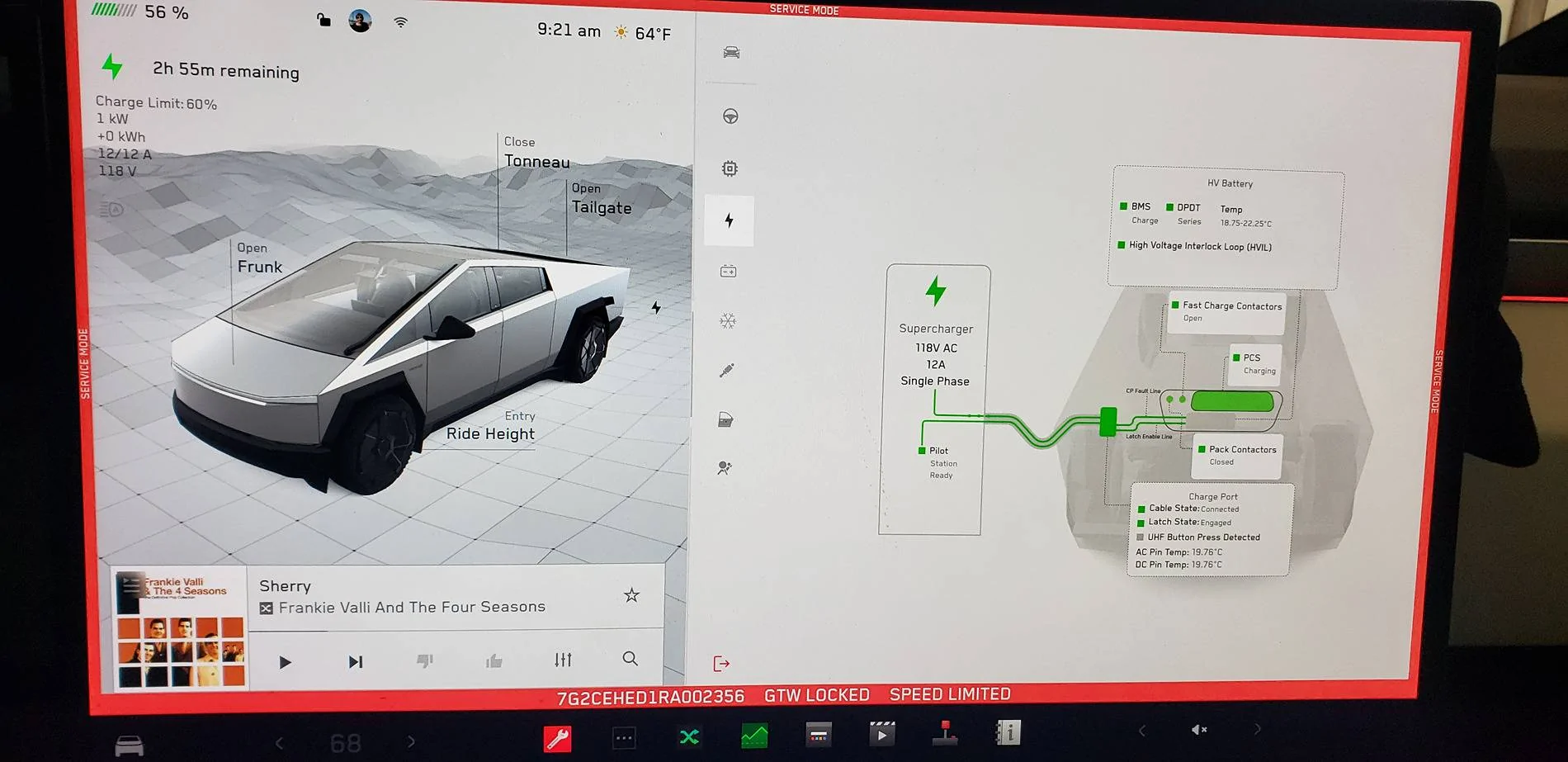
Today, I attempted to charge my Cybertruck from a 120V 15A receptacle in my garage using Gen 2 mobile connector (Level 1 charging). The battery was at 56% SOC and the charge limit was set to 60%. At the start, the 'time remaining' display was 3 hrs and 5 min which looked encouraging. I plugged the mobile connector into a Kilowatt meter to measure the power flowing into the truck. It read 1435W. I turned off all possible parasitic loads. The ambient air temperature was 64F, and the battery temperature was 18.75 - 22.25 deg C. The HV service display showed everything was working.

Tesla Cybertruck Poor Level 1 charging efficiency PCS Stat


After the estimated 3 hrs and 5 min, the 'time remaining' still read 1 hr 10 min and the battery state of charge was only 58%. The Kilowatt meter recorded that 4.42 kWh of grid energy had been fed to the truck. The battery temperature had risen to 21.25-25.75 deg C.

I continued charging until the 60% charging limit was finally reached after 5 hrs and 15 min with 5 kWh of accumulated battery energy. The Kilowatt meter measured 7.57 kWh from the grid, so the charging efficiency was approximately 66%.

Frankly, I didn't expect such poor efficiency from Level 1 charging using the mobile connector, and it made me question the economic practicality of Level 1 charging as a routine practice. I'm also having doubts about using solar panels to augment the truck's battery charge to achieve more driving range. Better to use solar panels to power things that would otherwise drain energy from the truck's battery (refrigerator, A/C, electric appliances, etc.)

At higher charging power the situation is not so dire. I think my dual fuel generator will be a good fallback power source when extra driving range is needed.
Sponsored


Outdoors

Well-known member
First Name
Outdoors
Joined
Nov 19, 2019
Threads
17
Messages
1,873
Reaction score
3,455
Location
North West Montana
Vehicles
S,3,Y,CT,CT(holding pattern) Slate is back on
Off-road adventure in an all electric vehicle can be risky. Having a portable fossil fuel generator or solar generator can ease the anxiety of running out of battery miles from the nearest charging station. Understanding what constitutes a viable range extending power source is important, and the question of charging efficiency feeds into that understanding.

Today, I attempted to charge my Cybertruck from a 120V 15A receptacle in my garage using Gen 2 mobile connector (Level 1 charging). The battery was at 56% SOC and the charge limit was set to 60%. At the start, the 'time remaining' display was 3 hrs and 5 min which looked encouraging. I plugged the mobile connector into a Kilowatt meter to measure the power flowing into the truck. It read 1435W. I turned off all possible parasitic loads. The ambient air temperature was 64F, and the battery temperature was 18.75 - 22.25 deg C. The HV service display showed everything was working.
PCS State.webp


Better to use solar panels to power things that would otherwise drain energy from the truck's battery (refrigerator, A/C, electric appliances, etc.)


I think I told everyone that before. Buy an larger ECO flow and use the crap out of that, and it works great with the solar. Save the juice of the truck for movement.

I also don't charge in service mode. Not saying you were, but might be different. I also use level 1 here and there. Don't have your experience less generator.
 

GuyV

Well-known member
First Name
Guy
Joined
Aug 17, 2023
Threads
1
Messages
814
Reaction score
1,073
Location
St. Louis, MO
Vehicles
Tesla Model S, FS Cybertruck AWD
Occupation
Retired
Country flag
Off-road adventure in an all electric vehicle can be risky. Having a portable fossil fuel generator or solar generator can ease the anxiety of running out of battery miles from the nearest charging station. Understanding what constitutes a viable range extending power source is important, and the question of charging efficiency feeds into that understanding.

Today, I attempted to charge my Cybertruck from a 120V 15A receptacle in my garage using Gen 2 mobile connector (Level 1 charging). The battery was at 56% SOC and the charge limit was set to 60%. At the start, the 'time remaining' display was 3 hrs and 5 min which looked encouraging. I plugged the mobile connector into a Kilowatt meter to measure the power flowing into the truck. It read 1435W. I turned off all possible parasitic loads. The ambient air temperature was 64F, and the battery temperature was 18.75 - 22.25 deg C. The HV service display showed everything was working.

PCS State.jpg


After the estimated 3 hrs and 5 min, the 'time remaining' still read 1 hr 10 min and the battery state of charge was only 58%. The Kilowatt meter recorded that 4.42 kWh of grid energy had been fed to the truck. The battery temperature had risen to 21.25-25.75 deg C.

I continued charging until the 60% charging limit was finally reached after 5 hrs and 15 min with 5 kWh of accumulated battery energy. The Kilowatt meter measured 7.57 kWh from the grid, so the charging efficiency was approximately 66%.

Frankly, I didn't expect such poor efficiency from Level 1 charging using the mobile connector, and it made me question the economic practicality of Level 1 charging as a routine practice. I'm also having doubts about using solar panels to augment the truck's battery charge to achieve more driving range. Better to use solar panels to power things that would otherwise drain energy from the truck's battery (refrigerator, A/C, electric appliances, etc.)

At higher charging power the situation is not so dire. I think my dual fuel generator will be a good fallback power source when extra driving range is needed.
That looks like they've got something wrong going on there, something they need to work on. :rolleyes:
 

scottf200

Well-known member
Joined
Jul 31, 2021
Threads
53
Messages
2,221
Reaction score
3,241
Location
Western NC
Vehicles
X; immed family 3 & Y
Country flag
The 2+ hrs extra, 66% efficiency, and the battery temperature increased from 18.75-22.25°C to 21.25-25.75°C, indicating some energy was lost as heat.
 

igs

Well-known member
Joined
Aug 7, 2023
Threads
45
Messages
1,183
Reaction score
1,730
Location
CA
Vehicles
CT, MX, MY
Occupation
Tesla: "To maintain service life, the battery pack should be stored at a state of charge (SOC) of 15 to 50%."
Country flag
I continued charging until the 60% charging limit was finally reached after 5 hrs and 15 min with 5 kWh of accumulated battery energy.
The display shows it's charging at 1kw so that's right.

The Kilowatt meter measured 7.57 kWh from the grid, so the charging efficiency was approximately 66%.
The computer alone uses 400w so that's also right.


Jedi2155

Well-known member
Joined
Apr 13, 2020
Threads
3
Messages
157
Reaction score
157
Location
Southern California
Vehicles
2024 Model Y AWD | FS Cybertruck AWD + FUSC
Occupation
Engineer
Country flag
Off-road adventure in an all electric vehicle can be risky. Having a portable fossil fuel generator or solar generator can ease the anxiety of running out of battery miles from the nearest charging station. Understanding what constitutes a viable range extending power source is important, and the question of charging efficiency feeds into that understanding.

Today, I attempted to charge my Cybertruck from a 120V 15A receptacle in my garage using Gen 2 mobile connector (Level 1 charging). The battery was at 56% SOC and the charge limit was set to 60%. At the start, the 'time remaining' display was 3 hrs and 5 min which looked encouraging. I plugged the mobile connector into a Kilowatt meter to measure the power flowing into the truck. It read 1435W. I turned off all possible parasitic loads. The ambient air temperature was 64F, and the battery temperature was 18.75 - 22.25 deg C. The HV service display showed everything was working.

PCS State.jpg


After the estimated 3 hrs and 5 min, the 'time remaining' still read 1 hr 10 min and the battery state of charge was only 58%. The Kilowatt meter recorded that 4.42 kWh of grid energy had been fed to the truck. The battery temperature had risen to 21.25-25.75 deg C.

I continued charging until the 60% charging limit was finally reached after 5 hrs and 15 min with 5 kWh of accumulated battery energy. The Kilowatt meter measured 7.57 kWh from the grid, so the charging efficiency was approximately 66%.

Frankly, I didn't expect such poor efficiency from Level 1 charging using the mobile connector, and it made me question the economic practicality of Level 1 charging as a routine practice. I'm also having doubts about using solar panels to augment the truck's battery charge to achieve more driving range. Better to use solar panels to power things that would otherwise drain energy from the truck's battery (refrigerator, A/C, electric appliances, etc.)

At higher charging power the situation is not so dire. I think my dual fuel generator will be a good fallback power source when extra driving range is needed.
66% efficiency is better than I thought, but fairly typical for L1 charging, this is common in ALL EV's since the EV's I use to drive 10+ years ago (Volt, Leaf, RAV4 etc.). Level 2 is needed to bring you efficiency to the 90%+ range.
 
OP
OP
Cybergirl

Cybergirl

Well-known member
Joined
Jul 3, 2020
Threads
40
Messages
872
Reaction score
2,933
Location
Illinois and Arizona
Vehicles
Tesla Model Y LR, Model Y SR, Cybertruck AWD FS
Country flag
The 2+ hrs extra, 66% efficiency, and the battery temperature increased from 18.75-22.25°C to 21.25-25.75°C, indicating some energy was lost as heat.
Yes, that's true. At the end of the charge the battery temperature rose to 27 deg C. Add to that the AC to DC conversion inefficiency. Lowering the charging rate to 8A (1000W), I measured an efficiency of only 36%.
The display shows it's charging at 1kw so that's right.


The computer alone uses 400w so that's also right.
I doubt that when the truck is at rest the computers draw 400W. If that were true, in 12 hours, the battery would lose 12 x 0.4W = 4.8kWh. That's 3.9% battery loss.
 

GuyV

Well-known member
First Name
Guy
Joined
Aug 17, 2023
Threads
1
Messages
814
Reaction score
1,073
Location
St. Louis, MO
Vehicles
Tesla Model S, FS Cybertruck AWD
Occupation
Retired
Country flag
Yes, that's true. At the end of the charge the battery temperature rose to 27 deg C. Add to that the AC to DC conversion inefficiency. Lowering the charging rate to 8A (1000W), I measured an efficiency of only 36%.

I doubt that when the truck is at rest the computers draw 400W. If that were true, in 12 hours, the battery would lose 12 x 0.4W = 4.8kWh. That's 3.9% battery loss.
I question whether it was "lost as heat" or that it was intentionally heating the battery, unnecessarily at that rate of charge at those temperatures. We have already seen they have acknowledged L2 heating/charging algorithm problems at subfreezing temperatures.

Losses from transmission, conversion and heat generation from charging alone should not be that high. They ought to easily be able to operate all the computer systems at low power as well. Perhaps your monitoring kept them at higher activity.
 

Crissa

Well-known member
First Name
Crissa
Joined
Jul 8, 2020
Threads
138
Messages
19,571
Reaction score
31,475
Location
Santa Cruz
Vehicles
2014 Zero S, 2013 Mazda 3
Country flag
66% efficiency is better than I thought, but fairly typical for L1 charging, this is common in ALL EV's since the EV's I use to drive 10+ years ago (Volt, Leaf, RAV4 etc.). Level 2 is needed to bring you efficiency to the 90%+ range.
That's not quite true, re older Volt, Leaf, RAV4.

They had the older, 80% efficient, cheap chargers so they're always stuck there. It's not the overhead that makes it inefficient, it's just older (cheaper) methods of rectifying AC to the appropriate voltage for charging.

It's just like you can choose a more or less efficient power supply for a PC or your USB powered devices. And when I mean just like, it's basically the same electronics! Power supplies have to adjust for the load they're powering: Chargers, on the other hand, adjust the voltage for the charge level so the load remains as consistent as possible. It's the same thing, just a different control.

So for instance, the chargers for the Gen 2 Zero I have is always that 80% efficient - even if you have the Level 2 6kW one.

-Crissa
 

Bobo_LaDouche

Well-known member
Joined
Nov 13, 2024
Threads
8
Messages
179
Reaction score
268
Location
Carson City, Nevada
Vehicles
Cybertruck, Model 3
Country flag
Thank you for the facts; 5 hours for 5 kWh looks like 3 miles range per hour of charging. Not nice when carrying gas and listening to a generator. Yes, it will have to be a 240v gen-set.

Not sure there is a solar solution yet either. Maybe cross my fingers that Tesla makes a new dc solar gizmo product line for direct charging... holding my breath.


mongo

Well-known member
Joined
May 27, 2024
Threads
5
Messages
4,521
Reaction score
5,497
Location
SE Michigan
Vehicles
Cyberbeast
Country flag
I question whether it was "lost as heat" or that it was intentionally heating the battery, unnecessarily at that rate of charge at those temperatures. We have already seen they have acknowledged L2 heating/charging algorithm problems at subfreezing temperatures.
Lost as heat. If you watch the thermal->coolant page it shows no active pack heating. It's just heat rejected from the computers and PCS.
 

GuyV

Well-known member
First Name
Guy
Joined
Aug 17, 2023
Threads
1
Messages
814
Reaction score
1,073
Location
St. Louis, MO
Vehicles
Tesla Model S, FS Cybertruck AWD
Occupation
Retired
Country flag
Lost as heat. If you watch the thermal->coolant page it shows no active pack heating. It's just heat rejected from the computers and PCS.
Something is wrong somewhere, losing half a kWh per hour just slow charging is crazy. The converter can't be that inefficient. Maybe the excess power use while monitoring is also making the heat management work harder as well. We know it burns a lot when sentry is on. :unsure:
 

cybercricket

Well-known member
Joined
Oct 31, 2024
Threads
13
Messages
656
Reaction score
798
Location
Oregon
Vehicles
Cybertruck
Country flag
Something is wrong somewhere, losing half a kWh per hour just slow charging is crazy. The converter can't be that inefficient. Maybe the excess power use while monitoring is also making the heat management work harder as well. We know it burns a lot when sentry is on. :unsure:
Conversion efficiency is lower when the voltage differential is higher. You get 120VAC input and you need to produce over 800VDC. Then the truck probably spends a bunch of juice running the computer, contactors, etc.
 

ABILISK

Well-known member
Joined
Nov 6, 2024
Threads
22
Messages
2,133
Reaction score
3,865
Location
DFW
Website
ts.la
Vehicles
‘24 Beast
Country flag
it made me question the economic practicality of Level 1 charging as a routine practice
… yeah…

Plugging into a 12A/110V socket is either a last resort or if you don’t need to drive for several days. It’s not designed for routine practice.

The ONLY thing it could be used for routinely is if you have a short drive to work and can plug in there while your car sits for 8-10 hours.
 

mongo

Well-known member
Joined
May 27, 2024
Threads
5
Messages
4,521
Reaction score
5,497
Location
SE Michigan
Vehicles
Cyberbeast
Country flag
Something is wrong somewhere, losing half a kWh per hour just slow charging is crazy. The converter can't be that inefficient. Maybe the excess power use while monitoring is also making the heat management work harder as well. We know it burns a lot when sentry is on. :unsure:
The pack heating is all due to inefficiencies elsewhere, once the pack is warm enough to charge at a rate that matches the charge connection. A 32A 240V charge calls for a warmer pack than a 12A 120V charge.

Conversion efficency is poor at lower power due to overhead of being on. The 500W is consumption by all the active electronics in the vehicle. Controllers, screen, charger, the cooling loop takes the heat from PCS and computers and transfers it to the pack.

Testing at 28F, I get 1% SOC every 90 minutes with 6A 240V, so net charge efficency of 57%. Losses of 620W. Took 45 minutes and 2% SOC to warm pack at start of charge.

Not sure on power draw if doing climate preconditioning from 1.44kW.
Sponsored


Top