
Cybergirl
Well-known member
- Joined
- Jul 3, 2020
- Threads
- 40
- Messages
- 872
- Reaction score
- 2,933
- Location
- Illinois and Arizona
- Vehicles
- Tesla Model Y LR, Model Y SR, Cybertruck AWD FS

- Thread starter
- #1
Off-road adventure in an all electric vehicle can be risky. Having a portable fossil fuel generator or solar generator can ease the anxiety of running out of battery miles from the nearest charging station. Understanding what constitutes a viable range extending power source is important, and the question of charging efficiency feeds into that understanding.
Today, I attempted to charge my Cybertruck from a 120V 15A receptacle in my garage using Gen 2 mobile connector (Level 1 charging). The battery was at 56% SOC and the charge limit was set to 60%. At the start, the 'time remaining' display was 3 hrs and 5 min which looked encouraging. I plugged the mobile connector into a Kilowatt meter to measure the power flowing into the truck. It read 1435W. I turned off all possible parasitic loads. The ambient air temperature was 64F, and the battery temperature was 18.75 - 22.25 deg C. The HV service display showed everything was working.

After the estimated 3 hrs and 5 min, the 'time remaining' still read 1 hr 10 min and the battery state of charge was only 58%. The Kilowatt meter recorded that 4.42 kWh of grid energy had been fed to the truck. The battery temperature had risen to 21.25-25.75 deg C.
I continued charging until the 60% charging limit was finally reached after 5 hrs and 15 min with 5 kWh of accumulated battery energy. The Kilowatt meter measured 7.57 kWh from the grid, so the charging efficiency was approximately 66%.
Frankly, I didn't expect such poor efficiency from Level 1 charging using the mobile connector, and it made me question the economic practicality of Level 1 charging as a routine practice. I'm also having doubts about using solar panels to augment the truck's battery charge to achieve more driving range. Better to use solar panels to power things that would otherwise drain energy from the truck's battery (refrigerator, A/C, electric appliances, etc.)
At higher charging power the situation is not so dire. I think my dual fuel generator will be a good fallback power source when extra driving range is needed.
Today, I attempted to charge my Cybertruck from a 120V 15A receptacle in my garage using Gen 2 mobile connector (Level 1 charging). The battery was at 56% SOC and the charge limit was set to 60%. At the start, the 'time remaining' display was 3 hrs and 5 min which looked encouraging. I plugged the mobile connector into a Kilowatt meter to measure the power flowing into the truck. It read 1435W. I turned off all possible parasitic loads. The ambient air temperature was 64F, and the battery temperature was 18.75 - 22.25 deg C. The HV service display showed everything was working.
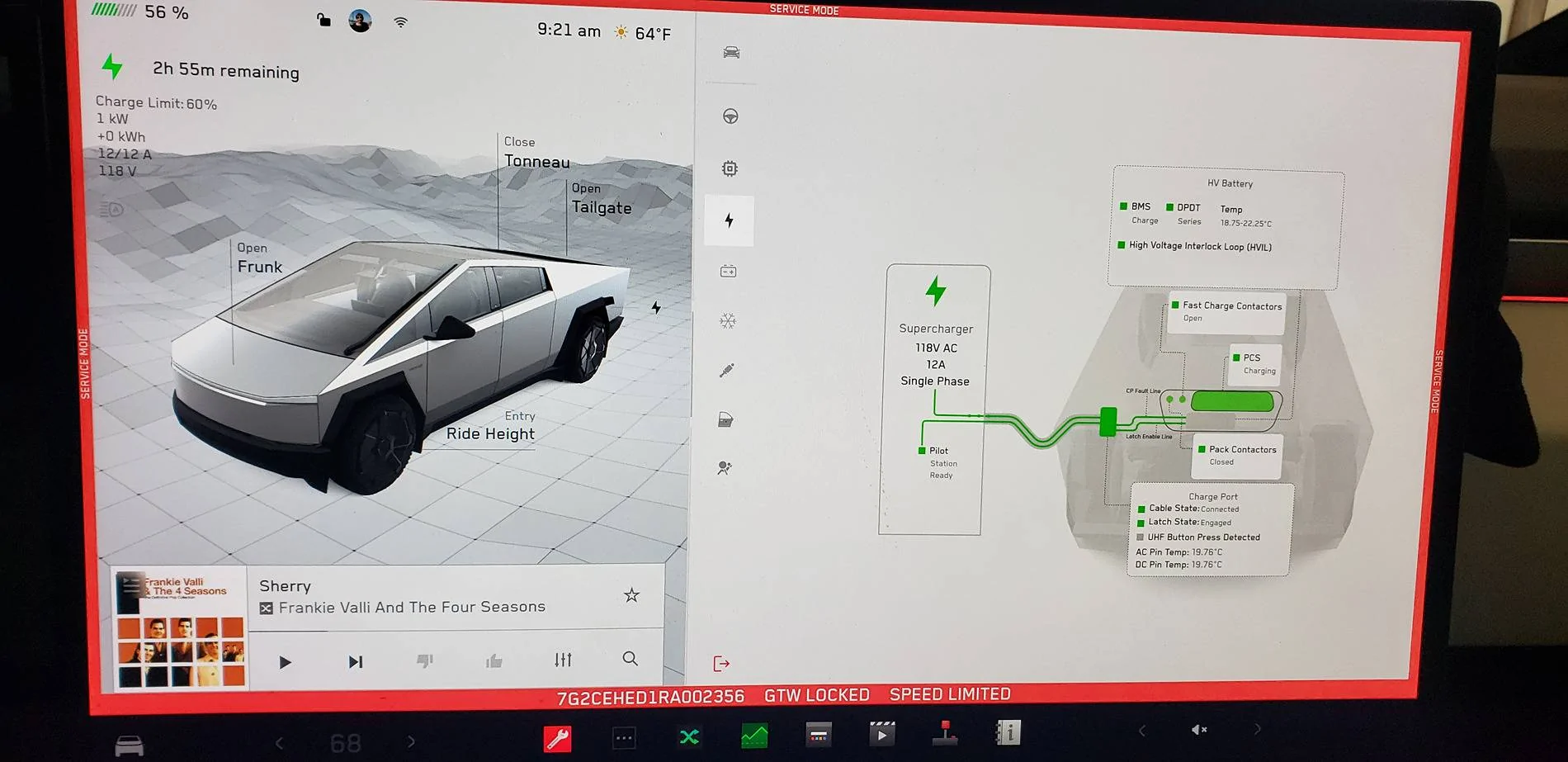
After the estimated 3 hrs and 5 min, the 'time remaining' still read 1 hr 10 min and the battery state of charge was only 58%. The Kilowatt meter recorded that 4.42 kWh of grid energy had been fed to the truck. The battery temperature had risen to 21.25-25.75 deg C.
I continued charging until the 60% charging limit was finally reached after 5 hrs and 15 min with 5 kWh of accumulated battery energy. The Kilowatt meter measured 7.57 kWh from the grid, so the charging efficiency was approximately 66%.
Frankly, I didn't expect such poor efficiency from Level 1 charging using the mobile connector, and it made me question the economic practicality of Level 1 charging as a routine practice. I'm also having doubts about using solar panels to augment the truck's battery charge to achieve more driving range. Better to use solar panels to power things that would otherwise drain energy from the truck's battery (refrigerator, A/C, electric appliances, etc.)
At higher charging power the situation is not so dire. I think my dual fuel generator will be a good fallback power source when extra driving range is needed.
Sponsored