
Sponsored

Yes 'Exoskeleton'?

JBee

Well-known member
First Name
JB
Joined
Nov 22, 2019
Threads
18
Messages
4,913
Reaction score
6,362
Location
Australia
Vehicles
Cybertruck
Occupation
. Professional Hobbyist
Country flag
I’ll just skip to phrasing it as an assertion:


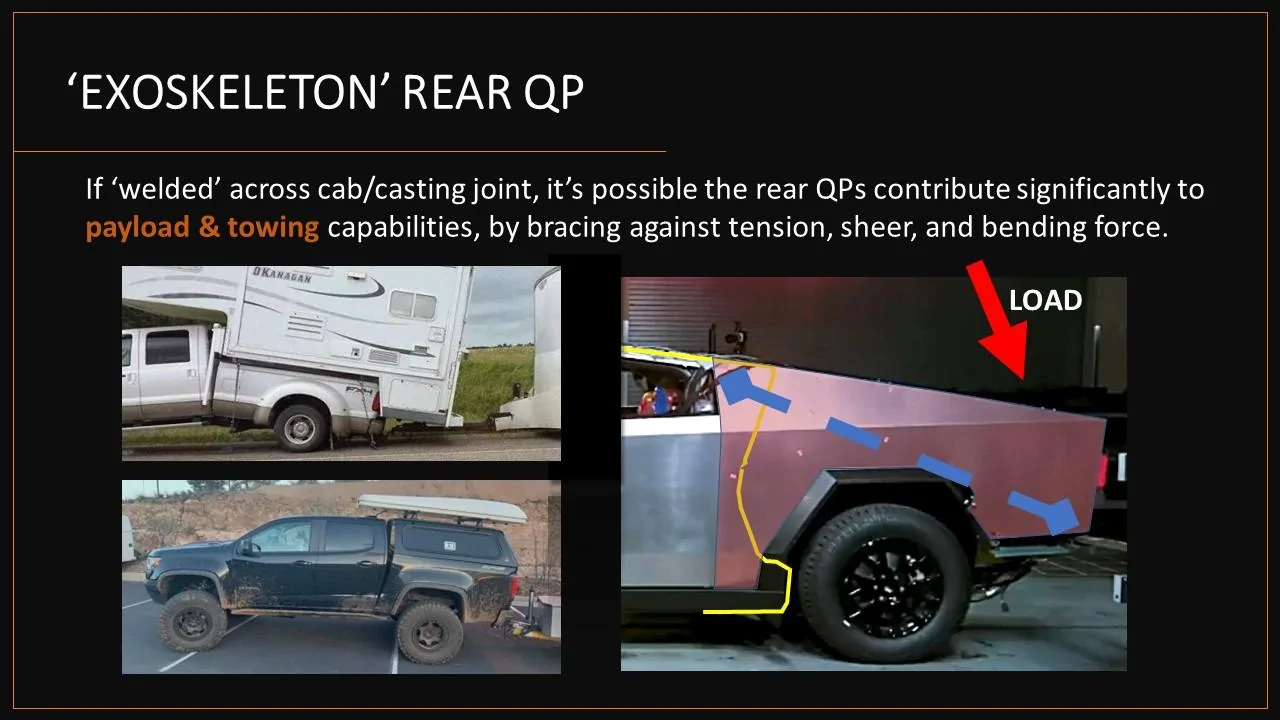
with half your breath you’re saying the obvious: these forces are borne by bolts and adhesives at joints

with the rest of your breath you’re saying that those same forces cannot be borne by a welded metal bracket across that same joint.

it’s bizzare

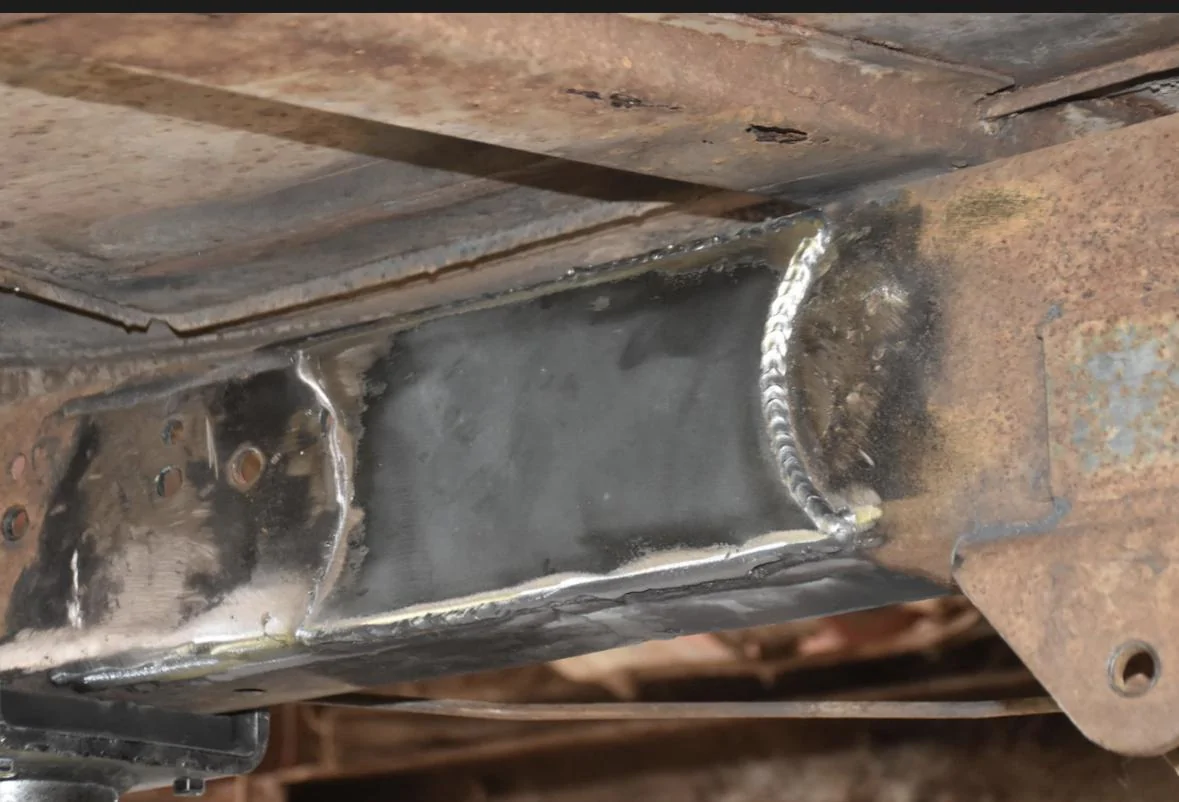
metal mending brackets are used to repair or increase strength of 4X4 frames all the time

049B24D0-63E1-4710-AB50-52837A2193CA.jpeg
Indeed it is quite bizarre, downright crazy even.

But that is the single line drawing of the load path you want me to believe in, so you can use the fenders structurally.

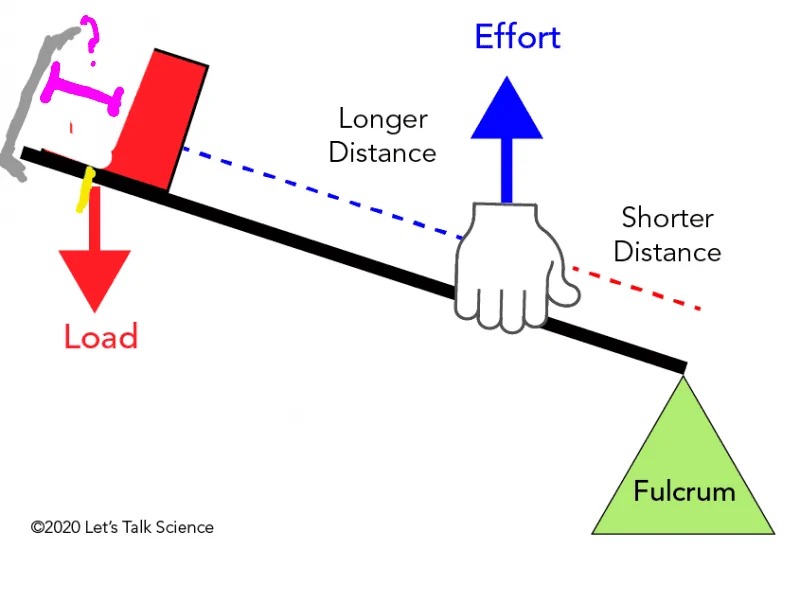
"IF" you want the fenders to do some structural work, then like the lever arm on the right, you have to get the fender inbetween the load and the fulcrum, so it can help that lever arm.

This is what I mean when I say there is "no load path" through the fenders, because they are "outside" of the load path.

Look again at the diagram below, but ignore all the bias and counterarguments, that you want to find to make your OP points, just consider this line drawing as if it were the only thing we are discussing. Just for one minute at least.

Now imagine that how it is attached together, even what it is made of is all irrelevant, because each part of the single line drawing has infinite strength.
Tesla Cybertruck Yes 'Exoskeleton'? third_class_lever_0


So once again that grey line is the fender, sitting to the left of the load. The load in this diagram can only act on the right hand side of the load, along the blue and red load path line tothe fulcrum. But cannot carry anything to the left of the load, along the pink line, because th we re is no fulcrum to carry it to. It's in the air, flapping in the breeze so to speak.

In this single line diagram the beam right of the load does all the work, the beam left of the load does nothing, except carry the fender in grey.

If we wanted the fender to share some load, the left side of the beam would also need to terminate on a fulcrum, or fixed point as well. If we put the fulcrum there the load would use the left beam and the fender as well, which would reduce the amount of load to the fight fulcrum.

This of course would be beneficial, but It is not haw the fender is attached to the structure on the CT. In the front axle the load sits inbetween both wheels, with each wheel representing a fulcrum to the ground, the suspension arms the levers to the center of the vehicle with the hand being the springs.

But the fender is on the outside of the wheel, like in the drawing, but not even connected to the lever arm bearing the load, nor the spring. Hence my comment that it might as well be in a trailer behind another car. This is not a flipant comment, it is how it is, and why I am so persistent on the point.

Anyway when I get home I'll draw out a sketch how I see the load paths on the CT so we can discuss it better with visual aids so we end up talking about the same thing.
Sponsored
 
OP
OP
cvalue13

cvalue13

Well-known member
Joined
Aug 17, 2022
Threads
74
Messages
7,153
Reaction score
13,769
Location
Austin, TX
Vehicles
F150L
Occupation
Fun-employed
Country flag
Anyway when I get home I'll draw out a sketch how I see the load paths on the CT so we can discuss it better with visual aids so we end up talking about the same thing.
Start instead by explaining how a metal mending bracket welded to a traditional frame - as shown earlier - is not structural to the frame, in the exact same manner as a bolt or adhesive or other weldments

that’s the only fundamental point of interest here

are you saying that frame repair shops throughout history have not understood how to repair frames?
 

JBee

Well-known member
First Name
JB
Joined
Nov 22, 2019
Threads
18
Messages
4,913
Reaction score
6,362
Location
Australia
Vehicles
Cybertruck
Occupation
. Professional Hobbyist
Country flag
To get somewhat back on track:

It’s maybe helpful to expand upon what the CT structure is not.

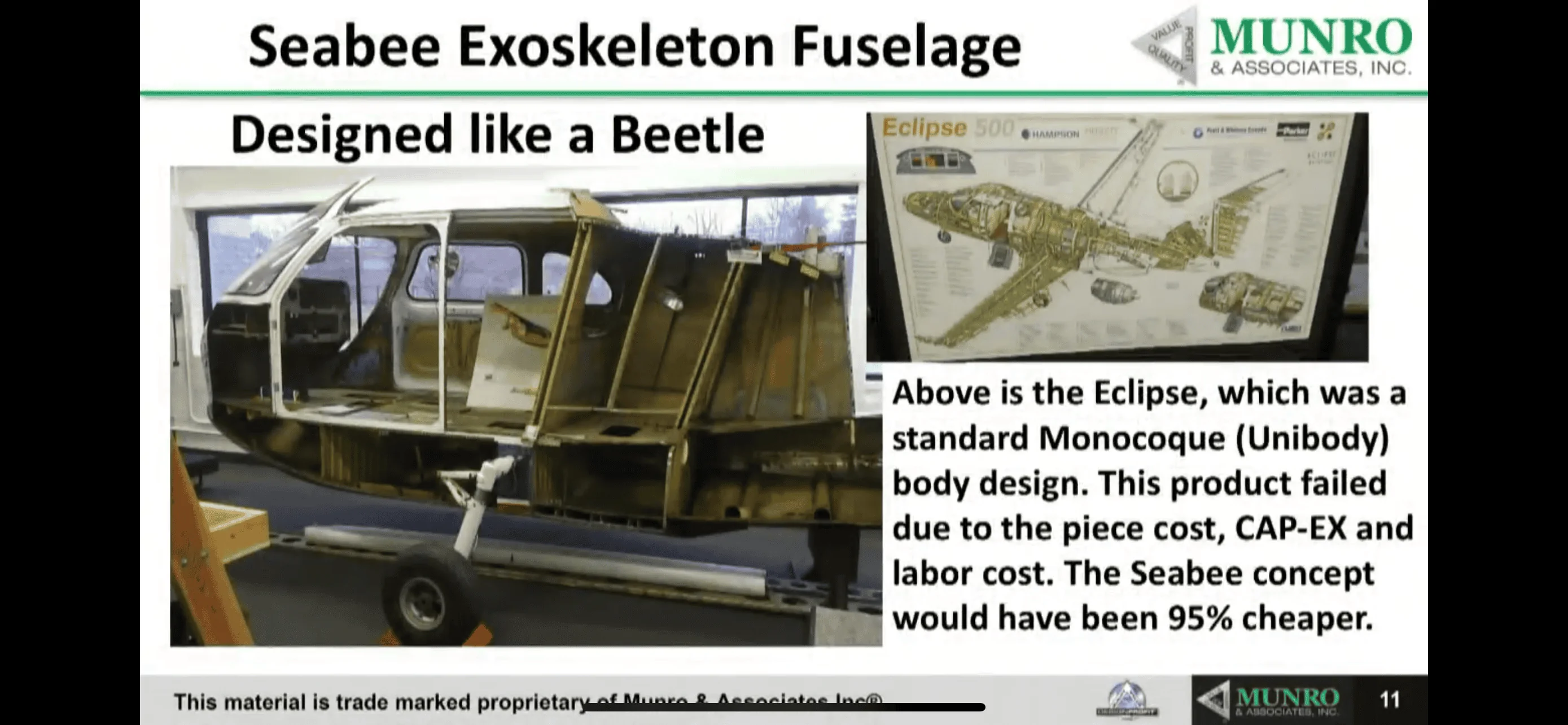
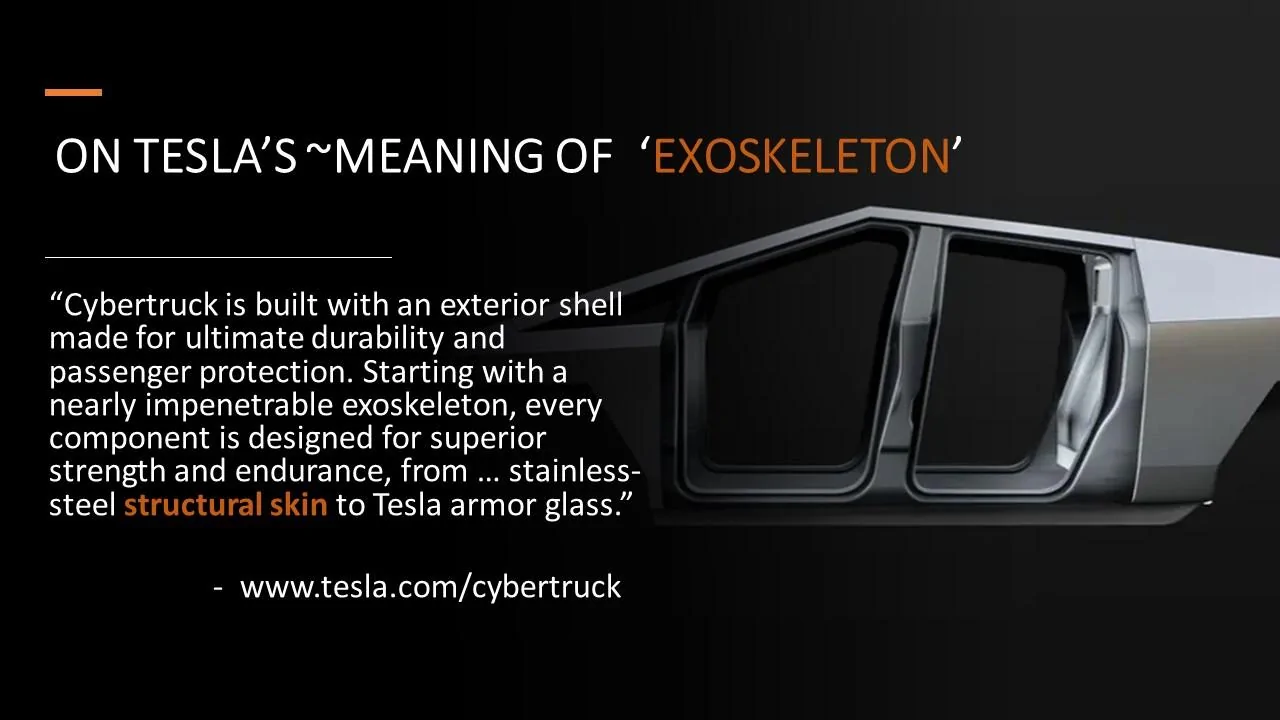
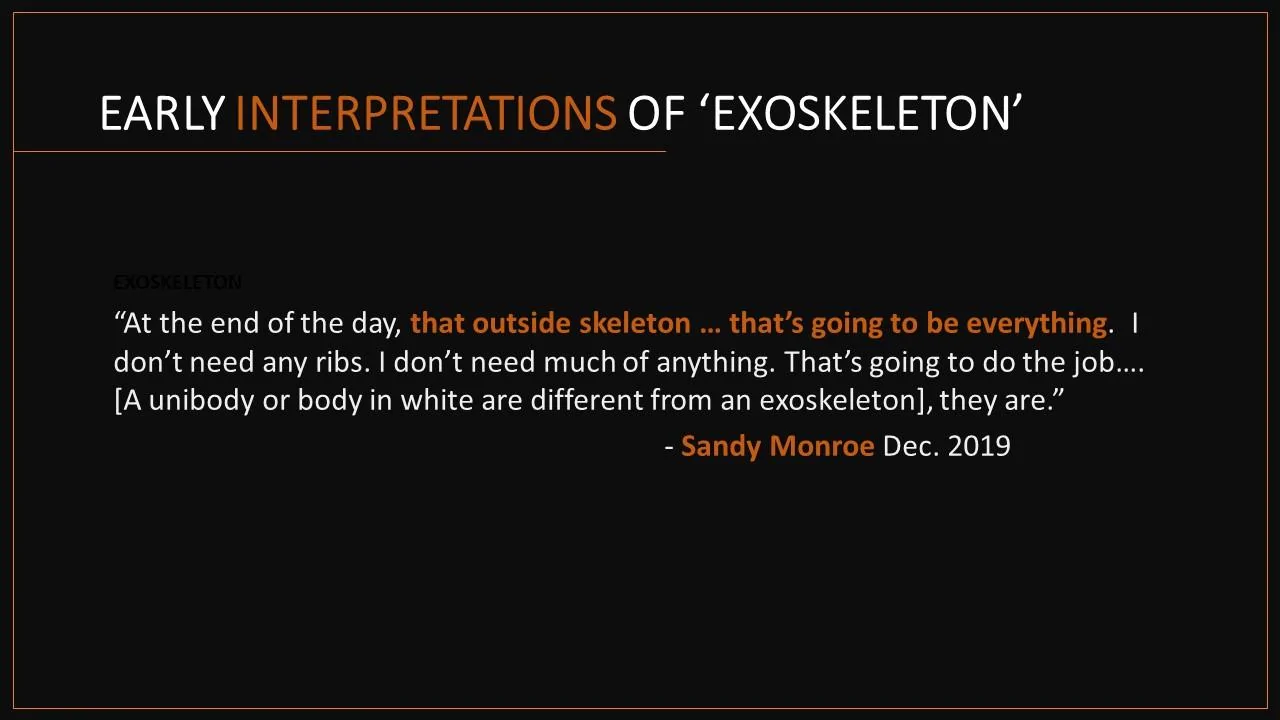
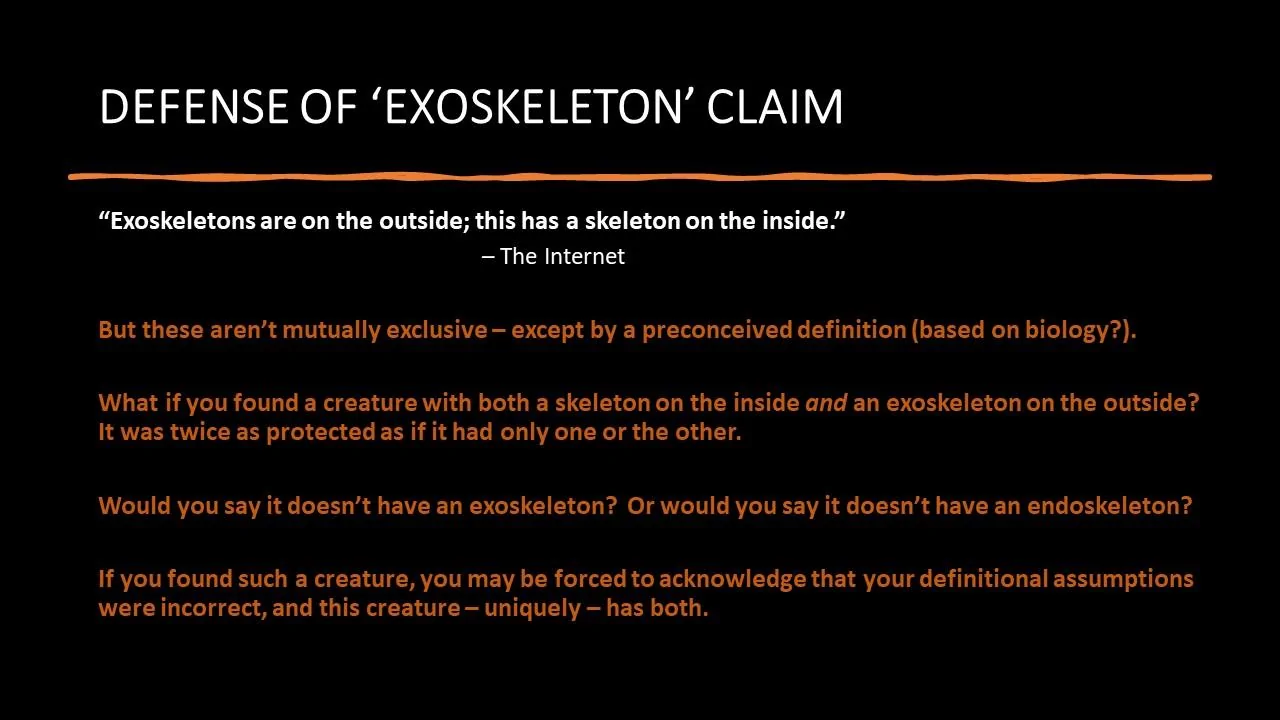
That is, based on what little Tesla said at unveil (and on its website), many thought the CT would have what I’ll call a “purists exoskeleton.” This purist exoskeleton view of Tesla’s comments wasn’t a misinterpretation by only non-engineers. Even informed engineers in the industry understood Tesla to be describing a purist exoskeleton. According to Sandy Munro, describing in 2019 his interpretarion (my emphasis):
“… What the exoskeleton does is to get rid of the requirements for internal longitudinals, stiffening ribs, and things like that because the structural skin would be doing all the work. What you are really doing is getting rid of roof bows, door surrounds, and things like that. They may still need an extra structure for where the hinges are. At the end of the day, you’re looking at a product that will still be self-supporting.”​

To give an example to this purist exoskeleton view, Monro gave analogous vehicle:

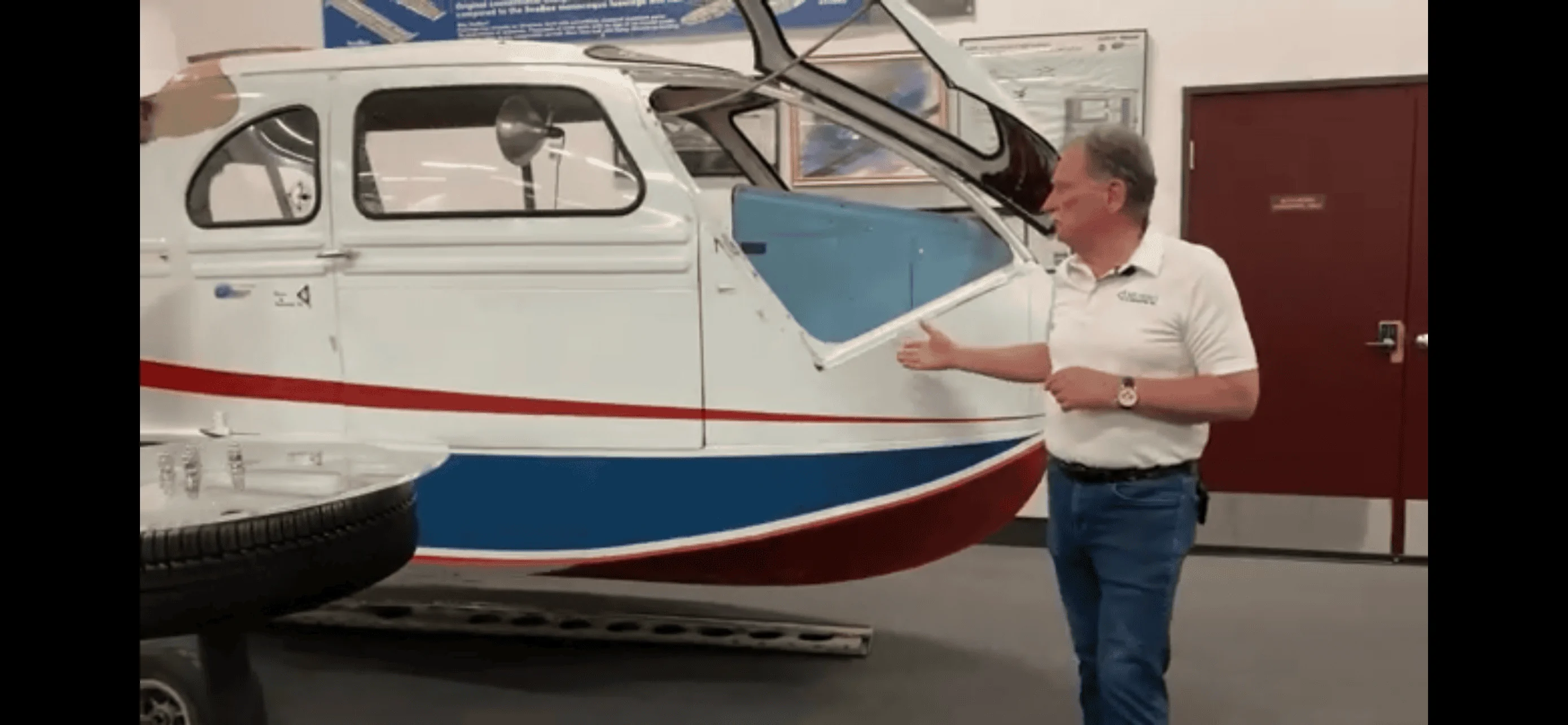
“[An] exoskeleton: so, the SeaBea [airplane] outside … is truly like a bug. It’s like a beetle. It’s got a hard shell. And you get inside and your safe. And the shell basically absorbs everything. So when [Tesla] came out with the 3mm … that’s pretty heavy duty stuff…. At the end of the day, that outside skeleton, at an 1/8th of an inch thick, that’s going to be everything. I don’t need any ribs. I don’t need much of anything. That’s going to do the job….”​


B2DEE649-80BE-4BA3-8889-9BA2550B2B58.png
2E9094E2-6B62-46D5-99B1-1ECD75CD8872.jpeg
“The SeaBee is very, very, interesting to us because the Republic corporation produced this SeaBee with 1/10th of the labor of a normal, general aviation aircraft… And the way they did it was by moving away from normal stick-build for an aircraft and going to an exoskeleton, similar to what Elon Musk is talking about when he brings up wanting to have the CyberTruck as a different type of a product.”

Monro set out the SeaBee as exemplary of a purist exoskeleton, and Monro’s mental model of his interpretation of what Tesla had described as the CyberTruck’s exoskeleton.

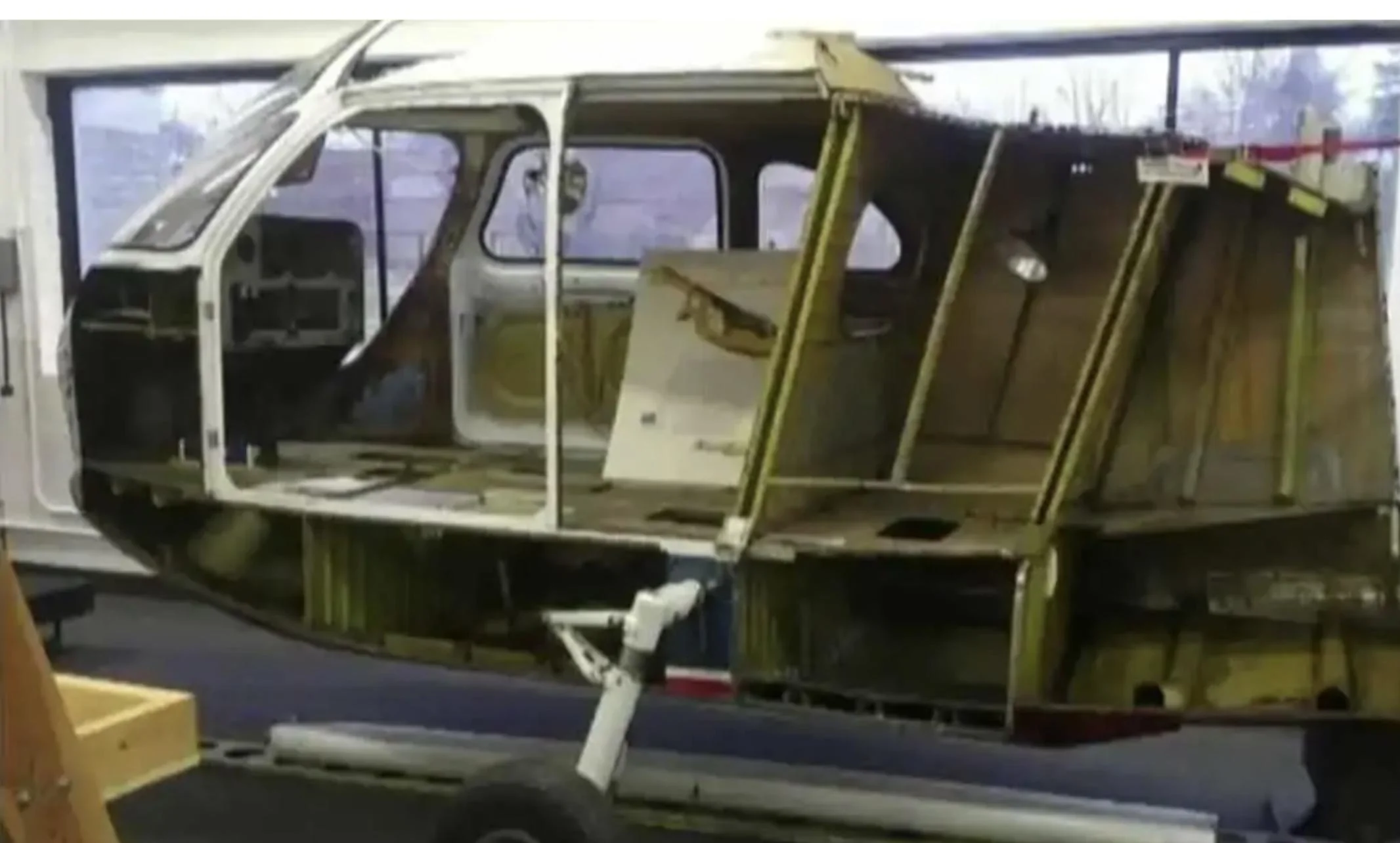
It’s worth noting that the SeaBee wasn’t completely devoid of internal structures, but to pinpoint both the limited extent and purpose of those internals:
“If we look inside [the SeaBee], we can see that the inside looks relatively clean, and we can see that the skin is basically the structural member. There are a few ribs, and longitudinals, but at the end of the day most of this is taken up by the skin which is relatively thick”​

Looking at these minimal internals referenced by Monro, it shows that they are largely of two varieties: structures for ~ergonomics (eg to create a floor structure for occupants, or for ), and braces that are themselves creating struts between and bonded to the ‘skin’ on the opposing side of the structure.

D73475B2-DC83-49D3-A043-32D238B284CB.jpeg


In all, the SeaBee and Monro’s related comments do a comprehensive if layman-friendly job of exemplifying the “purist exoskeleton” interpretation of Tesla’s comments regarding the intended construction of the CyberTruck.

Tesla’s comments were interpreted this way not only vehivle engineering experts like Monro, but also lay-public. Then commentary by experts like Monro such as the above further solidified the expectations of lay-public regarding Tesla’s comments.

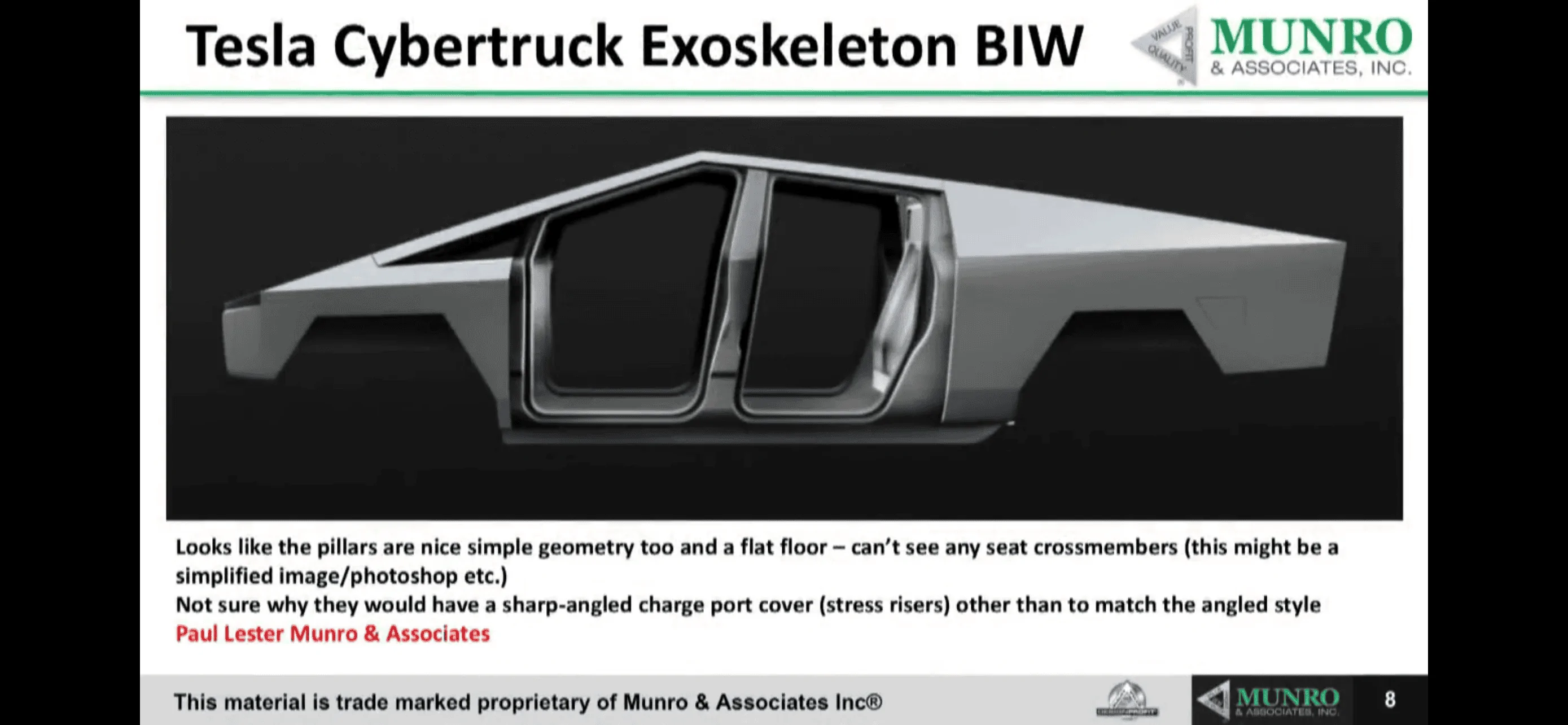
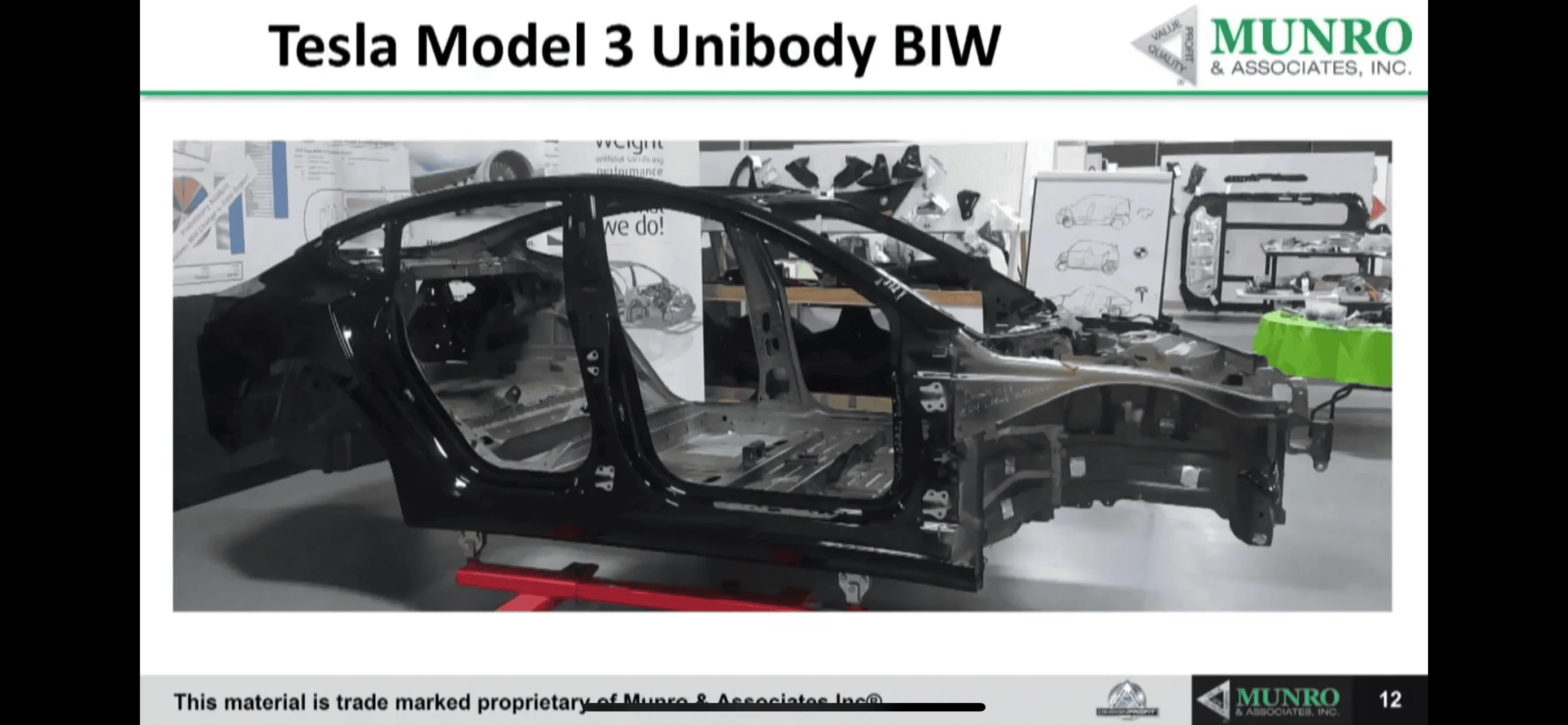
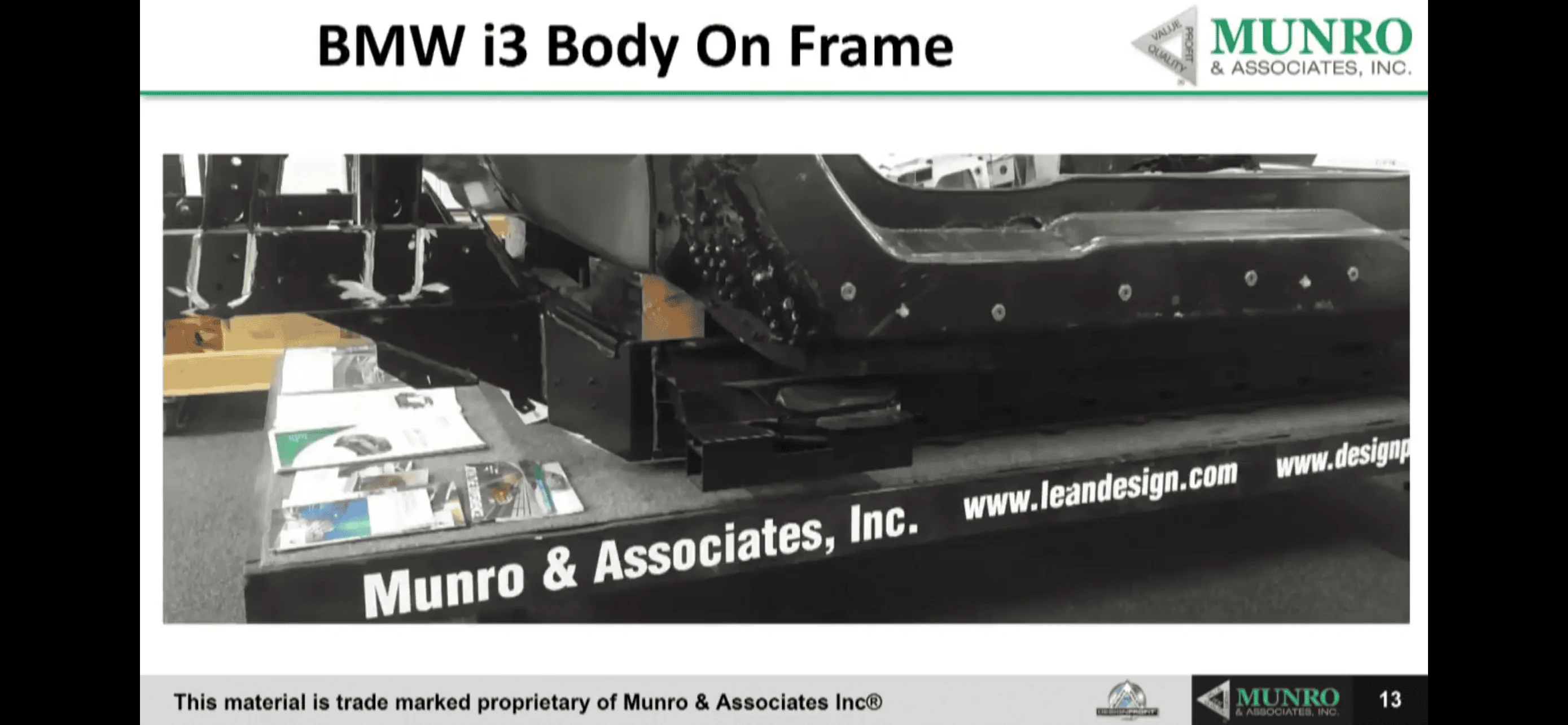
Not ending there, Monro elsewhere went on to then compare and contrast the SeeBee and CyberTruck purist exoskeleton to examples of unibody construction (Model 3) and body-on-frame (BMW i3):

3304AA6F-3AA4-4A5D-924D-CFE034E30B67.png

A74E5D70-980E-4B6F-A1F0-A58F182B85C0.png


DD8584DE-F982-4B24-B407-1F80DC130C05.png

E14B52A3-9C2F-4CF2-B98B-2473FC5862EB.png


All-in-all, the “purist exoskeleton” view of what to expect, and these sorts of contrasts with the above sorts of alternatives, fully set the expectations of a purist exoskeleton would look like, as well as what it would not look like.

Cutting forward to today, and several years of these expectations solidifying, gives the context to what the “purist exoskeleton” camp means when they say any version of “based on that Q1 earnings call photo of the frame, the CT is no longer a [purist] exoskeleton.”

To that extent, they are completely correct that the CT is not a purist exoskeleton, of the sort historically described by Monro and others.

But it’s worth emphasizing that Tesla has not to my knowledge ever described the CT to be such a purist exoskeleton. So purists are baseless to the extent that when they say the CT is not a purist exoskeleton they also insinuate that it is a reflection on Tesla or Tesla’s plans having changed.

That the CT is not a purist exoskeleton, is not fair critique of Tesla, as they’ve never weighed in with details. Stating that the CT is not a purist exoskeleton is only fair commentary upon people’s interpretations - such as Monro - which interpretation turns out to be incorrect.

That it’s not a purist exoskeleton does still leave the now highlighted question of: how f it’s not a purist exoskeleton, then what is it? How is it not just a body on frame or unibody, given the appearance of that Q1 frame photo?

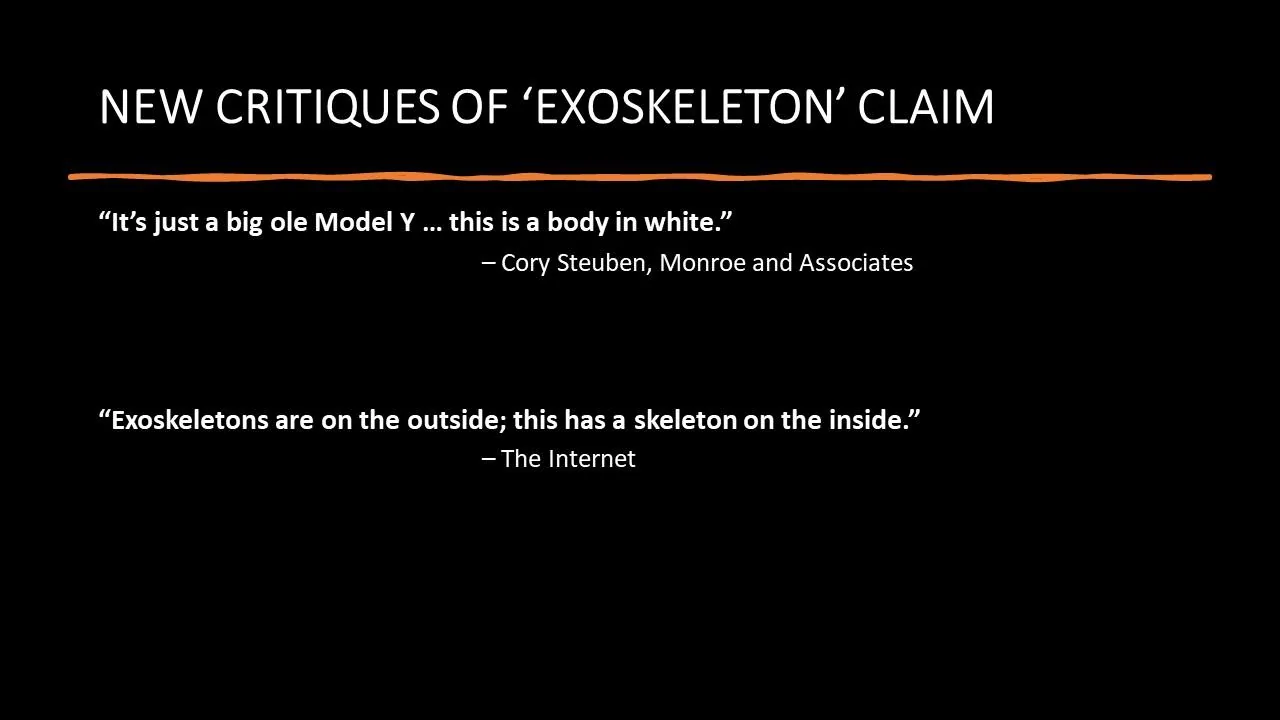
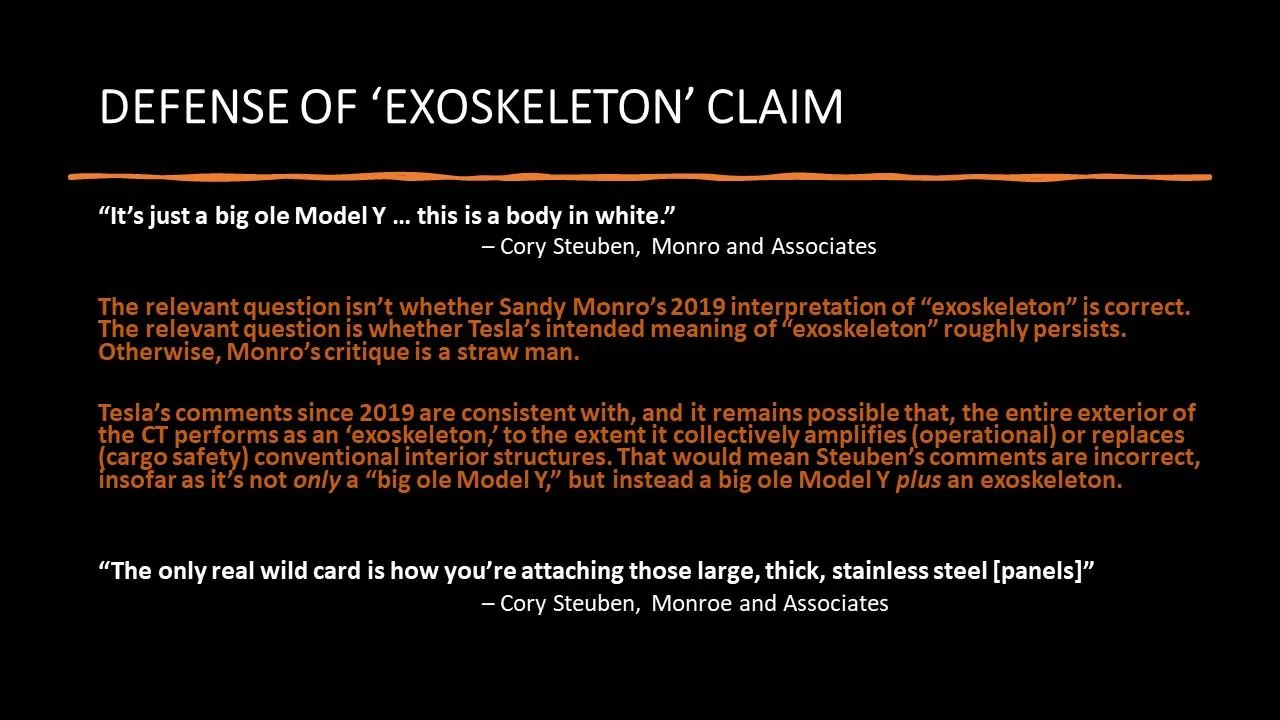
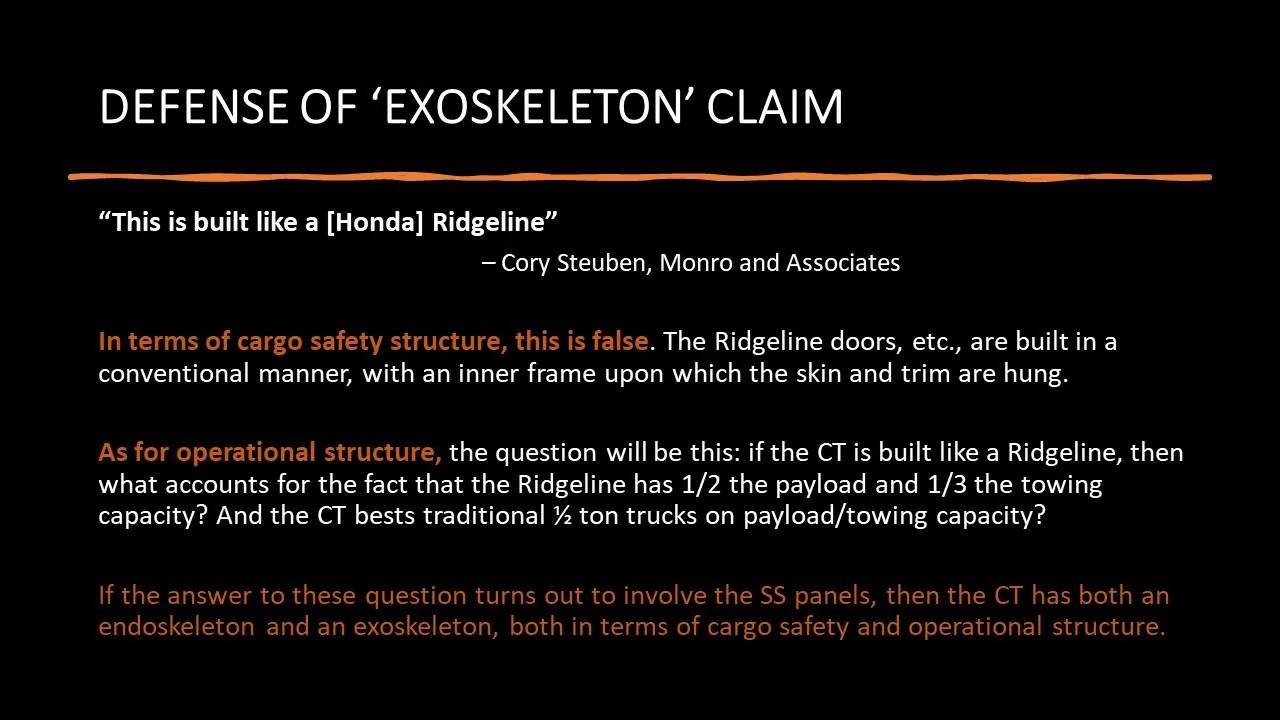
It’s a great question. And the answer is not obvious. Now having seen that photo, the vehicle engineering experts are themselves now exclaiming it is not only not a purist exoskeleton, but affirmatively declaring it a body in white or body on frame. Sandy Monro has said the CT now appears to be built like a BMW i3 (a body on frame). Cory says it’s a body in white like “a big ole Model Y.”

So they say not only is it not a purist exoskeleton, it’s not any sort of exoskeleton at all. This is in effect all for the some reasons as @JBee’s insistence here. It’s not just an insistence based on seeing the photo, but in understanding the physics of it all, and declaring that with what we’ve now seen the physics do not support the CT construction to be any sort of an exoskeleton - outside of providing occupant safety and durability from dents.

And I share that view, until more information is known. Despite insinuations in this thread, I have enough understanding of the physics involved to immediately grasp the point of view of Monro, @JBee and others.

But I’m also apparently more curious?

Because this leaves a glaring issue for Tesla. If all the experts say we’ve been duped, then how does Tesla next talk about the CT construction with a straight face? I’m curious, even if only in theory, if there is any means by which Tesla could use this frame in the CT and by some means still manage to have a defensible argument that the CT is still a meaningful exoskeleton (even if not a purist exoskeleton).

And so from that curiosity, merely as an in-theory exercise for whatever possible needle-threading may still be done, I arrived at one view explained in the OP.

It’s not explaining how I know it will be done, because I don’t. But similarly, experts declaring that it can’t possibly be done, at bottom, also do not yet know.

Because they’re experts, it would be much more fun if rather than declaring the obvious, they would if only for mental exercise spend some attention on dreaming up what might be unobvious.

Put differently:

Stop thinking that the interesting question is “is this an exoskeleton as I conceive of it” - the answer to that is obvious to anyone paying attention, expert or layman.

Start instead thinking of the (for the moment) only interesting question: how possibly could Tesla defend this, do they have any tricks up their sleeve?

The answer may be “no,” I’m fine with that.

But if there is an answer, and Tesla does have a trick up it’s sleeve, it seems obvious to me where that trick must be deployed: in how, and where, the SS panels are attached to the frame. Otherwise, if attached tot eh frame in the same or similar manner as either a Model Y or a BMW i3, then this isn’t a meaningful structural exoskeleton (outside the nominal sense of cargo protection and dent resistance).

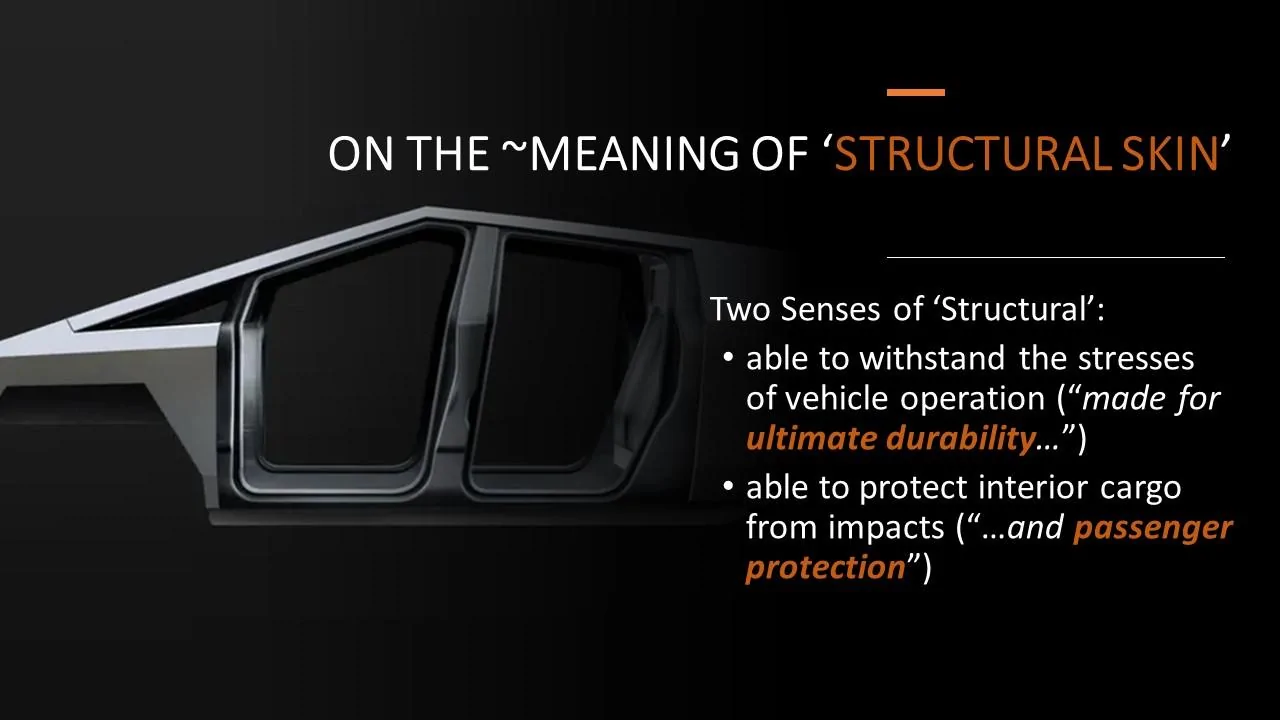
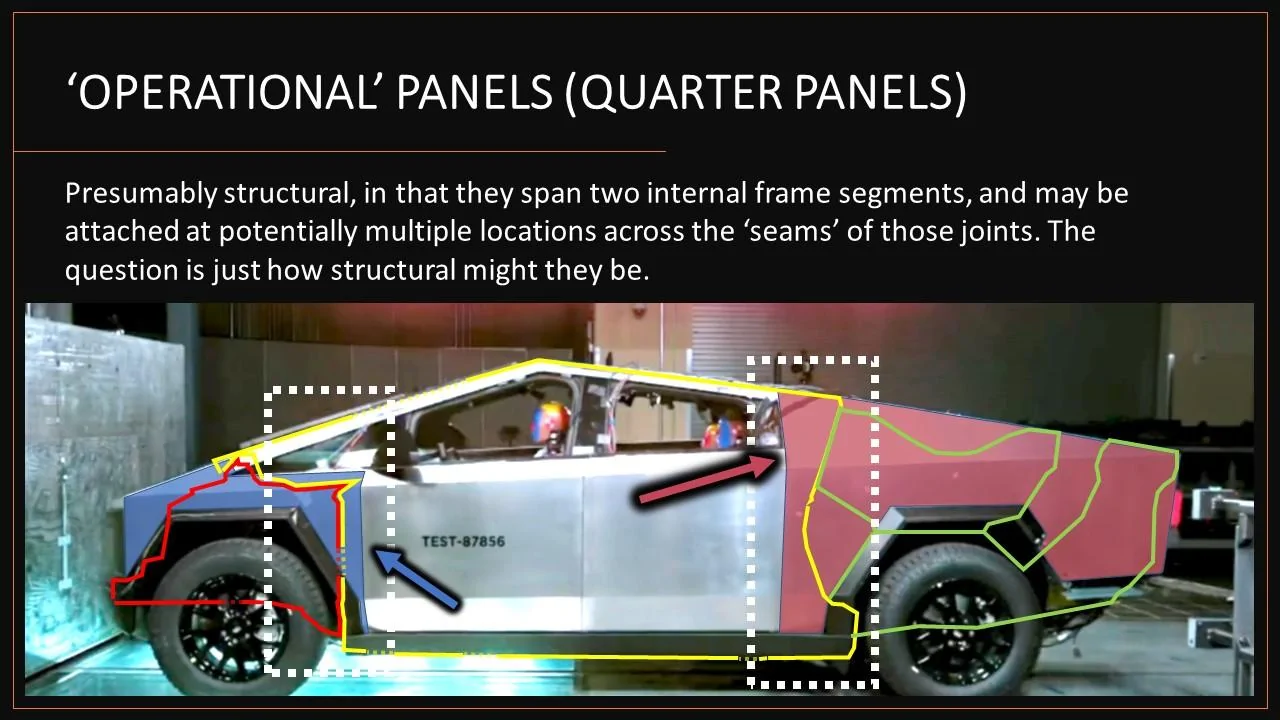
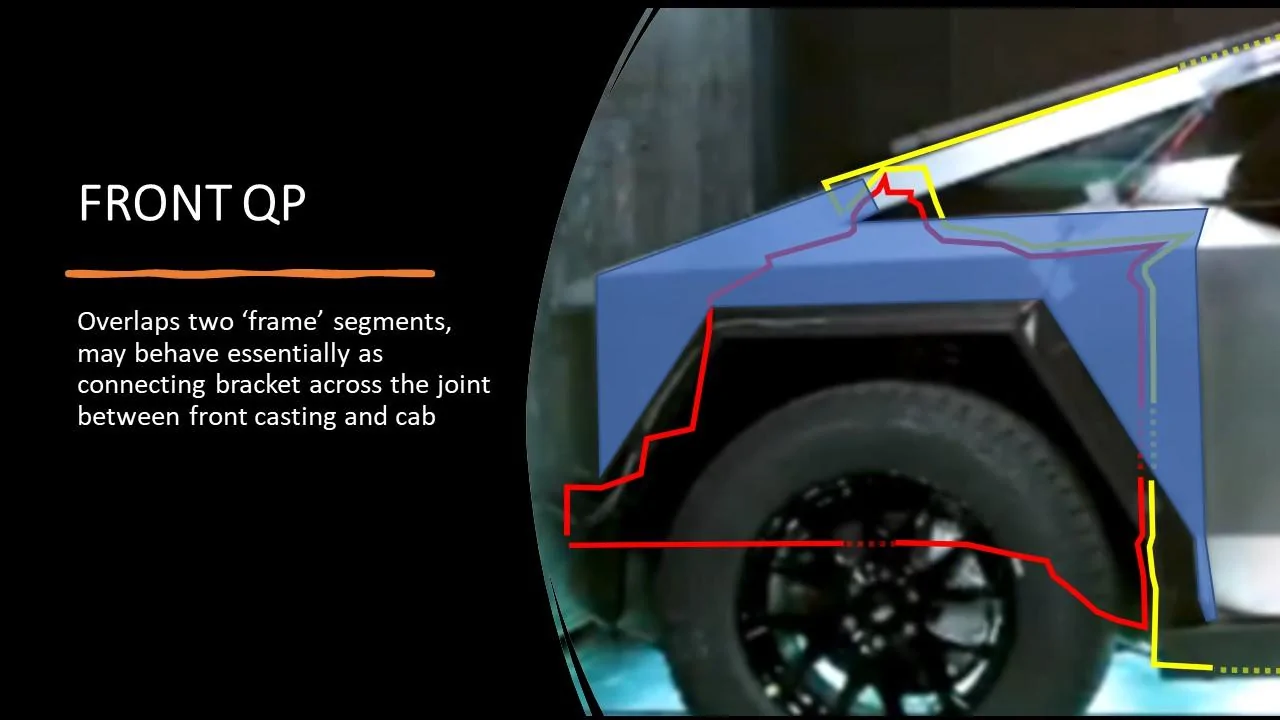
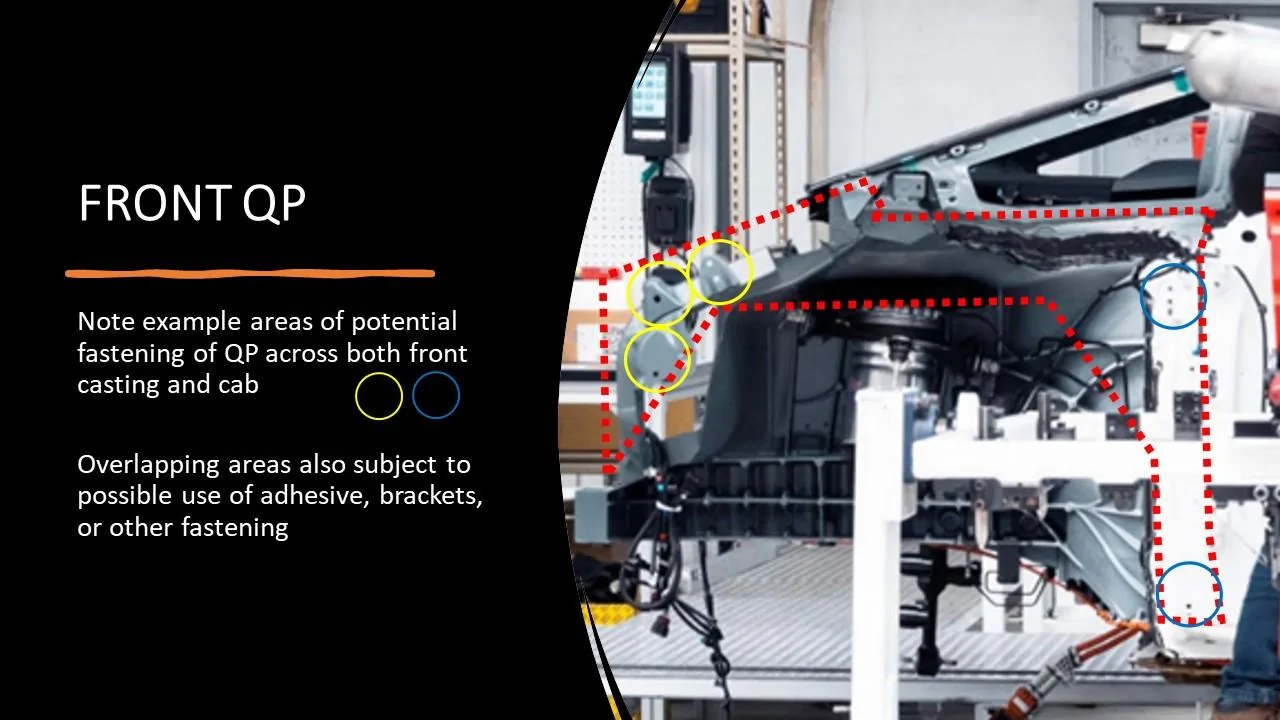
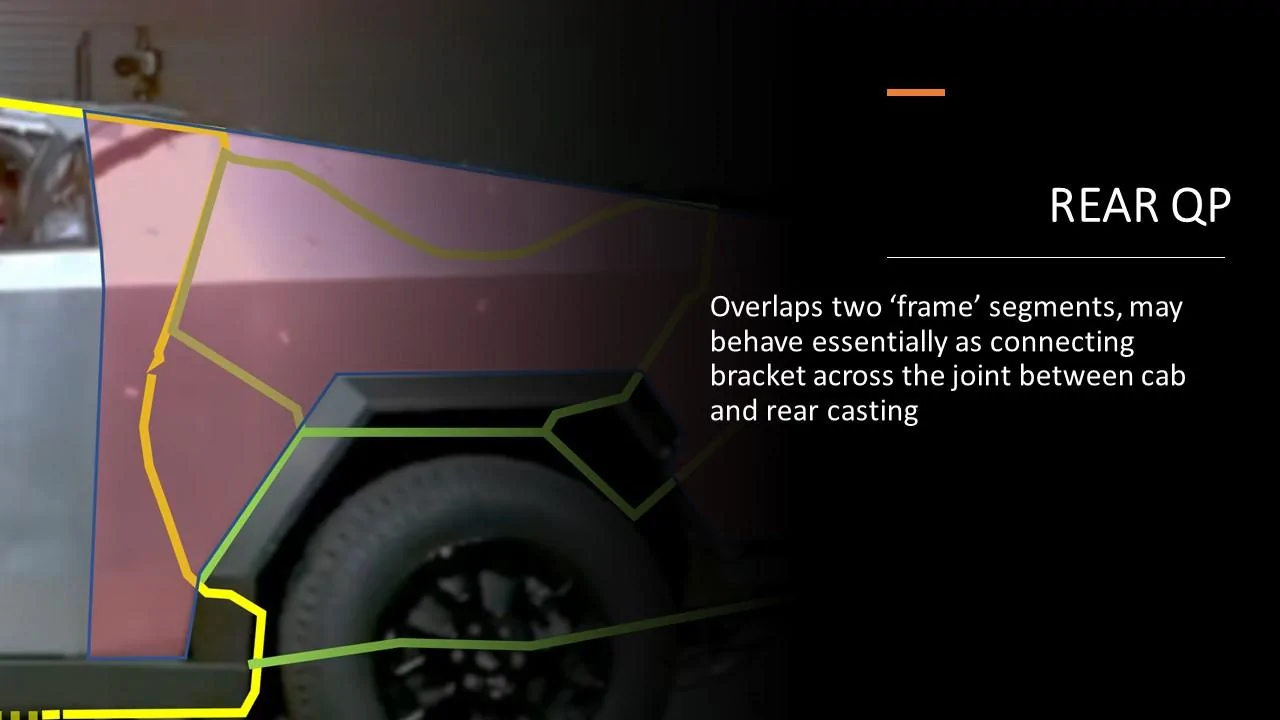
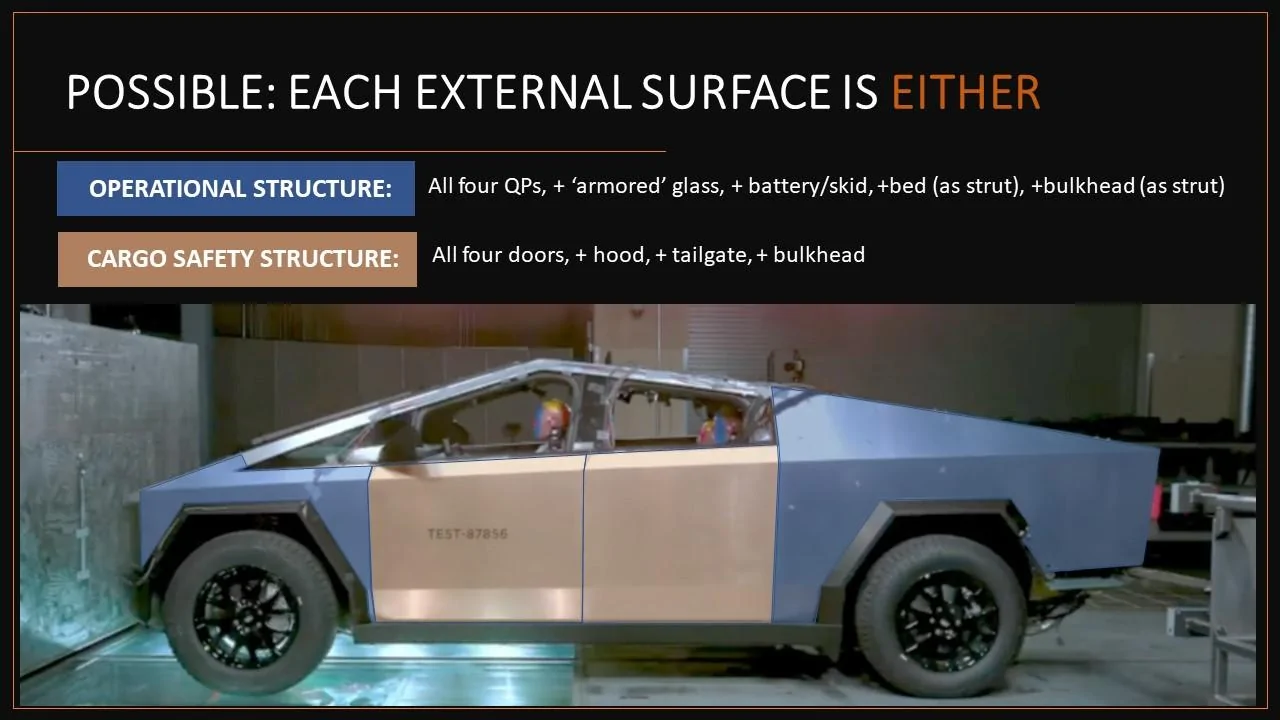
To me it seems, any trick up Tesla’s sleeve to with a straight face continue to describe this construction as a meaningful exoskeleton will have to involve some manner of attaching the ‘skin’ so that it performs some operational structure for the vehicle.

Cory at Monro, and @JBee, all appear to be assuming - perhaps reasonably - that there is no other method of attachment that can accomplish this.

That may well be right, and based on what we know to date it seems the outcome worth betting on, with some odds in favor.

But again, if only for the mental exercise or to focus on what seems the only (at present) interesting point, is the thought experiment: knowing what we know of the frame, and panels, is there any method and location of attachment of the latter to the former that may provide operational structure to the CT?

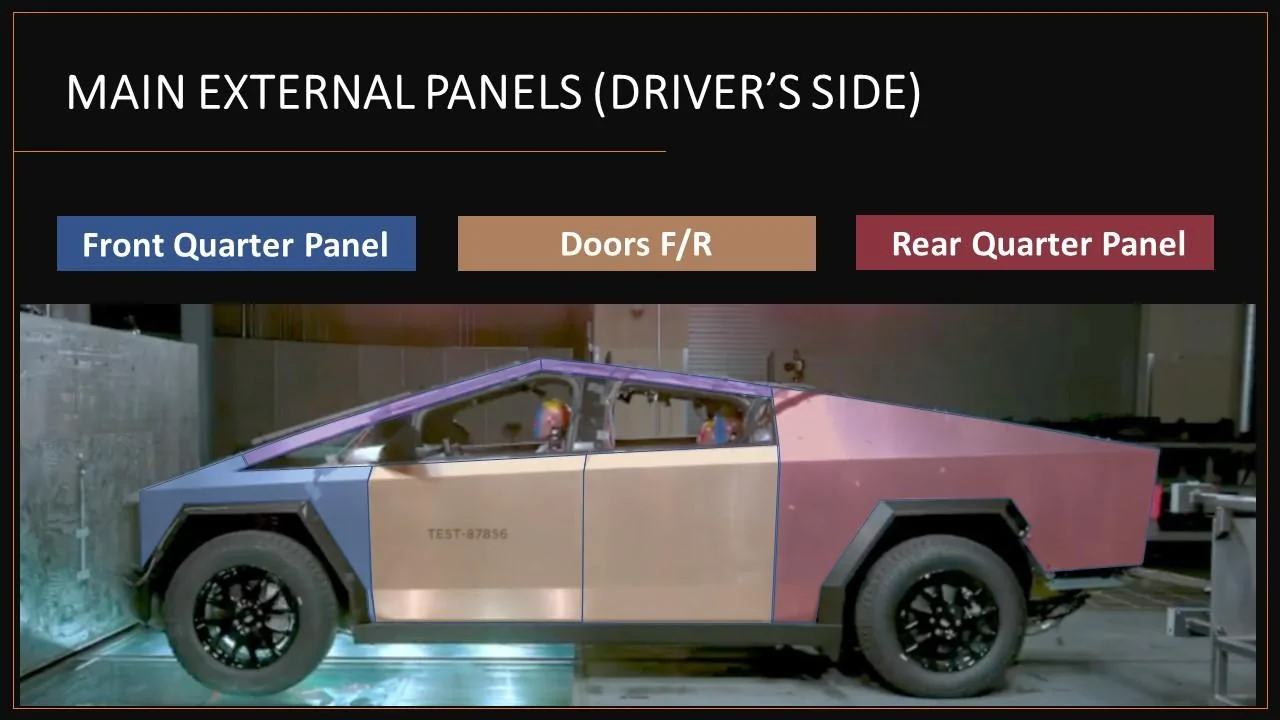
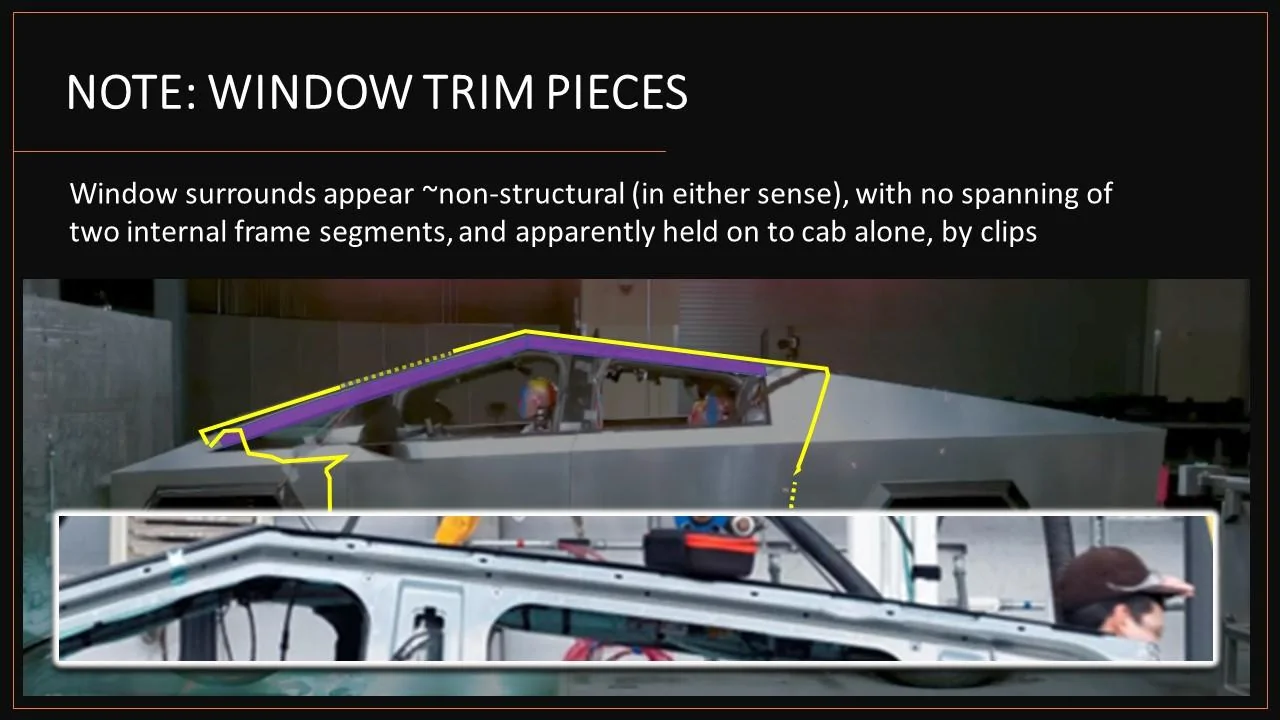
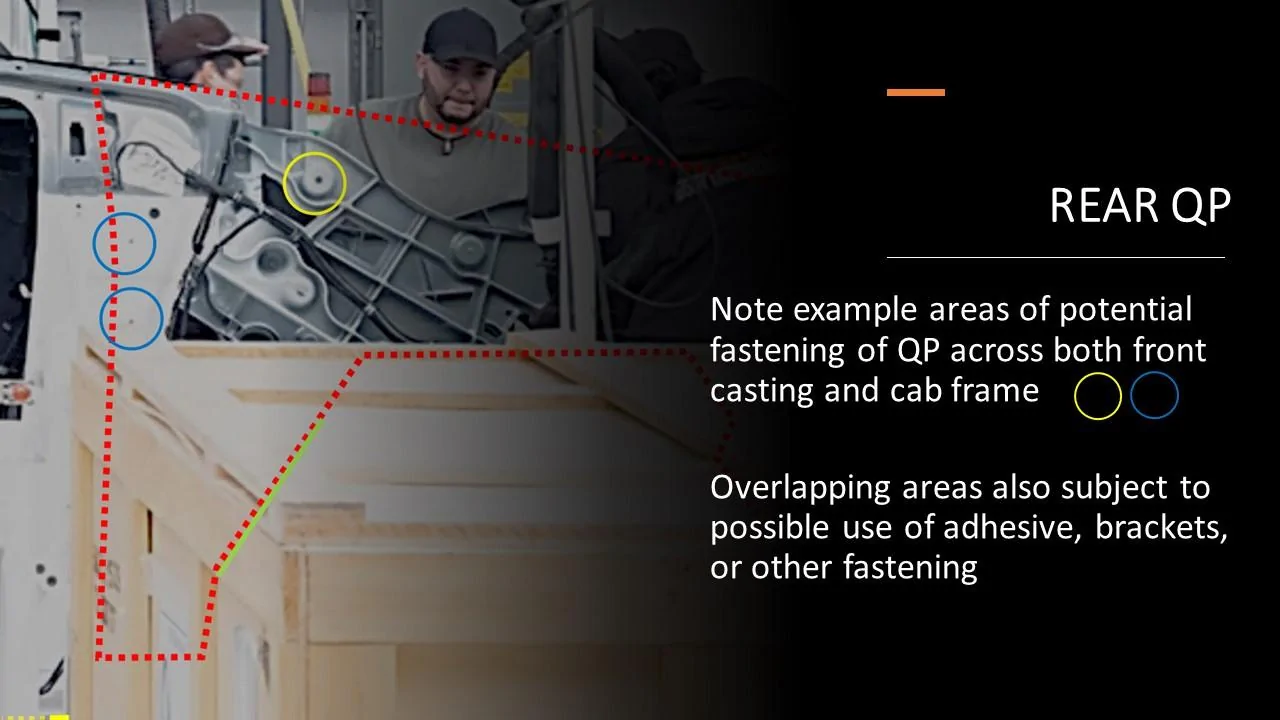
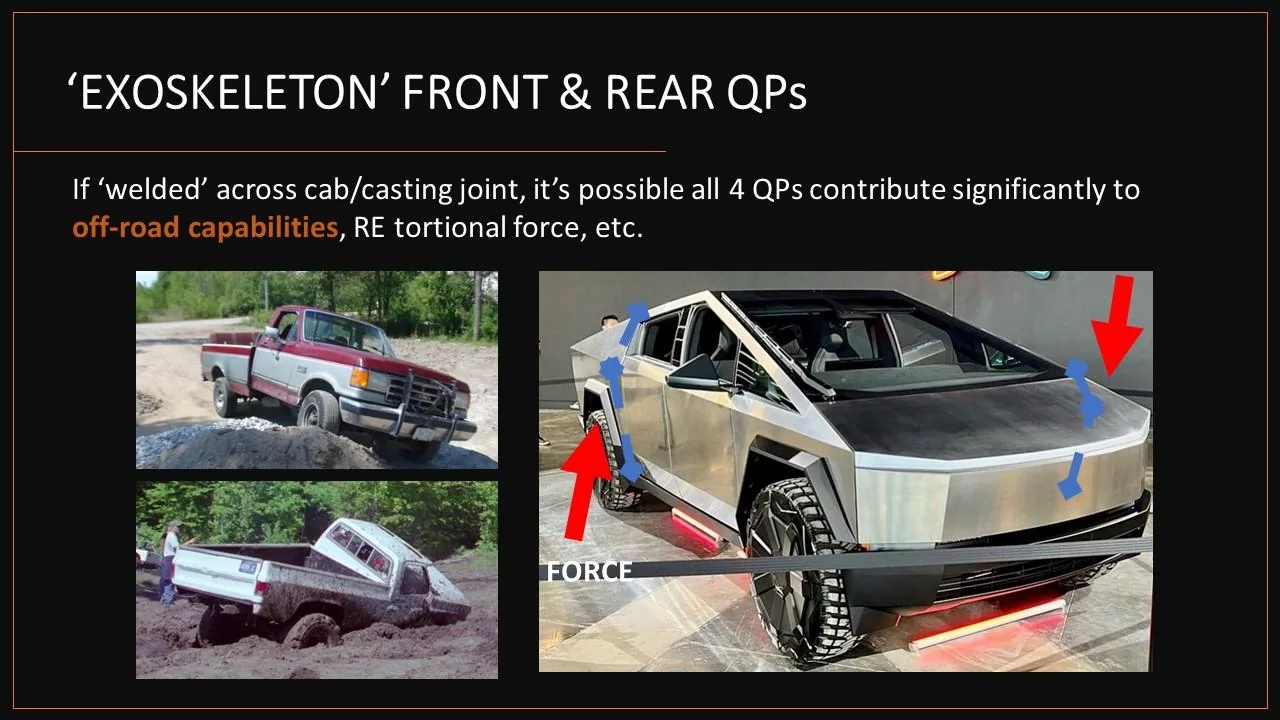
Seems possible, to me. Bolts and adhesive that are traditionally used to fuse the frame segments at joints, bare operational structure in the frame design. 3mm stainless panels are capable of being “welded” (in effect) across these same seams, in leu of or in addition to such conventional attachments like bolts and adhesive.

How that is impossible to be done, certainly has not been addressed in this thread.
I can completely agree with everything you said here, especially regarding the "purist exoskeleton" and our expectations that have grown over the years for lack of seeing under the skin. Literally.

The only contention I still have on the subject is the insistance that the fender can only be made structural if it is connected adeqautely. That is not the difficult part, it's simply still because the fender has to be in the load path to perform structurally, as described in my post above.

But please let me do some drawings to demonstrate that better before we continue with that part if the conversation. Note that I am only being insistent on this because it forms a different basis upon which to identify the structure properly, and hopefully learn something from the exercise.


JBee

Well-known member
First Name
JB
Joined
Nov 22, 2019
Threads
18
Messages
4,913
Reaction score
6,362
Location
Australia
Vehicles
Cybertruck
Occupation
. Professional Hobbyist
Country flag
I joined an internet anonymous club once.

It didn't help my addiction like I wanted it to though, because they only offered online courses using a VPN.
 
OP
OP
cvalue13

cvalue13

Well-known member
Joined
Aug 17, 2022
Threads
74
Messages
7,153
Reaction score
13,769
Location
Austin, TX
Vehicles
F150L
Occupation
Fun-employed
Country flag
After all the BIW photos of late, as in the above I continue to think:

• listening to Musk’s speech in 2019, it was fair of engineers/designers to interpret “exoskeleton” to mean what Munro et al described at the time

• but, there are other interpretations of “exoskeleton” available, and several such meanings can apply at once (and in different locations of the vehivle)

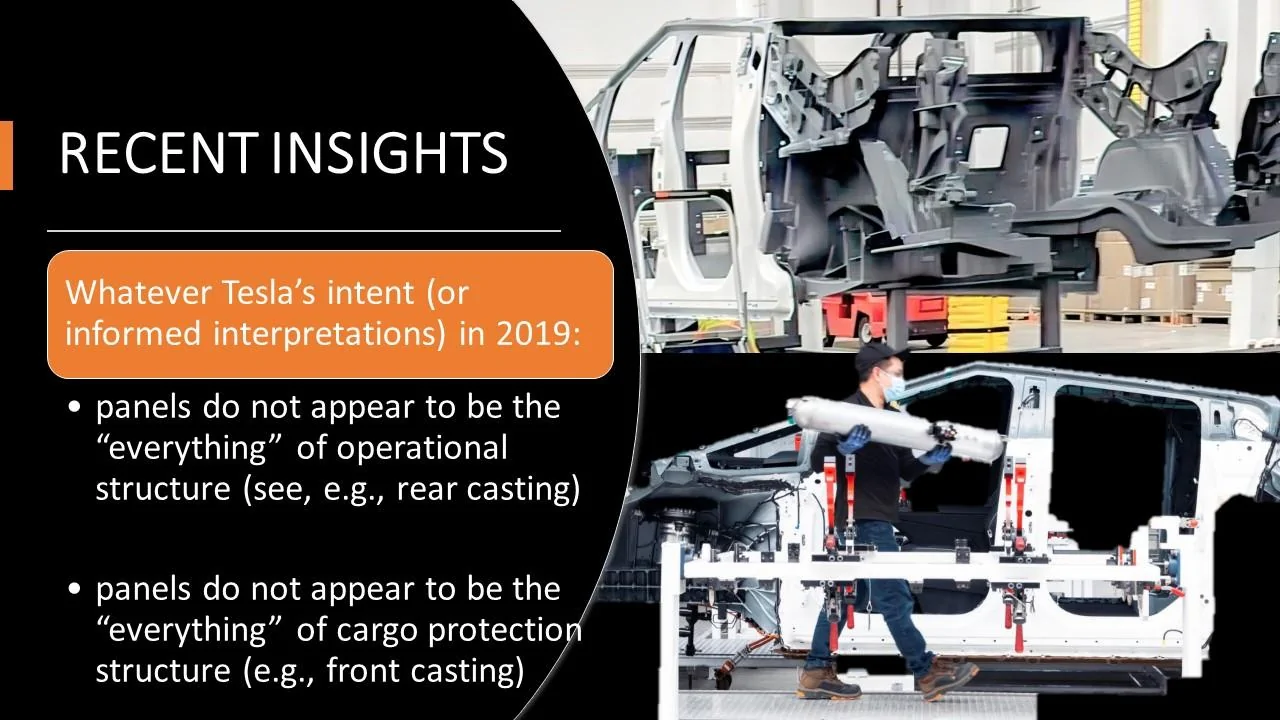
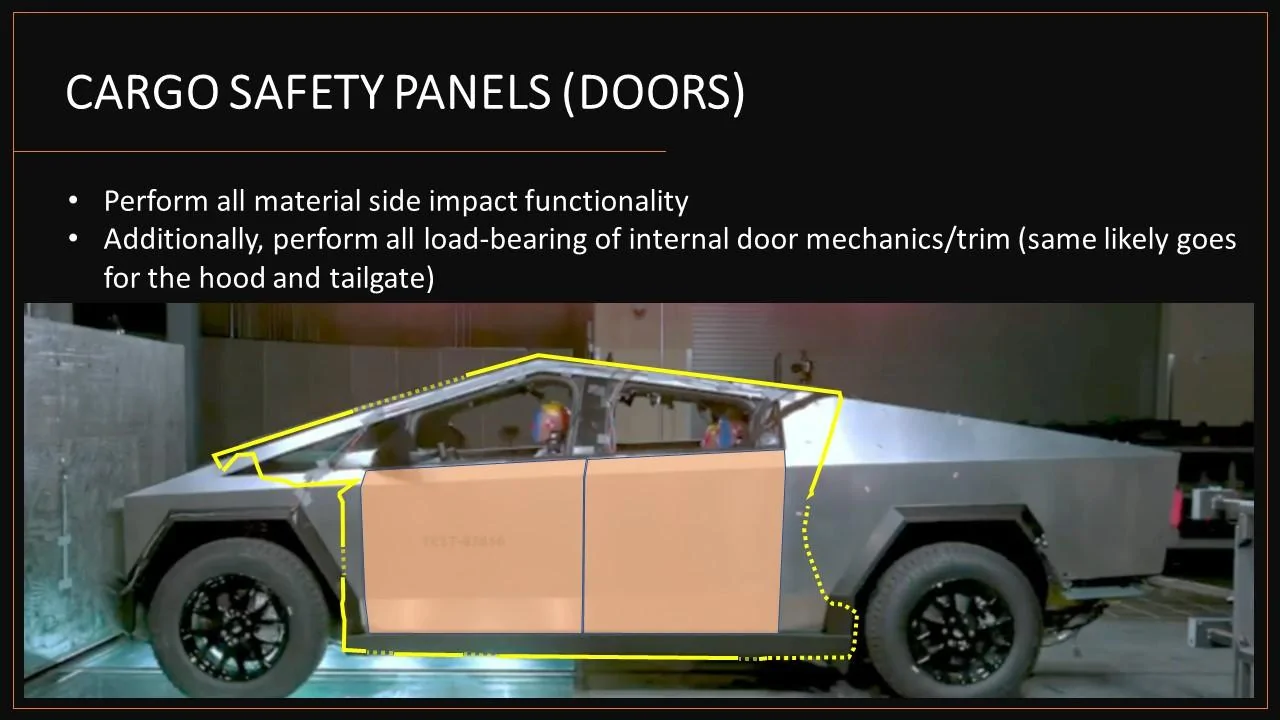
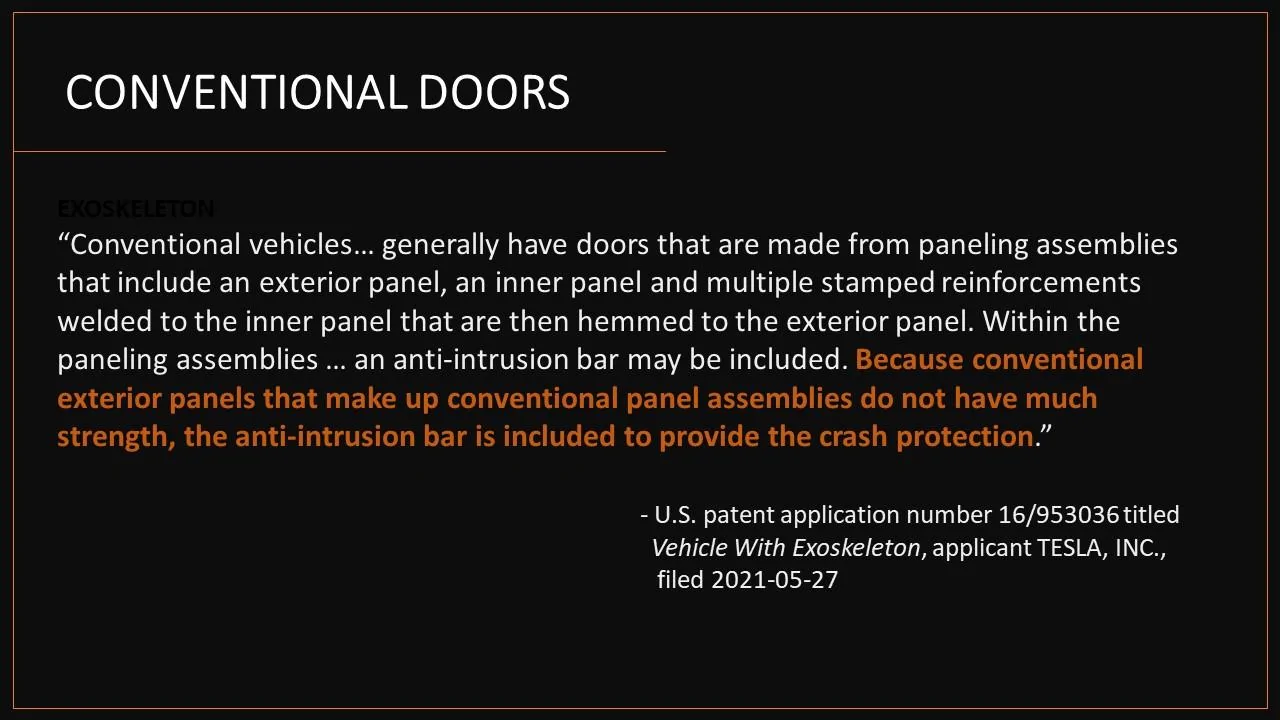
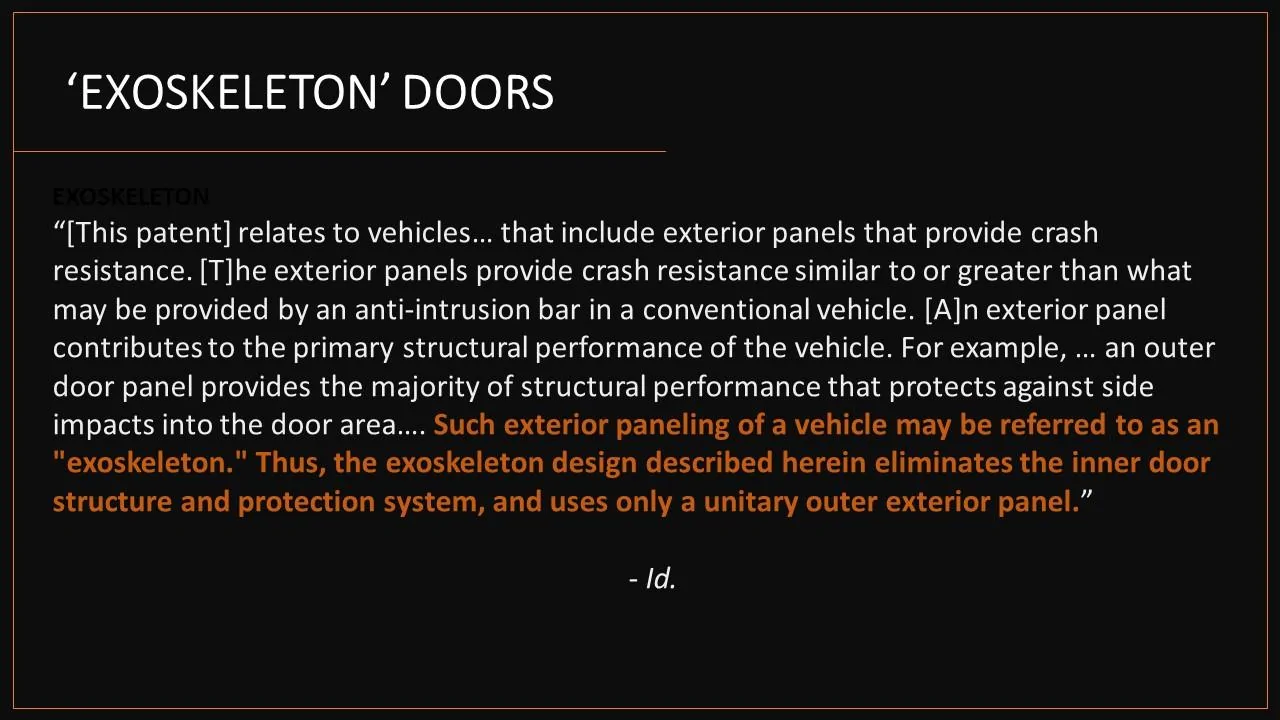
• for example, since 2019, the only concerted explanation of what Tesla means by “exoskeleton” is found in the patent w/r/t the door and other movable panels, and it describes two alternatives applicable simultaneously:
• the movable panel’s skin bear the primary loads carried by the panel (eg the door skin carries the door trim/mechanics)***​
• the movable panels provide armor-like protection of occupants/cargo​

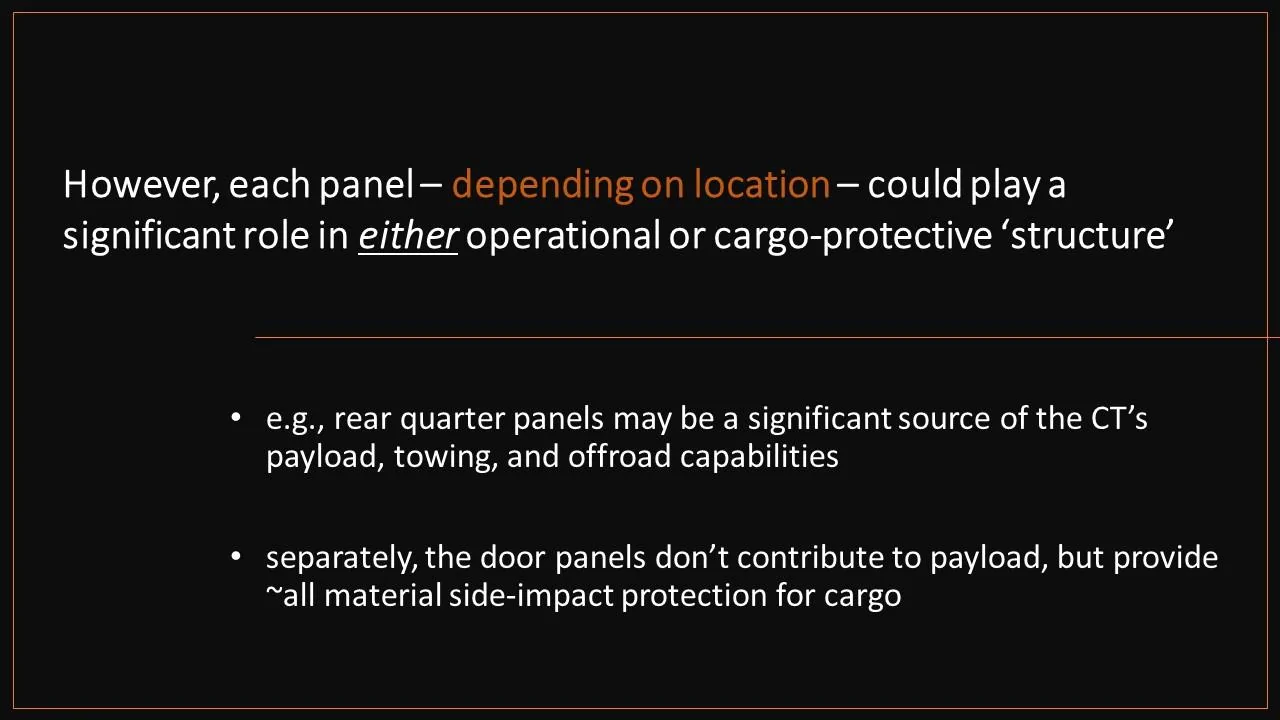
• as for the fixed panels, it still remains possible that the pack, glass, and at least certain of the other fixed SS panels provide material structural/operational strength to the vehicle in various locations of operational importance

• what’s described in the prior two bullets may be as much as Musk/Tesla meant (roughly) in 2019, despite what non-Tesla engineers/designers interpreted and spread about

• and even if and to the degree Tesla’s plans in 2019 changed to date, we can assume those changes have been in the direction of bettering the vehicle on an all-things-considered basis


In any event, once the CT is released and socialized, Musk seems the sort who will be compelled to explain his view on all this.


***though, the recent prototype door (nor tailgate?) hinges do not appear to attach to the SS panel, which seems to draw into question this assertion in the patent (as the SS panels would ‘hang’ on *that* structure)


PilotPete

Well-known member
First Name
Pete
Joined
May 8, 2023
Threads
12
Messages
1,578
Reaction score
3,969
Vehicles
Porsche, BMW, M3LR on order
Occupation
Chief Pilot
Country flag
After all the BIW photos of late, as in the above I continue to think:

• listening to Musk’s speech in 2019, it was fair of engineers/designers to interpret “exoskeleton” to mean what Munro et al described at the time
So, I've had time to speak with some of the most forward thinking structural engineers in the aviation field. I've asked the question of them regarding Exo v Endo. I referenced their consensus in another post without giving them credit. But here is what it comes down to...

The first question they asked was;
-"Really? What kind of BS trap are you setting me up for?" (they don't really use acronyms)
I explained.
As they see the pictures, and without seeing anything else, they have the following statements;
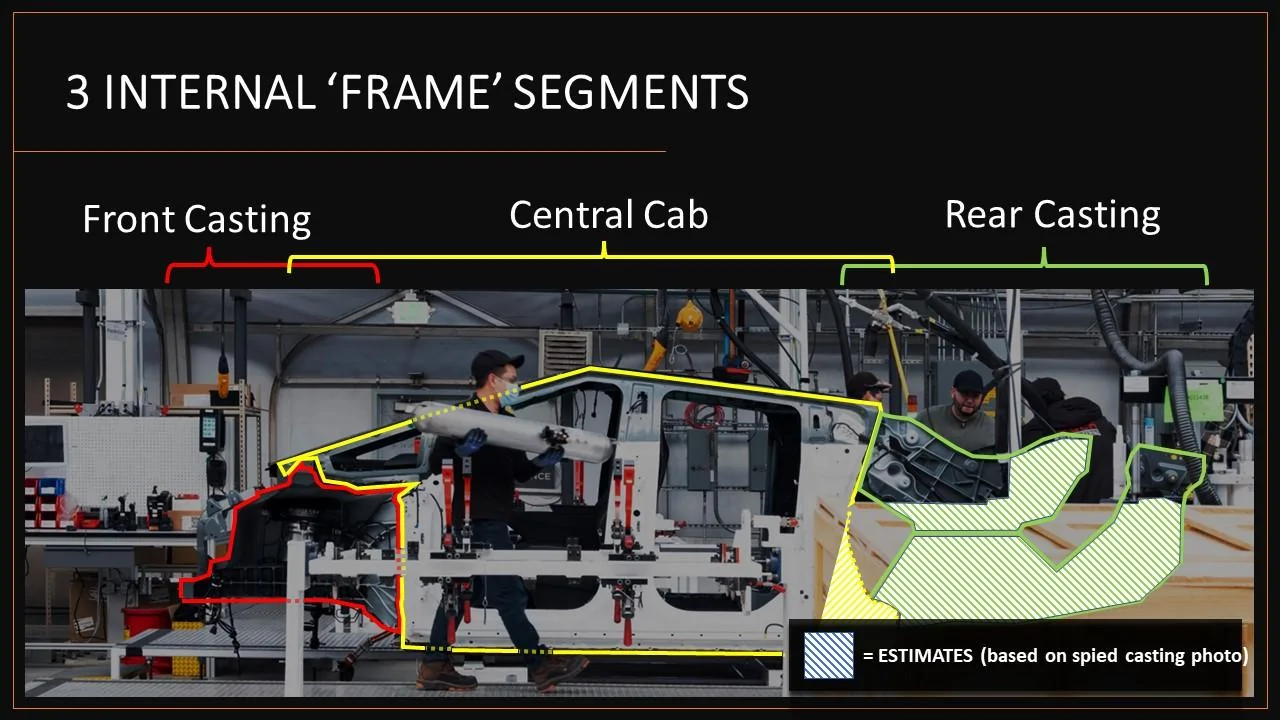
- The occupant cabin appears to be an "exoskeleton like design"
-The front and rear portions of the truck appear to be a "hybrid design" combining a space frame or truss and a monocoque or exo design. This is with the assumption that the skin that is attached is a load bearing member or shares some of the stress with the castings. They all pretty much agreed that it is a combination Exo and Hybrid Exo design.
-They pointed out it that in order for it to be considered "Endo" the frame would exist INSIDE the passenger cabin.
-They also mentioned that WW1 aircraft were Exo in their design in that the structure existed solely on the outside and fabric covers were not structural and they're only for aerodynamic purposes. It was with the advent of aluminum we started to see the skin as a load bearing structural member.
-A WW2 Blimp is one of the closest flying devises you get to a true Endo, as the balloon had structural wires and whatnot running throughout the internal section. The gondola was suspended from there. Modern LTAs have multiple bags internally and don't allow for an internal structure.
-There are current designs for aircraft that use composite sections for the fuselage that would qualify for an Exo design as they are baked into a single piece. (The Cirrus SR series is an example)
-They don't consider Exoskeleton to be an "aviation term". But they did concede the marketing guys "come up with some real BS names for some of our ideas. So those yo-yos might refer to something with that term. But they're wrong as often as they're right."
 

anionic1

Well-known member
First Name
Michael
Joined
Apr 30, 2021
Threads
29
Messages
1,666
Reaction score
2,014
Location
California
Vehicles
Cybertruck
Occupation
Estimator
Country flag
Gotta love the internet engineers. Here is the part you are neglecting to realize. A double walled stamped and sandwiched piece of plain steel less than 1mm in thickness can be stronger than a 3mm piece of flat stainless steel. They could engineer either to meet the same structural requirements. Flat steel is about the weakest shape you can pick so it needs to have ample attachments to make a strong composite member or be very thick.

I have been arguing for a while that the CT is not really an exoskeleton or a unibody or a body on frame. It’s really a cool unique composite that we haven’t seen before. I would call it an armored unibody.
 
OP
OP
cvalue13

cvalue13

Well-known member
Joined
Aug 17, 2022
Threads
74
Messages
7,153
Reaction score
13,769
Location
Austin, TX
Vehicles
F150L
Occupation
Fun-employed
Country flag
thanks for the valuable input!

the one confusing bit:

This is with the assumption that the skin that is attached is a load bearing member or shares some of the stress with the castings.
The assumption being made is the central question being asked?

While I know I’ve at times added to the confusion through too brief or un/careful phrasing:

Not really interested in the word “exoskeleton”, but instead the substantive descriptions Musk made about what he meant by that term - and the degree to which the production CT makes good on those descriptions.

Specifically, he appeared to be asserting exactly that “the skin that is attached is a load bearing member,” and further that it wasn’t just not “shar[ing] some of the stress with the castings,” but chose language that led many people to think the skin would be the predominant source of operational stress-bearing.

Accordingly, while Musk used the word “Exoskeleton” as a convenient and mildly illustrative shorthand, that choice of shorthand word is really irrelevant compared to what he went on to provide as a paragraph of functional description of how the CT would be constructed and the role the SS would play.

(For giggles, it would be interesting if you showed your compatriots instead that paragraph of Musk’s functional description, and got their take.)

Though to be clearer: I’m actually not so interested in whether people‘s interpretations of Musk’s description leads to confusion once they see the BIW etc. That seems uncontroversial: professional auto/aero engineers thought Musk meant one thing, only to be surprised by the BIW.

I’m more interested, instead, in understanding how and to what degree Musk’s description continues to be fairly represented by the production CT.

And I think it probably does still fairly describe the CT, in meaningful ways.

Interested to learn more, though!
 
OP
OP
cvalue13

cvalue13

Well-known member
Joined
Aug 17, 2022
Threads
74
Messages
7,153
Reaction score
13,769
Location
Austin, TX
Vehicles
F150L
Occupation
Fun-employed
Country flag
Gotta love the internet engineers. Here is the part you are neglecting to realize.
Can’t quite tell to which this is intended to refer exactly

though I can understand the sentiment, insofar as the reaction I get when running into internet lawyers

that said, I have found that it’s real-world engineers (even civil!) who tend to believe they’re the best internet lawyers, internet doctors, internet husbands, and really … anything.
 

PilotPete

Well-known member
First Name
Pete
Joined
May 8, 2023
Threads
12
Messages
1,578
Reaction score
3,969
Vehicles
Porsche, BMW, M3LR on order
Occupation
Chief Pilot
Country flag
The assumption being made is the central question being asked?
Sorry, but the reason I got the qualified answer I did was in their questions. “How does the skin attach to the structure?” I had to tell them, I have no idea. And from the pictures, they couldn’t lean one way or another. But when we discussed 3mm 300 series SS in a single bend configuration, they all said ”Sounds like it’s going to be structural.” And so they gave a qualified answer. They also pointed out a couple different ways the SS could be used as a structural member. They spoke about being able to see in a normal pickup (a couple drive them) you can see the cab flex left while the truck bed flexes right. One of them then commented “This SOB ain’t going to have any torsional flex.” Then one of them said something about I owed him a bottle of something. I forget what it was, but I think it was expensive.
Sponsored


Top