Sponsored

Tesla's Crafty Move? - Carbon Credits, The Extender, GVWR, and Payload

Variable556

Well-known member
Joined
Sep 21, 2020
Threads
1
Messages
70
Reaction score
105
Location
West Virginia
Vehicles
Explorer, Escape
Country flag
I don't know anyone disinterested in maneuverability and turning radius.

"This truck is just too damn fast off the line" said no one ever
I could hardly care less about speed and rear wheel steering. If it were actually an option? I’d delete it without a second thought to save some money. I suspect more than a few would.

(And no, no one needs to waste electrons explaining to me how it won’t happen, etc. I already know that.)
Sponsored

 

Coolio2000

Member
First Name
Mark
Joined
Dec 17, 2019
Threads
1
Messages
14
Reaction score
35
Location
Colorado
Vehicles
2019 F250 Limited FX4 6.7 diesel
Country flag
Speaking of tongue weight. Does anyone know if the CT will self-level when hooked up to a trailer? Any features like the F150 where it can weigh the weight in the bed?
 
OP
OP
cvalue13

cvalue13

Well-known member
Joined
Aug 17, 2022
Threads
74
Messages
7,153
Reaction score
13,769
Location
Austin, TX
Vehicles
F150L
Occupation
Fun-employed
Country flag
Speaking of tongue weight. Does anyone know if the CT will self-level when hooked up to a trailer? Any features like the F150 where it can weigh the weight in the bed?
the air suspension is supposed to be self-leveling

I’ve seen NO press (or UI) on built-in scales, however
 

scottf200

Well-known member
Joined
Jul 31, 2021
Threads
53
Messages
2,221
Reaction score
3,241
Location
Western NC
Vehicles
X; immed family 3 & Y
Country flag
the air suspension is supposed to be self-leveling
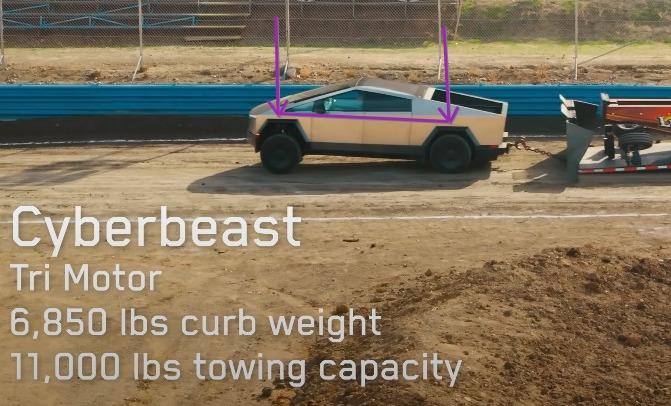
It appears to be broken ... look at this piece of junk /s

[Aside: sled at 35,000 lbs per video]
Tesla Cybertruck Tesla's Crafty Move? - Carbon Credits, The Extender, GVWR, and Payload lyVu23A
 

PilotPete

Well-known member
First Name
Pete
Joined
May 8, 2023
Threads
12
Messages
1,578
Reaction score
3,969
Vehicles
Porsche, BMW, M3LR on order
Occupation
Chief Pilot
Country flag
I meant the combination of those things made the difference, not "just" the pack. They should just go back to 18650...could of saved them a lot of hassle then huh? ;)
True, but I see two issues with that. First, I don't believe the 18650 isn't capable of being a structural battery. This may cause a weight gain to accommodate the 18650. Then there is the potential. I think the 4860 has the potential to meet or exceed the 18650, just not yet. Oh, third issue, cost. I think the 4680 is the key to lower cost per kW, and a potential key to a $26k car. I think the CT using the 4680 gives them the volume and experience to find every possible gain that the 4680 holds.

Sorry I didn't get the intent of your post. With all the posts ragging on the 4680 as being a failure, I'm reading things through that lens from time to time.


RVAC

Well-known member
Joined
Aug 11, 2021
Threads
1
Messages
864
Reaction score
1,291
Location
-
Vehicles
-
I don’t think that’s how GVWR works, from the perspective I’m describing

because the perspective I’m describing assumes (perhaps incorrectly, but)that Tesla is not going to release a truck with an advertised payload max of eg 1,600lb (and a tongue weight max of 1,1000)
I see where you're coming from, counterpoint would be the Silverado EV: 450mi of range, max 1400 lbs payload and max tongue of 1000 lbs. Ford with a highly optioned Lariat is in that ballpark also.

Not saying you're wrong about them sandbagging, just that the ZEV credit doesn't strike me as the reason given they have room before hitting class 3. All provided this range extender even sees the light of day.


in 2019, I think the hope was to build the truck structurally in a way that the weight savings came from the structural design.

but for one reason or another, that plan didn’t work out.
Agreed, I get the same impression, instead of mass being moved from the inside to the outside it mostly got added to the outside.


THIS is where I assume that what the right hand giveth, the left hand taketh away

If you want to advertise an impressive payload stat, AND an impressive towing stat, AND an impressive range stat, AND impressive safety stats, AND still be below a class 3 designation - something has to give.

So on my pet theory, what gave was reducing the weight of the truck for regulatory purposes (by both the pack size weight and associated structural weight savings from not having to engineer around the pack weight, including crash safety), and the stated payload, with the maneuver of getting back the range loss on the back end with this extender pack (that they price at $16K so not too many people demand it and cause a rehomologation)

And again, emphasizing, this extender may not be the only heavy accessory that will be offered - it’s just the one we’ve seen so far.

Folks who were dead set on 450+ miles now say, “Tesla would never sacrifice range for these other stats,” but I just don’t agree. Generally on range Tesla has philosophically changed since 2019. And for the few die-hard, the extender is a real (if expensive) fix, meanwhile letting Teela say with a straight face “offering up to ~450mi” (while, as is corporate custom, glossing over the associated issues with that solution in terms of lost bed volume, etc.)
Understood, although I think it's mostly down to complications with double stack packaging the crash safety angle is an interesting one. Do they test with max payload though? From the NHTSA/IIHS videos it doesn't seem so.
 
OP
OP
cvalue13

cvalue13

Well-known member
Joined
Aug 17, 2022
Threads
74
Messages
7,153
Reaction score
13,769
Location
Austin, TX
Vehicles
F150L
Occupation
Fun-employed
Country flag
with double stack packaging the crash safety angle is an interesting one. Do they test with max payload though? From the NHTSA/IIHS videos it doesn't seem so.

I didn’t have payload in mind with that comment, just curb.

a pack mass that large, condensed, and localized to one part of the vehicle envelope, would increase the need for strength (and so weight) in the rest of the envelope, especially in crashworthiness. A doubling of the inertia of the pack has to be contained by something with a doubled strength.


Not saying you're wrong about them sandbagging, just that the ZEV credit doesn't strike me as the reason given they have room before hitting class 3. All provided this range extender even sees the light of day.
you could be right about the outcome of course, as any hushed discussions I sure wasn’t a part of

but whether the range extender see the light of day is sort of immaterial to the ZEV point, in that the RE would be a consequence of the ZEV point not a reason for it.


I see where you're coming from, counterpoint would be the Silverado EV: 450mi of range, max 1400 lbs payload and max tongue of 1000 lbs. Ford with a highly optioned Lariat is in that ballpark also.
Yeah, and they’re both payload and towing limited for for that reason.

Would be viewed as even further limited for it if 4 years prior they’d announced 3,500lb payload and higher towing stats.
 
OP
OP
cvalue13

cvalue13

Well-known member
Joined
Aug 17, 2022
Threads
74
Messages
7,153
Reaction score
13,769
Location
Austin, TX
Vehicles
F150L
Occupation
Fun-employed
Country flag
Not saying you're wrong about them sandbagging, just that the ZEV credit doesn't strike me as the reason given they have room before hitting class 3. All provided this range extender even sees the light of day.
Thought I’d try and smoke this out a bit further/differently using as further context @Keeney’s good post from another thread, and also asking him to weigh in to correct any bad maths I enter below (which maths are necessarily overly simplified)

Remembering the following propositions:
(1) Tesla wants to avoid Class 3 designation​
(2) Tessla wants to convey as near as possible to class-leading payload/towing stats​
(3) Tesla wants to avoid conveying a material walk-back from 2019 payload/towing stats​

here then:


the above in mind, to scope both the relevant specs and optics involved here:

2019 Dual Motor Stats:
• Payload: 3,500​
• Towing: 10,000​
• Max Tongue: 1,000​
• Curb: [?]​
2019 Tri Motor Stats:
• Payload: 3,500​
• Towing: 14,000​
• Max Tongue: 1,400​
• Curb: [?]​


Let's use a simplified hypo where a person has 1,500lb of people, luggage, floor mats, premium wheels, whatever, in the truck, a 1,000 lb trailer, and let's assume the 2019 trucks had the same curb weights as the now known AWD and Cyberbeast (absent Range Extender), and a 1,000lb

2019 Dual Motor Results:
Class 3 truck (6,603 curb +3,500 payload = 10,103)​
Theoretical GCWR (GCWR - Empty Curb Weight = Max Tow Rating):​
16,603 - 6,603 = 10,000lb towing​
GVWR (w/o trailer): 8,103 (6,603 + 1,500)​
Remaining Tow Weight: 8,500​
Theoretical Max Tongue Weight: 850​
Theoretical Remaining Payload: 1,150​
2019 Tri Motor Stats:
Class 3 truck (6,843curb +3,500 payload = 10,343)​
Theoretical GCWR (GCWR - Empty Curb Weight = Max Tow Rating):​
20,843 - 6,843 = 14,000lb towing​
GVWR (w/o trailer): 8,343 (6,843 + 1,500)​
Remaining Tow Weight: 12,500​
Theoretical Max Tongue Weight: 1,400​
Theoretical Remaining Payload: 600lb​
The above simplified results all arrive at the sort of headline performance stats Tesla wants optically, and acceptable results - it's nothing new for to have to keep payload low to realize near max towing capacity figures. But both scenarios bust the Class 3 truck proposition.

And if you reduce each truck's stated payload to come in exactly under the Class 3 designation, you end up with the following (I think) unacceptable consequences to both stated/advertised stats, as well as real-world reality of the stated max tow ratings

  • a Dual Motor that has a stated payload of 3,396lb, and in our hypothetical above a theoretical remaining payload at max tow of 1,146lb
  • a Tri Motor that has a stated payload of 3,156b, and in our hypothetical above a theoretical remaining payload at max tow of 256lb

Not great optics from the start, having your upper trim model with a stated lower payload than the lower trim model, and your upper trim model with 14,000 stated towing having only 1,756 total payload headroom after accounting for max tongue weight.

To have your headline trim results not be lower than your base trim results, you basically have to give something on the comparative stats: e.g., find a payload and tow rating that can be held constant between the two trims.

And remember, the above hypotheticals only get a max range of 320mi and 340mi, respectively.

So now let's say Tesla engineers in an additional 1,000lb of native pack weight (from the pack itself, plus added structural/operational weight needed to support it, but keeping the trucks under the Class 3 designations:

2019 Dual Motor Results (with 1,000lb higher curb weight):
Class 2 truck (7,603 curb +2,397 payload = 9,999)​
Theoretical GCWR (GCWR - Empty Curb Weight = Max Tow Rating):​
17,603 - 7,603 = 10,000lb towing​
GVWR (w/o trailer): 9,103 (7,603 + 1,500)​
Remaining Tow Weight: 8,500​
Theoretical Max Tongue Weight: 850​
Theoretical Remaining Payload: -47lb
2019 Dual Motor Results (with 1,000lb higher curb weight):
Class 2 truck (7,843curb +2,156 payload = 9,999)​
Theoretical GCWR (GCWR - Empty Curb Weight = Max Tow Rating):​
21,843 - 7,843 = 14,000lb​
GVWR (w/o trailer): 9,343 (7,843 + 1,500)​
Remaining Tow Weight: 12,500​
Theoretical Max Tongue Weight: 1,400​
Theoretical Remaining Payload: -744lb


So adding the pack range natively to the truck, your headline stats are all illusory. In avoiding the Class 3 designation but keeping the headline stats, you end up with:

  • a Dual Motor that has a stated payload of 2,397lb, and in our hypothetical above a theoretical remaining payload of -47lb ... meaning you can't put even 1,400lb of accessories + people, plus luggage in the vehicle to achieve the max tow rating of 10Klb
  • a Tri Motor that has (compared to the dual) a lower stated payload of 2,156b, and in our hypothetical above a theoretical remaining payload of -744lb, meaning you cant put even 750lb of accessories + people, plus luggage in the vehicle to achieve a max tow rating of 14Klb

And now you're attempting to sell a 14K tow rated premium trim that has the glaring issue of having a stated lower payload, and in any event has a nearly illusory stated 14K towing figure


Under either scenario (with or without the pack weight being native), the initial propositions stated above...

(1) Tesla wants to avoid Class 3 designation​
(2) Tessla wants to convey class-leading payload/towing stats​
(3) Tesla wants to avoid conveying material walk-back from 2019 payload/towing stats​


... can sort of only, or at least best, be satisfied by simultaneously:
  • lowering stated payload (to avoid Class 3)
  • making stated payload identical between Dual and Tri (essentially sandbagging the Dual's stats so that they don't out-perform the Tri's stats)
  • making stated towing max identical between Dual and Tri (essentially sandbagging the Dual's stats so that they don't out-perform the Tri's stats)

Now you have stated performance figures that are class ~leading (2,500lb payload + 11,000lb towing), don't undercut the higher trim's price premium, and stay under Class 3 designation, so long as you don't add 1,000lb native to the curb weight


If you do add 1,000lb native curb weight, you're forced to both materially undercut the optics of either truck being class-leading (e.g., 1,500lb payload +11,000lb towing), and have material walked-back from 2019 payload/towing stats (a drop from 3,500lb to 1,500lb payload would be an embarrassment, on this view).


But keep the truck weight low (e.g., in the 6-7K territory, not the 7-8K territory), reduce the stated payload so that your towing stat isn't illusory, and keep them even between the two trucks - and you can satisfy all 3 propositions


Besides, given the ranges we're talking about, people who really need to tow heavy long distances probably aren't looking at your vehicle even if the stated payload/towing ratings are in the 3/4 ton range.

Getting the optimized ZEV credits on every truck sold, will be more valuable than attracting the few buyers who both (A) actually need near 3/4 ton capabilities, and (B) buy your truck despite the native towing range limitations.


I dunno, makes complete sense to me, but so do a lot of thing
 
OP
OP
cvalue13

cvalue13

Well-known member
Joined
Aug 17, 2022
Threads
74
Messages
7,153
Reaction score
13,769
Location
Austin, TX
Vehicles
F150L
Occupation
Fun-employed
Country flag
On the GVWR, yes - the proposition here is that Tesla has arranged things to avoid a Class 3 rating (likely for many reasons, but including optimizing ZEV incentives)

the wheel/tire point you raise certainly gets into the various moving pieces and motivations
 

RVAC

Well-known member
Joined
Aug 11, 2021
Threads
1
Messages
864
Reaction score
1,291
Location
-
Vehicles
-
I didn’t have payload in mind with that comment, just curb.

a pack mass that large, condensed, and localized to one part of the vehicle envelope, would increase the need for strength (and so weight) in the rest of the envelope, especially in crashworthiness. A doubling of the inertia of the pack has to be contained by something with a doubled strength.
Was referring back to the payload sandbagging & range extender point. Curb is same but If crash rating required max payload that would have meant testing at 10k lbs GVWR if not sandbagging, with all the complications that go along with it. Meanwhile range extender not being sold in high quantities would not trigger re-homologation so no need to crash test at 10k lbs GVWR if sandbagging. However if ratings are not conducted at max payload then advertising up to 2500 lbs or 3300 lbs makes no difference in that respect.

As for the integral pack scenario I understand what you mean. Though hard to quantify how much weight would have to be added in order to strengthen the vehicle for crash testing with an extra ~650 lbs in pack weight (170 Wh/kg), and so if an acceptable payload number would result or not while staying under class 3.


That's a good point, however in the scenario being discussed, sandbagging (2,500 lbs payload + ~700 lbs range extender) vs. not sandbagging (3300-3100 lbs payload - ~700lbs range extender) both are at about 10k lbs GVWR so no difference to be had there.


RVAC

Well-known member
Joined
Aug 11, 2021
Threads
1
Messages
864
Reaction score
1,291
Location
-
Vehicles
-
Thought I’d try and smoke this out a bit further/differently using as further context @Keeney’s good post from another thread, and also asking him to weigh in to correct any bad maths I enter below (which maths are necessarily overly simplified)

Remembering the following propositions:
(1) Tesla wants to avoid Class 3 designation​
(2) Tessla wants to convey as near as possible to class-leading payload/towing stats​
(3) Tesla wants to avoid conveying a material walk-back from 2019 payload/towing stats​

here then:

the above in mind, to scope both the relevant specs and optics involved here:

2019 Dual Motor Stats:
• Payload: 3,500​
• Towing: 10,000​
• Max Tongue: 1,000​
• Curb: [?]​
2019 Tri Motor Stats:
• Payload: 3,500​
• Towing: 14,000​
• Max Tongue: 1,400​
• Curb: [?]​


Let's use a simplified hypo where a person has 1,500lb of people, luggage, floor mats, premium wheels, whatever, in the truck, a 1,000 lb trailer, and let's assume the 2019 trucks had the same curb weights as the now known AWD and Cyberbeast (absent Range Extender), and a 1,000lb

2019 Dual Motor Results:
Class 3 truck (6,603 curb +3,500 payload = 10,103)​
Theoretical GCWR (GCWR - Empty Curb Weight = Max Tow Rating):​
16,603 - 6,603 = 10,000lb towing​
GVWR (w/o trailer): 8,103 (6,603 + 1,500)​
Remaining Tow Weight: 8,500​
Theoretical Max Tongue Weight: 850​
Theoretical Remaining Payload: 1,150​
2019 Tri Motor Stats:
Class 3 truck (6,843curb +3,500 payload = 10,343)​
Theoretical GCWR (GCWR - Empty Curb Weight = Max Tow Rating):​
20,843 - 6,843 = 14,000lb towing​
GVWR (w/o trailer): 8,343 (6,843 + 1,500)​
Remaining Tow Weight: 12,500​
Theoretical Max Tongue Weight: 1,400​
Theoretical Remaining Payload: 600lb​
The above simplified results all arrive at the sort of headline performance stats Tesla wants optically, and acceptable results - it's nothing new for to have to keep payload low to realize near max towing capacity figures. But both scenarios bust the Class 3 truck proposition.

And if you reduce each truck's stated payload to come in exactly under the Class 3 designation, you end up with the following (I think) unacceptable consequences to both stated/advertised stats, as well as real-world reality of the stated max tow ratings

  • a Dual Motor that has a stated payload of 3,396lb, and in our hypothetical above a theoretical remaining payload at max tow of 1,146lb
  • a Tri Motor that has a stated payload of 3,156b, and in our hypothetical above a theoretical remaining payload at max tow of 256lb

Not great optics from the start, having your upper trim model with a stated lower payload than the lower trim model, and your upper trim model with 14,000 stated towing having only 1,756 total payload headroom after accounting for max tongue weight.
Don't quite see the relevance of this exercise. Theory was that payload is being sandbagged so they can claim same payload with range extender installed and not exceed class 3. If that is the case why not advertise 3,396lb for dual and 3,156 lb for tri, which would not result in exceeding class 3, and have the range extender eat into that payload. Payload with range extender installed is quite similar in both cases but allows advertising much higher figures on trucks that are not optioned with one, which are going to far outnumber range extender equipped vehicles given said price-rehomologation reasons.


To have your headline trim results not be lower than your base trim results, you basically have to give something on the comparative stats: e.g., find a payload and tow rating that can be held constant between the two trims.
I understand but that more expensive trims/highly optioned trucks tend to have worse payload numbers is the norm across the industry


So now let's say Tesla engineers in an additional 1,000lb of native pack weight (from the pack itself, plus added structural/operational weight needed to support it, but keeping the trucks under the Class 3 designations:

2019 Dual Motor Results (with 1,000lb higher curb weight):
Class 2 truck (7,603 curb +2,397 payload = 9,999)​
Theoretical GCWR (GCWR - Empty Curb Weight = Max Tow Rating):​
17,603 - 7,603 = 10,000lb towing​
GVWR (w/o trailer): 9,103 (7,603 + 1,500)​
Remaining Tow Weight: 8,500​
Theoretical Max Tongue Weight: 850​
Theoretical Remaining Payload: -47lb
2019 Dual Motor Results (with 1,000lb higher curb weight):
Class 2 truck (7,843curb +2,156 payload = 9,999)​
Theoretical GCWR (GCWR - Empty Curb Weight = Max Tow Rating):​
21,843 - 7,843 = 14,000lb​
GVWR (w/o trailer): 9,343 (7,843 + 1,500)​
Remaining Tow Weight: 12,500​
Theoretical Max Tongue Weight: 1,400​
Theoretical Remaining Payload: -744lb


So adding the pack range natively to the truck, your headline stats are all illusory. In avoiding the Class 3 designation but keeping the headline stats, you end up with:

  • a Dual Motor that has a stated payload of 2,397lb, and in our hypothetical above a theoretical remaining payload of -47lb ... meaning you can't put even 1,400lb of accessories + people, plus luggage in the vehicle to achieve the max tow rating of 10Klb
  • a Tri Motor that has (compared to the dual) a lower stated payload of 2,156b, and in our hypothetical above a theoretical remaining payload of -744lb, meaning you cant put even 750lb of accessories + people, plus luggage in the vehicle to achieve a max tow rating of 14Klb

And now you're attempting to sell a 14K tow rated premium trim that has the glaring issue of having a stated lower payload, and in any event has a nearly illusory stated 14K towing figure


Under either scenario (with or without the pack weight being native), the initial propositions stated above...

(1) Tesla wants to avoid Class 3 designation​
(2) Tessla wants to convey class-leading payload/towing stats​
(3) Tesla wants to avoid conveying material walk-back from 2019 payload/towing stats​


... can sort of only, or at least best, be satisfied by simultaneously:
  • lowering stated payload (to avoid Class 3)
  • making stated payload identical between Dual and Tri (essentially sandbagging the Dual's stats so that they don't out-perform the Tri's stats)
  • making stated towing max identical between Dual and Tri (essentially sandbagging the Dual's stats so that they don't out-perform the Tri's stats)

Now you have stated performance figures that are class ~leading (2,500lb payload + 11,000lb towing), don't undercut the higher trim's price premium, and stay under Class 3 designation, so long as you don't add 1,000lb native to the curb weight


If you do add 1,000lb native curb weight, you're forced to both materially undercut the optics of either truck being class-leading (e.g., 1,500lb payload +11,000lb towing), and have material walked-back from 2019 payload/towing stats (a drop from 3,500lb to 1,500lb payload would be an embarrassment, on this view).


But keep the truck weight low (e.g., in the 6-7K territory, not the 7-8K territory), reduce the stated payload so that your towing stat isn't illusory, and keep them even between the two trucks - and you can satisfy all 3 propositions

Besides, given the ranges we're talking about, people who really need to tow heavy long distances probably aren't looking at your vehicle even if the stated payload/towing ratings are in the 3/4 ton range.

Getting the optimized ZEV credits on every truck sold, will be more valuable than attracting the few buyers who both (A) actually need near 3/4 ton capabilities, and (B) buy your truck despite the native towing range limitations.

I dunno, makes complete sense to me, but so do a lot of thing
2024 Dual Motor Results (with 1,000lb higher curb weight):
Class 2 truck
(7,603 curb +2,397 payload = 9,999)
Theoretical GCWR (GCWR - Empty Curb Weight = Max Tow Rating):
18,603 - 7,603 = 11,000lb towing
GVWR (w/o trailer): 9,103 (7,603 + 1,500)
Remaining Tow Weight: 9,500 9447
Theoretical Max Tongue Weight: 950
Theoretical Remaining Payload: -53lb


2024 Dual Motor Results (with 1,000lb higher curb weight):
Class 2 truck
(7,843curb +2,156 payload = 9,999)
Theoretical GCWR (GCWR - Empty Curb Weight = Max Tow Rating):
18,843 - 7,843 = 11,000lb
GVWR (w/o trailer): 9,343 (7,843 + 1,500)
Remaining Tow Weight: 9,500
Theoretical Max Tongue Weight: 950
Theoretical Remaining Payload: -294lb

Not sure where we're going with this ... an integral pack with ~450 miles of range and a payload of 2,396 and 2,156 lbs would be tremendous, if it were possible. One could carry 1,447 lbs of payload with the dual motor and 1,206 lbs of payload with a tri motor, all while towing 9,500 lbs. Those payload numbers would be better than the Lightning all while offering 100 miles more range, or significantly eclipse those of the Silverado 4WT/RST while offering about the same range.
 
OP
OP
cvalue13

cvalue13

Well-known member
Joined
Aug 17, 2022
Threads
74
Messages
7,153
Reaction score
13,769
Location
Austin, TX
Vehicles
F150L
Occupation
Fun-employed
Country flag
Not sure where we're going with this ... an integral pack with ~450 miles of range and a payload of 2,396 and 2,156 lbs would be tremendous, if it were possible. One could carry 1,447 lbs of payload with the dual motor and 1,206 lbs of payload with a tri motor, all while towing 9,500 lbs. Those payload numbers would be better than the Lightning all while offering 100 miles more range, or significantly eclipse those of the Silverado 4WT/RST while offering about the same range.
Ok, seems there’s just some fundamental disconnect on the clearly stated propositions. Most critically, seems, that you don’t think Tesla has any motivation to posture it’s truck at a certain payload rating and towing max relative to market, so long as their inches above market, regardless of being meters away from their 2019 ‘promise s’

no need to beat that difference of opinions into the ground

but perhaps you could, from your view, give your alternative hypothesis on whether or why, then, Tesla is sandbagging payload?

First There’s the indication provided by Musk at delivery event when he (awkwardly) mentioned that payload is 2,500lbs “but in reality can haul a lot more”

then there’s the additional indication of the two trucks having the same stated payload but the tri being a few hundred pounds heavier - and no indication of any relative functional difference between the trucks in terms of suspension, frame, etc.


Then it separate but relatedly leaves the question of why, exactly, they built the extender as an option rather than native to the truck
 
OP
OP
cvalue13

cvalue13

Well-known member
Joined
Aug 17, 2022
Threads
74
Messages
7,153
Reaction score
13,769
Location
Austin, TX
Vehicles
F150L
Occupation
Fun-employed
Country flag
That's a good point, however in the scenario being discussed, sandbagging (2,500 lbs payload + ~700 lbs range extender) vs. not sandbagging (3300-3100 lbs payload - ~700lbs range extender) both are at about 10k lbs GVWR so no difference to be had there.
Not sure I follow

maybe for more of the same reasons

there are a lot of reasons, if you want to stay below class 3, you don’t release a truck that’s a hair’s breath from the class 3 limit

let’s say you come to within 57lb, at 9,943lb (6,843 pounds curb, 700lb RE, and 2,400lb payload)

again, you subject yourself to rehomologation if you end up having any current options you hope to sell at any scale that alone or in combo with other such options come in over 57lbs total

your light bar, floor mats, and spare tire kit are a hit, and ordered on >10,000 units/year, and are coming In regularly at 10,250lb as shipped - Class 3

or, as mentioned before, say you have another few accessories that are aren’t released yet, but are heavy, and you hope to one day sell in numbers >10K/year - Class 3

And finally, what if in 2 years you anticipate the possibility of structural / battery pack weight increasing due to engineering changes (eg upgraded brakes and suspension) or operational changes (eg more tightly packed battery cells)

… only if you want to down-weight other parts of the truck, or be Class 3
 

Scott Beall

Well-known member
First Name
Scott
Joined
Dec 5, 2022
Threads
4
Messages
83
Reaction score
149
Location
USA
Vehicles
2017 Grand Cherokee (dd), 1966 Mustang, 1967 Corv
Country flag
So on my pet theory, what gave was reducing the weight of the truck for regulatory purposes (by both the pack size weight and associated structural weight savings from not having to engineer around the pack weight, including crash safety), and the stated payload, with the maneuver of getting back the range loss on the back end with this extender pack (that they price at $16K so not too many people demand it and cause a rehomologation)
Understood, although I think it's mostly down to complications with double stack packaging the crash safety angle is an interesting one. Do they test with max payload though? From the NHTSA/IIHS videos it doesn't seem so.
(Bold added)

These bring up the question of the safety of the range extender (RE) in a crash. From what I gather from comments here, the truck is not crash tested with the pack. That's a lot of weight sitting behind the cab that would have huge inertia. I doubt that the partition between the bed and cab is very strong. Of course it would be the same with anything you'd carry in the bed, but the range extender would be there all the time.

I'd like to know how they plan to hold the RE down and to see what a crash would look like with a RE in place. I may need to rethink my plan to get the RE.
Sponsored


Top